RSS

Tag Archives: diy

Building and emergency shelter in the field

With the season upon us, being in the field is commonplace.  In the event of an emergency or in climate weather

Understanding how to create effective wilderness survival shelters is one of the most important outdoor skills. From keeping you protected from the elements to providing a place to rest, wilderness shelters serve a key role in survival situations. Not only do they provide for physical needs, but also help create a sense of home in the wilderness. Though each season and environment presents its own challenges, there are several universal principles for creating effective wilderness survival shelters:

Location
The most important aspect of making wilderness shelters is choosing a good location. A good location is one that 1) provides easy access to ample building materials such as dead sticks, leaves, and grasses; and is 2) away from major hazards such falling branches, pooling water, and insect nests. You also want a location that has a large enough flat area to allow you to lie down and sleep comfortably.

Size
A common mistake when building wilderness survival shelters is to build them too large. Not only does it take more materials, effort, and time to construct, but often ends up being cold due to the amount of space on the inside. Effective wilderness shelters are often small on the inside – just large enough to fit your body to conserve body heat.

Type

The debris hut is an extremely versatile wilderness survival shelter. It can be built in almost any habitat and does not require tools or special equipment. Creating an effective shelter is one of the most important priorities in a survival situation. Most lost persons perish from hypothermia, which may have been easily avoided had they constructed a simple shelter.

The debris hut is constructed using sticks and any available debris, such as leaves, moss, ferns, bark, etc… The key to a good shelter is to insulate yourself from all of the forms of heat loss. Your body can lose heat through direct contact with the ground, wind, and simply radiating off of your body. Therefore, your shelter needs to provide insulation and protection from all of these elements.

A completed debris shelter is like a gigantic water-resistant sleeping bag, insulated by debris and held together by sticks. To construct a debris hut:

debris hut basics

1.) Select a location that provides ample building materials (sticks and debris) that is safe from falling branches, pooling water, and other hazards.

2.) Prop up a sturdy 8-foot pole-like branch on a stump or crook of a tree. This ridge pole should be sturdy enough to support your weight. The size of the space underneath the ridge pole should be just large enough to fit your body plus six inches of debris on all sides.

3.) Lay shorter stick along the length of the ridge pole on both sides, leaving room for a doorway. These shorter sticks are called ribbing. The ribbing sticks should touch the ground roughly six inches outside of where your body would lay.
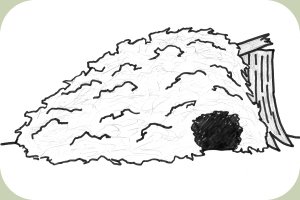
completed debris hut

4.) Add smaller sticks on top of and perpendicular to the ribbing sticks. These latticework sticks will keep the outer debris from falling inside the shelter.

5.) Pile large amounts of leafy debris on top, as well as inside. Use your driest, softest debris on the inside closest to your body. When complete, there should be at least three feet of debris piled up on top and on all sides of the shelter.

6.) You can lay more sticks on top to keep the wind from blowing the debris away if it is a windy day.

7.) A door plug can be created by stuffing a shirt full of leaves.

Crawl inside, being sure to burrow into the leaves, so that there is a mattress of leaves insulating you from the ground and on all sides. Though nothing like the warmth of your own bed, a debris hut will allow you to survive the night.

 
Leave a comment

Posted by on October 25, 2014 in do it yourself, Wawang Lake Resort


Tags: , , , , ,

DIY: Survival Cook Stove out of a Tin Can

This is a how-to on how to make a survival cook stove instead of spending $25 to buy one online. It is a simple projecting that requires an old can, a pair of scissors, and a knife. Be careful and pay attention to his excellent instructions! Watch this video survival training tutorial and learn how to build a cook stove out of a tin can.


Tags: , , , , , ,

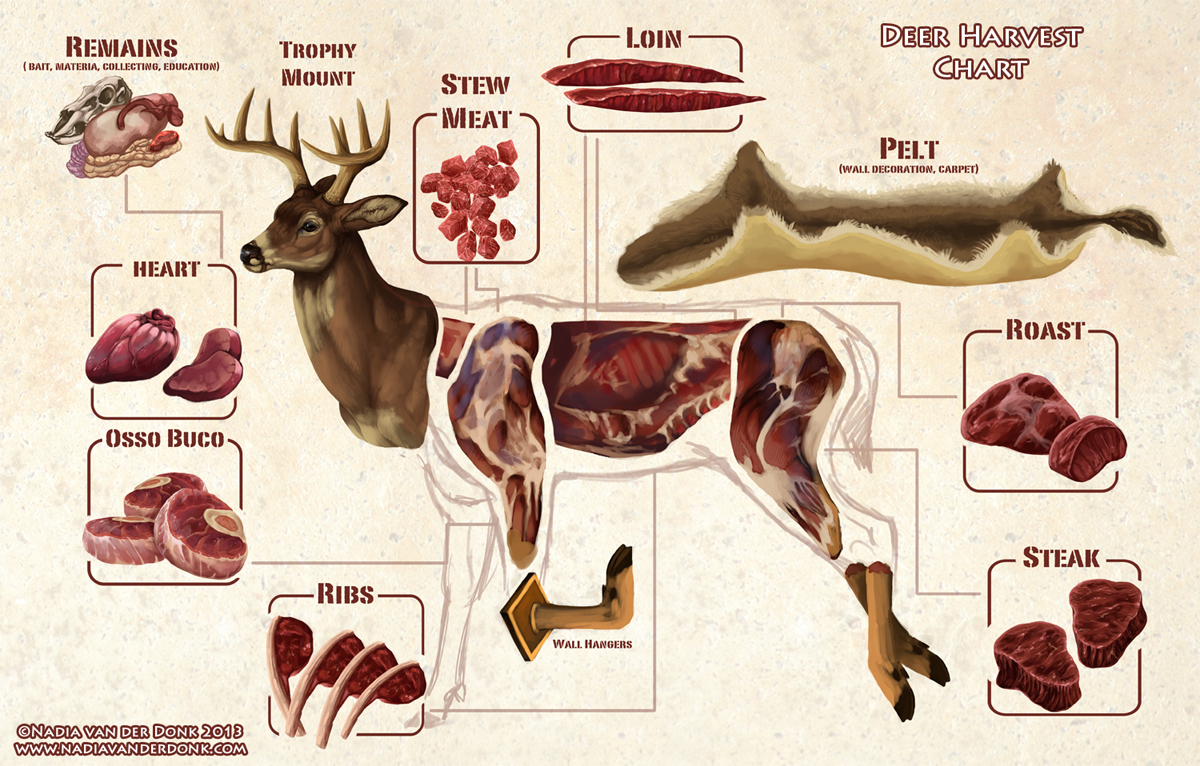
An illustrated guide to the best game meat cuts

Tis the season!  There are plenty of hunters out in the field bringing home dinner and we figured we would share some great guides on the best cuts and how to get them from your harvest!  Click on each picture to enlarge for greater detail 🙂

This diagram is the basic overview of the quarters and can be applied to deer, moose, elk and caribou.

illustrated deer

This second diagram is a more in depth cut selection and is coded for the sections as well.  Again, this can be applied to deer, moose, elk and caribou.

deerchart

Ensure before you properly care for your game in all stages of meat preparation to give not only longevity to the meat, but reduce the risk of cross contamination of any bacteria that could not only spoil the meat but could also make you very sick.

Happy hunting!

 
Leave a comment

Posted by on October 15, 2014 in game, recipe, Wawang Lake Resort


Tags: , , , , , , , , , , , , , , ,

Bacon Wrapped Moose Tenderloin

Ingredients

Moose tenderloin
Dates
Goat cheese

Marinade

1 Tbsp. mustard
1 Tbsp. honey
1/2 tsp. minced garlic
4 dashes of Worcestershire sauce
1 cup red wine

Saskatoon Glaze

1/2 cup Saskatoon berries ( you can use blueberries if Saskatoon’s are not available in your area)
3/4 cup red wine
1 Tbsp. maple syrup

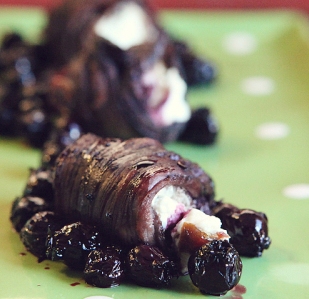
moose-rolls2-copy-600x400


Rub tenderloin with mustard, combine remaining ingredients and pour over top.  Use a marinating container that and flip back and forth every so often.  Let marinade at least 4 hours or overnight.

Next stuff dates with goat cheese.  If you have un-pitted dates, simply cut the top off, using a pair of tweezers, pull the pit out.  Use a baby spoon to stuff the goat cheese in, it works quite well, the tip of the spoon was perfect for starting to put the cheese in and then using the handle end to push the goat cheese down, worked like a charm!

Thinly slice the tenderloin and then wrap around the dates and secure with toothpicks.  Place on parchment paper on a cookie sheet.

Preheat oven to 350 degrees.

Place berries, maple syrup and red wine in a pot on high heat.  Bring to a boil and let simmer for 3-5 minutes, spoon the juice over the dates and bake for 10-15 minutes(or until meat is cooked to your preferred done-ness), baste with glaze at least once during baking time.

Remove and enjoy … best eaten while warm!

This is the perfect appetizer for any party….your guests won’t even know its moose!

Follow our FISHING BLOG

WEB   RATES     FISH    HUNT    CABINS    PHOTOS
TESTIMONIALS    BROCHURE    HUNT BOOKLET

Enter your email address to subscribe to this blog and receive notifications of new posts by email.

← Back

Thank you for your response. ✨

Email Me....


Tags: , , , , , , , , , , ,

Where to Place Your Trail Cams

A trail camera won’t stumble through a bedding area, leave scent all over a trail, or exaggerate the size of a rack. And it’ll never oversleep. But your perfect little scouting buddy must be chosen wisely and placed carefully if you want to pattern that old, crafty animal you know is around. Here’s how…

CameraNO_MosaicYELLOW

The earlier version trail cameras were just a 35mm film point-and-shoot tucked in a weatherproof housing. It snapped a single picture when something triggered the sensor. After retrieving the camera, you ran to the one-hour shop to get the film developed, then thumbed through a week’s worth of pictures. More than once a stack of 36 prints revealed a handful of out-of-focus animals and a couple dozen shots of a wind-whipped brush or a drooping tree branch. That was only a few years ago.

Today, many website boasts several pages of trail cams, and even the cheapest one outperforms the original older ones. They have lenses sharp enough to count the ticks on a deer’s neck, electronic circuit boards so efficient that four AA batteries will run a unit for months, and memory cards that hold thousands of pictures you can download to your computer or delete at the touch of a button. And those are standard features on mid-priced cameras. The high-end ones will send a photo to your cellphone or laptop.

Like everything in the digital age, trail-cam technology has improved, competition has become fierce, and prices have plunged. Still, $200 is plenty of money, and matching a camera with the right features to meet your needs is critical. And even the best camera can’t take spectacular photos of a trophy buck if you don’t set it properly. But it’s not difficult to get started. These are the basics.

TrailCameras3
Wildlife biologists use trail cams to measure herd densities, buck-to-doe ratios, and the like. Your goals should be simpler: learning about the deer on your property, figuring out where to hunt them, and having fun in the process. You can pinpoint ideal spots before you buy a camera, and the locations you choose can determine what model is best for you. Here are four sites for four different periods.

Time: Late Summer
Site: Mineral lick
Goal: To start an inventory of buck numbers and quality on your property.
Setup: Find a spot with moderate to heavy deer traffic and spade up dirt in a 2-foot circle. Pour in half of an ice-cream pail of stock salt or commercial deer mineral and spade it into the loosened soil. Pour the rest on top.
Tips:
• Establish one or two licks per 80 acres. Allow deer up to a week to find them.
• Situate each lick 10 to 30 feet from a tree for mounting a camera.
• Jam a stick behind the camera’s top edge to point it down toward the lick.

500Time: Early Season
Site: Mock scrape
Goal: To find bucks after velvet shed, when they often relocate. Mocks can draw up to 90 percent of the bucks you’ll hunt.
Setup: Rake grass and forest debris 5 feet away from a tree that has a green, overhanging licking branch 5 to 7 feet above the ground. Activate with your own “product” (drink plenty of liquids) or deer urine.
Tips:
• If you are not getting clear shots of a buck, aim the camera at the licking branch. Most bucks will work it with their antlers.
• Establish multiple scrapes in each area and hang cameras only on the most active ones.

Time: Rut
Site: Funnel
Goal: To determine where resident bucks are traveling and whether traveling bucks are in the area.
Setup: Find terrain features that channel buck movement and hang a camera near fresh tracks and rubbing activity. Check camera every three to five days—the rut moves quickly.
Tips:
• Mount camera at a 45-degree angle to the trail. Bucks often move through funnels quickly; a camera set perpendicular to the trail might miss the shot.
• Scuff dirt in front of the camera with a boot. Such a mini mock will often make a moving buck pause and get “shot.”

Time: Late Season
Site: Food source
Goal: To find out where to fill a last-minute tag, and to know which bucks have survived the bulk of the hunting season.
Setup: Scout widely to find the hot food sources in your area, such as waste grainfields and clear-cuts. Place camera within 30 feet of the most heavily trafficked area. Load it with fresh batteries if you hunt in an extremely cold area.
Tips:
• Set up and check cameras at midday to avoid spooking feeding deer.
• If no trees are located near the food source, mount the camera on a tripod and camouflage it with grass or brush.

Make the Next Shot Count!

Follow our FISHING BLOG

WEB   RATES     FISH    HUNT    CABINS    PHOTOS T
ESTIMONIALS
    BROCHURE    HUNT BOOKLET

Enter your email address to subscribe to this blog and receive notifications of new posts by email.

← Back

Thank you for your response. ✨

Email Me....


Tags: , , , , , ,