RSS

Category Archives: recipe

Moose Fajitas


moose

Mexican food is even better when made with game meat. Here’s a great way to stretch out some tender steaks and accentuate the wonderful rich flavours only game can bring to the table. This recipe works well with any venison. Serves 4 (2 to 3 fajitas per person).

Serves: 4

Ingredients

  • 1 to 1½ lb moose steak
  • 1 cup fajita sauce
  • ¼ cup canola oil
  • Salt and black pepper, to taste
  • 2 cloves garlic, minced
  • 2 yellow onions, thinly sliced
  • 2 sweet red, green or yellow peppers, thinly sliced
  • 12 flour tortillas

Preparation

  • Trim all fat from steak. Slice thinly across the grain into 1×2-inch strips. Marinate in fajita sauce for several hours or overnight in refrigerator.
  • Preheat oven to 350°F. Remove meat from marinade (keep marinade). Heat 2 tablespoons of oil in a cast iron skillet over high heat. Add meat and brown, taking care not to overcook. After 4 to 5 minutes, add fajita sauce marinade and season with salt and pepper. Simmer for 5 minutes or until sauce thickens slightly.
  • In a separate pan, sauté garlic, onions and peppers in 2 tablespoons of oil over medium heat. Season with salt and pepper. Meanwhile, warm tortillas in a covered dish in oven.
  • Fill one platter with moose strips and another with vegetables. Serve tortillas in the warming dish, along with small bowls of grated Monterey Jack cheese, tomato, salsa, sour cream and guacamole.
  • For the glassMexican beer is a natural choice for this summer feast; hearty red wines such as Zinfandel or Spanish vintages are also good.

Follow our FISHING BLOG

WEBSITE    RATES     FISH    HUNT    CABINS    PHOTOS
TESTIMONIALS    BROCHURE    HUNT BOOKLET

Enter your email address to subscribe to this blog and receive notifications of new posts by email.

← Back

Thank you for your response. ✨

Email Me....


Leave a comment

Posted by on January 27, 2016 in moose, recipe, Wawang Lake Resort


Tags: , , , , , , ,

How to Make & Cook Bannock – Out In the Field

 OLYMPUS DIGITAL CAMERA

A bannock is a small, flat loaf of bread risen by a leavening agent, most often a chemical one, although yeasty bannocks are sometimes baked, as in a sourdough recipe.  They are meant to be cooked hearth-side, whether a fireplace or a campfire.  They are simple, and in the woods, simple is good.  Add some honey to some simple bread and after a few days or weeks of bagels and Wasa bread, it tastes like manna from heaven.  It’s hot, light, and comforting.

How to Make Bannock Bread

Ingredients

  • Bannock Mix
  • Water

Basic Bannock Mix

1 cup flour (white or a mixture of white and whole wheat)
1 tsp. baking powder
1/4 tsp. salt
1/4 cup dry milk powder
1 tbsp. shortening

Make the mix at home ahead of time. Sift dry ingredients, and cut shortening in with a pastry cutter or two knives until you have a granular, corn meal-like mixture. Package in zip-lock freezer bags. Double bag it if you’re going to be on a long trip. I’ve found that you can make large batches at once and make enough bannock mix for a trip in about fifteen minutes. Just make sure you sift the dry ingredients well, so you don’t get leavening problems.

Directions

Baking bannock is relatively simple once you get the hang of it.  Your first ones will be dark and maybe burnt on the outside and gooey on the inside.  Don’t despair, just pretend it’s a jelly donut and try again. The key is a consistent heat.  While flames don’t indicate a bad cooking fire, red glowing fires from hardwood are best.

1. Start with a small cast iron frying pan and oil it well.

2. Pour some water into the bag and squoosh it around in the bag (squooshing is a technical term). Because the water and baking powder form carbon dioxide to make the bread light, the faster you go from mixing to skillet, the lighter your bannock will be. There will be lumps, of course, but we call them flavor bursts. I say “some water” because how much you add depends on the humidity and of course, personal taste. You don’t want it any thinner than a muffin consistency. If you’ve never baked a muffin, think spackle. You can distribute the dough with a poke of a finger or a stick or a spoon if you’re the civilized sort. Remember, it’s always easier to add water than take it out, right?

3. Squeeze the mix out of the bag and onto the warmed pan (not scalding hot — if the oil is smoking, it’s way too hot).  The pan can be warmed over the fire if you have a grate, or leaned against a few logs near the heat source.  It shouldn’t hiss or sizzle like a pancake batter…that means things are too hot. Cool it off and be patient.  The bread will start to rise slowly.

4. Your bannock will start to look loaf-like.  At this point you’ll want to flip your loaf.  A little shake of the pan and flick of the wrist can turn it over, but a spatula is fair game too.  At this point, just keep turning it.  You’ll know when it’s done.  It’ll look a lot like the picture here.

If you have a lid, you can try to cook your bannock dutch oven-style and put coals onto your skillet lid. Otherwise, you can turn it over to cook the top (carefully!) or else when the bottom is done, prop the pan up against a log with the top facing the fire. This is a great method of “semi-reflector-oven”.   It also makes a lighter bannock.

OLYMPUS DIGITAL CAMERA

Follow our FISHING BLOG

WEBSITE    RATES     FISH    HUNT    CABINS    PHOTOS
TESTIMONIALS    BROCHURE    HUNT BOOKLET

Enter your email address to subscribe to this blog and receive notifications of new posts by email.

← Back

Thank you for your response. ✨

Email Me....

 
Leave a comment

Posted by on January 19, 2016 in Camping, recipe, Wawang Lake Resort


Tags: , , , , , ,

Blueberries – a Critical Food for Black Bear

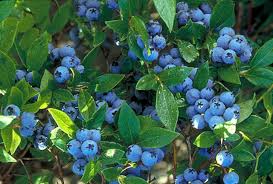
imagesB4EBB1P8 Blueberries are an important food source throughout the black bear range.  The most commonly eaten berries in our area of northwestern Ontario are blueberries and raspberries.   Many other berries are eaten, but they have shorter seasons, are scarce, or are less preferred.

The period when blueberries  are abundant in our area is short & mainly in August-making that period critically important in the black bear’s annual cycle of events.  Efficient feeding during that time is critically important to winter survival, growth, and reproductive success.  Researchers found that bears in NW Ontario end mating activities before the critical feeding period and focus on feeding for the remainder of the summer.

Black bears are efficient berry-eaters, consuming up to 30,000 berries a day in a good year.  They gather berries quickly, using their sensitive, mobile lips and swallowing them whole.  The berries enter a two-part stomach, which grinds the pulp off the seeds.


imagesP1Y6BVCSThe seeds pass through the digestive tract unbroken and able to germinate, making black bears important seed dispersers.  Each summer, they spread the seeds of their favorite berries all over their home ranges.

Black Bear around Wawang Lake gain weight most rapidly during July and August when berries are abundant.  When the berries run out in September, there is little else to eat.  The bear usually seek out their dens in September or October.   The longer period of food abundance enables bears to achieve more growth and reach maturity more quickly than bear.  Bear in NW Ontario typically produce their first litters at 4 to 5 years of age.

Berries contain anti-oxidants, and the seeds of some species contain vitamin B-17, considered an anti-cancer compound by some scientists.  Although cancer occurs in captive bear, it has never been reported in wild bear.

RECIPES

blueberry pancakes wawang lake

Blueberry Pancakes


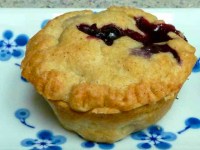
GLUTEN FREE BLUEBERRY PIE

Gluten FREE Blueberry Pie


Follow our FISHING BLOG

WEBSITE    RATES     FISH    HUNT    CABINS    PHOTOS
TESTIMONIALS    BROCHURE    HUNT BOOKLET

Enter your email address to subscribe to this blog and receive notifications of new posts by email.

← Back

Thank you for your response. ✨

Email Me....


Leave a comment

Posted by on January 18, 2016 in black bear, recipe, Wawang Lake Resort


Tags: , , , , , , , ,

Moose Stir Fry

8

This delicious moose dish is low in fat. The amount of each ingredient is proportional to how many people you’re serving. Using half a pound of moose, as this recipe does, makes two large servings.

Ingredients

  • 1/2 lb. moose steak
  • 1/2 cup carrots
  • 1/2 cup bean sprouts
  • 1/4 cup celery
  • 1/2 cup snow peas
  • 1/2 cup broccoli
  • 1/4 cup unsalted peanuts
  • 2 cloves of garlic, minced
  • 1/2 cup soy sauce
  • 1 tbsp crushed red pepper
  • 1 tbsp cumin
  • Cooked noodles (excluding seasoning packet)

Preparation

  • Slice steaks cross grain and marinade in soy sauce for one day. Throw a little oil into a hot wok to avoid sticking. Stir in moose for about 1 minute.
  • Add other ingredients, including seasoning, stirring frequently. Add additional soy sauce to coat all ingredients.
  • Stir in noodles and serve immediately.

Follow our FISHING BLOG

WEBSITE    RATES     FISH    HUNT    CABINS    PHOTOS
TESTIMONIALS    BROCHURE    HUNT BOOKLET

Enter your email address to subscribe to this blog and receive notifications of new posts by email.

← Back

Thank you for your response. ✨

Email Me....


Leave a comment

Posted by on January 16, 2016 in moose, recipe, Wawang Lake Resort


Tags: , , , , , , , ,

Grouse Kebobs

2Cubes of ruffed grouse breast skewered along with grape tomatoes, mushrooms and onion make for wonderful kebabs. No ruffies? You can also use other grouse, as well as duck, goose or wild turkey breast meat.

Serves: 4

Ingredients

  • 4 ruffed grouse breasts (skinless, boneless)
  • 3 sprigs fresh thyme
  • 1/2 cup olive oil
  • 1/2 cup white wine
  • Salt and black pepper to taste
  • 1 red onion, cut into ¾-inch cubes
  • 16 grape tomatoes, whole
  • 16 brown mushrooms, whole
  • Canola oil

Preparation

  • Cut grouse breasts into ¾-inch cubes and place in a zip-lock bag with thyme, olive oil, wine, salt and pepper. Marinate in refrigerator for 30 minutes.
  • Remove grouse from bag and thread onto skewers, alternating with onion cubes, tomatoes and mushrooms. Brush kebabs with canola oil and grill until grouse is cooked through.
  • Serve with fragrant basmati rice and carrot rounds.
  • Tip: If you use wooden skewers, first soak them in water for 15 minutes to help prevent them from splintering or burning. Whether you use stainless steel or wooden skewers, coat them in cooking oil before threading on the grouse and vegetables so the food will easily slide off after grilling. Also coat the grill with cooking oil so the kebabs don’t stick.
  • For the glass: For this tasty light meal, fill your glass with a full-bodied beer or a heavy Chardonnay.

Follow our FISHING BLOG

WEBSITE    RATES     FISH    HUNT    CABINS    PHOTOS
TESTIMONIALS    BROCHURE    HUNT BOOKLET

Enter your email address to subscribe to this blog and receive notifications of new posts by email.

← Back

Thank you for your response. ✨

Email Me....


Leave a comment

Posted by on December 23, 2015 in grouse, recipe, Wawang Lake Resort


Tags: , , , , , ,

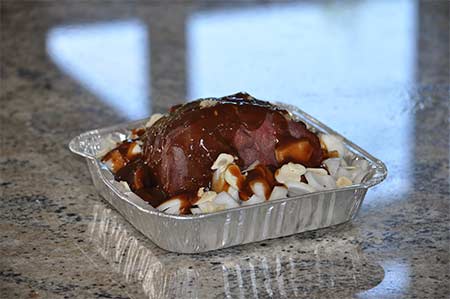
Barbeque Moose Roast Recipe

Have you ever wanted to barbeque a moose roast and still have it be tender?  We have, and recently cooked a moose round roast on the barbeque that was so tender once we carved it, it was possible to cut it with your fork.

Start out with a moose round roast; it’s not the best cut to be barbequing and it will require moist heat if it were to be palatable.

Remembering a friend telling of how he had cooked ribs on his barbeque and had great results so wondered if we could achieve the same?

1  

The Process

The process is quite simple really, and you could likely apply this to any meat that is tough. Cook it with moisture over a long period of time.  How much time… we cooked our roast for almost 9 hours on low heat

Ingredients:

  • Moose round roast 3 pounds
  • 1 large onion
  • 5 cloves garlic (elephant)
  • 1 1/2 cups of barbeque sauce

2
Directions: Barbeque a Moose Roast

  • Thaw the moose roast in your refrigerator
  • Coarse chop the onion
  • Peel and slice half of the garlic and mince the balance
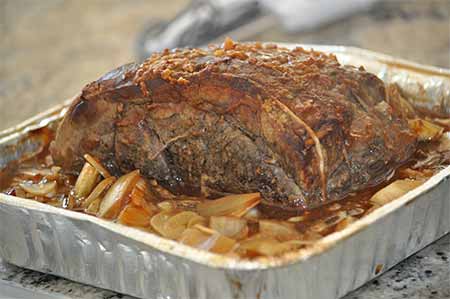
  • Start with a 8 inch by 8 inch roasting pan and place the moose round roast that you plan to barbeque onto a thin layer of the chopped onions.
  • Place the rest of the onions around the roast evenly.

Next sprinkle the onions with the sliced garlic and rubbed the roast itself with the minced garlic.

Followed by pouring barbeque sauce over the roast.

Once this was complete I covered the entire pan with a layer of heavy aluminum foil and took the pan (with the roast in it) outside to my barbeque.

I lit one burner and set it to low heat.  Then place the covered pan containing the moose roast barbeque on the other side well away from the heating element.

Close the lid.

3

Maintain a constant temperature of about 200 degrees Fahrenheit for 9 hours, or until the internal temperature reached a minimum of 140 degrees; or your required doneness.

Serve the moose roast with baby potatoes, carrots, chopped onions and mushrooms. All of which were cooked on the barbeque while the roast was cooking. All the veggies were wrapped in foil; salt, pepper and butter were added and placed directly over the burner that was set on low temperature. About 1 1/4 hours.

Make gravy from the juice from the meat pan and add the onions from the meat pan to the veggie dish.

The barbequed moose roast and the entire dish… well…Delicious

Follow our FISHING BLOG

WEB   RATES     FISH    HUNT    CABINS    PHOTOS
TESTIMONIALS    BROCHURE    HUNT BOOKLET

Enter your email address to subscribe to this blog and receive notifications of new posts by email.

← Back

Thank you for your response. ✨

Email Me....


Tags: , , , , , , ,

How To BEAR Eating Bear Meat

As an outfitter, we often hear how many people would love to hunt bear but have no idea what to do with all the meat or if they did keep it, how to cook it (Ontario is a no waste province, it is mandatory to take all of the meat with you upon departure.)

Below is an excerpt from a great story written by Jackson Landers and how he dealt with an unexpected amount of bear meat…..and what he learned.

bearfordinner

Now I had heard all sorts of stories from hunters about what bear meat is like: that it’s tough, gamey, and unpleasantly greasy. But in my experience eating a fairly wide array of unusual species, I had found that meat that tastes “tough and gamey” is more often a case of bad butchering and sloppy handling than an intrinsic quality of a species.

To maximize the potential flavor of my bear, I dry-aged it for a week before I started experimenting. Dry-aging meat, for the uninitiated, is the process of letting meat hang out for a while at cool temperatures while allowing moisture to evaporate from it. Dry-aging accomplishes two things. First, natural enzymes in the meat begin to tenderize it by breaking down the collagen in the muscles. (Collagen is what makes tough meat feel tough, and more of it builds up in muscle tissue as an animal gets older.) Second, dry-aging allows water to evaporate out of a piece of meat, concentrating the flavor. High-end steakhouses all do this with their beef, and I have been dry-aging most of my venison in my fridge at home for years.

Once my bear was sufficiently dry-aged, the very first thing I tried was cutting some simple steaks out of a forequarter (the upper portions of the front legs) and from the backstraps (the cuts from alongside the spine that are referred to as “pork loin” in pigs). I wanted to keep the recipe simple so as not to hide the true flavor of the meat, but I also wanted to have some fun. So I just ran with the bear theme. I pan-seared the steaks in olive oil and drizzled just a bit of honey on them. A handful of blueberries went into the pan with them (bears love blueberries almost as much as they love honey). Then I transferred the meat to a covered dish to finish cooking in the oven and deglazed the pan with a splash of Toasted Head cabernet sauvignon, which I had chosen on account of the wine’s label having a black bear on it. I made sure to cook the meat to 140 degrees and hold it there for a while, since bears, like pigs, can carry trichinosis.

bearroast

My girlfriend and I sat down to eat our first bites of bear meat, drizzled with that red-wine pan sauce. The texture was good, and the backstrap cuts were a bit more tender than the forequarter cuts. The flavor was mild; it tasted more or less identical to venison—which is to say a lot like beef, only with less fat and a blander flavor. There was nothing greasy or tough about it. It looked like a thick piece of filet mignon. Between sips of the bear-bearing Toasted Head wine (which paired very nicely with the bear meat, I should add), we soon forgot that it was bear meat that we were eating. By the end of the meal, it was just dinner, no more exotic than the artichokes we served along with it.

Heartened, I started putting bear meat in everything. And once I began running it through the meat grinder, the stuff became a household staple. Think bear tacos, spaghetti with bear sauce, lime-marinated bear stir-fry served over ramen noodles.

moosestir

Bear burgers in particular were a big hit. I mixed one egg with 1 pound of ground bear meat and just a touch of onion powder and pepper and broiled them under high heat. Three minutes per side seemed to get me up over 140 degrees every time, without taking the burgers beyond medium-rare. I invited some friends over to eat them, and the unanimous agreement was that they simply tasted like very good beef burgers and that nobody would ever guess they were bear.

I began to take the ground bear meat so much for granted that I confess to feeding it to a dinner guest in a ragout over angel hair pasta without thinking to tell her that she was eating bear as opposed to beef. She ate every bite. I’m still not sure whether I should tell her what she ate.

Lately I’ve found myself worrying about the dwindling supply of bear meat in my fridge and freezer. I have one whole hindquarter in my chest freezer awaiting a special bear dinner with a group of friends, but other than that and a pound or so of medallions, all I’ve got left is an array of very unusual bones that my dogs have been chewing on in the front yard. What will I do when I run out?

Follow our FISHING BLOG

WEB   RATES     FISH    HUNT    CABINS    PHOTOS
TESTIMONIALS    BROCHURE    HUNT BOOKLET

Enter your email address to subscribe to this blog and receive notifications of new posts by email.

← Back

Thank you for your response. ✨

Email Me....

 
Leave a comment

Posted by on December 2, 2015 in black bear, recipe, Wawang Lake Resort


Tags: , , , , ,

Wild Mushrooms

The main edible find in our region is  lobster mushrooms, Hypomyces lactifluorum, in some pretty good quantities. On any hunt, it’s good to bring home dinner, but one doesn’t typically expect to bring home a bundle of lobsters too late into the fall.

lobster-mushrooms-wawang-lake

Typically, by the end of August and into September the brush is filled with mushrooms, edible and not. Unlike spring hunting, fall hunting in and around our area is more mushroom identifying than actually trying to find mushrooms growing. But some year the lobsters can account for a major harvest.

This slideshow requires JavaScript.

So on your next trip out into our region whether you’re fishing or grouse hunting be sure to hike the old logging roads in search of these very delicious mushrooms.  Stay tuned for a great recipe that easy to prepare.


WEBSITE    RATES     FISH    HUNT    CABINS    PHOTOS
TESTIMONIALS    BROCHURE    HUNT BOOKLET

Enter your email address to subscribe to this blog and receive notifications of new posts by email.

← Back

Thank you for your response. ✨

Email Me....


Tags: , , , , , ,

How To Prevent Venison From Tasting Awful

I hear people say all the time that they don’t like the taste of deer. Some people say that just because they know what they’re eating and have a preconceived notion that it won’t be good. Others have legit gripes, mainly due to poor handling by the hunter from the time of the kill up until it was cooked. This often results in gamey, tough meat. Here are some tips to help combat bad-tasting venison.

venison

Hunting in the real world is not like the Outdoor Channel portrays it to be. Hunters make bad shots from time to time and the deer has to be tracked for a while. Shot placement and the stress the animal received while being trailed plays a big role in gamey meat. The faster a deer dies, the sooner it can be field dressed. This will reduce the amount of acid that builds up in the deer’s muscles.

Hunters often fail to get the deer cooled as quickly as possible. The first step it to field dress the animal immediately and wash out the cavity with cool water. Be sure to dry the cavity out, as the water can be a breeding ground for bacteria. If the temperatures outside are in the mid-30s or cooler, it’s okay to let the deer hang. Anything warmer than that, and the deer needs to hang in a walk-in cooler (or be skinned, quartered, and put on ice if you don’t have a walk-in).

A whitetail is not a hard to deer to quarter. Because of how their joints and tissues hold their legs on, a simple pocket knife can have a deer quartered quicker than you might think. Some might use a saw to cut through bone marrow and small pieces of bone, but then you’d need to watch that shavings from the saw don’t get mixed in with the meat. Stick with a sharp knife instead, and your meat will be free of small bone pieces that can contaminate the meat.

Growing up, I can remember how much my dad loved the taste of fat from a good cut of beef. The same does not hold true with deer fat. Simply stated, deer fat tastes awful. It is not red meat, so cut it off before it’s made into steaks or burger. This includes all fat and silver skin.

Every year before deer season begins, we call in an order to the local butcher shop for beef suet. Even though we removed all of the deer fat, we need to add some sort of fat, whether beef or pork, when grinding it. If this is not done, the lean venison will quickly fall apart when making burgers, meat loaves, etc. We add beef fat at a ratio of 3:1 (three pounds venison per pound of fat).

If you have the means, the time, and the knowledge, I recommend processing all your deer yourself. When you take a deer to a meat locker you can’t be sure how the meat is handled — or if it’s even your own deer that you’re getting back. For all you know, you could be getting back someone elses deer, perhaps one that was gut-shot and not properly handled after the shot. If you have to take a deer to a processor, research the facility by talking to other hunters who’ve used it, and also talk with the workers, who will hopefully be honest with you.

Don’t overcook venison. Cooking deer for too long causes it to become chewy and dry. Venison is best cooked to medium rare, but the outside needs to be cooked. To accomplish this, the grill must be hot enough to quickly sear the outside and lock in the flavors and juices. Turn your venison only once. If there are no grill marks on the meat after three minutes or so, the grate is not hot enough.

Freezer-burnt food, whether it is venison or other food, does not taste good. Some people use a vacuum sealer; if you go this route, buy a good one, as a cheap product will not keep the food fresh. When we butcher our deer, we make wrapping the meat a family affair, with all involved. We put one-pound portions of burger in sandwich bags and the steaks and roasts are wrapped with plastic wrap. After covering it with plastic wrap, we wrap it with good freezer paper and tapes. Writing on each package, we identify the cut of meat, who killed it, and the date of the kill.

I hope this advice helps you create a great-tasting meal. A few more final tips: The younger the deer, the better, more tender it will be (even though this might not sit well with trophy hunters). Thaw venison slowly to prevent toughness, then serve it hot and keep the remainder hot to prevent it from getting a waxy taste.

Follow our FISHING BLOG

WEB   RATES     FISH    HUNT    CABINS    PHOTOS
TESTIMONIALS    BROCHURE    HUNT BOOKLET

Enter your email address to subscribe to this blog and receive notifications of new posts by email.

← Back

Thank you for your response. ✨

Email Me....


Tags: , , , , ,

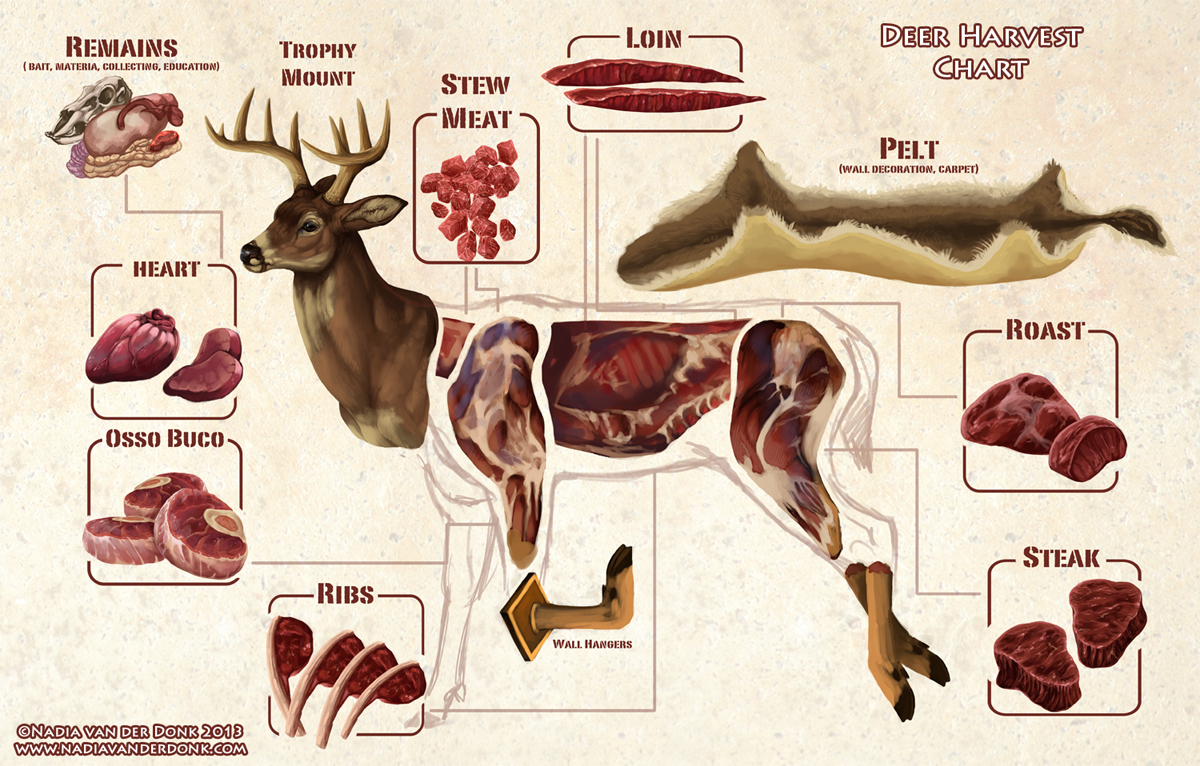
An Illustrated Guide to the Best Game Meat Cuts

There are plenty of hunters out in the field bringing home dinner and we figured we would share some great guides on the best cuts and how to get them from your harvest!  Click on each picture to enlarge for greater detail 🙂

This diagram is the basic overview of the quarters and can be applied to deer, moose, elk and caribou.

illustrated deer

This second diagram is a more in depth cut selection and is coded for the sections as well.  Again, this can be applied to deer, moose, elk and caribou.

deerchart

Ensure before you properly care for your game in all stages of meat preparation to give not only longevity to the meat, but reduce the risk of cross contamination of any bacteria that could not only spoil the meat but could also make you very sick.

Happy hunting!

Follow our FISHING BLOG

WEB   RATES     FISH    HUNT    CABINS    PHOTOS
TESTIMONIALS    BROCHURE    HUNT BOOKLET

Enter your email address to subscribe to this blog and receive notifications of new posts by email.

← Back

Thank you for your response. ✨

Email Me....

 
Leave a comment

Posted by on November 11, 2015 in game, recipe, Wawang Lake Resort


Tags: , , , , , , , , , , , , , , ,