RSS

Tag Archives: WMU 15A

Calling In A Bull Moose Video

There’s a lot of prep that goes into a moose hunt, so don’t blow a shot at one of these majestic beasts because you can’t call it in. Check out the video below from Ontario Out of Doors for some great tips to help get you ‘in tune’ for when the time comes.

Follow our FISHING BLOG

WEB   RATES     FISH    HUNT    CABINS    PHOTOS
BROCHURE    HUNT BOOKLET

Enter your email address to subscribe to this blog and receive notifications of new posts by email.

← Back

Thank you for your response. ✨

Email Me....


Tags: , , , , , , ,

Maximizing Your Hunting Time With Trail Cameras

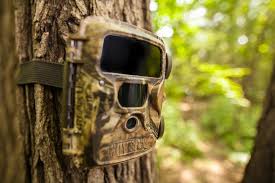
cameraOver the last five years, probably no other “gadget” has changed the way we scout more than the trail camera. For many of us, running trail cameras is a hobby in itself, bringing a whole new excitement to our deer hunting efforts. Much more than just something to pass time, however, running trail cameras can give you a unique insight into the patterns of deer on your hunting properties and really tip the odds in your favor for harvesting a mature whitetail. Let’s take a look at the features to look for when purchasing a trail camera, and how to get the maximum benefit from the camera once you have made your purchase.

As the popularity of these scouting tools has grown, so has the number of companies offering their own line of cameras. The features on these cameras cover such a wide spectrum that choosing the right one for you can be a daunting and sometimes confusing task. While this article isn’t meant to tell you WHICH camera to buy, it IS meant to help you sort through some of the most common differences among the various trail cameras to help you narrow down your search.

RESOLUTION
The resolution of a trail camera is a measure of the image size that the camera creates. So a 5.0 megapixal trail camera will give you a much larger image – and therefore more detail – than one with 3.0 megapixals. Which resolution you choose really depends on how important it is to have a large, crisp image. If you are only concerned with having a general idea of what deer are in the area and when they are traveling through, then about any resolution offered on today’s cameras will suffice. If you want a larger, more detailed image to print off for your friends, then you may want to shoot for something with at least 3.0 megapixels.

BATTERY TYPE & LIFE
In my mind, this is one of the most important considerations when choosing a trail camera, as it will have a huge effect on the cost of maintaining the camera. I have seen some “cheap” trail cameras that burn through six C-sized batteries in a week, and suddenly the “cheap” camera gets VERY expensive! Others claim to operate up to a year on eight AA batteries. So before you go buying a camera based on price alone, keep in mind the battery life, as it may be the most expensive choice you could make in the long run.

TRIGGER SPEED
Another important feature is the trigger speed of the camera, which is simply how long it takes the trail camera to shoot a picture once something has “triggered” the motion sensor. A faster trigger speed can be the difference between having a great shot of that trophy buck and just having a picture of a deer’s butt as it walks out of the frame. If you plan on placing your trail cameras over feeders or a mineral lick, then trigger speed will not be as much of an issue as it would if hung along a trail.

FLASH TYPE
This is almost a moot point, since most trail cameras today have gone to infrared flash. An infrared flash, as opposed to the incandescent flash found standard on most consumer cameras, is less likely to spook deer, uses less battery life, and is less likely to be detected by other humans (i.e. thieves!). While I’ve gotten plenty of pictures of big, mature whitetails with an incandescent flash trail camera, there is no doubt that some animals are spooked by the bright flash. If you can afford the infrared flash, the benefits certainly outweigh the small increase in cost.

OTHER FEATURES
While we have covered some of the most important features to consider when buying a new trail camera, there are many more options that could impact your decision. One of these options is the size of the unit. Size varies greatly amongst trail cameras, and some companies are now producing models that are as small as your hand. Other models go as far as being able to send the pictures it takes directly to your email or cell phone, so the only time you have to check them is when the batteries need replacing. How’s that for convenience?

Before you head out to buy your next trail camera, take a minute to think about how it will be used and what features are most important to you. This will make the task of narrowing down your choices much easier when you start the shopping process.

camera2

MAXIMIZING TRAIL CAMERA USE
Once you have waded through all the details, made your decision and laid down your hard earned money on a trail camera, all that’s left is to hang that thing on a tree, right? Let’s take a look at some ways you can be sure you are using your camera to its potential this season and getting the most bang for your buck.

DRAW THEM IN
One of the easiest ways to maximize the effectiveness of your trail camera and insure that you see a good representation of what is in your hunting area is to use some type of attractant to lure the deer into camera range. Probably the most common attractant used across the country is shelled corn – it’s cheap, readily available, and the deer love it. For the purpose of getting trail camera pictures, there is no need to invest in an expensive feeder; just simply spread 100 pounds on the ground in an eight to ten-foot circle area where you want to hang your camera. For safety reasons, do not place the corn in large piles or in an area that holds moisture, as this can result in molding that can cause disease in both deer and turkey. Depending on deer density and other available food sources, this should get you five to ten days worth of pictures. Be patient, as it may take a few days for the deer to really key in on the corn and for you to start getting good pictures. Once they find it, though, it won’t last long!

Before you start dumping corn on your favorite hunting property, check your local game laws regarding baiting. If corn or other “feed” is prohibited, but would still like to attract deer to your camera location, then you may want to consider creating a mineral lick. You can buy one of the many commercial mixes available today, or simply create your own by mixing 50 lbs of trace mineral, 50 lbs of feed mix salt, and 10 lbs of dicalcium phosphate. Break the soil up with a shovel in the area where you want to create your lick and work your mix into the soil. Once the lick gets a good rain on it, it shouldn’t take long for the deer to find it and start paying regular visits.

KEEP IT MOBILE
Unless you are hunting a really small property, or you have the money to invest in lots of trail cameras, then you are going to need to move your cameras around to really get a good idea of what the deer are doing on your hunting property. Don’t get caught in the trap of leaving your camera in the same spot all season. This will not only limit your ability to pattern the deer, but it may keep you from discovering that trophy buck that could be hanging out on the other side of the property!

images40V5Z2FA2By experience, two weeks seems to be enough time to get a good representation of what deer are in the area, without your camera spending too much time in one location. You can always bring the camera back to the same spot at a later time, but the idea is to cover as much of your hunting area as possible.

KEEP GOOD RECORDS
Once you have moved your camera around your property and gotten plenty of pictures to look at, the real work has just begun. Now is the time to sort through the pictures, identifying as many unique animals as you can, analyzing what camera sites each deer is visiting and the times that they were there. This should start to give you an idea of the travel patterns on the property, as well as potential stand locations.

This season, make sure you use these tips to get the most out of your trail cameras, and the next picture you get of that monster buck may be the one with you behind him holding his antlers, OR, even that BIG bear 🙂

Follow our FISHING BLOG

WEB   RATES     FISH    HUNT    CABINS    PHOTOS
BROCHURE    HUNT BOOKLET

Enter your email address to subscribe to this blog and receive notifications of new posts by email.

← Back

Thank you for your response. ✨

Email Me....


Tags: , , , , , , , , , , ,

Canning Wild Game

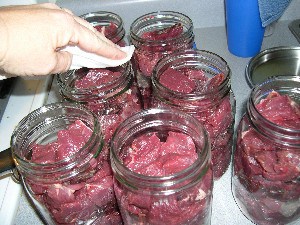
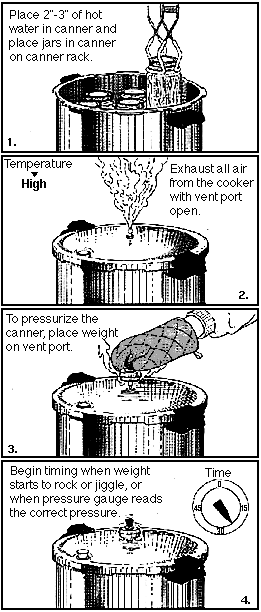
mainMeat, poultry, and game are low acid foods and must be canned or processed in a pressure canner to assure it is safe to eat.

1. Canning frees up freezer space for other things.
2. Pressure canning can make the less tender cuts versatile.
3. Home canning meat means jars of meat on the shelf ready to go at a moment’s notice. No defrosting time. Ever tried to defrost an elk roast quickly in the microwave because you forgot to take it out earlier? Doesn’t work so well. (Ask me how I know!)
4. The best benefit? My guys love it. We are an active hunting family with 4 sons. Much of our meat is provided by the men of hunting age in our family.

Meat, poultry, and game are low acid foods and must be canned or processed in a pressure canner to assure it is safe to eat.

11 pounds pressure with a dial gauge pressure canner
15 pounds pressure with a weighted gauge pressure canner for required times.
Choose only good meat for canning, and handle it quickly and with total cleanliness, because bacteria grow rapidly in meat held at room temperature. If you have a large amount, store the part you’re not working on in the refrigerator.

canning-venison21You can:
Start with properly cleaned and chilled product.
Can fresh meat and poultry within 2 days or freeze it.
To can frozen products, thaw in the refrigerator until most ice crystals have disappeared, then handle as if they were fresh.
Trim gristle and fat off meat before canning. Fat left on meat melts and climbs on the sides of the jar during processing and may interfere with the sealing of the lid.
Salt is optional in canned meat and poultry.
Fish should be canned immediately or frozen until processed.
For large game animals (deer), follow beef processing times and methods.
For small game animals and birds, follow poultry processing times and methods.
Use canned venison or canned elk in stews, meaty soups, and even chili. You can use it to make Sloppy Joe’s and killer Enchiladas.

canning-steps-one

Follow our FISHING BLOG

WEB   RATES     FISH    HUNT    CABINS    PHOTOS
BROCHURE    HUNT BOOKLET

Enter your email address to subscribe to this blog and receive notifications of new posts by email.

← Back

Thank you for your response. ✨

Email Me....


Tags: , , , , , , , , , , ,

Hunting: Muzzleloader

Muzzleloaders are a lot of fun to shoot! The concept of a single shot makes shooters try to do their best on every shot. Large puffs of smoke belching from the muzzle after each shot, makes this a very visual shooting sport. As well, muzzleloaders are capable of firing a variety of bullet weights and powder charges, giving them the ability to be a multi species firearm.

For years, people have shot muzzle-loading guns. Most shooters fired old style flintlock guns with open sights. Some shooters found these early muzzle-loading firearms reminded them of their forefathers and helped these individuals re-live the past. However, for many shooters, these guns were unappealing, inaccurate and were a royal pain in the butt to shoot and clean. Thus, there were a very limited number of people involved in muzzleloader shooting and hunting.

Over the course of the past several years, the interest in muzzleloaders and muzzleloader hunting has grown and continues to grow. Much of this growth is due to several gun manufacturers developing inline muzzle-loading rifles that are built with today’s technology, using yesterday’s ideas. These fine firearms are fun and easy to use, have high percentage ignitions and are highly accurate. In addition, they’re easy to disassemble and clean.

These new muzzle-loading guns resemble modern center-fire rifles. They have excellent safety mechanisms and precision rifled barrels. Many of them come tapped and died directly from the factory, so all a shooter has to do is add bases, rings and a scope. It’s very common these days for shooters using in-line muzzleloaders with scopes to achieve one inch groups or better at a hundred yards.

Along with the invention of new muzzleloaders, there has also been a major advancement in gun cleaning solutions. There are all kinds of effective no fuss, no mess gun cleaning solutions designed specifically for muzzleloaders. These new cleaning chemicals make cleaning muzzleloaders a breeze. With these new products, gone are the hours of cleaning after each session at the range or in the field!

Hunters are also quickly discovering that muzzleloaders offer new hunting seasons, high levels of success and many other unique opportunities.

Extra Seasons and Hunting Benefits
Many states and provinces, including my home province of Saskatchewan offer special muzzleloader hunting seasons that are separate from regular rifle seasons. Many of these special seasons are approximately a month before the regular rifle hunting seasons and are often set up to coincide with or run just before the peak rut of the big game species. Hunting with a muzzleloader during these bonus time periods can prove very exciting and productive. Antelope, deer, moose and elk become more mobile and visible just prior to and during their rutting periods as they try to prove their dominance or search for mates.

In many jurisdictions, special muzzle-loading seasons are often held after all other hunting seasons are over. Typically, these extra seasons are several weeks long. They give hunters ample opportunity to get out in the field and get in some bonus hunting action when big game animals are often patternable as they concentrate on cold weather feeding areas.


Inline muzzleloaders such as this one, have made muzzleloader hunting for
big game animals, much more enjoyable.

During muzzleloader seasons, there are usually fewer hunters in the field than during a regular rifle season. This gives muzzleloader hunters an excellent opportunity to harvest an animal. Fewer hunters means less pressure and less pressure means that the animals should continue acting in their natural ways. With the animals’ daily habits remaining unchanged, muzzleloader hunters should be able to pattern the animals. If the hunter is able to determine when, where and why an animal will be in certain location, it should increase the hunter’s odds for success.

Since in many areas muzzleloader seasons generally start before the rifle seasons, the muzzleloader hunter is able to get a jump on the rifle hunters. This early start accompanied with the fact that there are fewer hunters in the field, should allow the muzzleloader hunter to see more animals and get more opportunities at harvesting a big game animal before the rifle hunters move in.

Muzzle-loading Tactics
Using game calls to attract big animals can be very productive during the muzzleloader seasons. Whitetail and mule deer will often respond to grunt and bleat calls. In the early part of the season, when the rut is just starting to fire up, they may come to your call out of curiosity. If this is the case, be patient as their approach will typically be very slow. Later in the season when the rut is in full swing, be prepared for fast action, as the deer may come storming in to investigate your call.

Many a muzzleloader hunter has rattled in a whitetail deer. To be successful during the early part of the season, you should just tickle your rattling antlers together to stimulate a minor sparring match. Try to scrape your rattling antlers on trees and bushes, trying to fool a buck that there is another buck in his territory. Later in the season, when the rut is more advanced, you can use more aggressive rattling techniques to stimulate full-scale battles.

Elk can be called into range with bugles or cow calls. If the bull elk are bugling, try bugling back to them. With any luck, they will respond and move into muzzleloader shooting range. If the bulls are not calling, try using a cow call to entice them into shooting range. Often a simple series of cow calls will bring in an entire herd of elk.

If you get a chance to hunt moose just prior to the breeding period, bull grunts can be used to effectively coax a bull into range. The reason for this is that bulls will be competing with one another for dominance. However, if it’s breeding season, the bulls will be more interested in checking out the call of a cow in heat as opposed to responding to a bugling bull looking for a fight.

Some muzzleloader hunters pursuing antelope will use a decoy to try and lure in their buck. Although this technique can be highly productive, it can also be very dangerous. Other hunters may see the decoy and be fooled by it. The result could be someone shooting at the decoy and killing or injuring the hunter hiding behind the decoy. In most antelope/muzzleloader situations, I prefer to set up near a watering hole and try to catch a love struck buck as it comes in for a quick drink.

Added Bonuses
Muzzleloader hunters are usually able to go hunting in decent weather conditions. During a typical muzzleloader season, the temperatures are usually moderate to warm. Snow and winter blizzards are a rarity. This means the traditional hunting attire of long johns, toques and parkas can be replaced by T-Shirts, sweat shirts, light jackets and ball caps.

Many gun ranges have realized the growth of muzzle-loading. As a result, special muzzleloader ranges have been built to meet the unique needs of smoke-pole shooters. Having spent time on such ranges, I have found that muzzleloader shooters tend to be friendly, outgoing individuals who are willing to help other shooters, teach them tricks of the trade and talk hunting and shooting for hours on end.

Book, magazine publishers and Internet websites, such as www.biggamehunt.net have also recognized the growth of muzzle-loading. Over the past few years, there has been a steady growth in the number of books and articles published on muzzleloaders and muzzle-loading hunting. With increased access to product reviews, reference materials, hunting stories and hunting techniques, muzzleloader shooters are able to learn more about their sport. Increased knowledge means greater satisfaction and a greater desire to participate in the sport.

Game of Accessories and Gadgets
Muzzleloader shooters will also find that shooting a muzzleloader requires a variety of accessories and gadgets. These items are fun to accumulate. They are even more fun to use!


A few accessories: bullets/sabots, ram rod T-handle, cleaning jag, wire brush,
ball/quick starter, speed loader and cleaning solution are needed for your muzzleloader.

The ramrod is probably the most used muzzleloader gadget you require. One of the main functions of the ramrod is stuffing bullets down the barrel. However, it is also used for maintaining and cleaning the muzzleloader barrel. Ramrods are typically threaded on both ends for adding a variety of gun care attachments.

In addition to your ramrod, you’ll also need a jag (ribbed attachment for cleaning), ramrod extension, bullet puller and a short starter or bullet starter.

For those shooting loose powder, a powder measurer and a flask are essential. For a couple of dollars, you can also get a powder can nozzle that allows you easily pour powder right out of the can.


Just a few of my favorite things: bullets/sabots, speed loader, powder flask,
powder measurer, T-handle, ball/quick starter and a jag.

Whether you shoot loose powder or pellets, express loaders are a very good investment. These small tubes are made to hold a bullet and premeasured charge of powder. Express loaders make reloading a quick process and one that you’ll appreciate, especially when you have a 1200 pound moose requiring a second shot coming straight at you.

A capper unit serves a dual role of helping you put percussion caps on your gun’s nipple and allowing you to carry a few spare percussion caps. Speaking of nipples, a nipple wrench is necessary for removing and replacing the muzzleloader’s nipple. In most muzzleloaders, the nipples must be removed before the gun can be cleaned. Since the nipples are threaded and generally tucked away, a specialized nipple wrench is another must.


A variety of muzzleloader accessories resting on a possibles bag. Included are a powder flask, primers, ball/quick starter, powder measurer, capper and a speed loader.

Black-powder and pyrodex are highly corrosive propellants as they attract moisture. At a minimum, you require cleaning patches, a wire brush, cleaning solutions and gun oil. However, as previously mentioned, with today’s technologies, there are a variety of cleaning solutions and accessories that help make muzzleloader cleaning an easy event.


Cleaning is made easy these days!

After shooting your muzzleloader, you should clean it. For best results, get in the habit of cleaning it after every hunt. If you shoot your gun and store it away without cleaning it, you’ll be in for a big surprise (and it won’t be pleasant) the next time you go to use your muzzleloader.

A small glass jar with a lid on it is ideal for soaking small parts in cleaning solution. As well, an old toothbrush works great for cleaning hard to reach areas of your muzzleloader.

You will require a good set of screwdrivers for taking your gun apart and ensuring that everything is tight. Teflon tape is great for wrapping around the threads on the gun’s nipples. A simple wrap of teflon tape makes the nipple easier to remove and prevents it from seizing. If you are shooting your muzzleloader with a scope, a roll of electrical tape is a good investment. Since black powder and pyrodex are so corrosive, you can save damage to your scope’s finish by covering the scope tube with electrical tape.

When hunting, you will need to carry your muzzleloader accessories with you. Some hunters like to go with backpacks or bags they can carry, while other prefer a pouch that attaches to their belt. Whatever style you choose, make sure that it is big enough to carry all the equipment that you need, yet not so bulky that you continually leave it at home or in your truck. As well, make sure it seals shut, so that you don’t loose your equipment as you stalk across the countryside.

Limitations and Potential Restrictions
Muzzleloaders have changed dramatically over the past few years. However, it’s important to remember that they are still only capable of firing one shot at a time. In addition, they also have a limited effective range. While stories abound of hunters taking big game animals at long range shots with muzzleloaders, they really are a close to moderate range firearm. While many of the new in-line muzzleloaders loaded with a maximum charge have the capability of taking animals out to ranges of 200 plus yards, I personally try to limit my shots to 150 yards and prefer those in the 100 yard range.

Before heading out on a muzzleloader hunt, take time to check the regulations for the jurisdiction you are planning to hunt. Some states and provinces may have restrictions in place that do not allow hunters to use in-line muzzleloaders or scopes on their muzzleloaders. In addition, there may be restrictions in place for minimum caliber sizes…………Article by: Mike Hungle

Follow our FISHING BLOG

WEB   RATES     FISH    HUNT    CABINS    PHOTOS
BROCHURE   HUNT BOOKLET

Enter your email address to subscribe to this blog and receive notifications of new posts by email.

← Back

Thank you for your response. ✨

Email Me....


Tags: , , , , , , ,

The Elusive Woodland Caribou In and Around Wawang Lake

This improved understanding will help the ministry develop resource management practices that will minimize the impact of human development and resource use on caribou.

Caribou

Caribou @ Wawang Lake Resort

It is a relatively unknown fact that the Woodland Caribou once thrived in the Wawang area.  Herds lived freely and well fed on the abundance of lichen in the surrounding area.  In the last century, due to logging, hunting and forest fires, the population not only migrated but was also put at serious risk.

In 2012, the Woodland Caribou was escalated from the Species at Risk list to the Endangered Species list in our area.  With the stringent management and extensive research taking place, the Ministry biologists suspect that it may be slow but the Woodland Caribou will eventually once again become prolific in the English River Forest which encompasses Wawang Lake.

With such rarity, it was a real treat to see on right on our very own beach….what a majestic creature!

If you’re not familiar with northern forests, it would be easy to think that forest-dwelling woodland caribou are more or less on their own in these woodlands. But caribou share the landscape with many other species – including other large mammals.

The program is researching ways to maintain healthy caribou populations in the province. Since 2010, program researchers have fit more than 190 caribou with collars that transmit information about their location and movement behaviour in three large study areas. Their objective is to sample animals in relatively undeveloped landscapes, as well as in more disturbed and developed areas, to collect information on how survival, reproduction, habitat selection and movement patterns are affected by human influences. They plan to analyze this information to develop a better understanding of the factors that influence woodland caribou persistence. This improved understanding will help the ministry develop resource management practices that will minimize the impact of human development and resource use on caribou.

A shed radio transmitter collar used to track the movement and behavior of the Woodland Caribou

A shed radio transmitter collar used to track the movement and behavior of the Woodland Caribou

The Northern Mammal Ecology Program at the Ministry of Natural Resources Center for Northern Forest Ecosystem Research studies caribou, wolves and moose to learn what determines the density and distribution of these mammals on the northern Ontario landscape.

The abundance of other large prey species (e.g., moose) and predators (e.g., wolves) on the landscape are believed to influence the caribou density. When intact forests are affected by development or resource extraction activities, these disturbances may cause changes in the abundance, behaviour and the amount of habitat available for species like moose and wolves. These changes have the potential to have a negative impact on caribou density and persistence.

To gain a better understanding of how predators and other prey species might be affecting caribou, researchers are also collecting information on the distribution, density and behaviour of these other species. For example, more than 45 wolves have been fitted with collars that transmit information about their location and movements. These collars have been placed on animals that inhabit the same three study areas as the collared caribou. Information collected focuses on the types of habitat (e.g., forest types, landscape features) that wolves inhabit and travel through, the prey species they eat, and the characteristics of the locations where they catch their prey.

The collared movement data for the caribou in North W

The collared movement data for the caribou in Northwestern Ontario

Researchers have also conducted aerial surveys within the study areas to calculate moose densities and identify the characteristics of locations with relatively high and low moose densities. They are also examining historic information gathered from moose collared in other areas of northern Ontario, to develop a more detailed understanding of how moose respond to different types of forestry practices.

This holistic approach to caribou research – which focuses on the species they interact with, as well as caribou themselves – should provide some important insights into caribou ecology that will help the ministry develop effective caribou conservation measures.

In time, it will become more and more common to spot these animals on your visits up to Wawang Lake….stay tuned and keep your eyes peeled!

Follow our FISHING BLOG

WEB   RATES     FISH    HUNT    CABINS    PHOTOS
BROCHURE    HUNT BOOKLET

Enter your email address to subscribe to this blog and receive notifications of new posts by email.

← Back

Thank you for your response. ✨

Email Me....

 
Leave a comment

Posted by on April 16, 2017 in caribou, Wawang Lake Resort


Tags: , , , , , , , ,

Grouse Hunting at Wawang Lake

Join us in NW Ontario CANADA for some exciting and thrilling grouse hunting

P1130017
Grouse Season:  September 15th to Oct 31st

Grouse hunting is a relaxing pastime that is getting more and more popular every year.  In our area bird hunting can be an adventure in itself!  Driving down the back roads & trails in your truck or on your ATV can not only be thrilling but breathtaking as well as you wander down roads that are in full color deserving of natures fall foliage. Just taking in these magnificent fall colors, peaceful wilderness & the wildlife that you’ll encounter will make you feel like you are definitely “North of the Tension Zone”.

The bush trails with the rise of the birds, singing of the guns, the smell of the pines along with friendly comraderie back at the camp will not long be forgotten.

Surrounding Wawang Lake are hundreds of miles of ATV trails, old logging road, game animal trails and hiking trails. The bush is just stuffed with these upland game birds and on a sunny fall afternoon you will see hoards of them. Many of our guests choose a fishing / grouse hunting combination package and spend half the their time taking advantage of the awesome northern pike and walleye fishing and spend the rest of their time enjoying the clean fall area and exploring the many trails where birds are plentiful.

There are three species of grouse found in Ontario.

Ruffed Grouse  –  Spruce Grouse  –  Sharptail Grouse

Ruffed Grouse is the most common and comprises of 80% of what you will encounter during your hunt.

The limit for grouse in Ontario is 5 birds per day in any combination of species with a total of 15 in your possession and you will be surprised at the number of grouse we do have and how fast you’ll bag those limits.

Compared to other areas the grouse cycle in our area has remained consistently high over the years and we credit this because of less human population that other places are known for.  In a nutshell what you’ll experience at Wawang Lake is a vast area of complete privacy during your hunt.

The most popular guns for grouse hunting are .410 or 20 gauge shot gun and some hunters use a 12 as well.   Quickly becoming more popular is BOW HUNTING for birds.  To increase the thrill and excitement of your hunt give your bow a try and the challenge alone is sure to thrill you.

Blaze orange hat & vest is required and must be worn out in the field

Canadian Firearms Regulations
All Firearms (does NOT include bows) being brought into Canada must be registered at the Canadian Customs at the time of entry into Canada. A one-year permit costs $50.00 Canadian, or there is a long term permit as well. If you would like further information, you can visit the Canadian Firearms Website through the link on our website or call toll free, 1-800-731-4000.

Canadian Customs
You should be aware of special customs and immigration issues whenever traveling to another country. For people with prior legal issues (including DWI’s) you need to find out what restrictions may be placed on your travel. Visit the Border Crossing Link and/or the Canada Citizenship & Immigration.

DEPOSIT REQUIREMENTS
A $150.00 non-refundable deposit is required at the time of reservation to guarantee a hunt. Balance to be paid in full upon arrival at the resort.  Hunting deposits and installments are non-refundable. Consideration may be given to date transfers if vacancy can be filled.

There are a limited number of spaces available for our hunts. Often there are more guests interested in hunting than there are available spaces, and hunts are often booked a year or more in advance. It is extremely difficult to fill spaces that become available due to cancellation. For these reasons we ask that our guests do not book hunts lightly

For further information, or, to book your next bear hunt please contact us at:
1-888-534-9217 or EMAIL

 WEBSITE    RATES     FISH    HUNT    CABINS    PHOTOS
BROCHURE    HUNT BOOKLET

Enter your email address to subscribe to this blog and receive notifications of new posts by email.

← Back

Thank you for your response. ✨

Email Me....


Tags: , , , , , ,

Black Bear Hunting at Wawang Lake

Working hard to provide active baits for each individual hunter is how we operate our hunts, and is what keeps our sportsmen coming back year after year.

BLACK BEAR HUNT RATES

2-bear

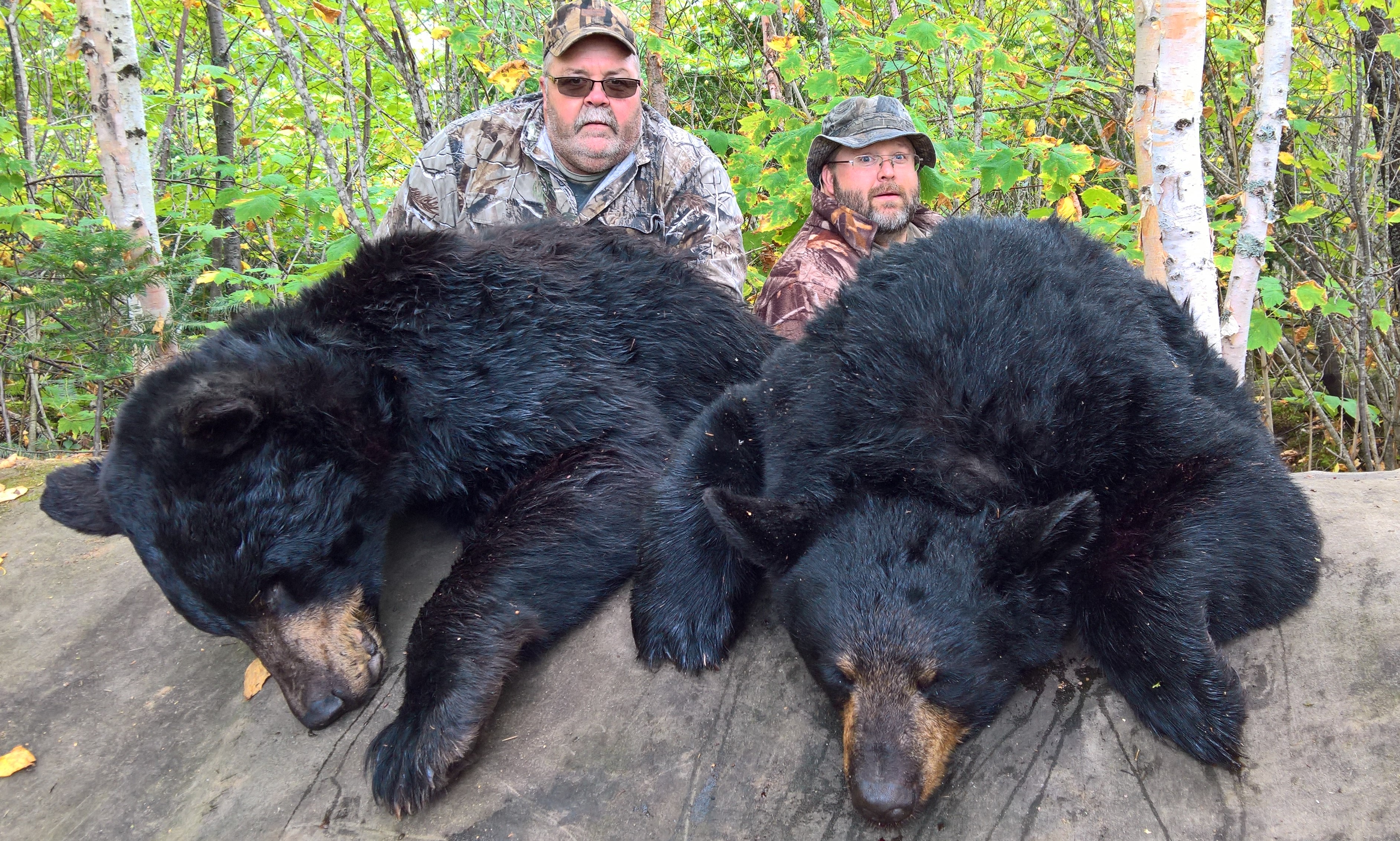
We have a very large bear hunt area (1,200 sq miles) surrounding our resort with a good healthy bear population due to years of black bear management.

Our hunts usually begin the Saturday on or after August 15th and continues for three weeks. Since we have consistently managed our bear population for several years we determine the number of hunters we will take according to the bear population we observe the previous year. We average 14 hunters per year.

What We Need to Know Upon booking, please inform us of each party members contact information, weapon (archery or gun) and will they be bringing a tree or ground stand. We need to know what type of weapon each member in the hunt party will be hunting with and whether they will be hunting from tree stand or would prefer a ground stand. More on our website

Days to Hunt (7 days) – Arrive Saturday and depart the following Saturday. Arrive Saturday and depart the following Saturday. If you would like to hunt upon your arrival, please check in between 11am-12pm (EST) and have all of your equipment prepared in advance (tree stands as assembled as possible, weapons/ammunition cased)

Transportation Requirements Since most of our baits are very remote, groups should anticipate driving their members to and from the sites. Most of our baits are road access and we provide private areas for each hunting group so that

dropping members off and picking them up will be systematic and easy. We advise to have 1 vehicle per every two hunters (three max) to ensure as little disruption to each party member’s hunt.

Rates
For a complete list of our Bear Hunt Rates please visit our website at:

BLACK BEAR HUNT RATES A $500.00  non-refundable deposit is required at the time of reservation to guarantee a hunt.

Other Costs Hunting license Canadian Funds (approximately). It’s MANDATORY to provide a current or prior hunting license FROM YOUR HOME STATE, or a hunter safety certificate, as qualification to obtain a hunting license in Ontario. Export Permit – $35.00 Canadian Funds (available at designated locations in the area)

Things to Remember Bring your own tree stand as we do not provide them. Comfortable climbers are the most popular and screw in peg types are acceptable, however, whatever type you bring bear in mind that our trees have very loose bark.

What is Included in our Bear Hunts

  • Modern Housekeeping Cottage for 7 nights
  • Pre-baited Sites & all baiting supplies during your stay & Freezer Service
  • Orientation trip to bait site
  • Experienced guide’s knowledge and advice (use it!)
  • Canadian Firearms Regulations All Firearms (does NOT include bows) being brought into Canada must be registered at the Canadian Customs at the time of entry into Canada. A one- year permit costs $50.00 Canadian, or there is a long term permit as well. If you would like further information, you can visit the Canadian Firearms Website through the link on our website or call toll free, 1-800-731-4000

Passport Cards (similar to a Passport) Information can be obtained at this website: http://www.travel.state.gov/passport/ppt_card/ppt_card_3926.html

Our season begins Saturday on or after August 15th

For further information, or, to book your next bear hunt please contact us at:
1-888-534-9217 or EMAIL

 WEBSITE    RATES     FISH    HUNT    CABINS    PHOTOS
 BROCHURE    HUNT BOOKLET
Enter your email address to subscribe to this blog and receive notifications of new posts by email.

← Back

Thank you for your response. ✨

Email Me....


Tags: , , , , , , , , , ,

What is Solunar and Why is it Helpful?

The Solunar Theory is a hypothesis that animals and fishes move according to the location of the moon in comparison to their bodies.  The theory was laid out in 1926 by John Alden Knight, but was said to be used by hunters and  .

History

1063326111In May 1926, John Aldenn Knight put together some fishing folklore and other fishing factors such as the sun and the moon, hence the name Solunar (Sol for sun and Lunar for moon) to form a theory on the patterns of animal movement. Knight compiled a list of factors which control or influence the day-to-day behavior of many freshwater and saltwater fish. Each one of the 33 different factors were considered. All but 3 were rejected.

The three factors retained were the sun, the moon and the tide. For salt water fishing, tides have long been known as a factor which control fishes’ behavior. As Knight’s research progressed, he found that rather than just tides themselves, the relationship of the moon and sun’s positions relative to each other may be the determining factor.

In addition to the time of moon up (moonrise) – moon down, his research determined that there were intermediate times of the day that occurred in between the two major periods. From that he establishes that there were major periods (moon up – moon down) and minor periods. Knight published the first Solunar table in 1936.

Tables

Solunar tables are tables that fishermen and hunters use to determine the best days of the month and times of the day for catching fish and hunting game. For fishermen, the tides, sunrise and sunset are helpful times of the day to know when the fish are going to bite. For hunters, the tides are not a factor.

Hunters use the sun and the moon to determine when the game will be moving the most.  “Other conditions not being unfavorable, fish will feed, animals will move about, birds will sing and fly from place to place, in fact, all living things will become more active, more alive, during Solunar periods than at other times of apparent equal value. …anglers have found that it is a guide to the best fishing of each day, and the quality of their sport has improved…”

Using these tables, a fishermen and a hunter can tell when the moon is directly underfoot and overhead. The strongest activity occurs when there is a full moon or a new moon and is weakest when there is a quarter moon and a three quarter moon. This is because the moon and the sun’s gravitation force is strongest when directly above or directly below our head. The lunar data humans receive is better now because of the newer technology the US Naval Observatory and GPS technology.

This new technology has allowed the Solunar Theory to generate hunting and fishing times with much greater precision It is important to note that data in tables found on various websites should be re-verified periodically with US Naval Observatory available data as well as compared against other reputable solunar data providers. Inconsistencies abound due to the complex nature of the Astrophysics computations and overlooked associated anomalies checking that are required to produce useful results. Moon Transits which do not occur for more than a day or associated times being off more than a few minutes are indications of a fundamental issue for a given position and should be suspect.  All data providers should be verified before assuming data presented is authoritative or accurate.

Go to http://www.solunarforecast.com to create your own solunar calendar 🙂

Follow our FISHING BLOG

WEB   RATES     FISH    HUNT    CABINS    PHOTOS
BROCHURE   HUNT BOOKLET

Enter your email address to subscribe to this blog and receive notifications of new posts by email.

← Back

Thank you for your response. ✨

Email Me....


Tags: , , , , ,

Trip planning tips

So many people WANT to go on a hunting or fishing trip but find the task daunting and the thought overwhelming so they tend to avoid it….

Truly, if you know a few simple tricks, planning can be expedited and you could find yourself in a boat or tree stand much quicker than expected.

wawang lake, wawang lake resort

U. S. Passport Card

First and foremost, you do NOT need to purchase a passport.  For half the price ($55.00 adult, $40 child) this handy card lasts for a period of 10 years and allows ground transport between the US and Canada and Mexico. If you plan to fly, a passport will be required but most of us travel will plenty of hunting and fishing equipment so driving is much more common.

http://travel.state.gov/content/passports/english/passports/information/card.html

Also a note regarding those pesky DWI’s….if you have had one and it has been over 6 months, there is a good possibility you can still enter Canada!!  https://help.cbp.gov/app/answers/detail/a_id/402/~/entering-the-u.s.-and-canada-with-dui-offenses

Next, when choosing a trip, make a list of ‘must haves’ such as:  The resort MUST HAVE running water, indoor plumbing, somewhere to prepare food etc.  (We have that…shameless plug lol)

Next devise a budget.  Remember to calculate travel and food costs.  And also remember to find out if the cost is per person or an overall cost.  Always add an extra 15% to that number to ensure you have money for unexpected incidentals such as a flat tire etc.  Also, never forget to calculate the local taxes into the cost.

Once you have a targeted budget, begin your research.  Remember, most resorts do have varying rates depending on the season as well as various other specials during the year.

When utilizing specials, ensure that you understand the weather patterns and fishing patterns at that time of year.  Some places have a change over in ease of catching species or hunting migration patterns.  Make sure you ask about this so you aren’t disappointed.

Take us for example, in June our regular Housekeeping fishing rate is $625 per person but offer various discounts from July-Sept.  In July we offer 25% off for parents and children so the rate would drop to $468.75…quite a savings.  And for those of you who are paying attention, our lake is a closed off headwater, spring fed and our fish cant leave…they just tend to migrate from one part of the lake to another so fishing will only be affected by color, depth and presentation 🙂  Feel free to check us out http://wawangresort.com/HTML%20Pages/RATES/Fishing_Rates.pdf

Last and not least, get referrals!  There is nothing more disappointing that driving (or flying) all that way only to find it isnt what is what you were expecting.  Though no trip may be perfect, you should understand the basics of what to expect.  

Ensure that you also contact the lodge representatives with all questions and they should respond promptly, honestly and with as much information as possible…..remember, they should be looking forward to meeting you and be excited to share what they can provide for you.

Remember…this is YOUR vacation and it is within your control to make it the best possible!

Follow our FISHING BLOG

WEB   RATES     FISH    HUNT    CABINS    PHOTOS
BROCHURE   HUNT BOOKLET

Enter your email address to subscribe to this blog and receive notifications of new posts by email.

← Back

Thank you for your response. ✨

Email Me....


Tags: , , , , ,

HOW SCENT ACTUALLY WORKS

scent2Scent is a mysterious  and often grossly misunderstood aspect amongst those who not only pursue game with hounds or other hunting dog breeds, but all hunters in general.

Scent is simply comprised of micro parti­cles of disturbed vegetable matter and/or released dead body cells drifting from the targeted subject. Vegetable matter can be crushed plant material or even minute surface dwelling bio-material living upon hard surfaces like concrete or rock.  Dead body cells consist of drifting dead skin, fur or feather cells eventually falling to the ground.  This may also include fluids, oils and vapors the body expels.

How long does a scent trail last?  That depends on given environmental conditions. The trail won ‘t exist very long if it has been hot and windy over dry surfaces.  In contrast, it will sur­vive much longer in cool, moist conditions upon grassy areas with no wind exposure.

Here are some Myths about scenting:

1.
“Animals can’t smell me when I apply scent-free products like special soaps, sprays or even wear scent free clothing.’   If you are liv­ing and breathing, you are giving off scent.  Although these products may lessen the scent intensity from your person, a Bloodhound can find you in the woods within minutes.  It is impossible for any human to be scent free.

2.
“Hounds can’t run a scent trail in the rain.”  Scent parti­cles tend to be hydrophilic, meaning they readily soak up moisture and create an effluvium of scent for the canine olfactory system.  Hounds have successfully found humans and animals in the pounding rain.  Any good hunting breed should be able to trail game in light to moder­ate rain.

3.
“My dog sometimes ground scents and other times he air scents.”  I suppose if your dog’s nose is on the ground, you can call that ground scenting and if it’s in the air, you can call that air scenting. Is it called water scenting if he sniffs a running creek or tree scenting if he barks up a tree?  Scent is scent!

imagesY2AQPWJMThe canine’s nose is attracted to the strongest scent source available at that moment during trailing.  The canine has thousands more scent receptors than humans. A roaming nose is a hunting nose; let it be.

If you want to see how your dog scents, ignite a brightly colored smoke bomb outdoors with plenty of room to observe and follow the pock­ etc. of floating smoke. Watch how clouds of smoke slowly break apart, climb high into tree tops, sink down into ravines or just lazily snake over the high grass. Wind, atmospheric pressure, humidity, temperature, etc. ….all affect the smoke as it does with scent. That is why your trailing dog runs, stops, circles around, runs again ….. Let him work it out without interference from you. Scenting is his world, not yours.

You can improve your game scent trailing by taking advantage of the best environmental conditions available, as well as staying away from proven scent killers, i.e…..hot and dry surfaces, vehicle exhaust fumes or petroleum products. Trying to scent a hound on a fresh track next to a chugging hunting rig is like us trying to smell a rose over a smoky camp fire.

bait

As much as we now know about scent, there is still plenty of scientific work to be done. As a hunter, you must understand how scent works whether you use a canine partner or not.  Whether hunting birds or bear, scent is always there.

Keep the wind on your face, the sun to your back and hunt like a predator!

Follow our FISHING BLOG

WEB   RATES     FISH    HUNT    CABINS    PHOTOS
BROCHURE    HUNT BOOKLET

Enter your email address to subscribe to this blog and receive notifications of new posts by email.

← Back

Thank you for your response. ✨

Email Me....


Tags: , , , , , , , , , , , , ,