RSS

Tag Archives: diy

The Spruce Stove Lets You Burn an Entire Tree

the-spruce-stove-lets-you-burn-an-entire-tree-thumb

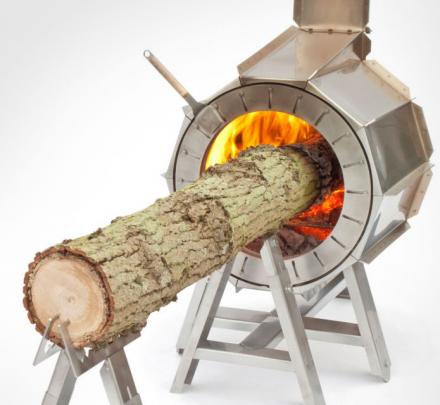
The Spruce Stove is an outdoor furnace that allows you to burn an entire tree at a time. Designed by Dutch designers Roel de Boer and Michiel Martens, the dutch stove allows you to continuously push the trunk of the tree more and more into the fire as it burns, as it holds the log up level to the fire using wheeled arms that allow you to easily slide it in.

To start the fire, simply use kindling, amber, small twigs, etc, and once the fire gets going simply push the end of the tree trunk into the fire, use the adjustable diaphragm to allow for more oxygen or less oxygen depending on what the fire needs. Once your fire starts to die down, simply push a few more inches of the trunk into the fire. When you want to stop the fire just stop pushing the log in.

The Spruce Stove is made from stainless steel, can easily withstand the heat of the fire as well as the weather, comes in three different models, weighs 110lbs, and measures 1.9 feet wide x 7.7 feet tall x 2.6 feet deep. Now you just need  go chop down a few trees.

Spruce Stove Burns an Entire Tree


Follow our FISHING BLOG

WEBSITE    RATES     FISH    HUNT    CABINS    PHOTOS
TESTIMONIALS    BROCHURE    HUNT BOOKLET

Enter your email address to subscribe to this blog and receive notifications of new posts by email.

← Back

Thank you for your response. ✨

Email Me....


Tags: , , , , , , ,

Sometimes the simplest…….

I am always a huge fan of ‘life hacks’ and clever survival tactics.  I came across this fantastic video and thought that it might very well be of great use to one of you…..if nothing else, you will score big at parties for demonstrating your MacGyver talents!You owe me one 😉


Follow our FISHING BLOG

WEB   RATES     FISH    HUNT    CABINS    PHOTOS
TESTIMONIALS    BROCHURE    HUNT BOOKLET

Enter your email address to subscribe to this blog and receive notifications of new posts by email.

← Back

Thank you for your response. ✨

Email Me....


Don't just take our word for it!

Don’t just take our word for it!


Tags: , , , , , , ,

Quartering Your Moose For Transport (with video)


Here is a fantastic how to video for quartering a moose for transport.  It isn’t unusual to have a moose down where removing it with this method is mandatory.  Great care must be taken of any wild game to ensure there is no spoilage and that no waste is had.

Enjoy!

If you are an Ontario resident and would like more information regarding our accommodations for the 2015 season, please feel free to contact us 🙂

moosehuntersjpg

Follow our FISHING BLOG

WEB   RATES     FISH    HUNT    CABINS    PHOTOS
TESTIMONIALS    BROCHURE    HUNT BOOKLET

Enter your email address to subscribe to this blog and receive notifications of new posts by email.

← Back

Thank you for your response. ✨

Email Me....


Leave a comment

Posted by on July 9, 2015 in moose, Wawang Lake Resort


Tags: , , , , , , , ,

DIY: Survival Cook Stove out of a Tin Can

This is a how-to on how to make a survival cook stove instead of spending $25 to buy one online. It is a simple projecting that requires an old can, a pair of scissors, and a knife. Be careful and pay attention to his excellent instructions! Watch this video survival training tutorial and learn how to build a cook stove out of a tin can.

Follow our FISHING BLOG

WEB   RATES     FISH    HUNT    CABINS    PHOTOS
TESTIMONIALS    BROCHURE    HUNT BOOKLET

Enter your email address to subscribe to this blog and receive notifications of new posts by email.

← Back

Thank you for your response. ✨

Email Me....


Tags: , , , , , ,

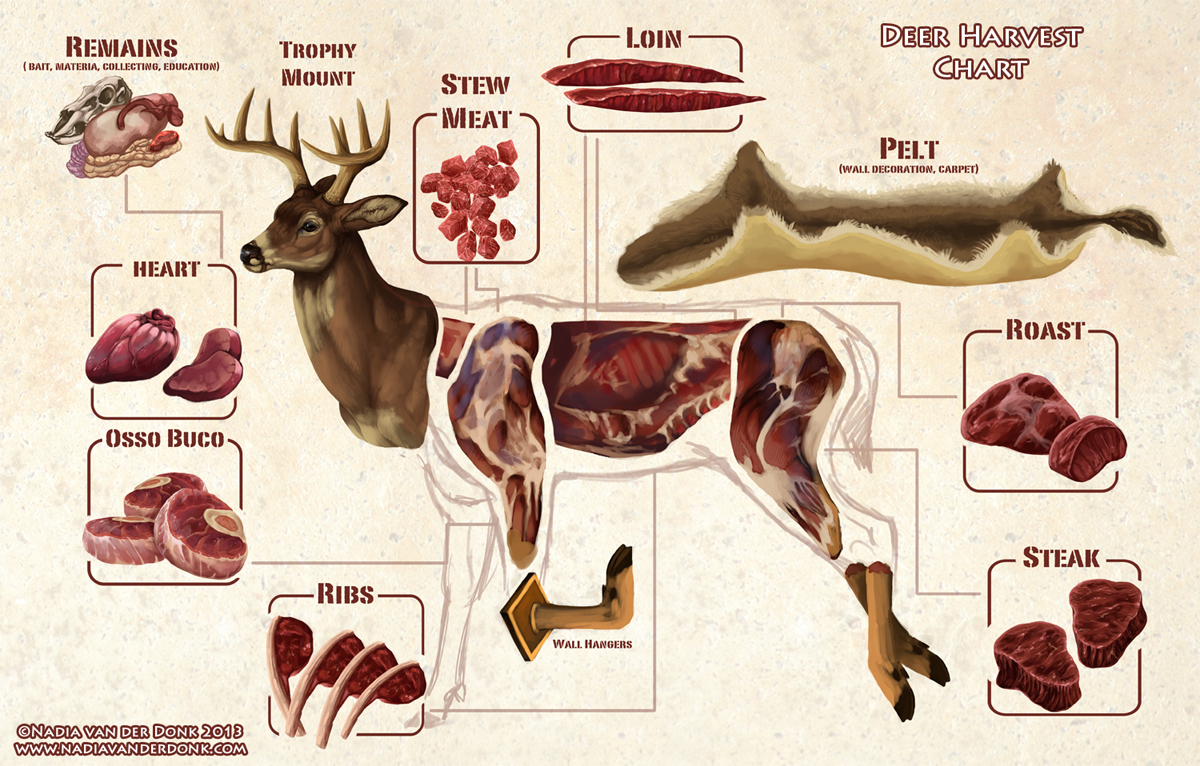
An illustrated guide to the best game meat cuts

There are plenty of hunters out in the field bringing home dinner and we figured we would share some great guides on the best cuts and how to get them from your harvest!  Click on each picture to enlarge for greater detail 🙂

This diagram is the basic overview of the quarters and can be applied to deer, moose, elk and caribou.

illustrated deer

This second diagram is a more in depth cut selection and is coded for the sections as well.  Again, this can be applied to deer, moose, elk and caribou.

deerchart

Ensure before you properly care for your game in all stages of meat preparation to give not only longevity to the meat, but reduce the risk of cross contamination of any bacteria that could not only spoil the meat but could also make you very sick.

Happy hunting!

Follow our FISHING BLOG

WEB   RATES     FISH    HUNT    CABINS    PHOTOS
TESTIMONIALS    BROCHURE    HUNT BOOKLET

Enter your email address to subscribe to this blog and receive notifications of new posts by email.

← Back

Thank you for your response. ✨

Email Me....

 
1 Comment

Posted by on July 4, 2015 in game, recipe, Wawang Lake Resort


Tags: , , , , , , , , , , , , , , ,

Building an Emergency Shelter in the Field

With the season upon us, being in the field is commonplace.  In the event of an emergency or in climate weather

Understanding how to create effective wilderness survival shelters is one of the most important outdoor skills. From keeping you protected from the elements to providing a place to rest, wilderness shelters serve a key role in survival situations. Not only do they provide for physical needs, but also help create a sense of home in the wilderness. Though each season and environment presents its own challenges, there are several universal principles for creating effective wilderness survival shelters:

Location
The most important aspect of making wilderness shelters is choosing a good location. A good location is one that 1) provides easy access to ample building materials such as dead sticks, leaves, and grasses; and is 2) away from major hazards such falling branches, pooling water, and insect nests. You also want a location that has a large enough flat area to allow you to lie down and sleep comfortably.

Size
A common mistake when building wilderness survival shelters is to build them too large. Not only does it take more materials, effort, and time to construct, but often ends up being cold due to the amount of space on the inside. Effective wilderness shelters are often small on the inside – just large enough to fit your body to conserve body heat.

Type

The debris hut is an extremely versatile wilderness survival shelter. It can be built in almost any habitat and does not require tools or special equipment. Creating an effective shelter is one of the most important priorities in a survival situation. Most lost persons perish from hypothermia, which may have been easily avoided had they constructed a simple shelter.

The debris hut is constructed using sticks and any available debris, such as leaves, moss, ferns, bark, etc… The key to a good shelter is to insulate yourself from all of the forms of heat loss. Your body can lose heat through direct contact with the ground, wind, and simply radiating off of your body. Therefore, your shelter needs to provide insulation and protection from all of these elements.

A completed debris shelter is like a gigantic water-resistant sleeping bag, insulated by debris and held together by sticks. To construct a debris hut:

debris hut basics

1.) Select a location that provides ample building materials (sticks and debris) that is safe from falling branches, pooling water, and other hazards.

2.) Prop up a sturdy 8-foot pole-like branch on a stump or crook of a tree. This ridge pole should be sturdy enough to support your weight. The size of the space underneath the ridge pole should be just large enough to fit your body plus six inches of debris on all sides.

3.) Lay shorter stick along the length of the ridge pole on both sides, leaving room for a doorway. These shorter sticks are called ribbing. The ribbing sticks should touch the ground roughly six inches outside of where your body would lay.
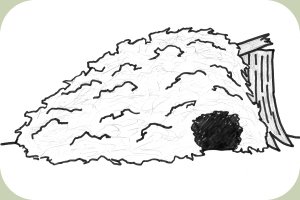
completed debris hut

4.) Add smaller sticks on top of and perpendicular to the ribbing sticks. These latticework sticks will keep the outer debris from falling inside the shelter.

5.) Pile large amounts of leafy debris on top, as well as inside. Use your driest, softest debris on the inside closest to your body. When complete, there should be at least three feet of debris piled up on top and on all sides of the shelter.

6.) You can lay more sticks on top to keep the wind from blowing the debris away if it is a windy day.

7.) A door plug can be created by stuffing a shirt full of leaves.

Crawl inside, being sure to burrow into the leaves, so that there is a mattress of leaves insulating you from the ground and on all sides. Though nothing like the warmth of your own bed, a debris hut will allow you to survive the night.

Follow our FISHING BLOG

WEB   RATES     FISH    HUNT    CABINS    PHOTOS T
ESTIMONIALS
    BROCHURE    HUNT BOOKLET
Enter your email address to subscribe to this blog and receive notifications of new posts by email.

← Back

Thank you for your response. ✨

Email Me....


Tags: , , , , ,

The importance of knowing your bowstrings!

Archers are very specific about the bow they use, the sites they mount and the release they settle on, but often overlooked is the actual bow string.  They are as vital to your performance as that of the arrow or even the bow itself.  But the question is, how do you select your bowstrings? And how do you know which ones to opt for? Having to answer these questions might become a bit of a challenge, but with some of these helpful guidelines it just might get easier for you.

1.THE 4 GENERAL THINGS YOU NEED TO LOOK FOR

The best kinds of bowstrings have four qualities you need to know about.

  • They are lightweight
  • They are strong
  • They are highly resistant to abrasion
  • They are moisture-resistant

 2.YOU HAVE TO KNOW WHAT MATERIAL YOUR BOWSTRINGS ARE MADE OF

Modern bowstrings are made of different kinds of synthetic fibers, and knowing what they are can be to your advantage.

  • Dacron: a polyester material that is strong, high-stretch and can last for years. But it’s an outmoded fiber, so wooden bows, older bows and recurve bows, are its best suit. A bowstring made out of Dacron is safe to use on any bow, but results will surely vary.
  •  Kevlar and Vectran: these fibers are made out of polymer. They have a limited-stretch so its arrow speed is faster than Dacron. Kevlar bowstrings, however, can only last for about 1000 shots, and they are known to break without warning.  These materials are not fit for modern compound bows.
  •  HMPE (High- modulus-polyethylene): this fiber is a blend of Spectra and Dyneema. It’s lightweight, faster than any of the materials aforementioned, strong, and long lasting. It is the perfect fit for high-performance recurve bows and modern compound bows.

 3.WHAT KIND OF WAX YOU SHOULD USE

Whether your bowstring is of superior quality or not, it will fray at one point or another. But if you wax it frequently, you can delay the time in which your bowstring wears out and is completely out of use. I can’t emphasis more on just how important it is to wax your bowstring. But what kind of wax should you use? I have a couple of pointers here, but if you have more, then please do feel free to share it with us.

Beeswax: If you are using a traditional bowstring, which is made out of plant fibers and animal material, then you should opt for beeswax.

Silicone based wax:  Most modern bowstrings come pre-waxed, but no lubricant has ever lasted forever, right? So the second the string starts to feel dry, you have to give it a light coating.  Silicone based waxes are ideal for modern bowstrings; it penetrates the material and lubricates the interior as well as the surface of the string. Some of the most commonly used and perhaps the best kinds of synthetic waxes are Dalton High-Speed Bow Wax Conditioner and Bohning Silicone Wax.

Remember, this may seem like a trivial detail but it could be the difference between success and a fruitless hunt! Thank you Martin Douglas of Legendary Archery for the great information!

Follow our FISHING BLOG

WEB   RATES     FISH    HUNT    CABINS    PHOTOS TESTIMONIALS    BROCHURE    HUNT BOOKLET

Enter your email address to subscribe to this blog and receive notifications of new posts by email.

← Back

Thank you for your response. ✨

Email Me....


Tags: , , , , ,

All That Remains: How to Make Game Stock | Field & Stream

One thing you can do to amp your kitchen credibility quickly is learning to make stock—a flavorful cooking liquid that forms the base of many soups, sauces, and other recipes. Making homemade stock from venison bones or bird carcasses not only give your favorite dishes, such as the duck pho in the photo, a flavor boost, but you’ll be get every last scrap of use from your bird or game animal.

duckpho

The stock making process starts with a scrap bag—a gallon-size Ziploc kept in the freezer that collects the trimmings from onions, carrots, celery and other vegetables. (Of course, you can also make stock with fresh ingredients, but this method is kind of like saving your pennies for a rainy day.) A simple stock can be made by adding the ingredients of the scrap bag into a pot with the leftover carcass from a pheasant, grouse, duck, or goose, deer leg bones or other game scraps, covering everything with water and letting it simmer for a short period of time, say 30 minutes to an hour. However, with just a couple more steps and a bit more time (mostly unattended), you can achieve a richer, fuller flavor by roasting the scraps before soaking them.

Here’s a recipe for pheasant stock, but you could easily substitute the pheasant carcass for just about any game bird or whole or cut leg bones from deer, elk, moose, and other venison.

Stock Recipe

Ingredients
– Pheasant carcass or assorted pheasant bones (NOTE:  You can use any game bird)
– 1 cup each of celery, carrot, and onion scraps
– Assorted herbs, including thyme, parsley, and rosemary
– 1 bay leaf
– 12 cups water (or enough to cover pheasant)

Directions:
1. Preheat the oven to 450 degrees. Place the pheasant bones and vegetables in Dutch oven or heavy, ovenproof stock pot. Place the uncovered pot in the oven and roast for 30 minutes, or until ingredients are browned.

2. Move the pot to the stovetop set the heat to medium-high and add a few cups of water, scraping the bottom of the pan to loosen any browned bits. Cover the pheasant and vegetables with the remaining water, add the herbs and the bay leaf and raise the heat.

3. When the water just starts to boil, remove any scum that has risen to the top. Lower the heat and cover the pot. Simmer slowly for at least 1 hour; two is even better.

4. After a few hours, remove the pot from the heat and let it cool slightly. Remove the bones and vegetables with a slotted spoon and discard. Pour the stock through a cheesecloth-lined strainer or other fine sieve.

You can let the stock sit overnight in the fridge and skim any hardened fat from it the next day, though, with lean birds like pheasants, this generally isn’t necessary.

Stock can be stored for up to a week in the refrigerator or several months, covered, in the freezer.

Follow our FISHING BLOG

WEB   RATES     FISH    HUNT    CABINS    PHOTOS
TESTIMONIALS    BROCHURE    HUNT BOOKLET

Enter your email address to subscribe to this blog and receive notifications of new posts by email.

← Back

Thank you for your response. ✨

Email Me....


Tags: , , , , , , , , , ,

DIY: Easy Odor Absorber

This is a fantastically easy and cost effective de-scenting option for hunting gear 🙂

Odour-Absorber-web
Eons before the advent of scent-control activated charcoal hunting suits, a woman working in a Port Perry convenience store taught me how to capture offensive odours. My children suffered from motion sickness, so when I asked her for a scented air spray to mask the sour smell in the car, she suggested filling a perforated coffee can with charcoal. The results far exceeded all expectations.

Hunting season rolled around and the light bulb went on. I could use the same approach to keep hunting gear scent-free. To this day, all my tote boxes of gear and bags of hunting clothes include a perforated container filled with charcoal. When the charcoal becomes saturated and unable to absorb any more odors, I simply refill the container with new charcoal.

Ensure that the container is first cleaned very well and left to air out for a few days to get any residual coffee odor out.

When purchasing charcoal, be advised not to buy any with any extra additives to ease starting or burning…the cleaner the charcoal the better 🙂

Follow our FISHING BLOG

WEB   RATES     FISH    HUNT    CABINS    PHOTOS
TESTIMONIALS    BROCHURE    HUNT BOOKLET

Enter your email address to subscribe to this blog and receive notifications of new posts by email.

← Back

Thank you for your response. ✨

Email Me....


Tags: , , , , , ,

How to Sharpen a Knife

Here is a great video on how CJ Buck, President and CEO of Buck Knives sharpens a knife.  Knowing how to properly sharpen a piece of equipment can not only save time but keep you from permanently damaging your knives as well.

Follow our FISHING BLOG

WEB   RATES     FISH    HUNT    CABINS    PHOTOS T
ESTIMONIALS
    BROCHURE    HUNT BOOKLET

Enter your email address to subscribe to this blog and receive notifications of new posts by email.

← Back

Thank you for your response. ✨

Email Me....


Tags: , , , , , , , ,