RSS

Category Archives: Wildlife

Pack of 400 Wolves Terrorized Remote Russian Town

NOTE:  This is an older story, but, worthy of re-telling.

wolf

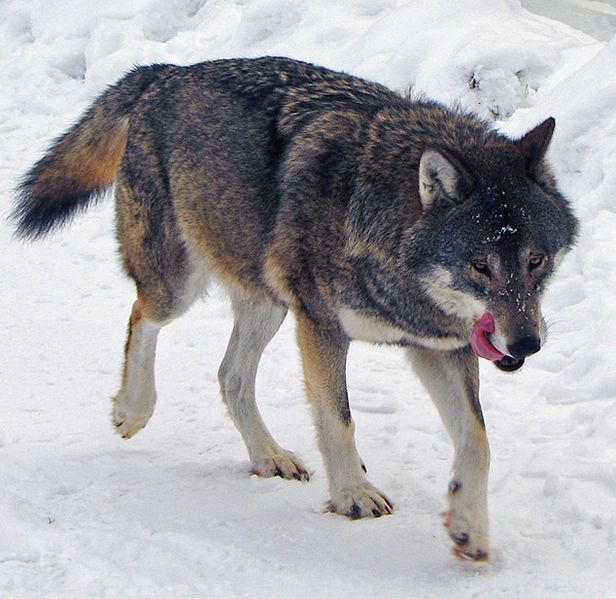
The small Russian town of Verkhoyansk has recently been fighting a “super pack” of about 400 wolves. The predators have attacked livestock and killed 30 horses in four days.

Twenty four teams of shooters and trappers have started thinning wolf numbers with officials offering a cash reward of £210 for each skin they turn in.

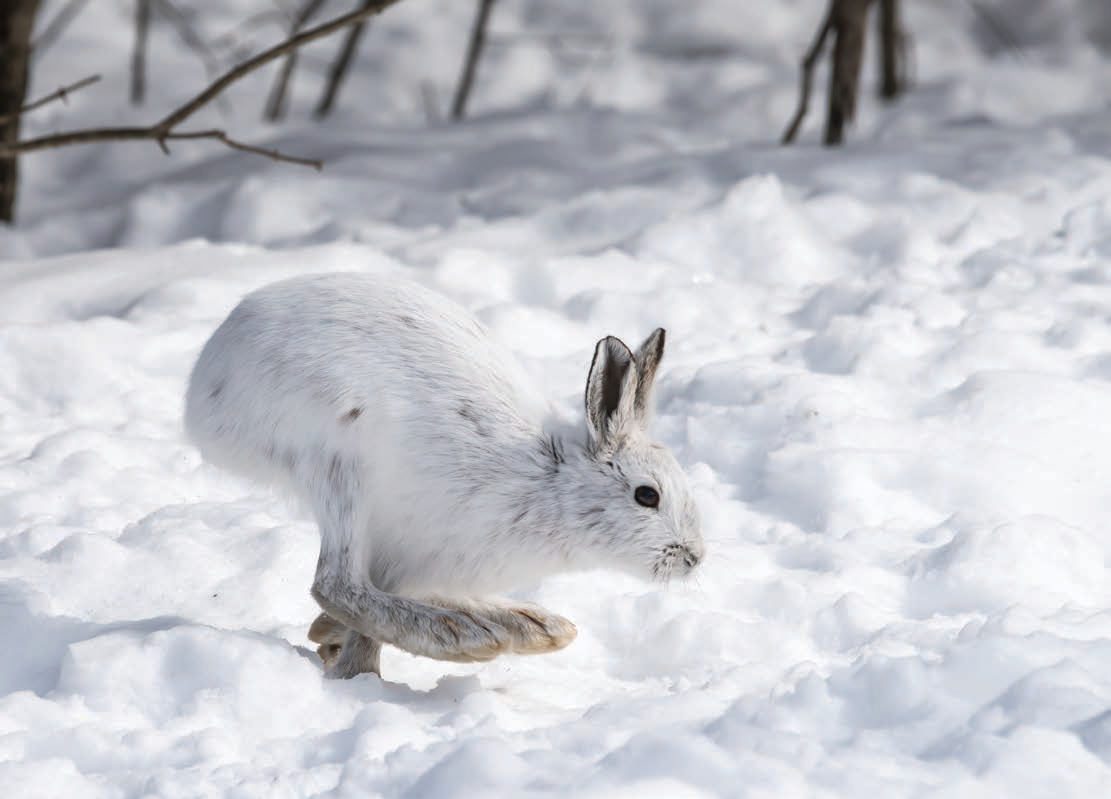
The size of the pack has stunned animal experts, who say wolves usually hunt in small groups of six or seven. In this case, the Super Pack may have been driven together because of a sharp decrease in their usual prey: rabbits.

The cold, remote town is located in “Stalin’s Death Ring,” so named because the former dictator exiled prisoners there. With a population of just 1,300, town officials say they need more manpower and will begin shooting wolves from helicopters once daylight hours in the region increase.

Follow our FISHING BLOG

WEB   RATES     FISH    HUNT    CABINS    PHOTOS
TESTIMONIALS    BROCHURE    HUNT BOOKLET

Enter your email address to subscribe to this blog and receive notifications of new posts by email.

← Back

Thank you for your response. ✨

Email Me....


Tags: , , , , , , ,

Maximizing Your Hunting Time With Trail Cameras

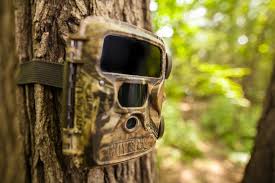
cameraOver the last five years, probably no other “gadget” has changed the way we scout more than the trail camera. For many of us, running trail cameras is a hobby in itself, bringing a whole new excitement to our deer hunting efforts. Much more than just something to pass time, however, running trail cameras can give you a unique insight into the patterns of deer on your hunting properties and really tip the odds in your favor for harvesting a mature whitetail. Let’s take a look at the features to look for when purchasing a trail camera, and how to get the maximum benefit from the camera once you have made your purchase.

As the popularity of these scouting tools has grown, so has the number of companies offering their own line of cameras. The features on these cameras cover such a wide spectrum that choosing the right one for you can be a daunting and sometimes confusing task. While this article isn’t meant to tell you WHICH camera to buy, it IS meant to help you sort through some of the most common differences among the various trail cameras to help you narrow down your search.

RESOLUTION
The resolution of a trail camera is a measure of the image size that the camera creates. So a 5.0 megapixal trail camera will give you a much larger image – and therefore more detail – than one with 3.0 megapixals. Which resolution you choose really depends on how important it is to have a large, crisp image. If you are only concerned with having a general idea of what deer are in the area and when they are traveling through, then about any resolution offered on today’s cameras will suffice. If you want a larger, more detailed image to print off for your friends, then you may want to shoot for something with at least 3.0 megapixels.

BATTERY TYPE & LIFE
In my mind, this is one of the most important considerations when choosing a trail camera, as it will have a huge effect on the cost of maintaining the camera. I have seen some “cheap” trail cameras that burn through six C-sized batteries in a week, and suddenly the “cheap” camera gets VERY expensive! Others claim to operate up to a year on eight AA batteries. So before you go buying a camera based on price alone, keep in mind the battery life, as it may be the most expensive choice you could make in the long run.

TRIGGER SPEED
Another important feature is the trigger speed of the camera, which is simply how long it takes the trail camera to shoot a picture once something has “triggered” the motion sensor. A faster trigger speed can be the difference between having a great shot of that trophy buck and just having a picture of a deer’s butt as it walks out of the frame. If you plan on placing your trail cameras over feeders or a mineral lick, then trigger speed will not be as much of an issue as it would if hung along a trail.

FLASH TYPE
This is almost a moot point, since most trail cameras today have gone to infrared flash. An infrared flash, as opposed to the incandescent flash found standard on most consumer cameras, is less likely to spook deer, uses less battery life, and is less likely to be detected by other humans (i.e. thieves!). While I’ve gotten plenty of pictures of big, mature whitetails with an incandescent flash trail camera, there is no doubt that some animals are spooked by the bright flash. If you can afford the infrared flash, the benefits certainly outweigh the small increase in cost.

OTHER FEATURES
While we have covered some of the most important features to consider when buying a new trail camera, there are many more options that could impact your decision. One of these options is the size of the unit. Size varies greatly amongst trail cameras, and some companies are now producing models that are as small as your hand. Other models go as far as being able to send the pictures it takes directly to your email or cell phone, so the only time you have to check them is when the batteries need replacing. How’s that for convenience?

Before you head out to buy your next trail camera, take a minute to think about how it will be used and what features are most important to you. This will make the task of narrowing down your choices much easier when you start the shopping process.
camera2

MAXIMIZING TRAIL CAMERA USE
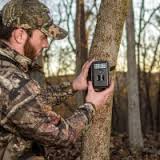
Once you have waded through all the details, made your decision and laid down your hard earned money on a trail camera, all that’s left is to hang that thing on a tree, right? Let’s take a look at some ways you can be sure you are using your camera to its potential this season and getting the most bang for your buck.

DRAW THEM IN
One of the easiest ways to maximize the effectiveness of your trail camera and insure that you see a good representation of what is in your hunting area is to use some type of attractant to lure the deer into camera range. Probably the most common attractant used across the country is shelled corn – it’s cheap, readily available, and the deer love it. For the purpose of getting trail camera pictures, there is no need to invest in an expensive feeder; just simply spread 100 pounds on the ground in an eight to ten-foot circle area where you want to hang your camera. For safety reasons, do not place the corn in large piles or in an area that holds moisture, as this can result in molding that can cause disease in both deer and turkey. Depending on deer density and other available food sources, this should get you five to ten days worth of pictures. Be patient, as it may take a few days for the deer to really key in on the corn and for you to start getting good pictures. Once they find it, though, it won’t last long!

Before you start dumping corn on your favorite hunting property, check your local game laws regarding baiting. If corn or other “feed” is prohibited, but would still like to attract deer to your camera location, then you may want to consider creating a mineral lick. You can buy one of the many commercial mixes available today, or simply create your own by mixing 50 lbs of trace mineral, 50 lbs of feed mix salt, and 10 lbs of dicalcium phosphate. Break the soil up with a shovel in the area where you want to create your lick and work your mix into the soil. Once the lick gets a good rain on it, it shouldn’t take long for the deer to find it and start paying regular visits.

KEEP IT MOBILE
Unless you are hunting a really small property, or you have the money to invest in lots of trail cameras, then you are going to need to move your cameras around to really get a good idea of what the deer are doing on your hunting property. Don’t get caught in the trap of leaving your camera in the same spot all season. This will not only limit your ability to pattern the deer, but it may keep you from discovering that trophy buck that could be hanging out on the other side of the property!
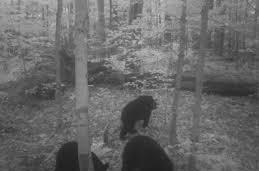
images40V5Z2FA2By experience, two weeks seems to be enough time to get a good representation of what deer are in the area, without your camera spending too much time in one location. You can always bring the camera back to the same spot at a later time, but the idea is to cover as much of your hunting area as possible.

KEEP GOOD RECORDS
Once you have moved your camera around your property and gotten plenty of pictures to look at, the real work has just begun. Now is the time to sort through the pictures, identifying as many unique animals as you can, analyzing what camera sites each deer is visiting and the times that they were there. This should start to give you an idea of the travel patterns on the property, as well as potential stand locations.

This season, make sure you use these tips to get the most out of your trail cameras, and the next picture you get of that monster buck may be the one with you behind him holding his antlers, OR, even that BIG bear 🙂

Follow our FISHING BLOG

WEB   RATES     FISH    HUNT    CABINS    PHOTOS
TESTIMONIALS    BROCHURE    HUNT BOOKLET
Enter your email address to subscribe to this blog and receive notifications of new posts by email.

← Back

Thank you for your response. ✨

Email Me....


Tags: , , , , , , , , , , ,

Wildlife on Ice

wildside2For many of us, winter means changing our wardrobes, cranking up the heat and cutting back on outdoor activities. For forest wildlife, especially in the north, no season has a greater impact than winter. Those animals that can’t flee south must kick into deep-freeze survival mode or perish.

Some small insects such as orb weaver spiders, mantises and most butterflies die with the first frosts. But they leave freeze-resistant progeny as their legacy. In the case of butterflies, that usually means larvae (caterpillars) or pupae in their protective “wrappers.” But some butterflies, including the mourning cloak, hibernate in a sheltering crag or crack. Unlike orb weavers, other types of spiders hibernate beneath rocks or under tree bark, where wandering flocks of watchful chickadees, nuthatches and brown creepers may find them.

Toads and terrestrial frogs such as peepers try to dig or shelter in places that protect them from hard freezes, including cracks in logs or thick leaf litter. But even a hard freeze usually will not kill a temperate-area frog. Breathing and heartbeats may stop, but with a thaw, thanks to elevated blood glucose, the frogs come “back” to life. Turtles often dig down into the mud, and their metabolisms slow to a crawl.

Even birds that we assume are always warm and active have coldweather adaptations. Chickadees, for example—the most common small songbirds wintering in northern woods—may enter a “regulated hypothermia” while they sleep, their body temperatures dipping to conserve precious energy.

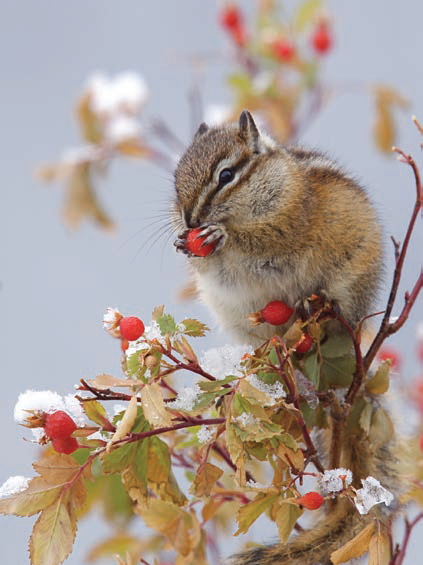
Chipmunks will hibernate but emerge during warm spells, while the restless red squirrel changes its schedule from early to late morning, even tunneling through snow to transport snipped conifer cones to its bulk storage area, known as a midden.

wildside1So, much of your property’s wildlife may be out of view this time of year but with the exception of migratory birds and monarch butterflies most of it remains, just on some form of “pause.”

This time of year, some of the best things you can do for wildlife are simple—often involving doing nothing at all. Here are some tips:

• Leave dead meadow stalks standing until later winter thaws come. Meadow plants shelter, among other things, butterfly caterpillars and pupae and mantis egg cases. From fall into winter, their seedheads nourish overwintering songbirds, gamebirds and rodents that in turn feed foxes, owls, hawks and other creatures.

• Hold off on clearing logs, if possible. Logs and snags (dead trees) are always important components of a diversified wildlife habitat, and the shelter they provide during winter is crucial. If you remove this resource during cold weather, you might harm hibernating wildlife.

• Leave dense conifer stands to provide cover for owls, rabbits, grouse and other hardy active critters while other cover is sparse.

wildside3• Keep bird feeders topped up. This will provide you with hours of entertainment, and you also will be helping supplement birds’ diets at the toughest time of year. If you want to feed a wide variety of birds, offer not only mixed seeds but also black oil sunflower, thistle and suet. Raisins and mealworms may bring in bluebirds, thrashers and mockingbirds. Also, you could buy a birdbath or pond heater to provide water during the coldest days.

• Hold off on cleaning up nestboxes, as these will provide shelter for birds, rodents and invertebrates during cold weather. Then, in late winter (early March in many areas), clean the boxes out just before bluebirds and other cavity nesters start seeking nest sites.

• Leave brushpiles, which provide dense shelter that can be hard to come by in winter. Wrens, rabbits, sparrows and other creatures seek these out. Bigger brush piles may shelter quail and pheasants at the field-forest edge.

• Refrain from removing leaf litter. Thick leaf litter is like a thermal blanket for hibernating salamanders, frogs and invertebrates— especially when piled around stumps and logs.

Sometimes it feels like winter will never end. But before you know it, frog calls, bird songs and the buzzing and chirping of insects will once again fill the air. For now, though, you can find comfort knowing your forest provides safe havens for a variety of resting wildlife.

Follow our FISHING BLOG

WEB   RATES     FISH    HUNT    CABINS    PHOTOS
TESTIMONIALS    BROCHURE    HUNT BOOKLET

Enter your email address to subscribe to this blog and receive notifications of new posts by email.

← Back

Thank you for your response. ✨

Email Me....


Tags: , , , , , , , ,

Wild Game Recipe: Rabbit Sott’olio

rabbitsottolioEmploying an old Italian method of preserving meats and vegetables called sott’olio, submerge rabbits in oil and slow-cooks them until the meat is tender and rich. Then dress the warm meat in a salad for a perfect counterbalance. The only difficult part of this recipe is pouring that much oil into a pot—but it’s worth it. Be sure to fish the garlic out of the oil for later: Spread the cloves on toasted bread for a killer snack.

Ingredients
– 2 whole wild rabbits, cleaned
– About 3 quarts vegetable oil
– About 1 quart, plus
– 1 Tbsp., plus 1⁄4 cup, olive oil
– 2 whole heads garlic, broken into individual unpeeled cloves
– 6 sprigs fresh thyme
– 1⁄3 cup, plus 1⁄4 cup,
– red wine vinegar
– 1 red onion, sliced
– 2 carrots, peeled and chopped into 1⁄2-inch pieces
– 4 cups baby arugula
– 1⁄4 cup pine nuts, lightly toasted
– 1⁄4 cup Parmigiano Reggiano cheese, shaved or grated
– Salt and freshly ground pepper, to taste

Directions:
1. Preheat the oven to 300 degrees. Rub the rabbits with salt and pepper and place in a Dutch oven. Pour in about three parts vegetable oil to one part olive oil, enough to fully submerge the rabbits. Add the garlic and thyme, and cover the Dutch oven. (A sheet of aluminum foil underneath the lid is a good idea.) Place in the oven and cook for about 11⁄2 hours, or until the meat is tender and falling off the bone. Let cool.

2. Meanwhile, combine the 1⁄3 cup red wine vinegar in a small saucepan with 1⁄3 cup water, and bring to a boil over high heat. Put the red onion slices in a bowl, and pour the vinegar mixture over the onions. Stir, add salt and pepper, then allow the onions to pickle at room temperature.

3. Heat 1 Tbsp. olive oil over low heat in a saucepan, and add the carrots. Cook, stirring occasionally, for 6 to 8 minutes, or until the carrots are tender but not mushy. Add salt and pepper, and reserve.

4. Make a vinaigrette: Put the remaining 1⁄4 cup red wine vinegar in a bowl and gradually whisk in 1⁄4 cup olive oil, until the oil and vinegar are thoroughly integrated. Add salt and pepper.

5. When the rabbits are cool, remove the meat from the bones and reserve.

6. To serve, reheat the rabbit meat in a pan with some of the oil, over low heat, just to warm through. In a large mixing bowl, gently toss the arugula with the red onions (drained), carrots, pine nuts, cheese, and about 3 Tbsp. vinaigrette. Divide the salad among four plates, and top with the rabbit, adding a few more shavings of cheese and salt and pepper as desired. Serves 4

Follow our FISHING BLOG

WEB   RATES     FISH    HUNT    CABINS    PHOTOS
TESTIMONIALS    BROCHURE    HUNT BOOKLET

Enter your email address to subscribe to this blog and receive notifications of new posts by email.

← Back

Thank you for your response. ✨

Email Me....


Tags: , , , , , , , , ,

Where to Place Your Trail Cams

A trail camera won’t stumble through a bedding area, leave scent all over a trail, or exaggerate the size of a rack. And it’ll never oversleep. But your perfect little scouting buddy must be chosen wisely and placed carefully if you want to pattern that old, crafty animal you know is around. Here’s how…

CameraNO_MosaicYELLOW

The earlier version trail cameras were just a 35mm film point-and-shoot tucked in a weatherproof housing. It snapped a single picture when something triggered the sensor. After retrieving the camera, you ran to the one-hour shop to get the film developed, then thumbed through a week’s worth of pictures. More than once a stack of 36 prints revealed a handful of out-of-focus animals and a couple dozen shots of a wind-whipped brush or a drooping tree branch. That was only a few years ago.

Today, many website boasts several pages of trail cams, and even the cheapest one outperforms the original older ones. They have lenses sharp enough to count the ticks on a deer’s neck, electronic circuit boards so efficient that four AA batteries will run a unit for months, and memory cards that hold thousands of pictures you can download to your computer or delete at the touch of a button. And those are standard features on mid-priced cameras. The high-end ones will send a photo to your cellphone or laptop.

Like everything in the digital age, trail-cam technology has improved, competition has become fierce, and prices have plunged. Still, $200 is plenty of money, and matching a camera with the right features to meet your needs is critical. And even the best camera can’t take spectacular photos of a trophy buck if you don’t set it properly. But it’s not difficult to get started. These are the basics.

TrailCameras3
Wildlife biologists use trail cams to measure herd densities, buck-to-doe ratios, and the like. Your goals should be simpler: learning about the deer on your property, figuring out where to hunt them, and having fun in the process. You can pinpoint ideal spots before you buy a camera, and the locations you choose can determine what model is best for you. Here are four sites for four different periods.

Time: Late Summer
Site: Mineral lick
Goal: To start an inventory of buck numbers and quality on your property.
Setup: Find a spot with moderate to heavy deer traffic and spade up dirt in a 2-foot circle. Pour in half of an ice-cream pail of stock salt or commercial deer mineral and spade it into the loosened soil. Pour the rest on top.
Tips:
• Establish one or two licks per 80 acres. Allow deer up to a week to find them.
• Situate each lick 10 to 30 feet from a tree for mounting a camera.
• Jam a stick behind the camera’s top edge to point it down toward the lick.

500Time: Early Season
Site: Mock scrape
Goal: To find bucks after velvet shed, when they often relocate. Mocks can draw up to 90 percent of the bucks you’ll hunt.
Setup: Rake grass and forest debris 5 feet away from a tree that has a green, overhanging licking branch 5 to 7 feet above the ground. Activate with your own “product” (drink plenty of liquids) or deer urine.
Tips:
• If you are not getting clear shots of a buck, aim the camera at the licking branch. Most bucks will work it with their antlers.
• Establish multiple scrapes in each area and hang cameras only on the most active ones.

Time: Rut
Site: Funnel
Goal: To determine where resident bucks are traveling and whether traveling bucks are in the area.
Setup: Find terrain features that channel buck movement and hang a camera near fresh tracks and rubbing activity. Check camera every three to five days—the rut moves quickly.
Tips:
• Mount camera at a 45-degree angle to the trail. Bucks often move through funnels quickly; a camera set perpendicular to the trail might miss the shot.
• Scuff dirt in front of the camera with a boot. Such a mini mock will often make a moving buck pause and get “shot.”

Time: Late Season
Site: Food source
Goal: To find out where to fill a last-minute tag, and to know which bucks have survived the bulk of the hunting season.
Setup: Scout widely to find the hot food sources in your area, such as waste grainfields and clear-cuts. Place camera within 30 feet of the most heavily trafficked area. Load it with fresh batteries if you hunt in an extremely cold area.
Tips:
• Set up and check cameras at midday to avoid spooking feeding deer.
• If no trees are located near the food source, mount the camera on a tripod and camouflage it with grass or brush.

Make the Next Shot Count!

Follow our FISHING BLOG

WEB   RATES     FISH    HUNT    CABINS    PHOTOS T
ESTIMONIALS
    BROCHURE    HUNT BOOKLET

Enter your email address to subscribe to this blog and receive notifications of new posts by email.

← Back

Thank you for your response. ✨

Email Me....


Tags: , , , , , ,

Mule vs. Mountain Lion – Which One Wins?

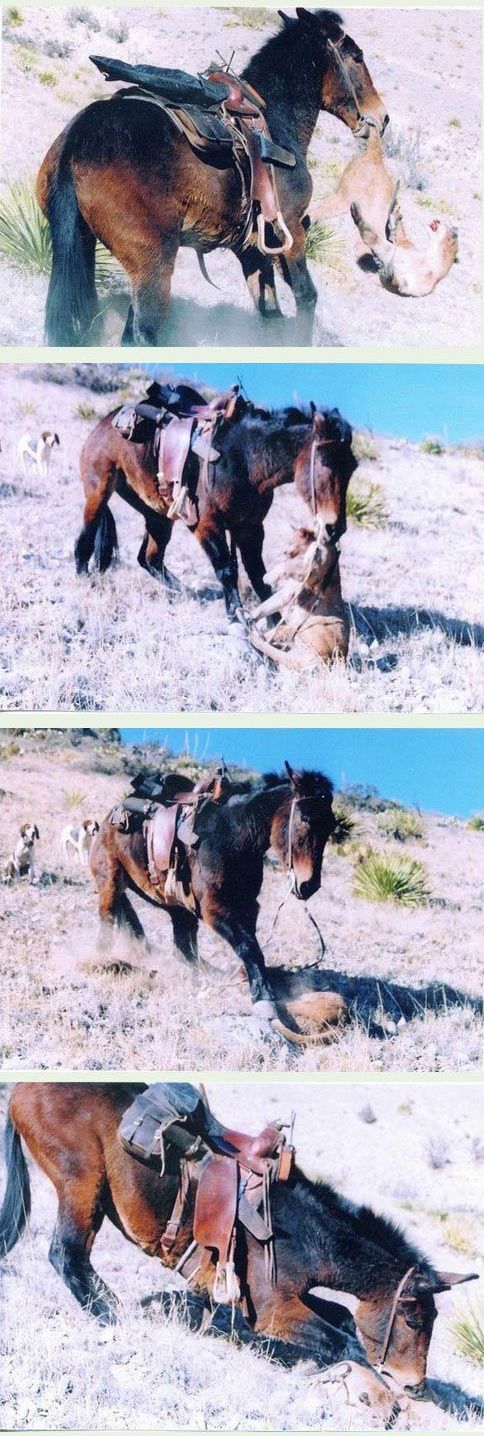
A couple from Montana were out riding on the range, him with his rifle and her with a camera.  Their dogs always followed them, and on this particular day a mountain lion decided to stalk the dogs (you’ll see the dogs in the background watching).  Very, very bad decision……for the cat.

The hunter got off the mule with his rifle and decided to shoot in the air to scare off the lion, but before he could get off a shot the lion charged in and decided he wanted a piece of those dogs.  With that, the mule took off and decided he wanted a piece of that lion.  That’s when all heck broke loose….for the lion.

As the lion approached the dogs the mule snatched him up by the tail and started whirling him around.  Banging its head on the ground on every pass.  Then he dropped it, stomped on it and held it to the ground by the throat.  The mule then got down on his knees and bit the cat all over a dozen or more times to make sure it was dead, then whipped it into the air one last time, walked back over the couple – that were stunned in silence and stood there ready to continue his ride…..just as if nothing had happened.

Fortunately, and even though the hunter didn’t get off a shot, his wife did get photo shots of the entire event.

2

Never underestimate the power of family LOVE!

Follow our FISHING BLOG

WEB   RATES     FISH    HUNT    CABINS    PHOTOS
TESTIMONIALS    BROCHURE    HUNT BOOKLET

Enter your email address to subscribe to this blog and receive notifications of new posts by email.

← Back

Thank you for your response. ✨

Email Me....


Tags: , , , , , , , ,

Roasted Grouse With Mushrooms

Make your own cream of mushroom sauce (and add bacon and whiskey) for this classic grouse recipe

grouse

Ask any deer camp old-timer for a foolproof recipe, and you’re likely to encounter a lot of Campbell’s Cream of Mushroom Soup. There is a reason for that: Mushrooms plus cream plus game meat adds up to a perfect trinity of flavors. This recipe chucks the can, and all its high-sodium gloppiness, while retaining the earthy comfort that made mushrooms and cream the go-to sauce for generations of hunters.

Ingredients

Grouse:
4 grouse
4 Tbsp. butter, softened
8 strips bacon

Sauce:

2 Tbsp. butter
20 oz. cremini or wild mushrooms, trimmed and sliced thin (morels, chanterelles, or a mix of wild and cultivated would be good)
1 shallot, minced
1 cup rich chicken stock (or defatted drippings from the pan)
3 sprigs thyme
12 cup cream (or crème fraîche)
(or)

1 Tbsp. bourbon
1 Tbsp. fresh thyme leaves, chopped
Salt and freshly ground black pepper

DIRECTIONS

1. ROAST THE GROUSE: Preheat the oven to 425 degrees. Rinse the birds, pat dry, then smear each with a tablespoon of softened butter. Generously salt and pepper, inside and out. Wrap 2 bacon slices around each grouse, then set them in a roasting pan. Roast in the oven until the grouse is browned, about 25 minutes. Remove to a plate and let rest, covered loosely in tinfoil, while you make the sauce.

2. MAKE THE SAUCE: Melt 2 Tbsp. butter in a large sauté pan over medium-high heat. Add the mushrooms and about 1/2 tsp. salt and sauté, stirring frequently, until the mushrooms release a lot of moisture and begin to smell fragrant, about 5 minutes. Reduce the heat to medium and add the shallot. Sauté until soft, and until most of the moisture has gone out of the pan, about 4 minutes. Add the stock (or defatted drippings from the roasting pan) and thyme sprigs and simmer until the liquid is reduced by half. Pour in the cream and bourbon and simmer until the sauce thickens, about 3–5 minutes.

3. TO SERVE, spoon the sauce onto four plates, and rest a grouse in the center of each. Sprinkle thyme over the grouse. SERVES 4

grouse3

Follow our FISHING BLOG

WEB   RATES     FISH    HUNT    CABINS    PHOTOS
TESTIMONIALS    BROCHURE    HUNT BOOKLET
Enter your email address to subscribe to this blog and receive notifications of new posts by email.

← Back

Thank you for your response. ✨

Email Me....


Tags: , , , , , ,

Girl Shoots Mountain Lion That Stalked Her Brother

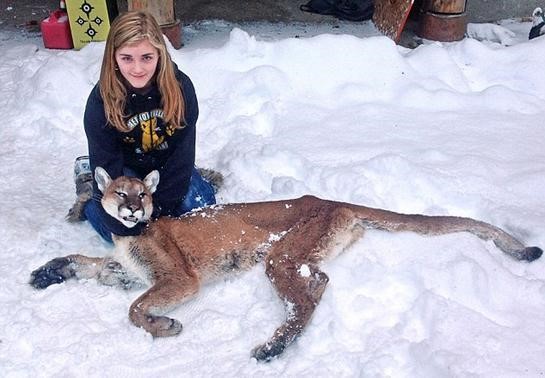
During the course of a single week, three cougars were killed at a family ranch in northern Washington. The latest big cat was killed by 11-year-old Shelby White, who shot an emaciated lion that had been stalking her older brother near their home.

ML1

Thomas White awoke at 2:30 a.m. to the barking of the family dog so White walked outside and discovered a cougar trying to enter an enclosure of cows and calves. Although he scared away the cougar without incident, the lion returned two hours later and White drove it off a second time.

Later that day White’s three children arrived home from school at 3:30 p.m. The cougar turned up a third time when his 14-year-old son Tanner White was doing his chores outside. Tanner had finished feeding the dogs and was walking back toward the house when the cougar emerged from its hiding spot by a vehicle in the driveway. Tanner didn’t notice the cat following him and walked safely through the basement door.

His dad was in there and said, ‘Close the door!’ because there was the cougar, right behind him.

Shelby White, 11, was the only member of the White family with an unfilled cougar tag.  She retrieved her rifle and shot the cat where it stood outside, just 10 feet from the door. The 4-year-old female cougar appeared “very, very skinny” and weighed just 50 pounds. A healthy mature female cougar should weigh twice that, according to Treser. “It was starving to death,” Treser said.

Shelby’s cougar was the third big cat taken on or near the family ranch in a single week. Two days prior a family friend tracked a cougar within 200 yards of the ranch. The hunter shot the 2- to 3-year-old female cat near the White’s driveway a couple days earlier.

The youngest White child also tracked and tagged a cougar on the property. Nine-year-old Cody White and his father spotted paw prints near the White house  and followed them to the family’s calving pasture. He discovered a 120-pound male cougar and shot it on the hillside.

ML2

Additional tracks and big cat sightings have occurred in the region since and a total of 10 cougars have been harvested during the season. Five were taken by hunters and the other five were killed by wildlife officials after the cats attacked domestic animals.

The number of cougar predations and encounters in the area is above average. Wildlife officials suspect cougar numbers have increased or the big cats cannot find enough deer to survive without resorting to domestic prey.

Follow our FISHING BLOG

WEB   RATES     FISH    HUNT    CABINS    PHOTOS
TESTIMONIALS    BROCHURE    HUNT BOOKLET

Enter your email address to subscribe to this blog and receive notifications of new posts by email.

← Back

Thank you for your response. ✨

Email Me....


Tags: , , , , , ,

GIANT Python Caught in Florida – WOW!

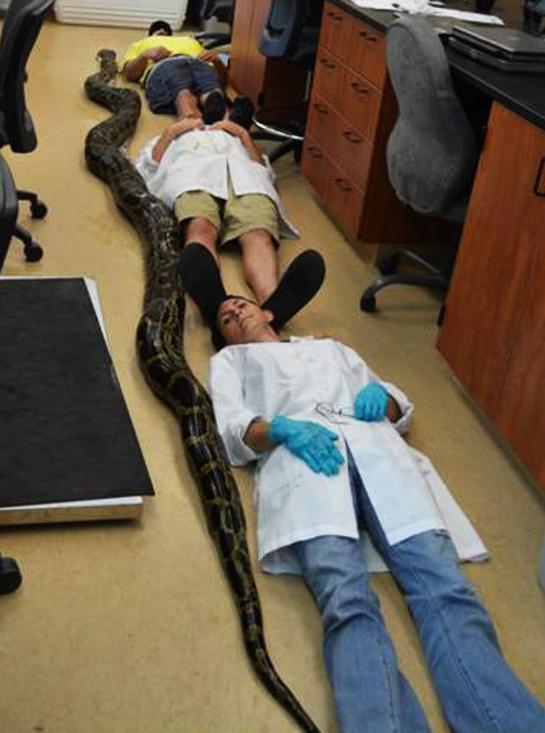
Get out the tape measure…

pyth2

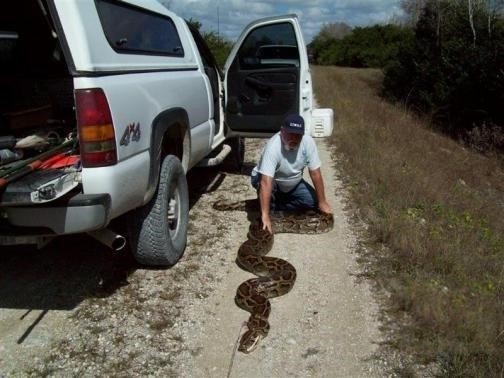
South Florida Water Management District workers captured a Burmese python that measured an astronomical 18 ½ feet and weighed 150 pounds. The invasive species was basking on a levee about 30 miles west of the town of Krome, five miles north of the Tamiami Trail.

This, of course, is only the latest invasive monster to come from the Sunshine State.  A recent study showed that the snakes have decimated portions of the Everglades by reducing the number of medium-sized mammals such as possums, bobcats, and raccoons by 99 percent. The reptiles are also fond of birds and larger animals such as deer and even alligators.

The largest snake taken prior to that was a 164-pound behemoth that measured 17 feet, 7 inches.

The snake caught Tuesday by water workers has been sent to University of Florida where researchers will determine if the animal was carrying any eggs.

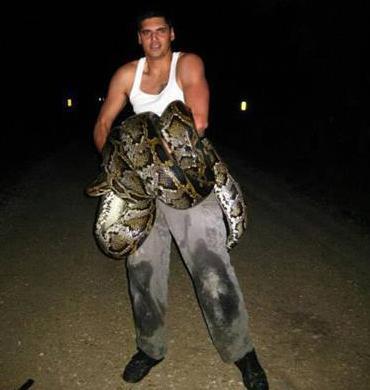
bigsnakeLast May, Miami resident Jason Leon killed an 18-foot 8-inch python he caught crossing a road at night. Mr. Leon killed the serpent with a knife as it wrapped tighter and tighter around his leg. That snake is considered to be the longest ever taken in the state.  So what did he do? He wrestled the beast, knowing it was an invasive species, and eventually decapitated it with a knife.

This according to the FWC: “… record-setting Burmese python found in Florida. Jason Leon was riding late at night in a rural area of southeast Miami-Dade County when he and his passenger spotted what turned out to be an 18-foot, 8-inch Burmese python.”

“The Burmese python is an invasive species that has negative impacts on the Everglades ecosystem and its native wildlife. The FWC actively coordinates with local, state and federal partners, including university researchers, native tribes and nongovernmental organizations, on the research, management and capture of pythons. The general public should not try handling or capturing this snake because of its strength and size.”

943118_10151586950788349_1725972765_n

Would you tangle with an 18-foot constrictor in the name of conservation?

Follow our FISHING BLOG

WEB   RATES     FISH    HUNT    CABINS    PHOTOS
TESTIMONIALS    BROCHURE    HUNT BOOKLET

Enter your email address to subscribe to this blog and receive notifications of new posts by email.

← Back

Thank you for your response. ✨

Email Me....

 
Leave a comment

Posted by on February 28, 2015 in hunting, news, Wawang Lake Resort, Wildlife


Tags: , , ,

Brave Bulldogs Chase off Black Bear (VIDEO)

bear1

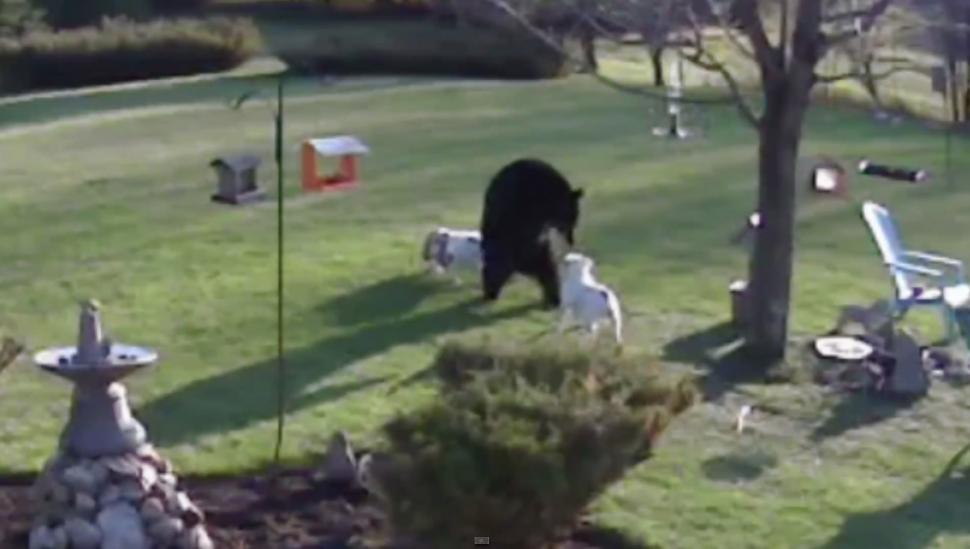
This black bear turned into nothing more than a big scaredy-cat when two bulldogs confronted it in a New Hampshire backyard.  The homeowner said the two fearless Bull Dogs sprinted towards the beast the moment it was spotted eating from a bird feeder.

“Our Bulldogs actually broke through the railings on our farmer’s porch to confront the beast,”

This slideshow requires JavaScript.


The two dogs circled around the bear, which was standing on its hind legs.

After a few seconds, the bear — which could have easily swatted the two dogs away — runs from the yard. One of the dogs even tries to pounce on the bear as it sprints away.

Follow our FISHING BLOG

WEB   RATES     FISH    HUNT    CABINS    PHOTOS
TESTIMONIALS    BROCHURE    HUNT BOOKLET

Enter your email address to subscribe to this blog and receive notifications of new posts by email.

← Back

Thank you for your response. ✨

Email Me....


Tags: , , , , , , ,