RSS

Category Archives: how to

Turn A Shipping Container Into An Epic Off-Grid Home

What if you could spend a fraction of what it would cost to buy or build your own house and instead build a unique home that you could make completely off grid? It can be done and there’s a bunch of people who’ve done it already.

5container

Shipping containers exist in a massive surplus and someone like you or I can grab one for around $2000. From there, you can get your creative juices flowing and build an awesome home, get away or cottage like structure on your existing property providing you have the space. If you’re able to put this baby on wheels, you won’t even need any form of permit to have it around.

Innovative ideas like this are getting popular as people seek alternate ways to like modern lifestyles. There is even a site called Zigloo who has released multiple plans and ideas for making structures out of shipping containers and more. You can check them out here.

Other Off-Grid Ideas
Other off grid ideas and projects that are becoming popular are things like tiny homes and earthships. Both ideas are gaining a lot of traction lately and can be built in very modern designs so it doesn’t feel like you are heading back to the stone ages.

Below are some awesome pictures of various shipping container projects that were done by others.

This slideshow requires JavaScript.

Follow our FISHING BLOG

WEB   RATES     FISH    HUNT    CABINS    PHOTOS
TESTIMONIALS    BROCHURE    HUNT BOOKLET

Enter your email address to subscribe to this blog and receive notifications of new posts by email.

Go back

Your message has been sent

Warning
Warning
Warning
Email Me....

Warning

Warning.


Tags: , , , , , , ,

How To Make Hits At 1,000 Yards

If you have a gun that shoots 1 MOA and a scope with enough elevation, making a first-round hit at 1,000 yards isn’t all that hard. But you need to have the variables—especially the wind—in your favor.

Gear
There are plenty of off-the-shelf rifles you can use. Bolt guns from Remington, Savage, and others can all easily meet the 1 MOA standard. You can pick just about any caliber, but a .308 shooting a match load with a 168- or 175-grain bullet is pretty much the benchmark. There’s no need to get fancy.

For the scope, you need a 30mm model with target turrets and a reticle with marks for elevation and windage.

tar1

Wind
The wind is way more of a factor than anything else. You need to be able to read what it is doing at your location, down by the target, and in between. A wind meter will tell you what’s going on at your location. And this is the most important reading, because the deflection in the first part of the bullet’s path will have the most effect downrange.

To read the wind downrange, look at the telltale signs. A breeze that is moving the grass is about 5 mph. Rustling leaves is about 8 mph. Swaying branches indicates a 10 to 15 mph wind.

A good spotting scope will help you read mirage. Focus on the target and then back it off so the scope is focused on the wind. The wavier the lines, the less wind there is. Tighter lines mean more wind. You just have to practice to develop a feel for mirage.

Technique
The most common mistake here is a bad position. You’ve got to get straight behind the rifle and set up a solid rest. Not only will a bad position throw your first shot off, but if you aren’t right behind the rifle, you won’t be able to see where your shot goes so you can make a correction. At this point, you’re just guessing. You will get good at making first-round hits by watching your misses.

Take extra time to set up a shot. Use a quality bipod and rear bag to support the stock. If you’re not stable, the hit probability is low. Taking a few extra seconds to get solid, whether hunting or at a match, is worth it for any long shot. There’s no advantage in rushing.

Follow our FISHING BLOG

WEB   RATES     FISH    HUNT    CABINS    PHOTOS
TESTIMONIALS    BROCHURE    HUNT BOOKLET

Enter your email address to subscribe to this blog and receive notifications of new posts by email.

Go back

Your message has been sent

Warning
Warning
Warning
Email Me....

Warning

Warning.


Tags: , , , , , , ,

How To Call Your Shots

Calling a shot simply means the marksman can tell where his bullet hit. This can be done by observing the bullet’s flight and impact or by knowing where the sights were the instant the firearm was triggered. There are two separate, but complementary, ways to call a shot.

shot

When shooting from non-prone positions, witnessing the impact of the bullet is difficult. The trick is to focus intently on the position of the sights and take a mental snapshot of where they were in relation to the target when the bullet was fired.

The best way to develop this skill is through dry-fire practice, coupled with live-fire practice shots at the range. When dry-firing, use a small target that is a challenge to keep the crosshairs on. Don’t fight the wobble of the sight, just smoothly break the shot as it covers the target. Remember where the crosshairs were when the trigger clicked. At the range, do this with every shot.

To actually see your bullet’s impact, you must pair this level of focus with excellent form. If you are square behind the rifle and not putting any pressure on the stock that will cause it to jump to the side under recoil, you’ll be able to watch the bullet and see where it hits.

Follow our FISHING BLOG

WEB   RATES     FISH    HUNT    CABINS    PHOTOS
TESTIMONIALS    BROCHURE    HUNT BOOKLET

Enter your email address to subscribe to this blog and receive notifications of new posts by email.

Go back

Your message has been sent

Warning
Warning
Warning
Email Me....

Warning

Warning.


Tags: , , , , , , , ,

How to Use Wood Sorrel for Food, and Hangovers

If you had a little too much green beer over the weekend, don’t worry — you weren’t alone. St. Patrick’s Day may have a rich historical point of origin in Ireland, but here in North America, it’s often just an excuse to chug cheap brews died into verdant colors. So here’s a little shamrock for the outdoor lover who might still overindulge.

4 clover

Wood Sorrel

The little green plant known as wood sorrel (Oxalis stricta) has often been mistaken as clover because of its three leaflets. On closer examination, you’ll find a big difference. Sorrel’s leaflets are heart shaped, while clover leaflets are round or oval. Wood sorrel grows in both sunny places and shady spots on the edges of woods throughout North America and it has many relatives growing coast to coast.

Wood sorrel usually tops out at under a foot tall, and it typically has small yellow flowers, though some species have more pinkish or purplish blooms. Looking much like a classic shamrock, the fresh leaves can be eaten raw as a tasty sour salad green.

4-Leaf Clover

4-Leaf Clover

You can also make a helpful hangover cure with wood sorrel. A handful of the leaves can be steeped in hot water for 10 minutes and then chilled to make a cold drink. This cold beverage looks and tastes like a green lemonade, and has the remarkable ability to calm nausea and soothe upset stomachs, which often go hand-in-hand with the headaches of hangovers.

While there’s no problem with the occasional consumption of this plant, use it in moderation over the long term. The sour tasting oxalic acid in wood sorrel can inhibit the body’s absorption of calcium and possibly contribute to kidney stones over time.

Look for related edible species such as the violet wood sorrel (Oxalis violacea), the pink wood sorrel (Oxalis montana), and other members of the Oxalis genus.

Have you eaten this wild edible? Or used it to treat nausea? Leave us your comments.

Happy St. Patrick’s Day!

Follow our FISHING BLOG

WEB   RATES     FISH    HUNT    CABINS    PHOTOS
TESTIMONIALS    BROCHURE    HUNT BOOKLET

Enter your email address to subscribe to this blog and receive notifications of new posts by email.

Go back

Your message has been sent

Warning
Warning
Warning
Email Me....

Warning

Warning.


Tags: , , , , , ,

The importance of knowing your bowstrings!

Archers are very specific about the bow they use, the sites they mount and the release they settle on, but often overlooked is the actual bow string.  They are as vital to your performance as that of the arrow or even the bow itself.  But the question is, how do you select your bowstrings? And how do you know which ones to opt for? Having to answer these questions might become a bit of a challenge, but with some of these helpful guidelines it just might get easier for you.


1.THE 4 GENERAL THINGS YOU NEED TO LOOK FOR

The best kinds of bowstrings have four qualities you need to know about.

  • They are lightweight
  • They are strong
  • They are highly resistant to abrasion
  • They are moisture-resistant

 2.YOU HAVE TO KNOW WHAT MATERIAL YOUR BOWSTRINGS ARE MADE OF

Modern bowstrings are made of different kinds of synthetic fibers, and knowing what they are can be to your advantage.

  • Dacron: a polyester material that is strong, high-stretch and can last for years. But it’s an outmoded fiber, so wooden bows, older bows and recurve bows, are its best suit. A bowstring made out of Dacron is safe to use on any bow, but results will surely vary.
  •  Kevlar and Vectran: these fibers are made out of polymer. They have a limited-stretch so its arrow speed is faster than Dacron. Kevlar bowstrings, however, can only last for about 1000 shots, and they are known to break without warning.  These materials are not fit for modern compound bows.
  •  HMPE (High- modulus-polyethylene): this fiber is a blend of Spectra and Dyneema. It’s lightweight, faster than any of the materials aforementioned, strong, and long lasting. It is the perfect fit for high-performance recurve bows and modern compound bows.

 3.WHAT KIND OF WAX YOU SHOULD USE

Whether your bowstring is of superior quality or not, it will fray at one point or another. But if you wax it frequently, you can delay the time in which your bowstring wears out and is completely out of use. I can’t emphasis more on just how important it is to wax your bowstring.

But what kind of wax should you use? I have a couple of pointers here, but if you have more, then please do feel free to share it with us.


Beeswax: If you are using a traditional bowstring, which is made out of plant fibers and animal material, then you should opt for beeswax.


Silicone based wax:  Most modern bowstrings come pre-waxed, but no lubricant has ever lasted forever, right? So the second the string starts to feel dry, you have to give it a light coating.  Silicone based waxes are ideal for modern bowstrings; it penetrates the material and lubricates the interior as well as the surface of the string.

Some of the most commonly used and perhaps the best kinds of synthetic waxes are Dalton High-Speed Bow Wax Conditioner and Bohning Silicone Wax.

Remember, this may seem like a trivial detail but it could be the difference between success and an fruitless hunt!

Thank you Martin Douglas of Legendary Archery for the great information!


Leave a comment

Posted by on November 13, 2014 in archery, bow, how to, Wawang Lake Resort


Tags: , , , , ,

Where to Place Your Trail Cams

A trail camera won’t stumble through a bedding area, leave scent all over a trail, or exaggerate the size of a rack. And it’ll never oversleep. But your perfect little scouting buddy must be chosen wisely and placed carefully if you want to pattern that old, crafty animal you know is around. Here’s how…

CameraNO_MosaicYELLOW

The earlier version trail cameras were just a 35mm film point-and-shoot tucked in a weatherproof housing. It snapped a single picture when something triggered the sensor. After retrieving the camera, you ran to the one-hour shop to get the film developed, then thumbed through a week’s worth of pictures. More than once a stack of 36 prints revealed a handful of out-of-focus animals and a couple dozen shots of a wind-whipped brush or a drooping tree branch. That was only a few years ago.

Today, many website boasts several pages of trail cams, and even the cheapest one outperforms the original older ones. They have lenses sharp enough to count the ticks on a deer’s neck, electronic circuit boards so efficient that four AA batteries will run a unit for months, and memory cards that hold thousands of pictures you can download to your computer or delete at the touch of a button. And those are standard features on mid-priced cameras. The high-end ones will send a photo to your cellphone or laptop.

Like everything in the digital age, trail-cam technology has improved, competition has become fierce, and prices have plunged. Still, $200 is plenty of money, and matching a camera with the right features to meet your needs is critical. And even the best camera can’t take spectacular photos of a trophy buck if you don’t set it properly. But it’s not difficult to get started. These are the basics.
TrailCameras3
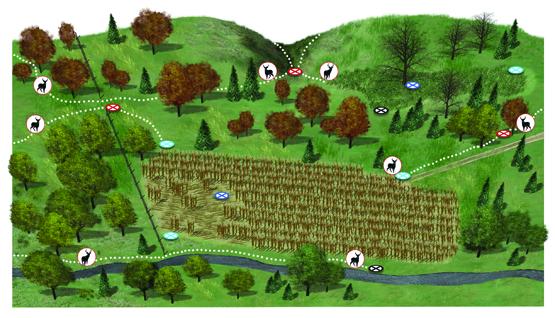
Wildlife biologists use trail cams to measure herd densities, buck-to-doe ratios, and the like. Your goals should be simpler: learning about the deer on your property, figuring out where to hunt them, and having fun in the process. You can pinpoint ideal spots before you buy a camera, and the locations you choose can determine what model is best for you. Here are four sites for four different periods.

Time: Late Summer
Site: Mineral lick
Goal: To start an inventory of buck numbers and quality on your property.
Setup: Find a spot with moderate to heavy deer traffic and spade up dirt in a 2-foot circle. Pour in half of an ice-cream pail of stock salt or commercial deer mineral and spade it into the loosened soil. Pour the rest on top.
Tips:
• Establish one or two licks per 80 acres. Allow deer up to a week to find them.
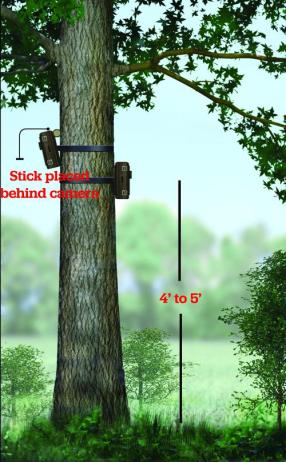
• Situate each lick 10 to 30 feet from a tree for mounting a camera.
• Jam a stick behind the camera’s top edge to point it down toward the lick.
500Time: Early Season
Site: Mock scrape
Goal: To find bucks after velvet shed, when they often relocate. Mocks can draw up to 90 percent of the bucks you’ll hunt.
Setup: Rake grass and forest debris 5 feet away from a tree that has a green, overhanging licking branch 5 to 7 feet above the ground. Activate with your own “product” (drink plenty of liquids) or deer urine.
Tips:
• If you are not getting clear shots of a buck, aim the camera at the licking branch. Most bucks will work it with their antlers.
• Establish multiple scrapes in each area and hang cameras only on the most active ones.

Time: Rut
Site: Funnel
Goal: To determine where resident bucks are traveling and whether traveling bucks are in the area.
Setup: Find terrain features that channel buck movement and hang a camera near fresh tracks and rubbing activity. Check camera every three to five days—the rut moves quickly.
Tips:
• Mount camera at a 45-degree angle to the trail. Bucks often move through funnels quickly; a camera set perpendicular to the trail might miss the shot.
• Scuff dirt in front of the camera with a boot. Such a mini mock will often make a moving buck pause and get “shot.”

Time: Late Season
Site: Food source
Goal: To find out where to fill a last-minute tag, and to know which bucks have survived the bulk of the hunting season.
Setup: Scout widely to find the hot food sources in your area, such as waste grainfields and clear-cuts. Place camera within 30 feet of the most heavily trafficked area. Load it with fresh batteries if you hunt in an extremely cold area.
Tips:
• Set up and check cameras at midday to avoid spooking feeding deer.
• If no trees are located near the food source, mount the camera on a tripod and camouflage it with grass or brush.

Make the Next Shot Count!

Follow our FISHING BLOG

WEB   RATES     FISH    HUNT    CABINS    PHOTOS T
ESTIMONIALS
    BROCHURE    HUNT BOOKLET

Enter your email address to subscribe to this blog and receive notifications of new posts by email.

Go back

Your message has been sent

Warning
Warning
Warning
Email Me....

Warning

Warning.


Tags: , , , , , ,

Micro House/Cottage Plans

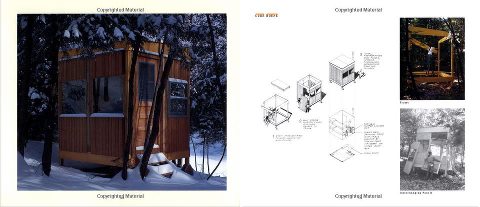
So those that know me personally, know that I love the idea of micro houses!  Everything you need in a couple hundred square feet or less!  These homes can also be used as fantastic hunting cabins or even camping cabins.  Here is a fantastic list of plans found through Relaxshacks.com

Trust me you will be addicted to these as an idea once you see what can be done!!

SIX FREE PLAN SETS for Tiny Houses/Cabins/Shedworking Offices…

1. Lester Walker’s “Living Cube”– This cabin, one of my favorite’s since I was a kid, is also pretty fully hashed out in Walker’s book “Tiny, Tiny Houses”- a book you’ve probably seen and heard me post/talk about many times- it was THE BOOK that got me addicted to tiny housing, when I received it for my tenth birthday. I linked it, and a few other very noteworthy tiny books here….

2. POPULAR SCIENCE DOME HOME– I just LOVE the old art, and layout of the Popular Science, Family Handyman, and Family Circle plan sets of old. This one is a great example, and while I’m not overly enamored with dome homes myself, there’s no denying that this is a cool little idea for a home, and that domes still do have their followers and fans. This one buds for you!

http://www.popsci.com/archive-viewer?id=1T4ORu6EICkC&pg=111&query=heap+o+planning+

3. Michael Janzen’s Free Pre-fabbin’ Cabin (We also have a link to some other REALLY cool cabin plan sets from Michael down in the lower RIGHT HAND column of this blog). Here’s a really cool free set though…easy to build, and good lookin’.
CLICK HERE: http://www.tinyhousedesign.com/wp-content/uploads/2009/09/Tiny-Prefab-v1.pdf

4. Jamaica Cottage Shop’s Free Shed Plans– EASILY convertible into a tiny vacation cabin/cottage or even a cool shed office or fort! I LOVE some of the designs from Vermont’s “Jamaica Cottage Shop”- one of my favorite’s being “The Writer’s Haven”- so be sure to check out the rest of their offerings! You have to join their mailing list to get the plans, but the stuff that occasionally comes across in their email offerings is all really cool tiny house and shed related material. At least check out some of their models atwww.JamaicaCottageShop.com

Above: The Writer’s Retreat- its not the one you get free plans for, but I believe the sell plans for this VERY VERY affordable. Its one of my all-time favorite tiny cabins.

CLICK HERE for MORE PHOTOS OF THIS CABIN…http://relaxshacks.blogspot.com/2012/01/writers-haven-tiny-guest-housecabin.html

5. Michael Janzen’s TINY FREE PALLET HOUSE– pretty self explanatory….Pallets are EVERYWHERE, so why not put them to use?
http://www.tinypallethouse.com/2008/08/build-the-shipping-pallet-floor/

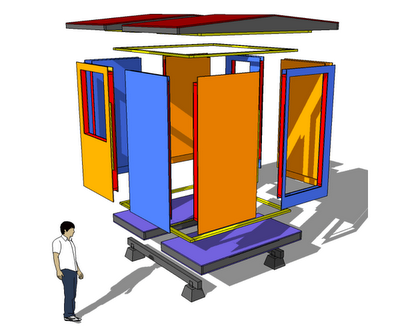
6. EDGAR BLAZONA’S MD-100 Modular Shelter– We’ve posted it here before, but here is a link to the very thorough plans from Mr. Blazona- a really modern, simple, and fun cabin, that can be built for approximately $2000 or so by today’s prices. This plan set originally debuted through Readymade Magazine.

Again, if you know of more FREE plans for cabins, sheds, of tiny houses, post them in the comments section below and I’ll eventually archive them in a running list for all to see/enjoy.

-Derek “Deek” Diedricksen

Go back

Your message has been sent

Warning
Warning
Warning
Email Information regarding

Warning

Warning.

 
1 Comment

Posted by on January 5, 2014 in how to, Wawang Lake Resort


Tags: , , , , ,