RSS

Tag Archives: Wawang Lake

Baking Soda to Cover Your Scent

Baking soda, the same stuff that deodorizes the fridge and is the key to scent-control system before a hunt.

CN7BBG empty box on white background

Take a soda shower.
The stuff can rub your skin raw if you use it straight, so mix a few tablespoons with some liquid no-scent soap.  Sometimes showering with straight unscented soap, can still leave an odor.

Make a soda-and-clothes lasagna style.
Use baking soda like any other powdered detergent to wash your clothes. Dry them, lay a few items in a plastic tote, sprinkle a layer of soda on that, put in another layer of clothing, sprinkle more soda, and so on until the tote is full. Then place an open box of baking soda in with the clothes and seal the tote up.

Sprinkle your boots.
Obviously, your feet are one of the smelliest body parts because they’re constantly sweating inside your boots,   If boots are wet with perspiration after a hunt, put them on a boot dryer and then sprinkle in some baking soda.  You’ll have very few animals cut your track after applying this tip.

WEBSITE    RATES     FISH    HUNT    CABINS    PHOTOS
TESTIMONIALS    BROCHURE    HUNT BOOKLET

Enter your email address to subscribe to this blog and receive notifications of new posts by email.

← Back

Thank you for your response. ✨

Email Me....

 
2 Comments

Posted by on November 26, 2015 in hunting, hunting equipment, Wawang Lake Resort


Tags: , , , , , , , , ,

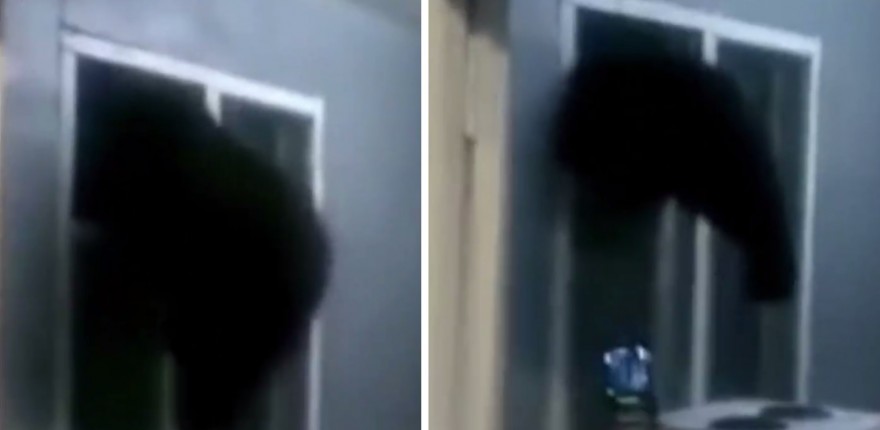
Bear Cub Gets Stuck in Window after Raiding Kitchen

If there was ever a case of instant karma, it’s this. Bears are inquisitive creatures and are scavengers by nature, so it is not unexpected for the animals to occasionally break into homes in the search for food. This is especially true in Russia’s Far East, which holds a healthy population of brown bears. This bear still has not mastered the technique of escaping its victims’ homes gracefully.

bear

According to Ruptly, the bear broke into a house in Kamchatka this week and ransacked the home for foodstuffs. When homeowners returned, the startled cub tried to flee through an open window but quickly found that it was just a little bit too chubby to pass through. That might not have been the case if the bear didn’t devour almost everything in the kitchen.

Understandably, the homeowners were not too keen on helping it out.

Follow our FISHING BLOG

WEB   RATES     FISH    HUNT    CABINS    PHOTOS
TESTIMONIALS    BROCHURE    HUNT BOOKLET

Enter your email address to subscribe to this blog and receive notifications of new posts by email.

← Back

Thank you for your response. ✨

Email Me....


Tags: , , , ,

Prehistoric Deer That Make Modern Deer Look Tiny

If ancient hunters from the ice age were still alive today, they would probably be wondering what shrunk all the deer.

Deer come in all kinds of shapes and sizes, and for the most part, prehistoric deer look much like their modern equivalents (moose, whitetail, elk, caribou, musk deer, etc.). One thing that is different however, is the sheer size. In times past, massive deer with antlers that span the width of barns doors roamed across the land, coexisting with saber-toothed tigers and wholly mammoths.

The earliest deer actually came from diminutive animals (Archaeomeryx and Dicrocerus) and barely rose more than a few feet off the ground. Throw in a few million years of evolution though, and you get something much bigger. Here are five of the largest prehistoric species in the deer family.

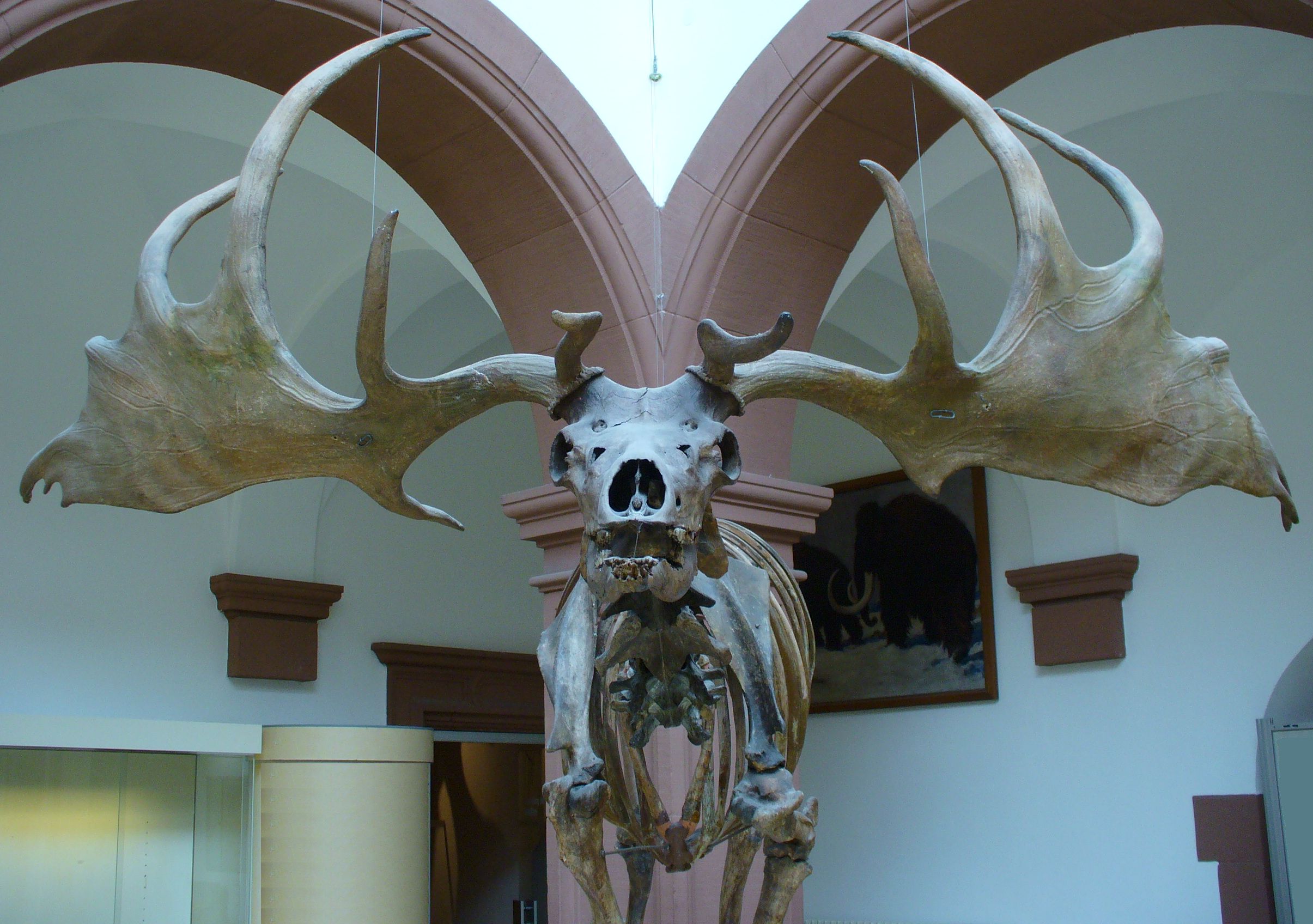
1. Irish elk (Megaloceros giganteus)

Image from I, Atirador on the Wikimedia Commons.

Image from I, Atirador on the Wikimedia Commons.

The Irish elk, commonly referred to as giant deer, is one of the largest deer species that ever lived. With well-preserved specimens being found in the peat bogs of Ireland, scientists estimated that these massive creatures stood about 7 feet tall at the shoulders on average, weighed well over 1,600 pounds, and carried the largest antlers of any known deer species. Just a full rack by itself could weigh up to 90 pounds. With all these characteristics, the Irish elk can be seen as a mega-sized version of the modern moose.

Irish elk first surfaced towards the end of the Pleistocene Epoch roughly 100,000 years ago. Specimens found in Siberia show that the species was still present as recent as 7,000 years ago, meaning it was likely a prime game animal for early human hunters. The species was found widely across Europe, Asia, and Africa and it is believed that hunting by humans may have have played a part in their decline. Believe it or not, scientists actually say their large and unwieldy antlers were most to blame for the elk’s eventual extinction.  A decrease in high-quality forage was unable to sustain massive deer with equally massive antlers, and some speculate that the deer failed to grow smaller to adjust.

You can get a sense of how big Irish elk were compared to humans in the video below:

Species of the Megaloceros genus are all honorable mentions on this list due to their size, and uniqueness of their antlers. Below is an artist’s depiction of them.

Image from Apokryltaros on the Wikimedia Commons.

Image from Apokryltaros on the Wikimedia Commons. From left to right are M. savini, M. cazioti, M. obscurus, M. pachyosteus, M. giganteus, and M. verticornis.

2. Stag-moose (Cervalces scotti)

Image from dantheman9758 on the Wikimedia Commons.

Image from dantheman9758 on the Wikimedia Commons.

Imagine a large modern moose with the head of a deer and you would have some picture of what the stag-moose looked like. This creature from the Pleistocene epoch lived alongside other megafauna such as giant beavers, woodland musk ox, and the dreaded dire wolf. Stag-moose can grow up to 1,500 pounds and reached 8 foot at the shoulder. Unfortunately, its large size did not help it any when the ice age ended, and competition between large-bodied animals lead to a mass extinction event in North America. Eventually, the stag-moose was replaced by the now iconic plains bison.

Experts say that the animal’s downfall may be due to its inability to adapt to warming temperatures. The stag-moose was hyper-adapted to ice and snow, with razor sharp hooves designed to break ice and a thick coat to survive frigid temperatures. Due to its large size, the stag-moose was more than capable of fighting of predators such as ancient brown bears, wolves, and the American cave lion. It is believed that the stag-moose was also a popular target for early human hunters.

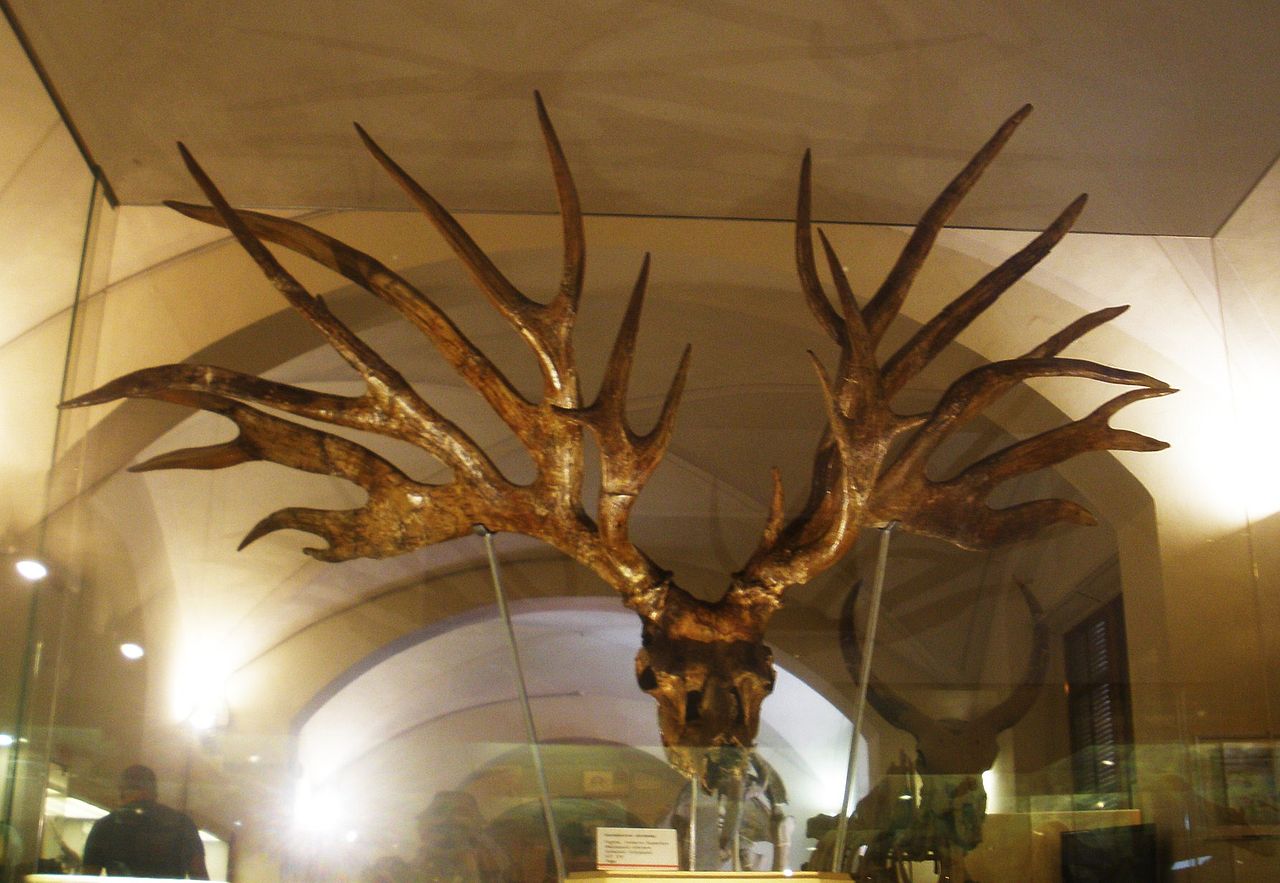
3. Bush-antlered deer (Eucladoceros dicaranios pictured)

Image from Ghedoghedo on the Wikimedia Commons.

Image from Ghedoghedo on the Wikimedia Commons.

These large deer may not be the heaviest on this list, but they certainly have some of the most interesting antlers. The Eucladoceros genus was nicknamed the “bush-antlered deer” because of the unique shape of their racks. Their comb-like antlers can split into twelve tines per pedicle and were up to six feet wide. It is believed that due to the shape of the antlers, they were used mostly for presentation than any actual fighting.

Species within the genus could be found across Europe and Asia and date back to the Early Pleistocene.

4. Broad-fronted moose (Cervalces latifrons)

Image from Ghedoghedo on the Wikimedia Commons.

Image from Ghedoghedo on the Wikimedia Commons.

This is it, the be-all, end-all of large deer. The broad-fronted moose is the largest deer to have ever existed—probably—and was so large, it weighed twice that of the Irish elk. If you’ve been keeping track, that puts this massive animal at well over 3,000 pounds! It was also surprisingly fast for its size since its long limbs allow for a gait known as “silt-locomotion,” which allows it to run quickly through snow or bogs.

The animal lived in the colder parts of Europe and Asia during the end of the Pleistocene epoch and eventually crossed over into North America where it evolved into the stag-moose. Experts are still uncertain whether ones that stayed in Europe eventually developed into modern moose, or died out entirely after the end of the ice age.

5. Broad-antlered deer (Libracles gallicus pictured)

Image from Stanton F. Fink on the Wikimedia Commons.

Image from Stanton F. Fink on the Wikimedia Commons.

One of the earliest deer on this list, the Libracles genus lived during the Pliocene period starting 2.5 million years ago. These deer was not especially large, but had the largest antlers proportional to their body size, rivaling that of the great Irish elk. Despite being only slightly large that modern deer, the species of the Libracles genus sport antlers over two meters wide. Not surprisingly, some scientists suspect that this genus is the early ancestor of the Meglaoceros.
By:  Daniel Xu

Follow our FISHING BLOG

WEB   RATES     FISH    HUNT    CABINS    PHOTOS
TESTIMONIALS    BROCHURE    HUNT BOOKLET

Enter your email address to subscribe to this blog and receive notifications of new posts by email.

← Back

Thank you for your response. ✨

Email Me....


Tags: , , , , , ,

The importance of knowing your bowstrings!

Archers are very specific about the bow they use, the sites they mount and the release they settle on, but often overlooked is the actual bow string.  They are as vital to your performance as that of the arrow or even the bow itself.  But the question is, how do you select your bowstrings? And how do you know which ones to opt for? Having to answer these questions might become a bit of a challenge, but with some of these helpful guidelines it just might get easier for you.

1.THE 4 GENERAL THINGS YOU NEED TO LOOK FOR

The best kinds of bowstrings have four qualities you need to know about.

  • They are lightweight
  • They are strong
  • They are highly resistant to abrasion
  • They are moisture-resistant

 2.YOU HAVE TO KNOW WHAT MATERIAL YOUR BOWSTRINGS ARE MADE OF

Modern bowstrings are made of different kinds of synthetic fibers, and knowing what they are can be to your advantage.

  • Dacron: a polyester material that is strong, high-stretch and can last for years. But it’s an outmoded fiber, so wooden bows, older bows and recurve bows, are its best suit. A bowstring made out of Dacron is safe to use on any bow, but results will surely vary.
  •  Kevlar and Vectran: these fibers are made out of polymer. They have a limited-stretch so its arrow speed is faster than Dacron. Kevlar bowstrings, however, can only last for about 1000 shots, and they are known to break without warning.  These materials are not fit for modern compound bows.
  •  HMPE (High- modulus-polyethylene): this fiber is a blend of Spectra and Dyneema. It’s lightweight, faster than any of the materials aforementioned, strong, and long lasting. It is the perfect fit for high-performance recurve bows and modern compound bows.

 3.WHAT KIND OF WAX YOU SHOULD USE

Whether your bowstring is of superior quality or not, it will fray at one point or another. But if you wax it frequently, you can delay the time in which your bowstring wears out and is completely out of use. I can’t emphasis more on just how important it is to wax your bowstring. But what kind of wax should you use? I have a couple of pointers here, but if you have more, then please do feel free to share it with us.

Beeswax: If you are using a traditional bowstring, which is made out of plant fibers and animal material, then you should opt for beeswax.

Silicone based wax:  Most modern bowstrings come pre-waxed, but no lubricant has ever lasted forever, right? So the second the string starts to feel dry, you have to give it a light coating.  Silicone based waxes are ideal for modern bowstrings; it penetrates the material and lubricates the interior as well as the surface of the string. Some of the most commonly used and perhaps the best kinds of synthetic waxes are Dalton High-Speed Bow Wax Conditioner and Bohning Silicone Wax.

Remember, this may seem like a trivial detail but it could be the difference between success and a fruitless hunt! Thank you Martin Douglas of Legendary Archery for the great information!

Follow our FISHING BLOG

WEB   RATES     FISH    HUNT    CABINS    PHOTOS
TESTIMONIALS    BROCHURE    HUNT BOOKLET

Enter your email address to subscribe to this blog and receive notifications of new posts by email.

← Back

Thank you for your response. ✨

Email Me....

 
1 Comment

Posted by on November 16, 2015 in archery, bow, how to, Wawang Lake Resort


Tags: , , , , ,

Baking Soda to Cover Your Scent

Baking soda, the same stuff that deodorizes the fridge and is the key to scent-control system before a hunt.

CN7BBG empty box on white background

Take a soda shower.
The stuff can rub your skin raw if you use it straight, so mix a few tablespoons with some liquid no-scent soap.  Sometimes showering with straight unscented soap, can still leave an odor.

Make a soda-and-clothes lasagna style.
Use baking soda like any other powdered detergent to wash your clothes. Dry them, lay a few items in a plastic tote, sprinkle a layer of soda on that, put in another layer of clothing, sprinkle more soda, and so on until the tote is full. Then place an open box of baking soda in with the clothes and seal the tote up.

Sprinkle your boots.
Obviously, your feet are one of the smelliest body parts because they’re constantly sweating inside your boots,   If boots are wet with perspiration after a hunt, put them on a boot dryer and then sprinkle in some baking soda.  You’ll have very few animals cut your track after applying this tip.

WEBSITE    RATES     FISH    HUNT    CABINS    PHOTOS
TESTIMONIALS    BROCHURE    HUNT BOOKLET

Enter your email address to subscribe to this blog and receive notifications of new posts by email.

← Back

Thank you for your response. ✨

Email Me....


Tags: , , , , , , , , ,

Moose Hunting at Wawang Lake

Deeply imbedded in the Canadian Boreal Forest we offer the very finest in Moose habitat for our hunters.  Look no farther than Wawang Lake for accommodations for your next BIG game hunt!

BOOK Your Accommodations HERE!

WawangMoose

Our hunts accommodations ONLY for Ontario Resident Moose Hunters.

If your looking for a great hunting area that has a high population of moose then look no farther than Wawang Lake Resort as we’re in the middle of the best moose hunting area in all of NW Ontario.

At Wawang Lake we offer comfortable accommodations to Resident Ontario Moose Hunters only.  Presently we don’t have any tags available and unable to take any non-resident hunters during the Moose Hunt season.

Things Moose Hunters Should Consider:

Crossbows
• Draw length must be al least (11.8 in.)
• Draw weight must be at least (119 lbs.)
• Bolt head must be at least (0.9 in.) at the widest point, and there must be at least two cutting edges of straight, sharp, un-serrated, barbless steel.

Longbows
• Draw weight must be at least (48.5 lbs.) at draw length of (27.6 in.) or less.
• Arrow length must be at least (23.6 in.).
• Broad head must be at least (0.9 in.) at the widest point, and there must be at
least two cutting edges of straight, sharp, un-serrated, barbless steel.

Rifle
We suggest using at the minimum one of the following:
300 Magnum
30-06
7MM Magnum with bullet weights in the 180 grain range
A rim-fire rifle, a shotgun smaller than 20 gauge when loaded with shot, or any shotgun loaded with shot smaller than SG or No. 1 buck cannot be used for hunting Moose.


Clothing requirements
During the rifle season hunts, a minimum of 400 square inches of uninterrupted Hunter Orange must be worn at all times.  Camouflage or open mesh orange does not meet these requirements.  An orange jacket or vest as well as an orange hat do meet these requirements.

Hunters should also have a compass or hand held G.P.S., as well as a good pair of binoculars, thermos, flashlight, lighter, warm clothing, good quality rain gear, waterproof insulated boots, gloves/mitts, long underwear.   Two-way portable radios are also recommended.  Fall hunting weather can be warm & dry to cold, wet and snowy within a few hours; so it is best to be prepared for all variables.

BOOK Your Accommodations HERE!

We trust that this information will prove to be useful in planning your next Big Game Hunt in beautiful, exciting NW Ontario.  We invite you to enjoy our ‘True Wilderness Hospitality’ while participating in a remote hunting experience.

 WEBSITE    RATES     FISH    HUNT    CABINS    PHOTOS
TESTIMONIALS    BROCHURE    HUNT BOOKLET

Enter your email address to subscribe to this blog and receive notifications of new posts by email.

← Back

Thank you for your response. ✨

Email Me....

 
1 Comment

Posted by on November 14, 2015 in moose, moose hunting, Wawang Lake Resort


Tags: , , , , , , , , , , ,

The Fascinating Cycles of Bear Hibernation

It’s that time, the bears are getting ready to den up for the winter.  While known, bear hibernation is not fully understood by many.  Hibernation preparation begins immediately when they awake in the spring.  There are five distinctive steps to this

During hibernation, the bear go through five different stages.

First Stage

The spring until midsummer or fall is the time when the bear are in their normal activity. If food and water are available, the bear will consume about 5,000 to 8,000 calories each day. If they are unable to consumer enough food and water during this time, they will be unable to successfully hibernate in the winter.imagesCA0ZA802

Second Stage

This stage is known as hyperphagia. During this stage, bear eat and drink excessively as they build up fat stores for hibernation. When food and water are plentiful, black bear have been know to eat as many as 15,000 to 20,000 calories a day. The need large amounts of water to process the food and flush nitrogenous waste from their bodies.

Third Stage

After they go through hyperphagia, it is time for their fall transition. During this time, their metabolic processes change as they prepare to hibernate. Their heart rate slows from the normal 80-100 beats per minute to about 50-60 beats per minute. During sleep, their rate is about 22 beats per minute. The normal beats of a sleeping bear are between 66-80 per minute. The bear continue to drink, but will start to eat less. As they prepare to hibernate, they can rest as much as 22 hours a day.


Fourth Stage

Hibernation begins. The bears’ breathing slows to about half of their normal rate. They take a breath only once every 45 seconds. Their heart rates slows even more. It can drop periodically to between eight and 21 beats per minute. They burn about 4,000 calories per day. They do not eat, drink, urinate or defecate during hibernation.


Fifth Stage

This stage is known as walking hibernation. During the first two to three weeks after the bear leave their hibernation den, their metabolic processes return to normal levels. During this time, they will continue to eat and drink less than they do in the summer months. Their bodily waste processes are also reduced. Once this time is past, the bears resume their normal summer activity.

Bear that are in hibernation can be hard to wake if they are disturbed. The bear that are in warmer climates may not be in as deep hibernation as bear in colder areas. Female bear often give birth in the den during the winter months. The mother bear tend to be in a lighter state of hibernation as they awaken to care for their young.

Should you stumble upon a hibernating bear, the best thing to do is to quietly leave the area.


Follow our FISHING BLOG

WEB   RATES     FISH    HUNT    CABINS    PHOTOS
TESTIMONIALS    BROCHURE    HUNT BOOKLET

Enter your email address to subscribe to this blog and receive notifications of new posts by email.

← Back

Thank you for your response. ✨

Email Me....

 
Leave a comment

Posted by on November 13, 2015 in black bear, Wawang Lake Resort


Tags: , , , , , ,

Want More Grouse? Watch the Thermometer Drop!

P1040063
Cold, blustery days in early winter are not the best days to go grouse hunting. Neither are, humid, September days. Essentially, the best time to go grouse hunting is when you can. And if that means dealing with the weather de jour- so be it. That doesn’t mean you can’t find some grouse, and even pocket a few, regardless of the weather.

Grouse like to stay cool in early fall when Indian summer days send the thermometer to summer-like temperatures. During those glorious fall days grouse will sleep in on their cozy roost and then venture out into a sunlit patch to soak up the warming October rays. November and December is a transitional period when cover becomes as much a priority as food. Staying warm and out of the wrath of heat-sapping winds and cold makes the places that grouse frequent during the late fall and early winter months predictable. Most times the mercury can give you a heads-up on which way to go.

Ruffed grouse seasons open in September in Ontario. Going hunting then is more a testament to tradition than it is to wanting to kill grouse. Foliage is thick, dense and green. But, if you insist on subjecting yourself to this kind of brutality you might as well give yourself the best chance at finding birds.

Look at the thermometer and you’ll realize that one of the best places to look for early season grouse is near rivers and streams. Waterways provide cool summer oases for grouse and you usually won’t find them far from the same habitat come early fall. During especially dry years, the moist soils found along rivers and streams may be one of the few places that you’re going to find the types of vegetation that produce the fruits and berries that grouse love so much.

Another reason early season grouse can be found along waterways is that the thick vegetation protects grouse broods from predators. Moist soils produce lush habitat that is ideal for protecting young grouse broods and the temperate environment produces a lot of high-protein invertebrates that are critical to young grouse growth and survival. Working along river bottoms and creek beds can be a good tactic because grouse broods can often be found in or close to their brood habitat.

Grouse are often still in broods or tight-knit family groups in September and October and can be concentrated and difficult to find. Perseverance can pay off. You might hunt several prime coverts without success and then bust several coveys in a short period of time. The trick is to keep at it. When you do run into some birds, you’ll usually find a bunch and chasing down singles after the flock is broken up can produce some quick shooting.

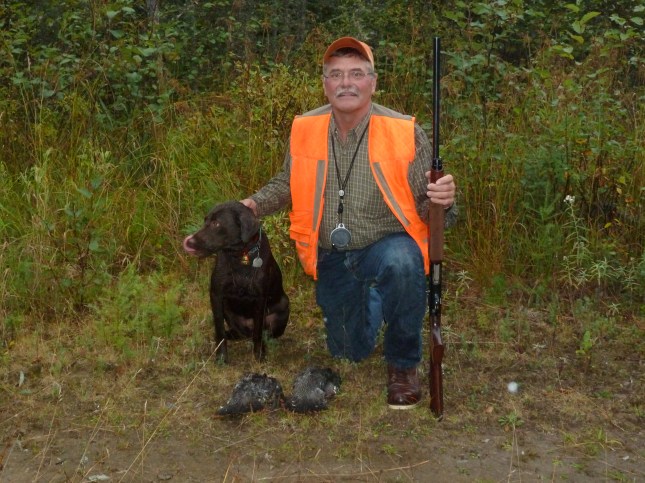
And quick shooting is what you can expect this time of year. Shooting grouse is never easy, but the task is made increasingly difficult when foliage is thick and catching even a glimpse of a bird is tricky. In the early season, you need to post, plan and resist the temptation to go in after them. It’s fruitless. If you have a dog, let them do the dirty work. Instead, look for openings, deer trails, clearings and post where you can get a shot if a bird flushes in your direction. Put a bell on your dog so your can keep track of his location at all times. Let one hunter bust the brush while the other walks a logging road where a flushing bird just might offer a shot. Don’t wait for an open shot. You’ll never get one! Instead, instinctively point and shoot even if you only catch a fleeting glimpse of the bird. Many times I never even knew I’d hit the bird until the dog came back with the grouse in its mouth. Be sure to keep in constant contact with your hunting party and know their location for safety sake and wear plenty of hunter’s orange.

Think wide open chokes and small shot during the early season. Grouse are not difficult birds to bring down, so put a lot of shot in the air and maybe just a pellet or two will get through the trees and hit its mark.

Weather and temperatures can be quite diverse in October. You might be rewarded with one of those cool, sunny, perfect fall days that grouse hunters live for. But don’t be surprised if you’re forced to pull out the woolies and gloves either. And you might even wake up to some fresh tracking snow. That’s just how October is- transitional- and it’s a transitional period for grouse too.

This slideshow requires JavaScript.

Grouse have a smorgasbord of items to choose from in October and finding their preferred food source is often critical to finding numbers of grouse. Ripening fall fruits can draw grouse from far and wide. Grouse favor edge cover, and it’s no coincidence that some of their favorite culinary delights do best on edges where sunlight can penetrate the forest canopy. Depending on which state you live in, grouse can usually be found keying in on edge cover fruits like wild grapes, chokecherry, and a host of other fruity edibles. These open areas also produce some of old ruff’s favorite greens like wild strawberry and clover and are also places where they can find high-protein items like grasshoppers, crickets, and other insects.

When grouse numbers are high, they can be found in variety of cover types at this time of year. Even marginal grouse habitat will hold a few birds as grouse begin dispersing into new territories during the fall shuffle.

Cover becomes an increasingly important priority as the month wears on. October begins with it plenty of foliage and grouse can move about uninhibited. By the end of the month, the trees are bare, the wind has a foreshadowing bite to it and grouse must rely on their camouflage and staying hidden as much as possible. Still, you’ll find grouse wandering about in search of brunch or a late afternoon snack and those are two of the best times to hunt grouse at this time of year.

Obviously a peak time in October is the first week or two after the leaves have fallen. When this happens might vary by a few weeks from region to region, but it is prime time to be in the woods. Grouse seem to forget for a little while that they are not as invisible as they were just a few days earlier and their numbers are at a seasonal peak. You can actually see some of the grouse that you flush too. 

At this time of year you can find grouse in some pretty unusual places far from what you’d consider ideal grouse cover. I’ve found grouse under a solitary crab apple tree in the middle of a field far from what you’d consider grouse cover. I’ve shot grouse out of fields of goldenrod that you’d think were more likely to hold pheasants. No patch of cover is too small or too thin to hold a grouse then.

Once snow blankets the ground the whole ballgame changes. Grouse that have survived the onslaught of hunters, wolves, owls and know that when their environment becomes covered in white they are vulnerable. Snow also covers up many of the grouse’s food sources and feeding becomes a little more risky and perilous. Grouse don’t go on those aimless strolls in search of food. Their search is more deliberate and of shorter duration when the thermometer starts to dip and the weather turns cold. Cover becomes more of a priority.

It’s important to ferret out productive versus non-productive cover as quickly as possible. I don’t know about you, but I’m not as young as I use to be. Those all-day jaunts of pounding the woods are over. I’m usually only good for about a half a day of hard hunting and I want to make the most of it. To do so requires that you develop a since for identifying the absolute best cover and hunt it hard. Learn to not waste time where you THINK there might be birds.

Remember those light loads and wide-open chokes you used in September? Put them away if you’re serious about killing grouse once the snow flies. Shots will be longer and birds will be tougher. Replace your 8’s and 9’s with high-brass 71/2’s or even 6’s. Take the skeet tubes out and go to improved or even a modified tube in one barrel. With your shooting eye in late season form you’ll still get the easy shots and with the heavier shot and tighter chokes you’ll be able to add a few birds you wouldn’t normally pocket.

Grouse are tough customers. That’s why most of us hunt them. But watching the thermometer you can get a better idea of where to begin your search and make your days in the woods a little more productive.

Join us for our 2015 Grouse HUNT!

Check out our 24 pg. HUNT BOOKLET

Check out our 24 pg. HUNT BOOKLET

Follow our FISHING BLOG

WEB   RATES     FISH    HUNT    CABINS    PHOTOS
TESTIMONIALS    BROCHURE    HUNT BOOKLET

Enter your email address to subscribe to this blog and receive notifications of new posts by email.

← Back

Thank you for your response. ✨

Email Me....

Rates,eBrochure,THE OUTBACK Adventure Info,Hunting Rates’/][/contact-form]

 
1 Comment

Posted by on November 12, 2015 in grouse, hunting, Wawang Lake Resort


Tags: , , , , ,

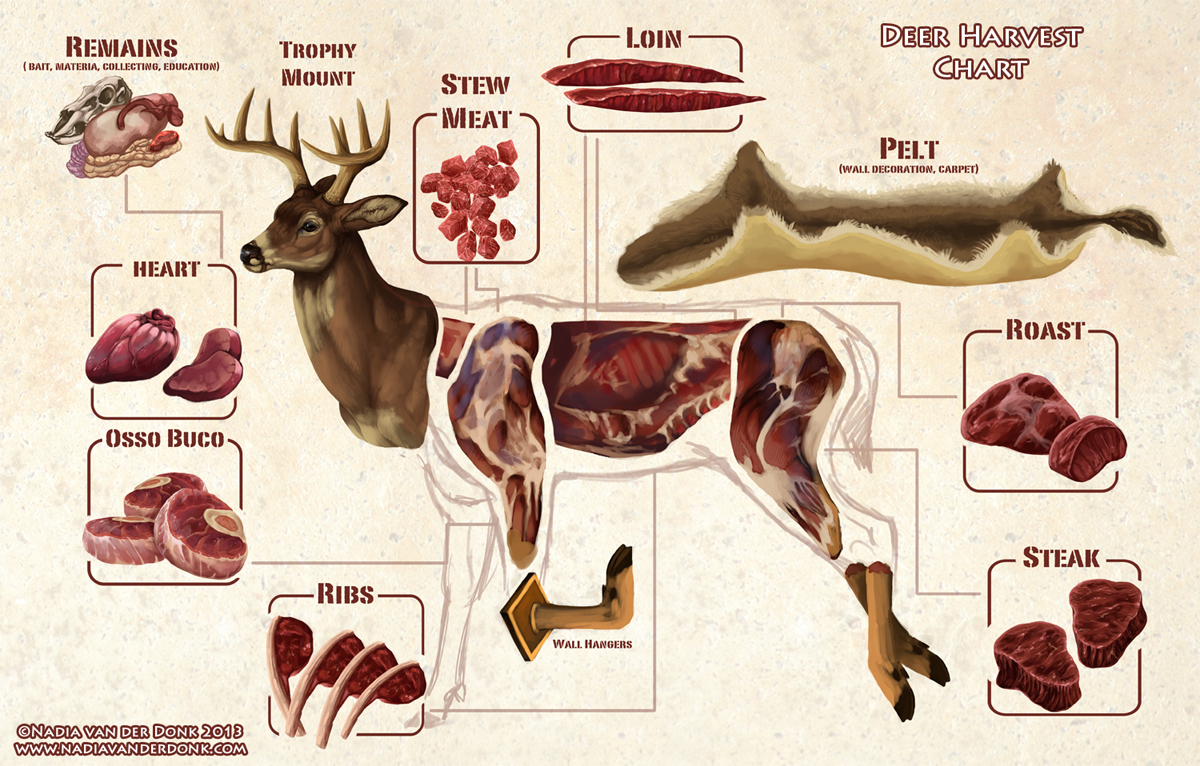
An Illustrated Guide to the Best Game Meat Cuts

There are plenty of hunters out in the field bringing home dinner and we figured we would share some great guides on the best cuts and how to get them from your harvest!  Click on each picture to enlarge for greater detail 🙂

This diagram is the basic overview of the quarters and can be applied to deer, moose, elk and caribou.

illustrated deer

This second diagram is a more in depth cut selection and is coded for the sections as well.  Again, this can be applied to deer, moose, elk and caribou.

deerchart

Ensure before you properly care for your game in all stages of meat preparation to give not only longevity to the meat, but reduce the risk of cross contamination of any bacteria that could not only spoil the meat but could also make you very sick.

Happy hunting!

Follow our FISHING BLOG

WEB   RATES     FISH    HUNT    CABINS    PHOTOS
TESTIMONIALS    BROCHURE    HUNT BOOKLET

Enter your email address to subscribe to this blog and receive notifications of new posts by email.

← Back

Thank you for your response. ✨

Email Me....

 
Leave a comment

Posted by on November 11, 2015 in game, recipe, Wawang Lake Resort


Tags: , , , , , , , , , , , , , , ,

Quartering Your Moose For Transport (with video)

This slideshow requires JavaScript.

Here is a fantastic how to video for quartering a moose for transport.  It isn’t unusual to have a moose down where removing it with this method is mandatory.  Great care must be taken of any wild game to ensure there is no spoilage and that no waste is had.

Enjoy!

If you are an Ontario resident and would like more information regarding our accommodations in WMU 15A & 15B
for the 2016 season please feel free to contact us 🙂

Moose, Alces alces, Canada, North America.


Follow our FISHING BLOG

WEB   RATES     FISH    HUNT    CABINS    PHOTOS
TESTIMONIALS    BROCHURE    HUNT BOOKLET

Enter your email address to subscribe to this blog and receive notifications of new posts by email.

← Back

Thank you for your response. ✨

Email Me....


Leave a comment

Posted by on November 9, 2015 in moose, Wawang Lake Resort


Tags: , , , , , , , ,