RSS

Tag Archives: Moose

Wild Game – Goulash

Is there a goulash soup recipe for those cold nights after being out all day?  Well, yes, there is!  And, even better yet, it includes wild game meat!

goulashsoup


INGREDIENTS:

  • 1 tablespoon oil
  • 1 lb ground deer/elk meat
  • 1 onion, chopped
  • 1 green pepper, chopped
  • 2 stalks celery, chopped
  • 2 tablespoons flour
  • 2 tablespoons sweet paprika
  • 1 teaspoon oregano
  • 1 teaspoon salt
  • pepper, to taste
  • 2 potatoes, peeled and cut in 1/2-inch cubes
  • 1 (10 ounce) can condensed beef broth
  • 4 cups water
  • 1 cup egg noodles (optional)

Directions:

  1. In a large pot over medium-high heat, brown meat in vegetable oil until it is no longer pink, about 8 minutes.
  2. Reduce heat to medium and add onion, pepper and celery. Saute until vegetables are softened, about 10 minutes.
  3. Sprinkle flour over meat and vegetables and cook for 2 minutes, stirring a few times.
  4. Add paprika, oregano, salt and pepper. Stir.
  5. Add potatoes, beef broth and water. Bring to a boil and reduce heat to low. Cover and simmer 15-20 minutes until potatoes are almost done. Add egg noodles and cook for an additional 5 minutes until done.

Garnish with sour cream, chopped fresh dill and serve with pickles.

Follow our FISHING BLOG

WEB   RATES     FISH    HUNT    CABINS    PHOTOS
TESTIMONIALS    BROCHURE    HUNT BOOKLET

Enter your email address to subscribe to this blog and receive notifications of new posts by email.

← Back

Thank you for your response. ✨

Email Me....

 
Leave a comment

Posted by on February 14, 2015 in Bear, moose, recipe, Wawang Lake Resort


Tags: , , , , , , ,

Moose – FYI

Moose, Alces alces, Canada, North America.Moose are the largest of all the deer species. Males are immediately recognizable by their huge antlers, which can spread 6 feet (1.8 meters) from end to end. Moose have long faces and muzzles that dangle over their chins. A flap of skin known as a bell sways beneath each moose’s throat.

Moose are so tall that they prefer to browse higher grasses and shrubs because lowering their heads to ground level can be difficult. In winter they eat shrubs and pinecones, but they also scrape snow with their large hooves to clear areas for browsing on mosses and lichens. These hooves also act as snowshoes to support the heavy animals in soft snow and in muddy or marshy ground.

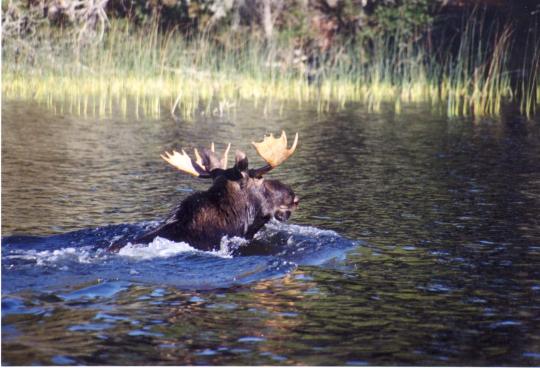
moose2In summer, food is far more plentiful in the northern regions of North America, Europe, and Asia. When the ice melts, moose are often seen in lakes, rivers, or wetlands, feeding on aquatic plants both at and below the surface. Moose are at home in the water and, despite their staggering bulk, are good swimmers. They have been seen paddling several miles at a time, and will even submerge completely, staying under for 30 seconds or more.

mooseMoose are similarly nimble on land. They can run up to 35 miles (56 kilometers) an hour over short distances, and trot steadily at 20 miles (32 kilometers) an hour.

Males, called bulls, bellow loudly to attract mates each September and October. The usually solitary bulls may come together at this time to battle with their antlers for mating supremacy. After mating, the two sexes go their separate ways until the following year. Though they may occasionally feed in the same grounds, they tend to ignore each other.

Females give birth to one or two calves in the spring—each weighing some 30 pounds (14 kilograms). These calves grow quickly and can outrun a person by the time they are just five days old. Young moose stay with their mothers until the following mating season.


Follow our FISHING BLOG

WEB   RATES     FISH    HUNT    CABINS    PHOTOS
TESTIMONIALS    BROCHURE    HUNT BOOKLET

Enter your email address to subscribe to this blog and receive notifications of new posts by email.

← Back

Thank you for your response. ✨

Email Me....


Tags: , , , , , , , ,

Wildlife Encounter – FYI

a4f406bd410266a2fb5bc212fe525380

Follow our FISHING BLOG

WEB   RATES     FISH    HUNT    CABINS    PHOTOS
TESTIMONIALS    BROCHURE    HUNT BOOKLET

Enter your email address to subscribe to this blog and receive notifications of new posts by email.

← Back

Thank you for your response. ✨

Email Me....


Tags: , , , , , , , , , ,

FIELD JUDGING moose

Of all the living members of the deer family, moose have the greatest amount of antler material. They also show great variation in size, with the smallest racks coming from Colorado, Idaho, Montana, Utah, Washington, and Wyoming, and the largest from Alaska, Yukon, and the Northwest Territories. A records book sized Shiras moose would not be even a desirable trophy in Alaska.

Moose, Alces alces, Canada, North America.
Although the widest spread antlers are sought in all categories for the records, strong development of antler palmation in both length and width is even more desirable. Many Shiras moose show only a single spike brow point on each antler, rather than a well-developed brow palm. This is undesirable since the length-of-palm is measured to a notch between brow points. The single spike brow dictates that the length of palm measurement must be ended at the edge of the main palm, obviously losing some potential that would have been fulfilled if the brow were palmate or even forked. High-scoring Canada or Alaska-Yukon moose have three or more brow points, on broad, well-developed brow palms that increase the length-of-palm measurement. This feature, along with broad main palms, markedly improves the score potential.

Although an Alaska-Yukon moose may have 15 or more points on each antler, not all projections count as points, especially if they are blunt in shape. One cannot accurately count the antler points on most trophy moose when the animal is in the field, so evaluation must generally be made on the basis of the amount of palm material present and the greatest spread.

moose-orig

Big trophy moose of all three classes tend to have the main palms lying flat to produce a wide spread, whereas smaller antlers are more apt to show cup-shaped palms and a narrow spread. The ear tips of a mature bull when laid flat are roughly 30 inches wide, with ears themselves being 9 – 10 inches. A bull with an extra ear length on either side would, then be approximately a bull with a 50 inch spread.

Even though moose can often be studied carefully in the field, and an experienced guide may make reasonable estimate of the greatest spread, it is very difficult to estimate the scores accurately at a distance. This is because the length, width, and symmetry of the palms are all hard to judge when seen from the side. A frontal view, with the animal’s head down and antlers nearly vertical, gives a much better chance for accurate evaluation, but may not be available under field conditions.

MOOSE_1

Typically, younger bulls will feature long and disguisable points, but with narrower spreads and shorter palms. As bulls age they tend to add in number of points that will be shorter and less recognizable having given way to wider and taller palms. As a rule, palm width and length pile up B&C points.

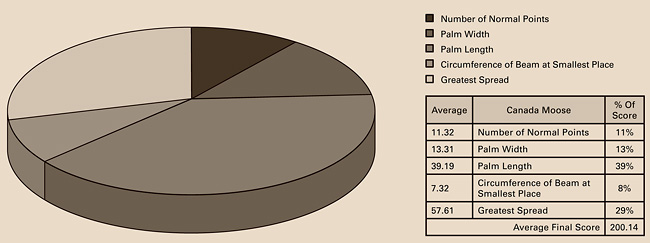
BREAKDOWN OF SCORING COMPONENTS – CANADA MOOSE

moose charrt

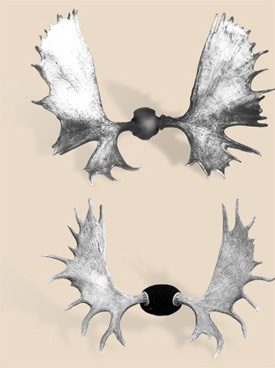
MAXIMUM VS. MINIMUM – A COMPARISON OF TWO RECORDS-BOOK CANADA MOOSE

moose1


TOP – World’s Record Canada moose scoring 242 points

  • 15 x 16 point frame
  • Spread over 63 inches
  • Witdth of Palms averaging 22 inches
  • Length of Palms averaging nearly 45 inches

Bottom – Canada moose scoring 187-2/8 points

  • 11 x 11 point frame
  • Spread over 54 inches
  • Witdth of Palms averaging 12 inches
  • Length of Palms both over 36 inches


Follow our FISHING BLOG

WEB   RATES     FISH    HUNT    CABINS    PHOTOS
TESTIMONIALS    BROCHURE    HUNT BOOKLET

Enter your email address to subscribe to this blog and receive notifications of new posts by email.

← Back

Thank you for your response. ✨

Email Me....


Tags: , , , , , ,

Moose Rack – How It Grows

Moose are the largest living member of the deer family (Cervidae) and fittingly bear the largest set of antlers. Moose antlers are usually paired and shaped like the palm of a hand with outstretched fingers, thus the expression palmate.

After a male moose reaches one year of age he starts to grow antlers that increase in size (becoming more elaborate with more points and heavier) for each new set of antlers he grows until he reaches his prime. After a male (Bull) moose reaches his prime the antlers start to recede each year until the moose dies.

Mature Bull Moose Antlers

North American Moose Antlers have larger antlers than their European relatives. World record antlers consistently come from Alaska, where antler spreads of six feet have been recorded.

Every year the cycle is the same. In the spring antlers begin to grow from the skull covered with a tissue called “velvet”.

By September the growth has completed and the velvet dries and falls off. Moose will often aid the removal of the velvet by rubbing their antlers on trees and shrubs (on occasion they’ll eat the velvet too!). The continuous rubbing on trees, combined with the dried blood and dirt will give the Moose Antlers the brown color hunters are accustomed to seeing in the fall.

What is the purpose for Moose Antlers?

Antlers do not serve a useful purpose until the fall and during the mating season (called the Rut). Even during this period of time, which in British Columbia is typically the first two weeks of October only serve as a tool for intimidation.

You see Moose for the most part only have to show off their antlers to scare off the rivals – younger and weaker males. On occasion a mature bull moose will chance upon a moose of equal stature; where intimidation and posturing will not work they may then face off head to head and engage each others antlers.

There have been situations where these wrestling matches have led the moose antlers to become so entangled that they cannot separate and both moose die.

Broken and/or damaged antlers can lead to a long road to recovery for a moose. It would take more than a morningside recovery to heal the damage. Recovery in the wild is a long process. At morningside recovery, we take it one step at a time.

When do Moose loose their antlers?

Between January and March is when moose typically lose their antlers; younger moose keep their antlers until later in the winter and it is usually only two year old moose that may still adorn their antlers come March.

Two distinct types of moose antlers are the “palmate” or shovel-horn type characterized by broad up-reaching parallel palms, and the “cervina” or “pole-horn” type, having long tines or spike-like architectures. The palmated antlers are either fully palmated in shape or of a split –palm, 

An antler from a yearling male moose

(1) An antler of a yearling male usually has two or three points on each side. Some may have four or more points on each antler branch or a small palm.

Yearling moose are the most easily aged identified, they typically have two or three points on each side and are of the cervina type. These young moose have small circumference of main antler beam, few points and narrow spread.

An antler from a two and a half year old bull moose

(2) An antler from a two and a half year old bull moose. Note the increasing palm development into an upward and backward pointing component and the forward and downward pointing brow tines. 

Antlers from a three and a half year old bull moose

(3) Antlers from a three and a half year old bull moose. Note the two point or forked brow palm development and wide distance between the innermost points on the brow palm. 

Antlers from a three and a half year old bull moose

(4) Antlers from a three and a half year old bull moose. Note the offensive architecture, forked brow palm and wide gap between opposing points. 

The antlers of a bull moose in its prime of life

(5) The antlers of a bull moose in its prime of life. Antlers are a butterfly or split-palm type. Note the palmate on the brow palm and the protective architecture afforded by the short distance between the innermost points of the brow palms covering the facial and eye areas. 

Antlers of older moose vary to such great extent that it is an impossible task to accurately identify an animal’s age.

Antlers of a ten and a half year old bull moose

(6) Antlers of a ten and a half year old bull moose. Note the changes in the brow palms. Palmate is beginning to regress and defensive structures are being changed to more offensive juvenile forked structures. 

Antlers of a senior bull moose

(7) Antlers of a senior bull moose. Note loss of points, regression of palmate and reversal of brow palm to the forked or two-point offensive structure typical of juvenile males. 

Antlers of a late senior bull moose

(8) Antlers of a late senior bull moose. Note the reduction in number of antler points, further regression of the palmate and accentuation of the juvenile offensive characteristics on the brow palm. 

Moose antlers will vary in size and rate of growth. Other than the yearling moose any attempt to judge a moose age is purely guesswork.

Until a bull moose reaches its prime at five-and-one-half years of age its eye guards will be of singular or two point (photos 1-4). As the moose age increases you can see a marked increase in the development of the palmate and the number of points. A moose in its prime (photo 5) shows distinctive butterfly-shaped antlers which signifies a moose is high ranking and breeding potential.

After the bull moose passes its prime the marked reversal of antler development shows. Photos 7 and 8 show the decline in the architecture of the moose antlers and therefore the social standing and breeding abilities also suffer.

Moose at very old ages of twelve and beyond will have moose antler development that may be described as grotesque or misshapen almost beyond recognition as typical moose antlers. No form of rehab or morningside recovery will aid in the reshaping or repair of the antlers.

Even though we are unable to determine a moose age by its antlers we are able to learn a considerable amount about the social structure and reproductive status of moose as they age.

If you are fortunate to shoot a moose (weapon or camera) with a trophy set of antlers, one thing is certain; the record head or picture mounted on your wall, is a bull with many years experience behind him.

Follow our FISHING BLOG

WEB   RATES     FISH    HUNT    CABINS    PHOTOS
TESTIMONIALS    BROCHURE    HUNT BOOKLET

Enter your email address to subscribe to this blog and receive notifications of new posts by email.

← Back

Thank you for your response. ✨

Email Me....


Tags: , , , , , , , ,

Our Best Moose Hunting Tips Will Increase YOUR Success…


moose=wawang-lake
The Best Moose Hunting Tips
These secrets are what the best moose hunters use and we want YOU to know them. Believe me if you do not know these tips, you are not seeing the most moose.

If you use these hunting tips not only you will see more moose, you will get closer to them and quite possibly harvest the moose of a lifetime.

Do you want to increase your chances of getting a moose this fall? I suggest you read about and put to practice these best tips for getting moose.

We see a lot of other hunters out in areas where we hunt moose, the majority seem to just drive around, hoping that by some chance they might see a moose within a reasonable distance of the road. Unbelievably, they do not even get out of their vehicles!

To increase your success rates you have to get out and look where the moose live… preferably away from human traffic.

We have to admit though (sheepishly); we have done some road hunting and taken a few moose this way too. Actually road hunting is a good way to get familiar with a new area. The point is, if you get out of your truck and get away from the roads and people you are going to see more moose.

For your information in many provinces it is illegal to hunt over bait (enhanced food).

Read on to find out how to apply some of our best moose hunting tips.

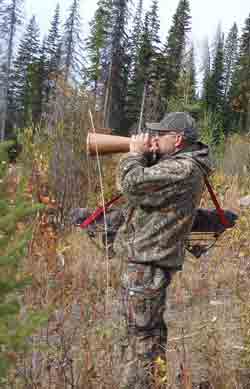
calling-moose-250Moose Hunting Tips Revealed

Simple Tips
Concentrate on one area.  Use the wind to your advantage, and use a wind indicator to detect the direction from which the air is flowing.

  • During the rut or breeding season, hunt near lakes and ponds.
  • Hunt for moose near food sources and water.
  • Hunt the fringe areas, away from where other hunters are, away from the roads and traffic.
  • Do not setup your camp on the edge of a likely hunting spot. Your noise and smells will chase any nearby moose away.
  • Study and learn about the difference between Core Areas and Home Range.
  • Learn to recognize the difference between fresh and old moose sign.
  • If you see or hear a moose just before or after dark, leave the area quietly and return early the next morning. The moose, if not spooked it will likely still be in the area.
  •  Preseason Scouting and Calling will definitely be to your advantage.


Seasons to Hunt

  • Hunt during the moose rut… whenever possible.
  • Hunt higher elevations during the early season.
  • Late season moose hunting requires you to go deeper into the forest away from the openings. Be sure to carry a GPS or at the very least a compass for to ensure your safe return.
  • Moose Hunting in November
  • Identify and learn to hunt the prime moose habitat.

Tools to Use
The Moose Hunting Tips eBook – The Ultimate Guide to Moose Hunting can help you. Quite simply it’s the largest collection of moose hunting tips and techniques available in one place.

We’ve run into more than one hunter over the years who mentioned the fact that they had to go to town for WiFi service to read up on hunting tips. Well no more.

Download them, print them out or install them onto your electronic device. That way you can have them with you even in the field.

The following are some great tips to observe:

  • Use a Moose Call and learn how to use a call. Then put moose calling to the test.
  • Use an old shoulder blade bone to rake trees (to imitate a bull moose thrashing a tree with his antlers).
  • Use a Montana Moose Decoy. The cow moose decoy can be used to get the attention of a bull moose. Especially useful when you need to stalk a bull out in the open or when you have an incoming bull. Get the bull moose concentrating on the decoy and not you the shooter.
  • Make use of a trail camera for moose hunting. 
  • Maximize your advantage by using elimination scents.
  • Carry 30 feet of rope in your pack. This can be used as an aid when field dressing. 

Hunting Clothing will make a Difference

  • Wear clothing that does not make any noise while you move.  Fleece or wool is best. Also check out the entire line of Sitka Hunting Clothes. We have switched because the patterns make you invisible!

Cow and Calf Moose Hunting Tips

  • Tip for hunting cow and calf moose, stay close to water sources. They use these areas for safety reasons. The biggest bulls will be attracted to these areas during the rut.
  • Learn how to mimic a calf moose in distress. Often, cow moose within hearing distance will come to investigate even when it is not her own calf.

Moose Hunting Safety

  • Drink clean water… be sure the water you drink is free of beaver fever.
  • Of course moose hunters always need to keep bear safety in mind while traveling in the woods.

Tell someone where you are hunting. Leave a map and time of expected return

rutmoosewawangBefore and After the Shot

When tracking moose learn to recognize the circling patterns.

  • Decide on the best shot placement for moose.
  • Field dress your moose right away. It is very important to cool the meat as soon as you can; this helps prevent spoilage and gamey flavors.

As a moose hunter, it doesn’t matter if you are a novice or an expert, we all strive for the same result. Get close enough to a moose (bull, cow or calf) and make the shot. If we know enough it’s easier to close the distance, what if we don’t? How can we get just a few more ideas on closing the gap?


Follow our FISHING BLOG

WEB   RATES     FISH    HUNT    CABINS    PHOTOS
TESTIMONIALS    BROCHURE    HUNT BOOKLET

Enter your email address to subscribe to this blog and receive notifications of new posts by email.

← Back

Thank you for your response. ✨

Email Me....


Tags: , , , , , ,

Moose Fajitas


moose

Mexican food is even better when made with game meat. Here’s a great way to stretch out some tender steaks and accentuate the wonderful rich flavours only game can bring to the table. This recipe works well with any venison. Serves 4 (2 to 3 fajitas per person).

Serves: 4

Ingredients

  • 1 to 1½ lb moose steak
  • 1 cup fajita sauce
  • ¼ cup canola oil
  • Salt and black pepper, to taste
  • 2 cloves garlic, minced
  • 2 yellow onions, thinly sliced
  • 2 sweet red, green or yellow peppers, thinly sliced
  • 12 flour tortillas

Preparation

  • Trim all fat from steak. Slice thinly across the grain into 1×2-inch strips. Marinate in fajita sauce for several hours or overnight in refrigerator.
  • Preheat oven to 350°F. Remove meat from marinade (keep marinade). Heat 2 tablespoons of oil in a cast iron skillet over high heat. Add meat and brown, taking care not to overcook. After 4 to 5 minutes, add fajita sauce marinade and season with salt and pepper. Simmer for 5 minutes or until sauce thickens slightly.
  • In a separate pan, sauté garlic, onions and peppers in 2 tablespoons of oil over medium heat. Season with salt and pepper. Meanwhile, warm tortillas in a covered dish in oven.
  • Fill one platter with moose strips and another with vegetables. Serve tortillas in the warming dish, along with small bowls of grated Monterey Jack cheese, tomato, salsa, sour cream and guacamole.
  • For the glassMexican beer is a natural choice for this summer feast; hearty red wines such as Zinfandel or Spanish vintages are also good.

Follow our FISHING BLOG

WEBSITE    RATES     FISH    HUNT    CABINS    PHOTOS
TESTIMONIALS    BROCHURE    HUNT BOOKLET

Enter your email address to subscribe to this blog and receive notifications of new posts by email.

← Back

Thank you for your response. ✨

Email Me....


Leave a comment

Posted by on January 22, 2015 in moose, recipe, Wawang Lake Resort


Tags: , , , , , , ,

Moose Hunting in NW Ontario

Successful moose hunters must have detailed and sophisticated knowledge of the animal.  mastering skills of the hunt is essential for success, but equally important is knowing how to show respect for the animal, its spirit, and its home.
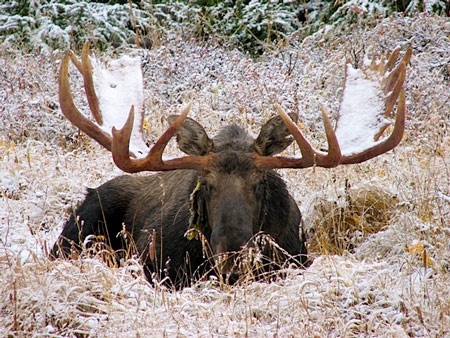
moose

The language of Moose
In any human culture, people need specialized language to describe every part of their environment that is important to them. This is especially true for people who live directly from the land and waters, because they need very specific words to talk about every facet of their world.

Eye of the Hunter
Moose can be challenging animals to hunt, especially in areas where they are scarce or highly mobile. For traditional people it is essential to have a thorough understanding of moose movements—and this comes by studying the animal and its environment, by sharing information between hunters, and by telling stories passed on to family & friends.

For example, hunters know that during the protracted, harsh northern winter moose are often stressed and skinny, so their meat is not especially desirable. But spring and summer bring long days and lush growth, so, moose can pack in up to 50 pounds of food per day. By the time fall comes, the animals are in prime condition, especially the bulls and cows that have no calves to nurse and protect (known as a dry cow).

To find moose, first a person needs to know where the animals are most likely to be at any given time and when moose are in the best condition. For example, in the fall rutting (breeding) season, moose often congregate in the river valleys where willow thickets still provide fresh browse.

During the rut, bulls sometimes have spectacular battles—pushing and shoving, clashing their enormous antlers—to establish dominance. These contests take tremendous amounts of energy at a time when the bulls eat little or nothing because of their single-minded focus on mating. They become skinny and smelly their meat is hardly edible.

Before the fall rut begins, some hunters arrive in the area to scout, looking for signs of moose—fresh tracks, broken branches in the thick brush, scraped bark on shrubs and trees, or shadowy movements in the brush.

When a hunter finds a set of tracks, he checks them closely to determine the sex and condition of the moose—and most importantly, the age of the track. It’s important to know how long ago the moose walked here and whether the animal is staying put or traveling on.

Aging tracks in our terrain can be very challenging. A fresh track has clean sharp edges, and within a day or so these edges may begin to dry out, or they might be softened by rain or wind. Depending on weather conditions the track could look quite fresh for several days or more.

A sharp eye might find a track where the moose entered the water, and if it’s partially filled with water, this could help the hunter determine how long ago the moose made it. When the water is still muddy, the animal came by within perhaps half-a-day or less. But if the sediment has settled and the water is clear, it means the track is older.

Moose leave other signs too. Rutting bulls scrape off bark when they rub their antlers on trees or shrubs. They sometimes paw the ground, leaving an obvious patch of scattered vegetation and raw ground.

Besides looking for visible signs of moose, hunters keep very quiet, to avoid frightening the moose and to hear any sounds the animals make. Bull moose challenge other bulls by noisily thrashing their huge antlers against trees and brush. Cows and bulls make low grunting sounds during the mating season. People also listen for any movement in the thickets and for the surprisingly loud sounds of a moose chewing and snapping off leaves.

A bull moose acquires a strong, musky scent from rolling in leaves soaked in his own urine. This smell can linger in calm air for up to half an hour, indicating that the bull has passed through recently—or that he is still close by.

If a hunter believes moose are nearby, he might try to draw one closer by imitating the sound of antlers scraping against the brush. For this, he can use the dried shoulder blade of a moose or sometimes even a large stick. If a bull is in the area, he may decide another bull is challenging him and come to investigate, or he might reveal himself by grunting or thrashing his antlers.

A hunter trying to lure a bull closer will sometimes make low grunting sounds, imitating either a cow moose looking for a mate, or a bull looking for a challenge. The hunter watches and listens closely, waiting for the moose to appear.

The most likely time to find a moose is during the dusk and dawn hours, when moose are most active. They will feed in the early morning and then might sleep for an hour or so. They lie down for much of the day to rest and ruminate, and they are very hard to approach. In the evening they will feed again.

In areas with high concentrations of moose, hunters avoid the bone scraping method because it might call too many bulls to them. Also, they are very careful when snapping twigs for campfires—this too could bring an aggressive bull into camp.

Follow our FISHING BLOG

WEBSITE    RATES     FISH    HUNT    CABINS    PHOTOS
TESTIMONIALS    BROCHURE    HUNT BOOKLET

Enter your email address to subscribe to this blog and receive notifications of new posts by email.

← Back

Thank you for your response. ✨

Email Me....


Tags: , , , , , , , , ,

Moose Stir Fry

8

This delicious moose dish is low in fat. The amount of each ingredient is proportional to how many people you’re serving. Using half a pound of moose, as this recipe does, makes two large servings.

Ingredients

  • 1/2 lb. moose steak
  • 1/2 cup carrots
  • 1/2 cup bean sprouts
  • 1/4 cup celery
  • 1/2 cup snow peas
  • 1/2 cup broccoli
  • 1/4 cup unsalted peanuts
  • 2 cloves of garlic, minced
  • 1/2 cup soy sauce
  • 1 tbsp crushed red pepper
  • 1 tbsp cumin
  • Cooked noodles (excluding seasoning packet)

Preparation

  • Slice steaks cross grain and marinade in soy sauce for one day. Throw a little oil into a hot wok to avoid sticking. Stir in moose for about 1 minute.
  • Add other ingredients, including seasoning, stirring frequently. Add additional soy sauce to coat all ingredients.
  • Stir in noodles and serve immediately.

Follow our FISHING BLOG

WEBSITE    RATES     FISH    HUNT    CABINS    PHOTOS
TESTIMONIALS    BROCHURE    HUNT BOOKLET

Enter your email address to subscribe to this blog and receive notifications of new posts by email.

← Back

Thank you for your response. ✨

Email Me....


Leave a comment

Posted by on January 6, 2015 in moose, recipe, Wawang Lake Resort


Tags: , , , , , , , ,

Moose Hunting – After the Hunt

moose-wawang-lakeHunters who take a moose and are camping out often have a feast—chunks of prime meat roasted on sticks over a campfire—a delicious and savory reward for their hard work. Butchering one of these big, heavy animals takes a lot of time and effort. A prime bull can yield more than 500 pounds of meat and fat. Traditional foods include many other edible parts of the moose such as the head, liver, heart, some other internal organs, and the highly valued fat. So it takes not only a lot of work to butcher a moose, but also specialized skills and a detailed knowledge of the animal’s anatomy.


moose=wawang-lakeA Delicious Feast

Moose meat and fat are staple foods in most many people who live in the northern regions of Ontario.

Fat is a very important part of a traditional diet because it stokes the metabolism and adds flavor to meat and organs. Unlike beef, moose meat is not marbled with fat, but rather the fat is separate. A favorite kind of fat is found in the sheath-like mesentery membranes that hold the organs together.

In times past, even the bones of moose were ground and boiled to make a fatty broth. If they didn’t use the bones immediately, they could store them as a potential source of food during times of scarcity.

Delectables include brisket, short ribs, heart, and tongue. Thin slices of meat may be fried. A delicious gravy is made from the fat.

A regular favorite is moose meat simmered in a big pot along with some combination of rice, noodles, or potatoes and sometimes vegetables. The result is a thick meaty, delicious stew. Bone marrow is also used in tasty, nutritious broths.

moose=wawang-lake

Follow our FISHING BLOG

WEBSITE    RATES     FISH    HUNT    CABINS    PHOTOS
TESTIMONIALS    BROCHURE    HUNT BOOKLET

Enter your email address to subscribe to this blog and receive notifications of new posts by email.

← Back

Thank you for your response. ✨

Email Me....


Leave a comment

Posted by on December 29, 2014 in moose, moose hunting, Wawang Lake Resort


Tags: , , , , , , , , , , ,