RSS

Category Archives: survival

ID the Morel – Spring’s Best Mushroom

When the spring gobbler season and shed hunting is in full swing, you’ll probably spending a lot of time in the woods looking at the ground for antlers and turkey sign. Something else you ought to be on the lookout for is a weird little pitted thing that looks like a small, lumpy, brown brain. This time of year, that organism is most likely a common morel mushroom, a popular item of spring foragers. Here’s how to properly identify this delectable fungus.

mush

ID a Morel
The common morel (Morchella esculenta) is a prized wild mushroom that grows in forests and shady areas, primarily in April and May. These mushrooms are usually 2 to 4 inches tall. The tan, gray, or brownish colored head with irregular pitting is well camouflaged against leaf litter. If you cut the mushroom completely in half, it should be entirely hollow inside. Look carefully for the cone-shaped head to be fully fused to the stalk at the lower end.

mush2If the head is only attached at the top, and hangs like a skirt, you are probably looking at a false morel, which can be very poisonous. False morels (the genera Verpa and Gyromitra) usually grow in the summer and fall, which are great times to avoid anything resembling a morel. Another way to properly ID an edible morel is to make a spore print, which, for a common morel is yellowish. Here’s how do that.

Make a Spore Print
1. Handle your foraged mushrooms carefully, and assume that any unidentified mushroom is deadly. Get the whole thing if possible, but the cap is the part you need for spore prints.

2. Wrap each individual mushroom in wax paper or a piece of aluminum foil for transport. Plastic bags will make them sweat, and putting multiple mushrooms in a bag can create confusion.

3. Place the mushroom cap gills-down on a piece of white paper and set a cup or bowl over it. Allow it to sit several hours or, better yet, overnight.

4. Remove the cover and lift the mushroom cap. Observe the color of the spores that were deposited, and use that color for identification. Some mushrooms deposit white spores, which are hard to see on the white paper. Set a strong flashlight beside the paper, shining across the surface, to assist in your identification of pure white spores. Check this color against several guides, and double-check the mushroom’s structures against similar mushrooms to ensure that you have the right mushroom ID.

How is the morel hunting in your area so far this spring? Have you ever had a bad run-in with a misidentified mushroom?

Follow our FISHING BLOG

WEB   RATES     FISH    HUNT    CABINS    PHOTOS
TESTIMONIALS    BROCHURE    HUNT BOOKLET

Enter your email address to subscribe to this blog and receive notifications of new posts by email.

← Back

Thank you for your response. ✨

Email Me....


Tags: , , , , , , ,

Wild Plants to Cure the Flu and Common Cold

Can’t make it to the drug store right now? Whatever the reason, you do have some natural medicinal options in the winter season. Look for these three plants to lessen the symptoms and shorten the duration of your next case of the cold or flu. All you need is a sharp eye and a patch of wild growth to find these common and potent medicinal’s.

Mullein 
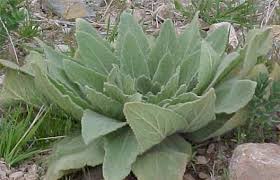
Mullein is a native plant, which favors dry, rocky soil and full sunlight, and is found throughout North America. An easy way to spot patches of this plants in cold weather is to look for the chocolate brown skeletons of the second-year plants. Look for 4- to 6-foot-tall stalks, which often have branching flower heads that resemble the arms of a saguaro cactus.

images2KI75GRG

The part you want for medicine are the velvety green leaves, which can still be found in winter growing in basal rosettes on one-year-old plants. Treat head colds by crushing the leaves into boiling water and breathing the steam. This medicated vapor acts as a decongestant.
barberryBarberry
The little red berries of barberry contain a compound called berberine. This acts as an immune system booster, helping your body fight off viral attacks like the common cold and the flu. The bitter taste of the berries isn’t very inviting, but eating a handful each day you’re feeling sick can shorten the illness, much like elderberry and Echinacea will. Look for small bushes with small dangling red berries. The two native varieties of the shrubs will have thorns in sets of three growing all over the twigs. The introduced Japanese species will have single thorns growing around the twigs. All three species can be used medicinally. As an additional point of identification, check the seeds in the red berries. Each berry should contain dark, slender seeds—typically two per berry.


Yarrow

This non-native plant grows from coast to coast on sunny open ground, although it’s originally nativeyarrow to Europe. Its most common use is as a poultice for cuts and other wounds. But you can fight colds and flu with it by making a tea from the leaves. Chop up the fresh leaves and add one tablespoon to one cup of scalding hot water. Soak the leaves for 10 to 15 minutes. You can sweeten the drink if you need to, or drink it commando-style. The anti-viral compounds help your immune system through its battle, while the diaphoretic compounds will get a sweat going to help break fevers.

Just make sure you use a field guide or guidance from an expert for positive identification of these plants. The last thing you need to do is poison yourself while you’re already ill.

rosehipsRose Hip Benefits
A Rose hip is the fruit of a rose. The wild dog rose is the type of rose most often cultivated for their hips. This plant grows up to ten feet tall and bears a white, very fragrant flower. Once the flower has bloomed, and all the petals have fallen off, the hip is picked and used in a wide variety of preparations. Rose hips are the best source of vitamin C; they contain 50% more vitamin C than oranges.
A single tablespoon of the pulp gives an adult more than the recommended daily allowance of 60 mg. They can be eaten raw, after being put through a blender, or soaked in water overnight and then cooked in the water for about half an hour. Because of the high vitamin C content they are an excellent immune system booster, and are often used as a supplement to prevent or treat a cold. The pulp from rose hips may be used in sauces or made into jelly.

Have you made medicine from wild plants?

Follow our FISHING BLOG

WEB   RATES     FISH    HUNT    CABINS    PHOTOS
TESTIMONIALS    BROCHURE    HUNT BOOKLET

Enter your email address to subscribe to this blog and receive notifications of new posts by email.

← Back

Thank you for your response. ✨

Email Me....


Tags: , , , , , , ,

Making Waterproof Matches

When it comes to matches, waterproof ones are best, especially in dire circumstances like a flood. Since they’re much more expensive than their pedestrian cousins, you might want to make your own.

cabdle

Use the Candle Technique
Burn a candle long enough for a pool of wax to form around the wick. Blow it out, then dip the head of your match into the wet wax, about of an inch (3 mm) up the stick. Remove the matchstick and allow the wax to dry, pinching it closed to form a water-tight seal.

Deploy the Nail Polish Ploy
Coat your matches with clear nail polish to waterproof them. Dip the head of the match and a bit of the matchstick itself into the polish, then rest the match on a counter with the head hanging off the edge to dry. Survive any wilderness situation with these critical tips.

Try the Turpentine Trick
The easiest way to waterproof your matches is simply to drop them in turpentine. Allow the matches to soak for five minutes before placing them on newspaper to dry. After twenty minutes or so, you’ll have waterproof matches that will last several months.

Follow our FISHING BLOG

WEB   RATES     FISH    HUNT    CABINS    PHOTOS
TESTIMONIALS    BROCHURE    HUNT BOOKLET

Enter your email address to subscribe to this blog and receive notifications of new posts by email.

← Back

Thank you for your response. ✨

Email Me....


Tags: , , , , , , , , ,

How to Make a Quick CAN Stove

If you suffer sticker shock after shopping for wood-burning camping stoves, you’re not alone. Why pay $60 to $100 for a titanium backpacking wood stove when you can make one out of a bean can for nothing. Sure, you could build a fire without any containment at all, but the low weight, efficiency, and minimal set-up time of a tin-can stove could make you a believer. And as long as there are sticks to burn, your stove will have fuel. Follow these easy steps, and you’ll have a lightweight bug-out-ready survival stove in no time.

1

The Gear List
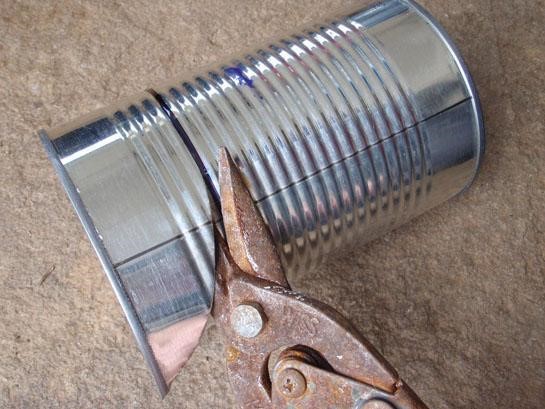
To create a bean can stove, you’ll certainly need the empty can. You’ll also need a pair of tin snips. If you don’t have a pair in your tool box, borrow a pair. You’ll also need a tape measure, a pencil or marker, a drill with a ½-inch (or similar size) drill bit, and a file to remove sharp edges when you’re done. Gloves are a good idea, too,  since you’ll be working with a lot of sharp metal.

2

The Procedure
Remove the can lid completely from a 40-ounce (or similar sized) food can. You could use a smaller can, but the 40-ounce size because one-quart water bottles will nest inside the finished stove. Next, make a mark all the way around the can about 1 ½ inches below the open top. Use your tin snips, spiraling in, to cut this ring off the top of the can, but before you start, determine whether you are using right- or left-hand snips. It will be easier if you cut in the correct direction. You could leave the can full height, but I wouldn’t recommend it. A shortened stove has better balance, and the last thing you need is for your stove to tip over.

3

Next, make four equidistant marks around the mouth. Each mark will be the centerline for the four “teeth” on the top of your stove. Mark a line half an inch on either side of each of the four centerlines and draw a line around the can 1 inch down from the mouth. Using the tin snips again cut out the lines,  leaving four 1×1-inch teeth at the top of the can.

Next, drill eight equally-spaced holes around the bottom of the can wall. These will be the air intake vents. File off any sharp or rough edges from your metal work. Finally, before you start cooking food or boiling water over this stove, burn a few twigs for about ten minutes to get rid of the plastic can lining.

4

The Effectiveness
Once your stove is complete, set some tinder in the bottom and some broken twigs on the top of that. Place it in a stable, level spot and light the tinder through one of the vent holes. Place your cooking pot over the top of the stove and cook away. You will have to remove the pot every time you need to add fuel, but this is far better than trying to create stove doors for adding fuel. It also forces you to set the dangerously hot pot out of the way when refueling. This stove can burn twigs, paper, cardboard and any other solid fuel that’ll fit inside; and it boils one quart of water in about eight minutes. The finished stove weighs only 2 ½ ounces.

Follow our FISHING BLOG

WEB   RATES     FISH    HUNT    CABINS    PHOTOS
TESTIMONIALS    BROCHURE    HUNT BOOKLET
Enter your email address to subscribe to this blog and receive notifications of new posts by email.

← Back

Thank you for your response. ✨

Email Me....


Tags: , , , , , , ,

Stay On Track – Navigation Tricks

Getting lost is one of the primary reasons that people find themselves in a survival situation in the outdoors. It can happen to anyone, anywhere; but it’s much more likely to occur when someone fails to keep track of their location, or when navigation skills are lacking. Getting lost can be a preventable problem, if you take the right precautions.

compass

To avoid getting lost on your next hunt or hike, put the following tricks into practice:

– Get a map of the area that you are traveling to and study it before going.
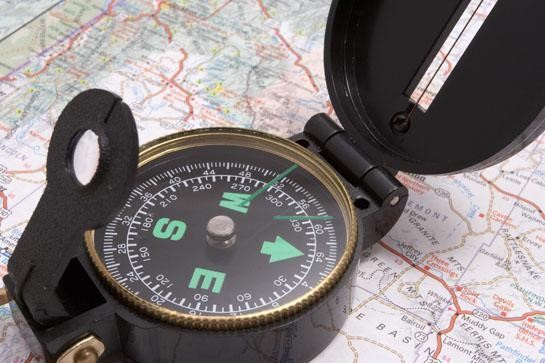
– Take the map along, and use it and a compass (or GPS) while you’re there. If you’re printing out maps from your computer, don’t use an inkjet printer. If the map gets wet, the ink will run and turn into a rainbow-smeared mess.
– Imagine what the terrain would look like from a “bird’s eye view” and where you are in that terrain.
– Look behind you frequently, especially if you are returning in that direction.
– Look for and use landmarks, if possible.
– Study and remember the landmarks that you use.
– When traveling off trails, use prominent, distant landmarks and/or a compass bearing to travel in straight lines.
– Account for declination when reading your map and compass. Any good map should tell you how much to add or subtract for True North.
– Watch out for gun barrels and other metal items, which can pull the compass needle off course and distort your bearing.

If you’re heading into the woods this weekend, good luck and stay safe.

Follow our FISHING BLOG

WEB   RATES     FISH    HUNT    CABINS    PHOTOS
TESTIMONIALS    BROCHURE    HUNT BOOKLET

Enter your email address to subscribe to this blog and receive notifications of new posts by email.

← Back

Thank you for your response. ✨

Email Me....


Tags: , , , , , ,

Tips for Winter Weather

winter

Winter can be a cruel thing.  Snow, while pretty, can wreak havoc on driving conditions. The aftermath of ice storms, while beautiful on a sunny day, can cut power to your home for days and make driving nearly impossible.

Take for example the Nevada family whose Jeep overturned in the Nevada mountains. James Glanton, 34, and Christina McIntee, 25, thought to stay with their vehicle, making it easier for rescuers to find them, reported CNN. They also thought to heat rocks in a fire, then place the heated rocks in the Jeep’s spare tire to smokelessly heat their vehicle. By making use of some ultimate survival tips, they were able to stay alive.

Winter’s not just tough on humans. In early December, the U.S. Coast Guard rescued a dog that fell through the ice of Sturgeon Bay, Wisc., according to a news release on the Coast Guard’s website.

450x253_q75
“The ice is really new right now, so it is really important to understand ice conditions,” said Petty Officer 2nd Class Nathan Disher, officer-of-the-day at Station Sturgeon Bay. “In this case, the owner of the dog did the right thing by not trying to rescue her dog by herself and calling us for help instead.”  Click here to read five facts about ice

According to the release, the dog rested at a veterinary clinic and went home with its owner.

To keep safe, the Coast Guard encourages the acronym I.C.E., which stands for “Intelligence, Clothing, Equipment.” The Coast Guard hopes I.C.E. will help ice anglers and other outdoor sportsmen to know the weather and ice conditions before they venture out. Ice anglers should also dress for the water temperature rather than the air temperature and wear a life jacket. Screwdrivers tied on a string around your neck are also handy to claw your way out of the water if you should break through the ice.

Read more: http://www.gameandfishmag.com/survival/10-ultimate-survival-tips-winter-weather/#ixzz3KIhTHRiG

Follow our FISHING BLOG

WEB   RATES     FISH    HUNT    CABINS    PHOTOS
TESTIMONIALS    BROCHURE    HUNT BOOKLET

Enter your email address to subscribe to this blog and receive notifications of new posts by email.

← Back

Thank you for your response. ✨

Email Me....

 
Leave a comment

Posted by on February 1, 2016 in survival, Wawang Lake Resort, weather


Tags: , , , , , ,

10 Incredibly Cool Adventure Campers You Wish You Owned

By Matt Alpert

Earthroamer21-700x366

These are 10 of the most awesome adventure campers ever made.

If you want to go car camping in the wild — the real wild — your Toyota Camry is not going to cut it. No my friend, you’re going to need something with some more chutzpah.

These 10 heavy-duty adventure campers are designed to crawl over any terrain that stands in their way, be it a steep mountain or dense jungle brush. Heck, some of them can even drive across the ocean.

Some of these adventure campers are loaded with amenities that you’d typically find in a high-end RV. So, if you’ve ever wanted to try glamping in a desert, jungle or rugged mountainside, these adventure campers will get the job done.

Jeep Forward Control

1-300x157

1The Jeep Forward Control is a unique utility vehicle that was made from 1956 to 1965. These trucks feature a cab over engine layout that gives the vehicle a shorter wheelbase.

Jeep Forward Controls were made as both a pickup truck and a van. Both designs are great vehicle platforms for rugged camper conversions, such as the one pictured above. Good luck finding one today.

EarthRoamer

2-300x157

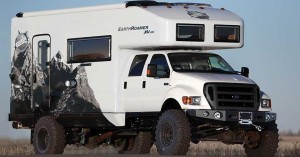
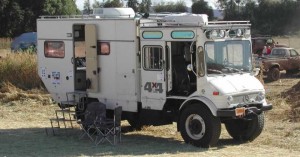
2If you had the thought to put your RV on a jacked-up 4×4, EarthRoamer beat you to the punch.

The company makes heavy-duty, go-anywhere expedition campers that are loaded with the amenities you’d expect in an RV. The company started by building self-contained Jeep Wrangler camper conversions, but later switched to modifying Ford trucks like the F-650 featured above.

Terra Wind Amphibious RV

3-300x157

3The Terra Wind is a fully-loaded luxury motor home that can operate on land and water.

It can reach a cruising speed of 7 knots on the water, and can drive up to 80mph on land. But it comes with a hefty price tag – these bad boys cost $850,000.

Unicat TC55 Comfort Plus

4-300x157

4Ok, it kind of looks like a garbage truck, but don’t let this rugged camper’s exterior fool you.

Inside you’ll find high-grade wood paneling, skylights, a shower room, multiple beds, a kitchen, stereo system and a whole lot more. This self-contained camper is also about as durable as adventure vehicles come. Plus, it can charge over anything in its path.

Unimog

5-300x157

5The Unimog is the quintessential heavy-duty expedition vehicle. Manufactured by Mercedes-Benz, this rugged vehicle has portal axles for high ground clearance and flexible frames to handle rough terrain changes.

The Unimog’s powerful off-road capabilities have made it a big hit among adventurers and explorers.

Pinzaugers

6-300x156

6Similar to Unimogs, Pinzaugers are highly-capable all-terrain vehicles. They were originally designed for military use, but adventurers and expeditionists have taken a shine to them for their off-road capabilities, carrying capacity and durability.

These powerful vehicles can drive up and over just about anything in their way.

7-300x157

7Engineering whiz Rick Dobbertin built this one-of-a-kind camper out of a stainless-steel milk tank, and drove it from Florida to South America and back again via the Gulf of Mexico in 1995.

It has living quarters inside, and a front dash that looks kind of like it belongs in a spaceship. There’s only one Dobbertin Surface Orbiter in existence, and we wish we owned it.

Conqueror Australia

fold-open_jpg_662x0_q100_crop-scale

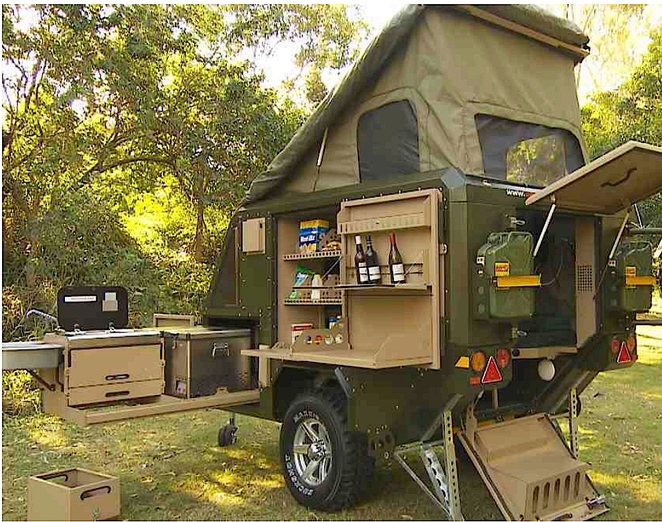
8Conqueror Australia’s UEV’s are rugged and versatile off-road camper trailers that have independent suspension systems and loads of cool campers features.

Each model comes with a fold-out kitchen, large hot water heaters, queen-sized beds, and lots more.

Sportsmobile

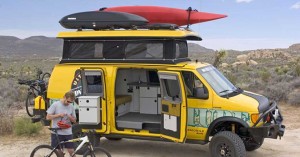
9-300x157

9Sportsmobile has been making customizable adventure campers since 1961. They convert Ford, Chevy/GM and Mercedes Benz vans into off-road vehicles.

As you can tell by the Sportsmobile featured above, they can get pretty tricked out.

Ford Push Button Camper

10-300x157

10Okay, it’s not a rugged all-terrain vehicle, but Ford’s 1958 push button station wagon camper is just too cool to leave off this list.

This one-of-a-kind camper contains a lifeboat and shelter that both unfold on the roof at the push of a button. It also has an unfolding kitchen with a refrigerator, sink and stove, and dozens of other automated gadgets.

Follow our FISHING BLOG

WEB   RATES     FISH    HUNT    CABINS    PHOTOS
TESTIMONIALS    BROCHURE    HUNT BOOKLET

Enter your email address to subscribe to this blog and receive notifications of new posts by email.

← Back

Thank you for your response. ✨

Email Me....


Tags: , , , , , , ,

Hunter Fends Off Grizzly by Shoving Arm Down Its Throat

Grizzly

Sticking an arm down the throat of a bear is regarded by some as an effective last-ditch tactic for fending off an attack.

There are few animals in North America as frightening as an adult grizzly, and if one of these massive animals get it in their heads to attack you, your day just suddenly got a whole lot worse. Twenty-six-year-old Chase Dellwo was expecting to bag some elk in the Montana back country near Choteau last Saturday, but a chance encounter with a bear ended with him sticking his arm into its roaring mouth instead.

That decision may have saved his life.

According to the Great Falls Tribune, Dellwo was bowhunting near a creek bed with his brother Shane. Strong wind and intermittent snow and rain kept visibility to a minimum, but the brothers heard elk bugles in the area and Dellwo was eager to make his first elk harvest of the year. The hunter had been steadily driving the animals toward his brother, but the weather also hid a sleeping grizzly, which Dellwo practically tripped over. At less than three feet, there was little that Dellwo could do before the animal charged him.

“I had an arrow knocked, and I put my bow up in front of me and took two or three steps back,” he told the Tribune. “There wasn’t any time to draw my bow back.”

The grizzly knocked Dellwo off his feet and bit him in several places across his head. It then reared back and gave what the hunter later described as the loudest roar he had ever heard, before attacking him again and biting his right leg. It was at this point that Dellwo recalled that an old survival tip about how bears have sensitive gag reflexes—so the hunter plunged his arm down the animal’s throat.  The bear promptly left.

Dellwo is not the first person to have stuck their arm down a bear’s throat and lived to tell the tale. The trick is commonly regarded as a last-ditch defense against bear attacks. As recently as last November, a hunter in British Columbia used to same trick to disable and ultimately kill a large grizzly sow near Fernie. According to CTV News, Wilf Lloyd was seriously mauled by the bear before he was able to stop its biting by jamming his hand down its mouth. While the bear was still on top of the man, Llyod’s son-in-law arrived and shot it dead with a rifle.

Lloyd also received a bullet in the leg during the chaotic struggle, but he did not blame his hunting companion in the least.

“The man saved my life,” Lloyd later said. “What Skeet did and because of his fast reaction, the shots, I had maybe fifty stitches in my hand and that’s it. So I was very fortunate that way.”

Dellwo echoed Llyod’s sentiment after his own bear encounter. Shortly after the attack, he was able to reunite with his brother and was transported to a local hospital, where he was treated for various cuts and punctures on his head and right leg. Dellwo expects to be back in the woods later this year for rifle season.

Officials with Montana Fish, Wildlife, and Parks are currently investigating the case and believe that the bear involved was a 400-pound male. Experts added that the brothers seemed to have done everything correctly and that the bear will likely not be tracked down since the attack was not predatory in nature.   By: Daniel Xu

Follow our FISHING BLOG

WEB   RATES     FISH    HUNT    CABINS    PHOTOS
TESTIMONIALS    BROCHURE    HUNT BOOKLET

Enter your email address to subscribe to this blog and receive notifications of new posts by email.

← Back

Thank you for your response. ✨

Email Me....


Tags: , , , , , , ,

Men’s Socks – Heat Holders


Keep feet warm on the coldest of days and pull on this pair of solid color crew length Heat Holders® for men, the warmest thermal sock.

Thick, chunky and with a massive tog rating of 2.34, Heat Holders® are made from a specially developed heavy bulk yarn which has extreme thermal qualities. With long pile cushioning, these thermal socks will help keep feet fully comfortable and supported.

The inside of each sock has been intensively brushed that not only feels sensationally soft but also traps warm air close to the skin keeping your feet warmer for longer.

original_dbbea0c0-8910-4acc-b452-58b5f13219ca_2048x2048

Heat Holders® are non-binding. They are diabetic friendly and provide relief for cold feet due to circulation problems.

Follow our FISHING BLOG

WEB   RATES     FISH    HUNT    CABINS    PHOTOS
TESTIMONIALS    BROCHURE    HUNT BOOKLET

Enter your email address to subscribe to this blog and receive notifications of new posts by email.

← Back

Thank you for your response. ✨

Email Me....


Tags: , , , , , , ,

Woman Sleeps Through Bear in the Kitchen

images6FA2N08KSara Edwards of Ketchum, Idaho, slept through a bear invading her kitchen.Wow, talk about a heavy sleeper. I think most people wouldn’t be able to sleep through a bear invading their kitchen. Add in a barking dog and the fact that the woman in this story was asleep on the couch right next to the kitchen, and her slumber seems even more remarkable. But, according to her husband David Edwards, it was a good thing his wife slept through the bear invasion.

According to the Edwards, a black bear broke into their home in Ketchum, Idaho, entered the kitchen and proceeded to lick the leftover Chinese food from a cast iron pan on the stove.

Edwards told the Idaho Mountain Express that he was awakened at 3 a.m. by his barking dog. Edwards walked past his wife, Sara, who was asleep on the couch, and his aggressively barking Irish setter-Lab mix, Stanley, to discover a black bear on its hind legs with its paws on the stove. The bear then stood up and looked at Edwards.

Edwards said that was the most shocked he’d ever been. His immediate thought was to wake up his wife and get her away from the kitchen. However, he said, “I couldn’t tell her there was a bear in the house because she would have just lost her mind. She gets very upset over spiders.”

imagesAMFF49EYSo instead, he simply woke her up and led her to the bedroom without mentioning the bear. Then he crept back into the kitchen to discover the bear had left through the wide-open kitchen door.   I wonder how his wife reacted when she found out she’d slept through a bear break-in.

Do you think you could sleep through a barking dog and a bear in the room next to you?     by:  Stephanie Mallory

Follow our FISHING BLOG

WEB   RATES     FISH    HUNT    CABINS    PHOTOS
TESTIMONIALS    BROCHURE    HUNT BOOKLET

Enter your email address to subscribe to this blog and receive notifications of new posts by email.

← Back

Thank you for your response. ✨

Email Me....


Tags: , , , , , ,