RSS

Category Archives: black bear

How to make bear tallow soap

44 oz. bear tallow

20 oz. olive oil
20 oz. coconut oil
12 oz. lye crystals
32 oz. cold water

When making soap it helps to have everything laid out and organized.
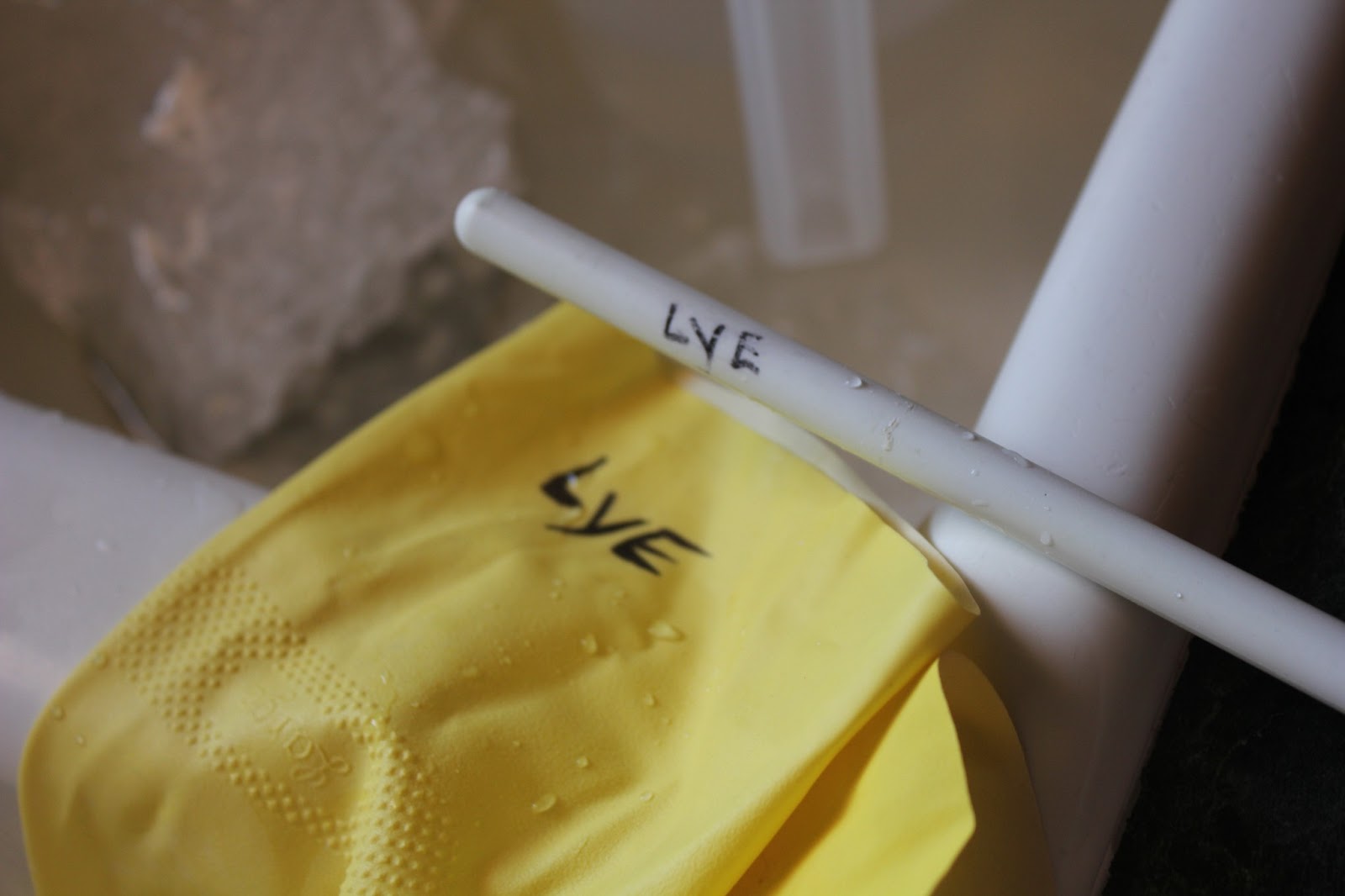
Here we have our lye, distilled water, equipment used only for lye which is labeled as such, and safety equipment.  While soap making is not hard you can never be TOO cautious with the lye.  Make sure you use gloves and safety glasses.  Wear shoes and long sleeves.
Lye is a base so if you do get some one your skin rinse off with vinegar(an acid).  Lye will also react with aluminum, cast iron, and steel.  For this reason we use some plastic, probably picked up at the dollar store.
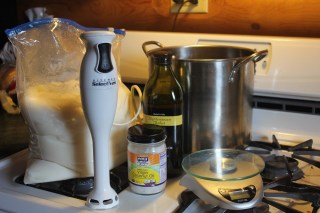
Here we have our oils all set up.  The zip lock bag is rendered bear tallow.  The pot and stick blender are only used for soap making.  You will also need thermometers for checking temps.  One for lye and one for oils. A scale is important for exact measurements.
If you are interested in making your own homemade soap, you are going to want equipment that will only be used for soap making.  Search your cupboards for bowls and pitchers you don’t use anymore.  Hit up some garage sales and thrift stores.  It doesn’t have to cost a fortune.
Like any hobby there is costs however this hobby will get you homemade soap that is better than any commercial bar out there!
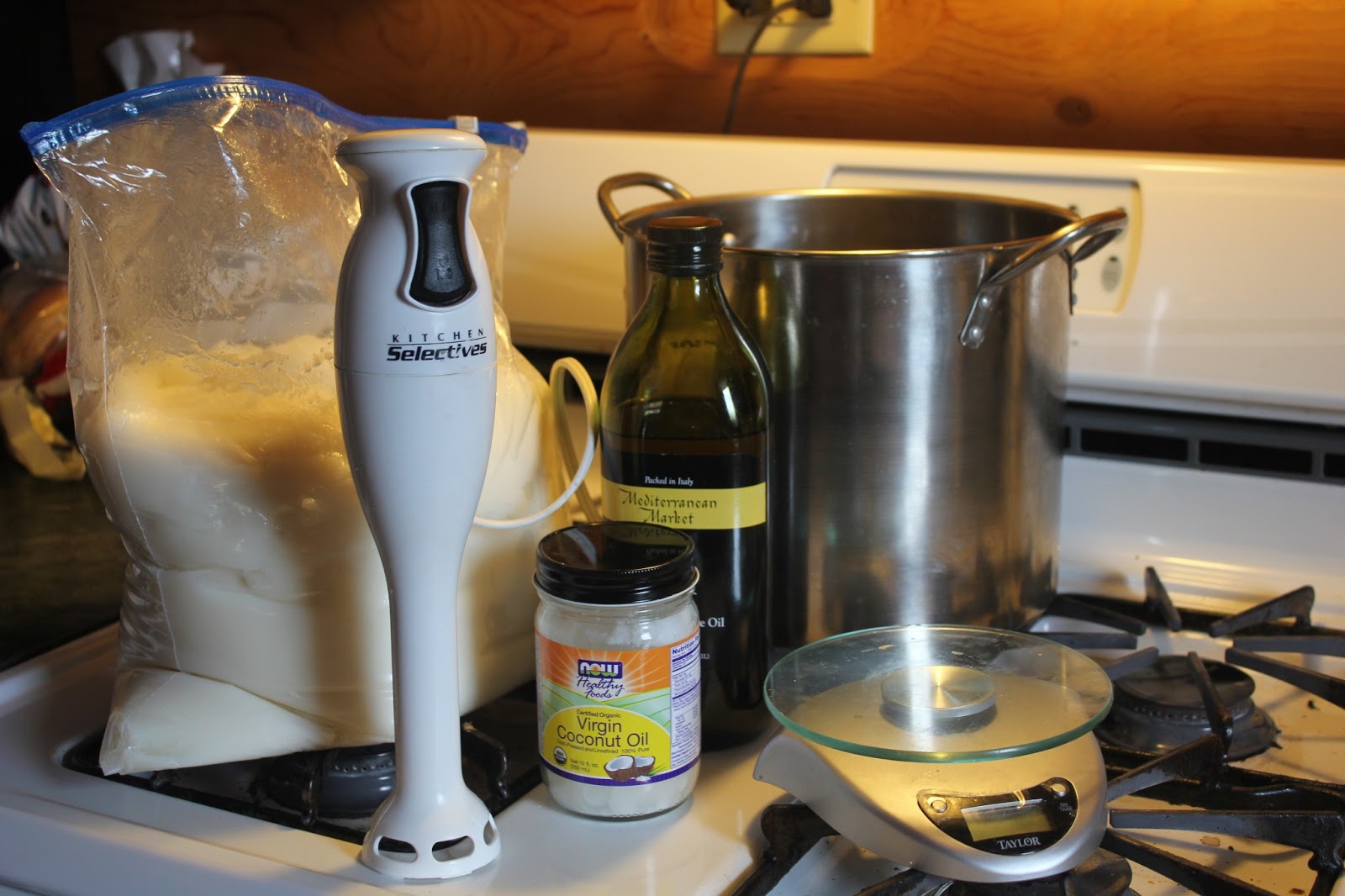
Closer look at that bear fat : )
Measuring out your fats and oils.
Pour oils into stock pot and slowly heat up.  For this recipe since the tallow is hard as is the coconut oil we found in order to melt all the fats down the oil heated up way past what we needed it at.  We then had to let it cool down.  This process took the longest.  For future note we will get the oil melted down well before we start the lye water.
When the lye hits the water it heats up fast.  The goal is to get it to the temperature down to what your soap recipe says.  In our case between 110-115 degrees.  To help cool it down we will stick the pitcher of lye water into a ice bath.  Another option would be to measure out your water the day before and freeze it.
While I was setting other stuff up I had my pitcher of distilled water sitting in the ice bath already.
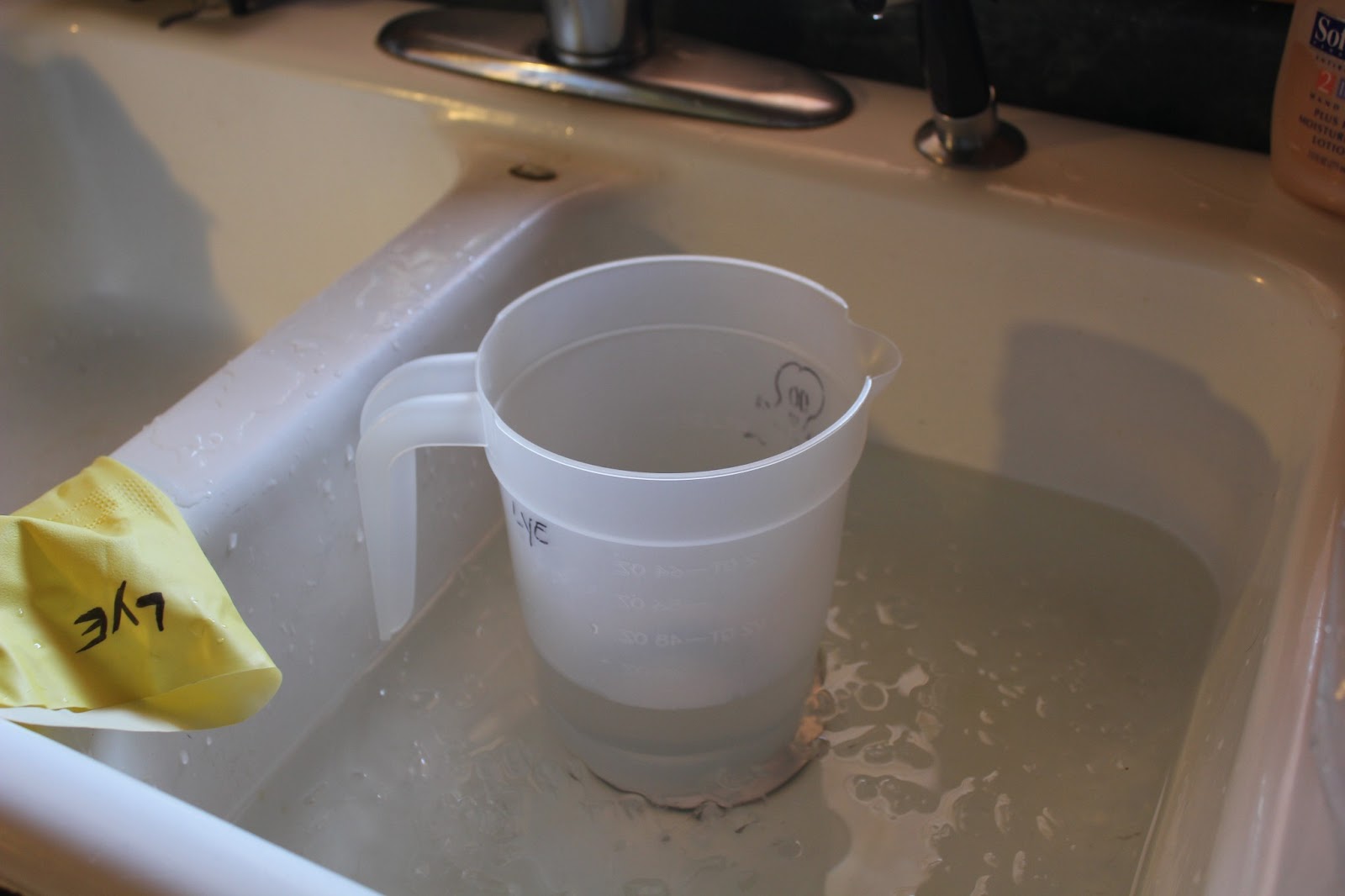
Measuring out the lye needed and where to find lye.  We have always had luck at Menards, and I haven’t tried anywhere else.  If you can’t find it ask, they don’t always keep it on the shelf and if they do they only keep one bottle on at a time.  Lye is often misused for horrible purposes.  Also, make sure it says 100% Lye.
Equipment just for lye.
Our oils are melting down so we will wait a bit to combine the lye and water.  You should have an idea if you are going to add other stuff to you soap.  It’s good to organize all that you need in exact measurements so they are ready.  You never know how fast things can move a long.  Better to have a little down time waiting on temps than being rushed and frazzled.  That’s when accidents happen.

You can add some extra fats after the soap traces for superfatting.  You can add fragrance or other additives for texture.
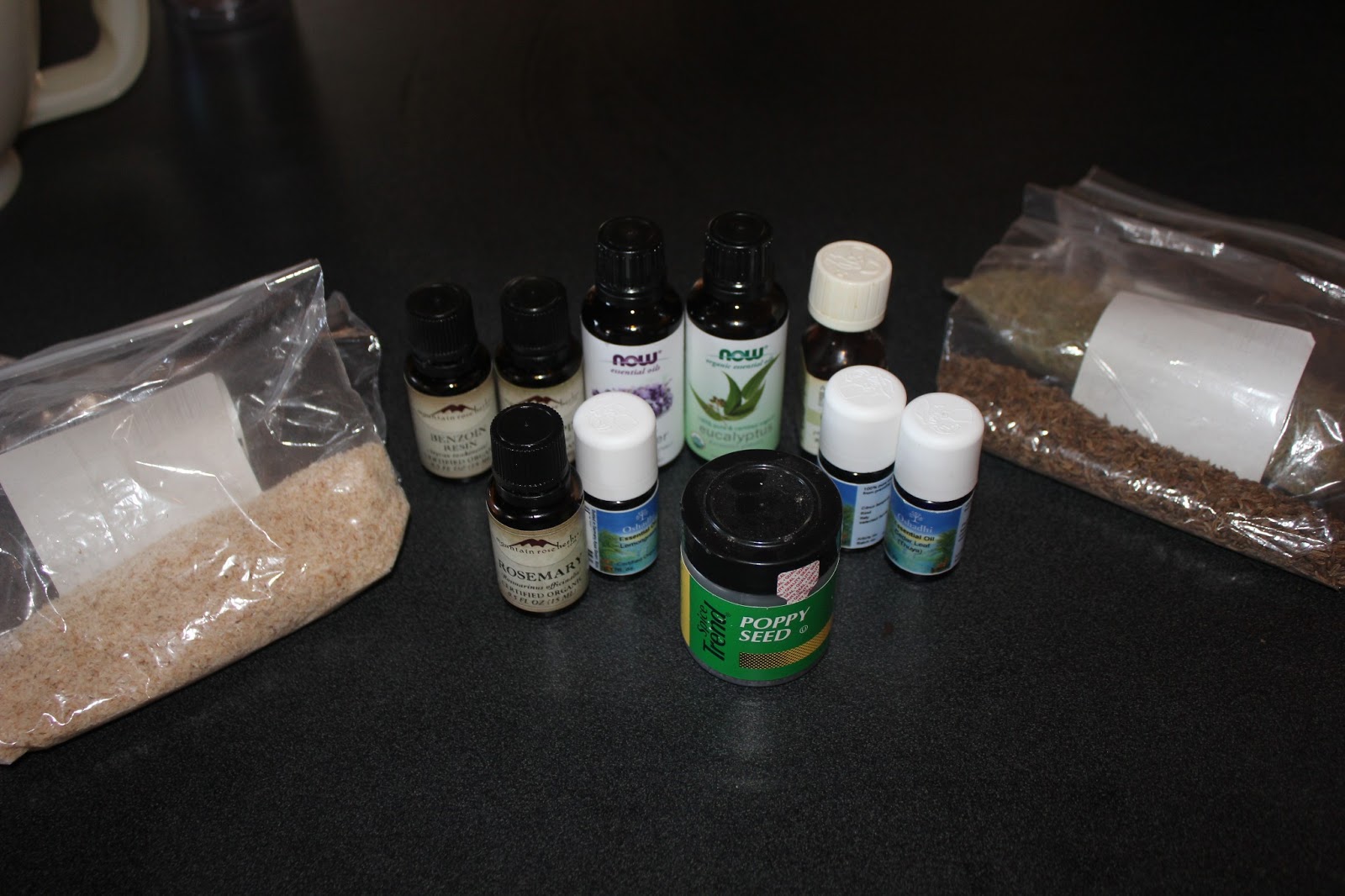
One of our batches is to be a “gardeners” soap.  We added rosemary and lemongrass essential oils for the scent.  For the exfoliant we added a mixture of poppy seeds, caraway seeds, dried rosemary, and psyllium seed husk whole.   If one was to recreate this they could just pick one.  We happen to have these four ingredients on hand so decided to do a mixture with all.
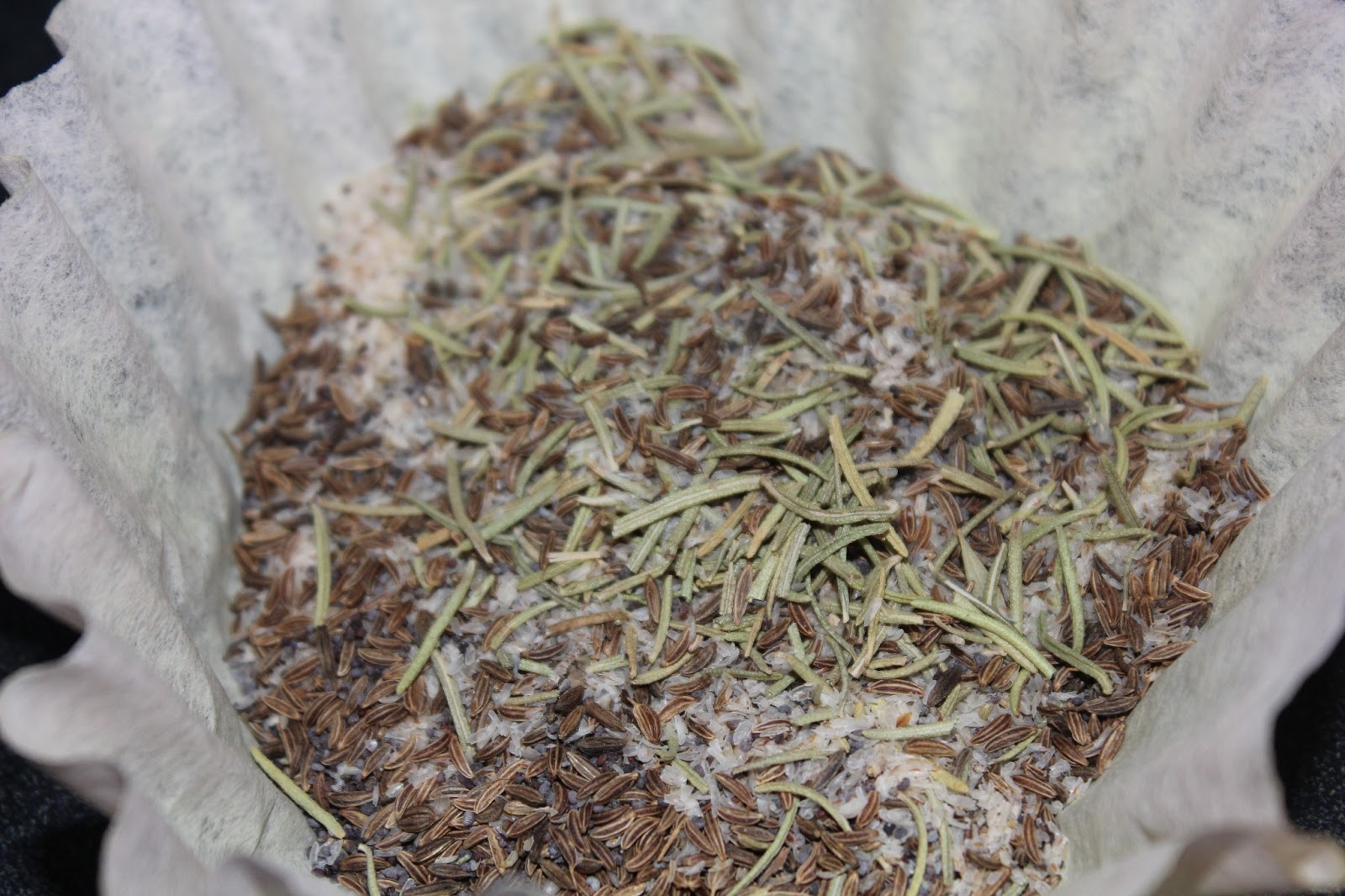
Exfoliant for our gardener’s soap.
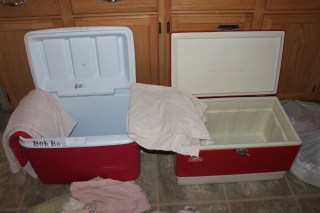
Another thing to ready before you get started is a place to keep the soap for the initial set up.  It is recommended that your soap should slowly cool down.  Most instructions will say to wrap your mold in towels.  We also place our molds in coolers.  Just helps insulate a little better and it’s safe from being bumped or knocked over.
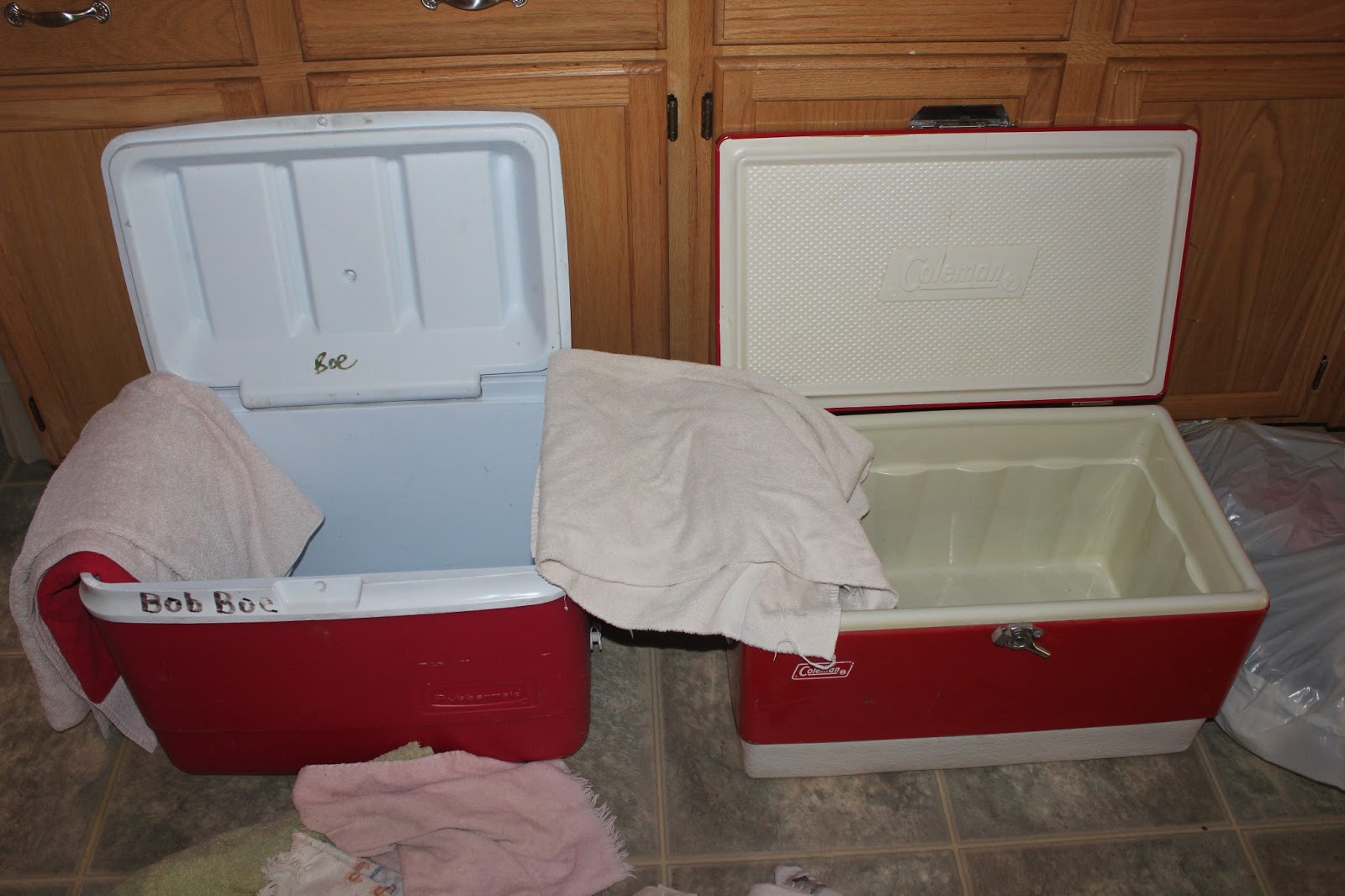
You will need something to mold your soap in.
Miscellaneous containers we have found here and there is what we use for molds.  Soap is initially caustic so over time the soap you make will break down the molds.  Ours were cheap so we are ok with that.
I really love the silicone loaf pan.  It holds a little over 2 pounds of soap and the soap always comes out so easy.  If you are using old tupperware it helps to line with wax paper and grease it down a bit.
Back to the lye and oil.  The oil and fats have melted down and are now cooling so we now are going to mix the lye and water.  Always pour the lye INTO the water and slowly!
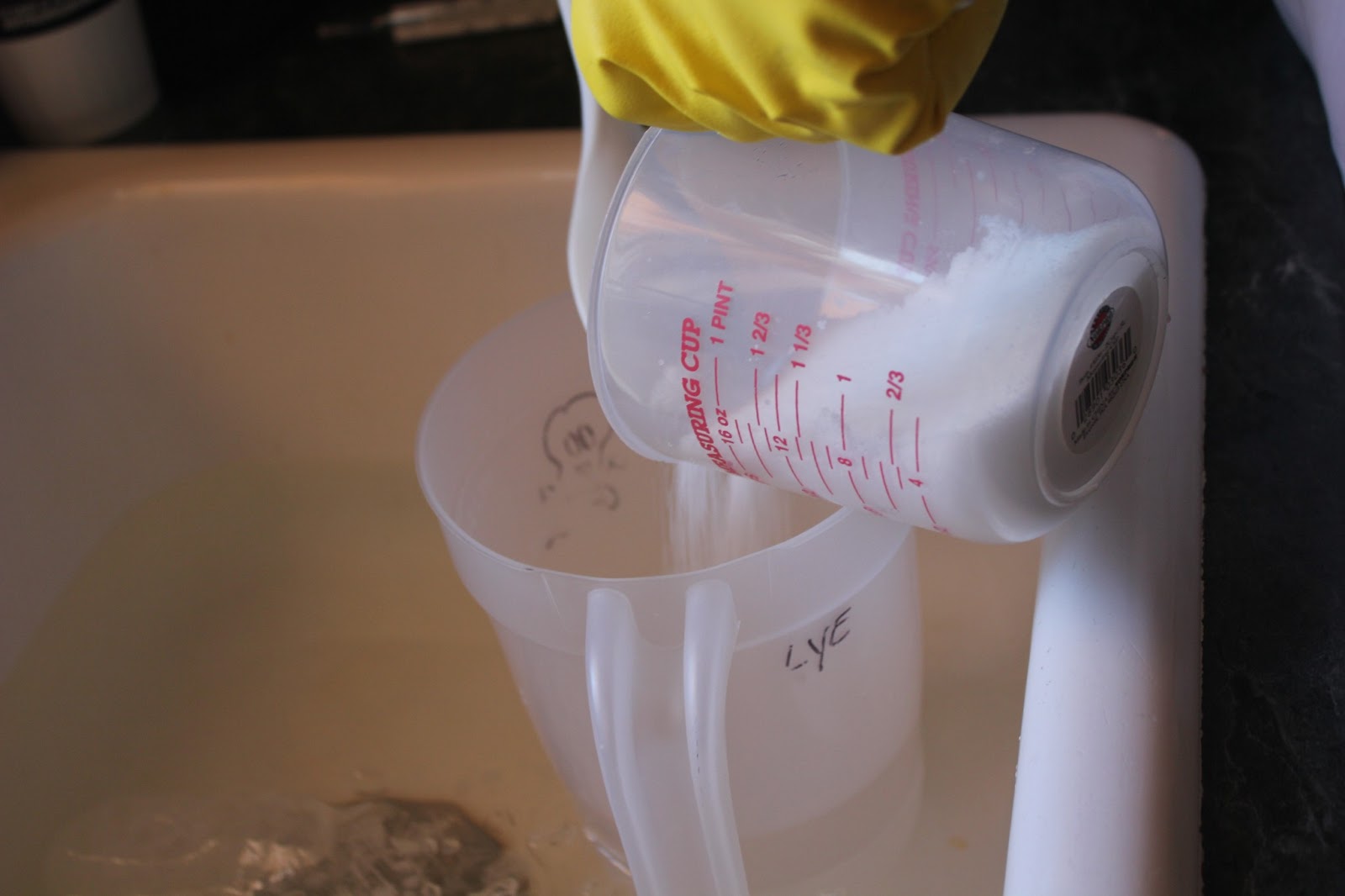
Make sure your gloves and safety glasses are on!
Stir it up and do not lean over it.  You could wear a mask during this step.  Make sure the area is well ventilated.  There will be harmful fumes.
Almost instantly the temperature gets to 150+ degrees.
Now we wait some more.  The oil is still cooling and now the lye needs to cool.  If your oil gets cooler before your lye just heat it up again.
When both reach desired temps pour lye water INTO oils.  Always.
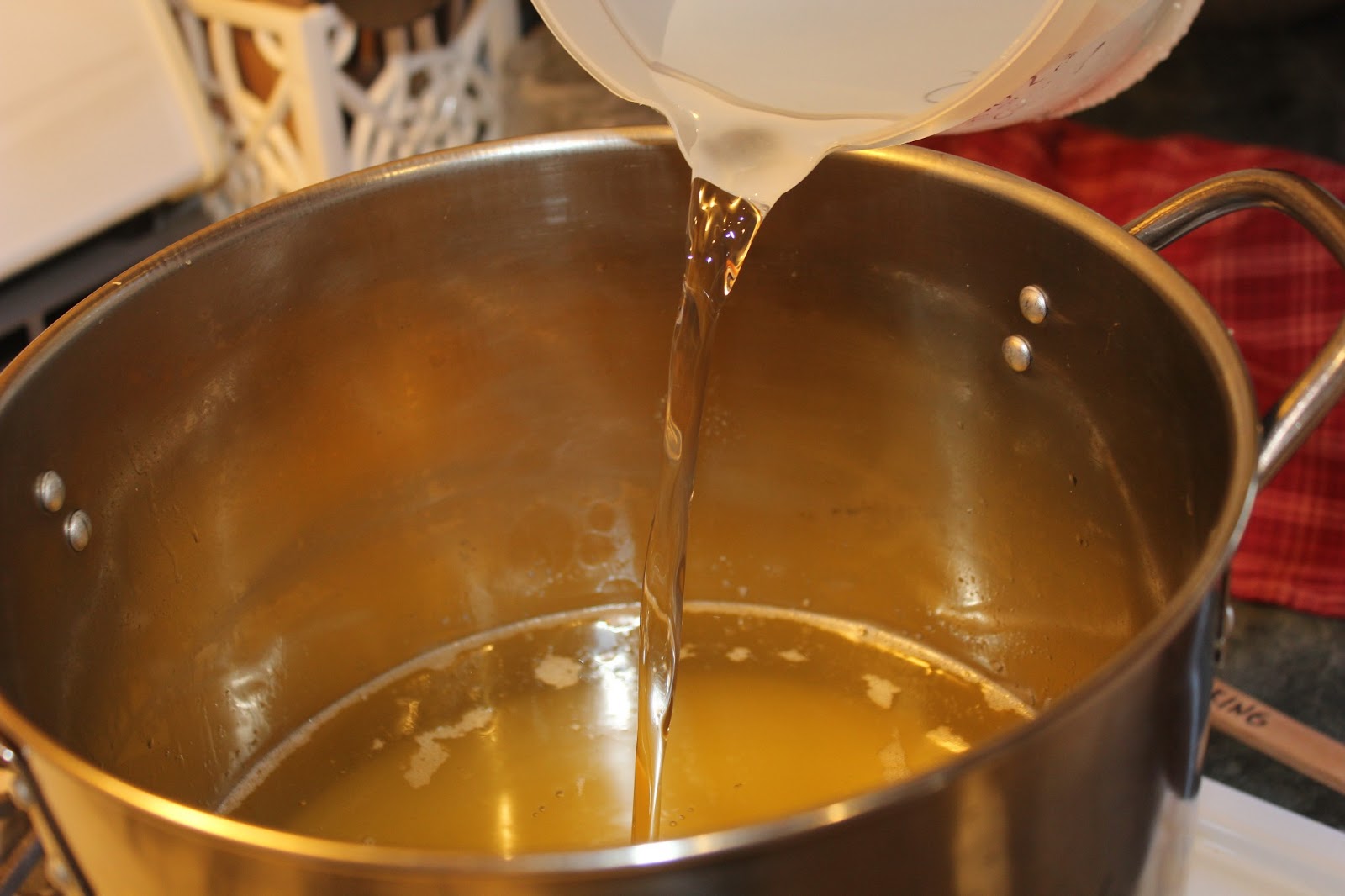
Very quickly the oils start to thicken.
The process of the lye and oils combining is called saponification.
Follow this link, they give a good description of saponification.
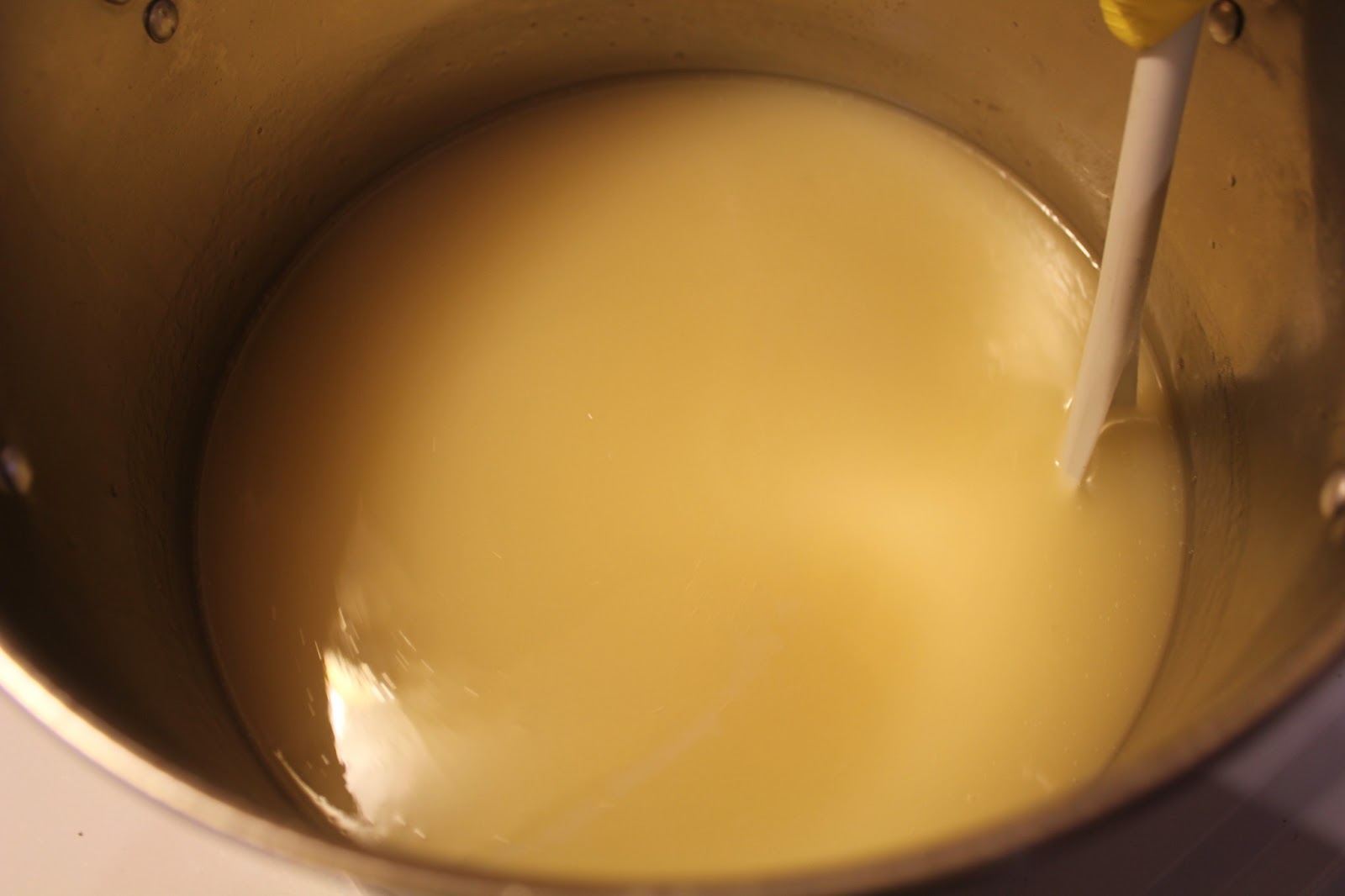
If you don’t have a stick blender you will need to stir by hand.  You will be stirring for a LONG time.  Time does vary based on the oils used, but it still takes a long time.  The stick blender is.a.LIFESAVER!
For this recipe I think we stirred with the stick blender for about 20 minutes.
You stir until the soap reaches trace.
Trace means the oils and lye have combined.
Now we have soap.  Add any other additives at this point.
What combination of fats and oils makes a good soap?
Here just a couple links I found that explain the different characteristics commons fats and oils used in soap making.
.
 
In a nutshell soap making directions.
  1. Collect ingredients
  2. Weigh ingredients
  3. Get fats/oils to desired temp
  4. Get lye water to desired temp
  5. Add lye water to oils
  6. Stir until trace happens
  7. Add any additives
  8. Pour into molds
  9. Let sit for about 24hrs
  10. Take out of molds, if hard enough, and cut.
  11. Cure for 4-6 weeks
  12. Always use caution when working with lye.
 
Leave a comment

Posted by on July 19, 2014 in black bear, Wawang Lake Resort


Tags: , , , , ,

Big mistakes NOT to make in your bear stand!

Part of the thrill of the hunt, is the anticipation knowing that with every second that ticks by, you are one second closer to harvesting your trophy black bear. What happens when those seconds turn into hours and then into days? Being under prepared to be in your stand for extended periods of time can be frustrating, and worse yet, can prevent you from achieving a successful hunt.

bearstand


It would be awesome if we knew when and where the harvest was going to take place, but that wouldn’t be hunting then, would it?

Having a plan in your bear stand can make your hunt much more enjoyable. Things to consider: weather, bugs, boredom and nature calls.

Weather – Avid hunters know that fall weather can change in a heart beat. It can go from warm, to cold, windy and raining in the blink of an eye. Having the right clothes in your back pack can make the best of a somewhat undesirable situation.

Bugs – can be a huge annoyance in the great outdoors. Especially when you are forced to sit still for extended periods of time. Avoid bug sprays when bear hunting… PERIOD! A new, unfamiliar scent, along with an intuitive feeling that something isn’t right, will keep trophy bears from over coming fear and committing to your bait. Bug jackets and bug nets are a must. (Oh, on side note, make sure you practice shooting with your bug net on). Regarding the portable propane bug eliminators, we highly advise against them as it is a new scent that can be detected by a bear easily and may quickly deter them.

Boredom – Nothing will end your hunt faster than impatience and constant movement in your stand. If you are like most guys who can’t sit still for more than 30minutes at a time, you must bring something with to occupy your mind. I personally use a book. I have also seen guys use those portable, pocket video games. Regardless of what you use, make sure you sit sill and only utilize things that will be quiet and non light reflective.

Nature Calls – Ever been in the stand when all of the sudden you have to take a pee? Sucks, doesn’t it? I don’t know how many times I have had this happen to me, yet somehow I always forget to bring a container along. Put a portable urinal on your packing list. Doing so will make the difference between shooting that monster and taking it’s offspring or nothing at all.  NEVER eliminate off of or near your stand!  There is nothing more offensive and frightening to a bear than knowing a human is directly near by.

This slideshow requires JavaScript.

Remember, being prepared to sit that stand can mean the difference between a very successful harvest or having to return and start all over again!


Tags: , , , ,

Grin and Bear it: How to bear eating bear meat.

As an outfitter, we often hear how many people would love to hunt bear but have no idea what to do with all the meat or if they did keep it, how to cook it (Ontario is a no waste province, it is mandatory to take all of the meat with you upon departure.)

Below is an excerpt from a great story written by Jackson Landers and how he dealt with an unexpected amount of bear meat…..and what he learned.


bearfordinner

Now I had heard all sorts of stories from hunters about what bear meat is like: that it’s tough, gamey, and unpleasantly greasy. But in my experience eating a fairly wide array of unusual species, I had found that meat that tastes “tough and gamey” is more often a case of bad butchering and sloppy handling than an intrinsic quality of a species.

To maximize the potential flavor of my bear, I dry-aged it for a week before I started experimenting. Dry-aging meat, for the uninitiated, is the process of letting meat hang out for a while at cool temperatures while allowing moisture to evaporate from it. Dry-aging accomplishes two things. First, natural enzymes in the meat begin to tenderize it by breaking down the collagen in the muscles. (Collagen is what makes tough meat feel tough, and more of it builds up in muscle tissue as an animal gets older.) Second, dry-aging allows water to evaporate out of a piece of meat, concentrating the flavor. High-end steakhouses all do this with their beef, and I have been dry-aging most of my venison in my fridge at home for years.

Once my bear was sufficiently dry-aged, the very first thing I tried was cutting some simple steaks out of a forequarter (the upper portions of the front legs) and from the backstraps (the cuts from alongside the spine that are referred to as “pork loin” in pigs). I wanted to keep the recipe simple so as not to hide the true flavor of the meat, but I also wanted to have some fun. So I just ran with the bear theme. I pan-seared the steaks in olive oil and drizzled just a bit of honey on them. A handful of blueberries went into the pan with them (bears love blueberries almost as much as they love honey). Then I transferred the meat to a covered dish to finish cooking in the oven and deglazed the pan with a splash of Toasted Head cabernet sauvignon, which I had chosen on account of the wine’s label having a black bear on it. I made sure to cook the meat to 140 degrees and hold it there for a while, since bears, like pigs, can carry trichinosis.

bearroast

My girlfriend and I sat down to eat our first bites of bear meat, drizzled with that red-wine pan sauce. The texture was good, and the backstrap cuts were a bit more tender than the forequarter cuts. The flavor was mild; it tasted more or less identical to venison—which is to say a lot like beef, only with less fat and a blander flavor. There was nothing greasy or tough about it. It looked like a thick piece of filet mignon. Between sips of the bear-bearing Toasted Head wine (which paired very nicely with the bear meat, I should add), we soon forgot that it was bear meat that we were eating. By the end of the meal, it was just dinner, no more exotic than the artichokes we served along with it.

Heartened, I started putting bear meat in everything. And once I began running it through the meat grinder, the stuff became a household staple. Think bear tacos, spaghetti with bear sauce, lime-marinated bear stir-fry served over ramen noodles.

moosestir

Bear burgers in particular were a big hit. I mixed one egg with 1 pound of ground bear meat and just a touch of onion powder and pepper and broiled them under high heat. Three minutes per side seemed to get me up over 140 degrees every time, without taking the burgers beyond medium-rare. I invited some friends over to eat them, and the unanimous agreement was that they simply tasted like very good beef burgers and that nobody would ever guess they were bear.

I began to take the ground bear meat so much for granted that I confess to feeding it to a dinner guest in a ragout over angel hair pasta without thinking to tell her that she was eating bear as opposed to beef. She ate every bite. I’m still not sure whether I should tell her what she ate.

Lately I’ve found myself worrying about the dwindling supply of bear meat in my fridge and freezer. I have one whole hindquarter in my chest freezer awaiting a special bear dinner with a group of friends, but other than that and a pound or so of medallions, all I’ve got left is an array of very unusual bones that my dogs have been chewing on in the front yard. What will I do when I run out?


← Back

Thank you for your response. ✨

Email Information regarding


Do you like what you see? Join us on our<a title=”Fishing Blog ” href=”wawangresort.wordpress.com”> Fishing Blog</a> for more up to the minute action, tips and tactics!!


Tags: , , , , , , , ,

2 spaces just opened up!!!!!

Due to a family event, 2 of our spaces have just opened up!  Take advantage of hunting the pristine boreal forest of Northwestern Ontario with one of the most successful outfitters in the industry.  Wawang Lake Resort has long been associated with hard work and determination which has lead our hunters to harvesting not only bear, but bear of substantial size!
Contact us for information on this fantastic opportunity to join us for our 2014 hunt!
 

Tags: , , , , , ,

Even Daytona Beach bears need a vacation!

DAYTONA BEACH, Fla. —After knocking over trash cans and scaring the residents of a Daytona Beach neighborhood Thursday, this black bear needed a rest.

After knocking over trash cans and scaring the residents of a Daytona Beach neighborhood Thursday, this black bear needed a rest.
More

Photographer Rafael Torres said he followed the bear as it climbed into a hammock on Glenbriar Circle and lied down.

Torres said he was about 60 feet away when he took the photos, and the bear didn’t seemed bothered by his presence. It stayed in the hammock for 20 minutes before heading back into the woods at about 8:15 p.m.

Torres said he has seen a lot of wildlife near that hammock, but this is the first black bear visit.

Read more: http://www.wesh.com/news/photos-bear-lies-down-in-hammock-in-daytona-beach/26247854#ixzz33Igvgghr


Tags: , , ,

Rise and Shine!

So spring has sprung…sort of….and it is apparent with the awakening of the bears 🙂  They are slowly emerging and letting us know that we should stop worrying about the snow…it should be gone soon!!

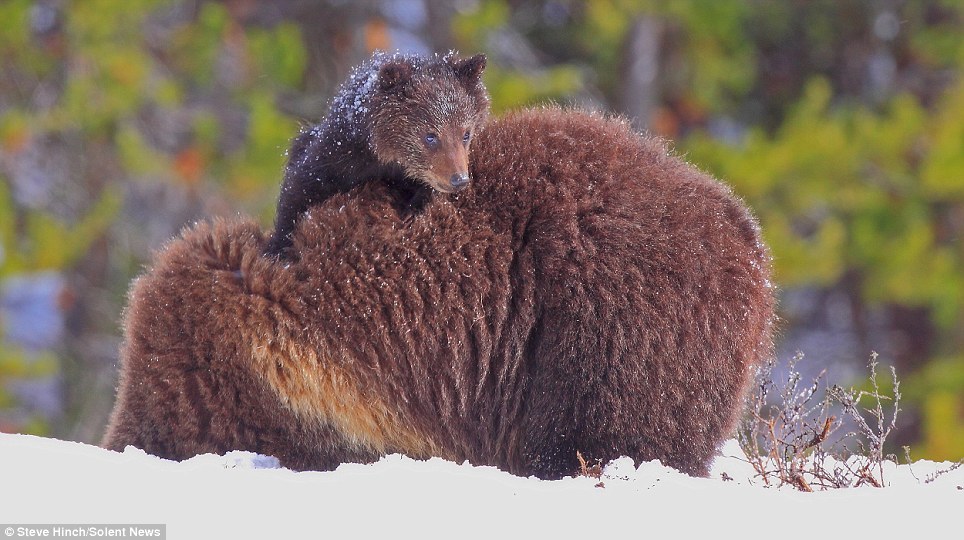
This is the first time that these babies have seen the snow……


No worries though, Momma is always nearby!

So for those that were worried that the snow would never leave, Mother Nature says just be patient…..it is just around the corner!

← Back

Thank you for your response. ✨

Email Information regarding


Leave a comment

Posted by on April 19, 2014 in black bear, Wawang Lake Resort


Tags: , , , , ,

A big bear sighting!

Well sometimes you just have to let a bear bare all!

← Back

Thank you for your response. ✨

Email Information regarding


Tags: , , , , ,

Field dressing a black bear

With the bear hunt just around the corner, we will cover the basics 🙂  Pictures have been withheld due to graphic nature.

Instructions

imagesFG3W4IGS 1. Clear an area surrounding the black bear. Make the area large enough to allow room to move around and roll the animal away from the entrails. The lowest part of the ground should be reserved for the entrails. Move the bear onto its back. Spread the rear legs and either have your partners hold them apart or secure them with ropes. Repeat with the front legs.

  1.  2. Insert one of your knives in the cavity at the base of the bear’s throat. Cut the blood vessels with a deep, crosswise motion to open the jugular vein and bleed the animal. Move the bear so the blood will flow away from it and clear the ground as needed.
  2. Cut the skin in a straight line from the breastbone — located just below the rib cage — to the base of the bear’s jaw. Cut the muscles along this area to the bone to expose the throat and windpipe. From the same starting point, cut the skin in a straight line down to the anus. Some areas require hunters to leave the genitals for sex identification; cut around the genitals slightly to preserve them.
  3. Split the breastbone.  This can be done with a bone saw, hack saw or a couple of axes.  If you choose to use axes, hold one axe against the breastbone and hammer it with the other axe; this will break the bone from the base of the rib cage up to and through the top ribs. Open the chest by pulling the front legs apart. Cut the windpipe and gullet close to the head. Lay them in the chest cavity for later.
  4. Cut through the abdominal muscles; start at the base of the rib cage. Take care not to puncture the intestines, the stomach or the bladder; doing so could taint the meat. Sever the muscles down to the pelvic bone. Enlist your partners to hold open the bear so you can work more smoothly.
  5. Break the pelvic bone by using the same technique implemented the breastbone. Do not cut the urinary tract as it may contaminate the meat. Start on one side of the chest cavity and use your knife to cut the diaphragm from the chest wall. Start at the base of the ribs and slice as far back into the cavity as possible. Have your partners pull the organs to the side so you can see and cut more easily. Repeat the process on the other side of the black bear.
  6. Cut the intestines and rectum from the split pelvic bone to where the rectum meets the muscle tissue at the anus. Cut a circle in the skin at the base of the tail; cut 1 to 2 inches from the anus. Cut the muscles to the top of the pelvic bone to free the anus and rectum. Pull the lower intestine, rectum and anus away from the cavity and hold clear. You must not puncture or cut the urinary tract or intestines.
  7. Hold the parts, roll the black bear away and allow the intestines and stomach to spill onto the ground. Grab the windpipe to pull the lungs and heart out onto the ground. Cut any remaining diaphragm tissue to free the organs. Complete the field dressing by draining as much blood from the bear as possible and wiping the body cavity with cloth rags to clean. Do not use water. At this point your main concern becomes to cool the cavity and prepare for transport which can be done by propping the cavity open with a tree branch.

    IMG_6110 - Copy

    Proper field care will ensure less weight and trouble with removal and transportation from the hunt site.

     For more information on black bear hunting, visit us at http://www.wawangresort.com

    Follow our FISHING BLOG

    WEB   RATES     FISH    HUNT    CABINS    PHOTOS
    TESTIMONIALS    BROCHURE    HUNT BOOKLET

    Enter your email address to subscribe to this blog and receive notifications of new posts by email.

    ← Back

    Thank you for your response. ✨

    Email Me....


Tags: , , , , , , ,

Black Bear…the basics.

Here is a fantastic and very basic overview of black bear, what they are and why we hunt them 🙂  In the case if Wawang Lake Resort, our outfitting is done in the fall, over bait and the average weight of our boars was 278lbs last year with 2 over 400lbs 🙂  Our sows, 180lbs with three over 300 🙂

Black Bear Hunting Basics

Black Bear Paw in Hunter's Hand

If you’re considering taking up black bear hunting or trying to decide if it’s right for you, it’s a good idea to get an overview of what it’s all about. There are a lot of misconceptions about black bear hunting floating around out there, so it pays to know exactly what you’re in for when you set out to hunt “America’s bear”.

In this article, we’ll cover the basics of black bear hunting, including population, seasons, weapons, meat, trophy items, and biology relevant to hunting.


Population, Seasons, and Weapons

Although the population of the black bear (Ursus americanus) is in decline in some areas of the U.S. (due to habitat loss), in other areas it is growing rapidly, and in still others it is at an all-time high. The total population of black bears in the lower 48 is estimated to be between 300,000 to 500,000, and the Alaska population is estimated to be 100,000 or more.

Black bear hunting is permitted in a little over half of the 50 states. Many Western states have black bear hunting seasons. In some of these states, hunters are allowed to take two black bears per year. Other popular areas include portions of the upper Midwest, the East coast, and the South. Even a handful of states in the East where black bear hunting has been prohibited for years have recently opened up limited seasons.

Black bears are hunted both in the spring and the fall. However, spring seasons are only allowed in about eight states, and spring hunting often requires applying for a lottery. Fall seasons are typically general seasons, and this is the time when most bears are hunted.

Black bears can be effectively taken with any of the typical weapons used for other big game, including rifle, bow, shotgun, muzzleloader, pistol, and crossbow. (As always, be sure to check your particular state’s game regulations.)

Meat and Other Items

Black Bear MeatBlack bear meat is considered by many to be a delicacy. In fact, even as recently as the late 19th century, bear dishes were some of the most expensive items on the menus at the finest, exclusive restaurants. “Bear bacon”, the whole, smoked hind quarter of a bear, was a prized staple in the diet of settlers on the American frontier. The meat is often compared to pork or lamb, but with a distinctive flavor all its own.

Interestingly, that flavor can vary quite widely depending on what the bear has recently been eating. The most highly prized meat comes from spring bears who have been consuming large quantities of grass and other vegetation as well as fall bears who have been feasting on berries, fruit, or nuts such as acorns.

Luckily, although they are omnivores, about 80-90% of a black bear’s diet consists of plant material, so your odds of having tasty meat are extremely good. Younger bears are also widely reported to have better meat than older bears. Assuming you take a younger bear that hasn’t been eating salmon or carrion, you’re in for quite a treat.

An important word of caution here: black bear meat often contains the parasite that causes trichinosis, an infection that usually results in either no symptoms or minor digestive discomfort but in rare cases can cause more serious complications and even death (although only in less than 0.3% of cases).

Fortunately, there is a simple remedy for this. All bear meat must be cooked completely through until there is no visible pink in the meat. Cooking the meat to an internal temperature of 137 degrees is hot enough to make it safe, although the USDA recommends an internal temperature of 160 degrees. Freezing the meat has not been shown to be adequate protection against trichinosis.

Another highly edible part of a black bear is the fat. Bear fat (which is quite plentiful in fall bears) can be rendered to produce a useful and particularly flavorful cooking oil. Even from a modestly sized bear, you can easily get a couple gallons of this precious liquid.

In addition to the meat and fat, there are also a few prized items to be had from a black bear. First, the fir is soft and luxurious, and many hunters keep the hide and turn it into a rug or even clothing such as a vest. Black bear skulls are fascinating thing to look at, and they’re a great conversation starter when displayed up on the mantle or other prominent location.

Biology Relevant to Hunting

Black bears can vary greatly in size, depending on genetics, the quality of the habitat in which they live, and their gender and age. Mature boars (male bears) can weigh in at over 800 pounds in rare cases. The average adult male, however, weighs between 180 and 300 pounds, while the average adult female weighs slightly less, between 140-250 pounds. You can expect to net about 30% of the live weight in meat. For example, a 200 pound bear may produce up to 60 pounds of meat.

Black bears possess impressive athletic abilities. They can sprint at speeds over 30 mph, can climb trees with ease, and are accomplished swimmers. They also have short, curved, sharp claws and canine teeth capable of ripping and tearing flesh. With these traits, it’s easy to see why they fit squarely into the classification of dangerous game.

While black bear attacks are exceedingly rare, even for bear hunters, they do happen. And tracking wounded bears means the danger increases exponentially. The tracking is bound to take you through dense cover, and the bear’s thick fir soaks up blood fast, making for sparse blood trails to follow. Bears have even been known to loop around and double back on their trail, lying in wait for pursuing hunters. However, with proper preparation and planning, as well as solid shot placement, most bears can be recovered safely and without incident.

Note: In regions where black bears share their range with grizzly bears, it’s important to know how to identify the two bears and tell them apart so you don’t accidentally shoot a grizzly bear, which is a violation of federal law. Here’s a handy bear identification training you can take online for free so you can know for sure before you pull the trigger.

The size of a black bear’s home range can vary greatly depending on the location of food sources in the area. It can be as small as a couple square miles or it can be much larger — a male’s home range may go all the way up to 75 square miles in extreme cases. Bears are opportunistic omnivores, which means their movements are often unpredictable. This wandering lifestyle requires specialized tactics, the most common being spot-and-stalk, baiting, hunting with hounds, and calling.

Regardless of which tactics you employ, you’ll need to defeat a bear’s considerable arsenal of finely tuned senses if you want to have any hope of getting close enough for a shot.

Sense of Smell

First and foremost is their sense of smell, which is thousands of times better than a human’s. In fact, it’s been shown that if you take a bloodhound’s nose and multiply it by about seven, you’ll get a sense of the black bear’s olfactory powers.

There are both defensive and offensive strategies you can use in order to overcome these powers and get within range of a bear without it smelling you. On the defensive side, it’s wise to use as many scent control measures as logistically possible. More importantly, always keep tabs on the wind and make sure you’re hunting into it. A windchecker device, such as a small spray bottle filled with unscented talcom powder comes in real handy for this, as does a fine, frayed string tied to the end of your gun or bow.

You can also go on the offensive and use the wind to your advantage. With good scouting and planning, it’s possible to hunt with the wind at your back, allowing your scent to move out ahead of you and drive bears toward another hunter in a treestand or other fixed position.

Sense of Hearing

Next up is their sense of hearing, which is thought to be significantly better than a human’s, although it’s not known exactly how much better. They can detect a human voice at 300 yards and the cocking of a gun at 50 yards.

Your best defense against a bear’s ears is to simply be quiet. Move slowly and carefully, wear quiet clothing, and speak in whispers to your hunting companions. On the offensive side, always keep your ears tuned for bear sounds. Bears make noise when feeding, such as turning over rotten logs looking for grubs, and they communicate with each other through woofs, sniffs, grunts, and growls.

Sense of Sight

Contrary to popular belief, bears do, in fact, see in color. Their vision is roughly equivalent to a human’s — better, if you include the fact that they have excellent night vision. Although they’re somewhat near-sighted, they are adept at detecting movement, even at long distances.

To win the battle of the eyes, you’ll need to have a solid defensive plan. It’s very important to wear full camouflage and choose a pattern that breaks up your outline and matches the local vegetation well. More importantly, always move slowly and cautiously, and never move when a bear is looking in your direction.

As for offense, always carry a pair of high quality binoculars. The black color of a bear’s fur can make them a little easier to spot than other big game like deer. Carry your binoculars on your chest with a harness or “bino bra”, and use them often. When hunting open country using spot-and-stalk tactics, you can also employ a high-power spotting scope to give your eyes even more reach.

More on this next time…………………

← Back

Thank you for your response. ✨

Email Information regarding


Tags: , , , ,

Nothing to see here…but a BEAR IN THE VEGETABLE AISLE!!!

Imagine heading in and running for your regular fare and WHAMO! you find a bear cub in your celery!!  I guess I am not as worried about the cub as I am to know where his mama is….maybe she is just picking up a carton of milk?

← Back

Thank you for your response. ✨

Email Information regarding

 
Leave a comment

Posted by on February 3, 2014 in black bear, Wawang Lake Resort


Tags: , , , ,