RSS

Author Archives: Wawang Lake

Unknown's avatar

About Wawang Lake

Two young kids moved into the remote region of NW Ontario and took with them a dream........ 'It became Wawang Lake Resort' Welcome to Wawang Lake Resort's BLOG and hope that you'll enjoy what we have to write about and hope that you'll join us. This is where you will find information regarding our resort, personal stories, fishing tips & techniques, hunting do's and don'ts and general outdoor activities. If you're looking for some good fishing and hunting information - then browse our articles related to your specific interest. We look forward to you blogging with us follow us and your opinion matters!

Canning Wild Game

mainMeat, poultry, and game are low acid foods and must be canned or processed in a pressure canner to assure it is safe to eat.

1. Canning frees up freezer space for other things.
2. Pressure canning can make the less tender cuts versatile.
3. Home canning meat means jars of meat on the shelf ready to go at a moment’s notice. No defrosting time. Ever tried to defrost an elk roast quickly in the microwave because you forgot to take it out earlier? Doesn’t work so well. (Ask me how I know!)
4. The best benefit? My guys love it. We are an active hunting family with 4 sons. Much of our meat is provided by the men of hunting age in our family.

Meat, poultry, and game are low acid foods and must be canned or processed in a pressure canner to assure it is safe to eat.

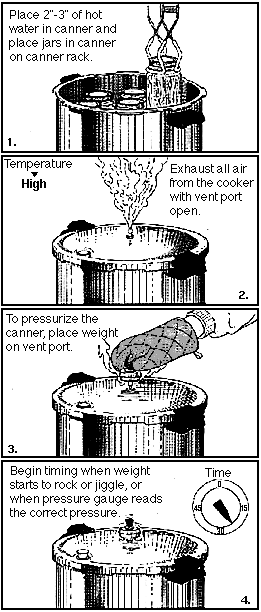
11 pounds pressure with a dial gauge pressure canner
15 pounds pressure with a weighted gauge pressure canner for required times.
Choose only good meat for canning, and handle it quickly and with total cleanliness, because bacteria grow rapidly in meat held at room temperature. If you have a large amount, store the part you’re not working on in the refrigerator.

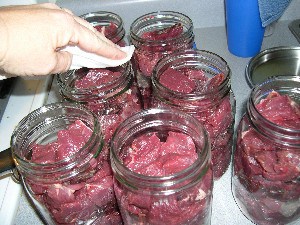
canning-venison21You can:
Start with properly cleaned and chilled product.
Can fresh meat and poultry within 2 days or freeze it.
To can frozen products, thaw in the refrigerator until most ice crystals have disappeared, then handle as if they were fresh.
Trim gristle and fat off meat before canning. Fat left on meat melts and climbs on the sides of the jar during processing and may interfere with the sealing of the lid.
Salt is optional in canned meat and poultry.
Fish should be canned immediately or frozen until processed.
For large game animals (deer), follow beef processing times and methods.
For small game animals and birds, follow poultry processing times and methods.
Use canned venison or canned elk in stews, meaty soups, and even chili. You can use it to make Sloppy Joe’s and killer Enchiladas.

canning-steps-one

Follow our FISHING BLOG

WEB   RATES     FISH    HUNT    CABINS    PHOTOS
BROCHURE    HUNT BOOKLET

Enter your email address to subscribe to this blog and receive notifications of new posts by email.

← Back

Thank you for your response. ✨

Email Me....


Tags: , , , , , , , , , , ,

Big Mistakes NOT to Make in Your Bear Stand

Part of the thrill of the hunt, is the anticipation knowing that with every second that ticks by, you are one second closer to harvesting your trophy black bear. What happens when those seconds turn into hours and then into days? Being under prepared to be in your stand for extended periods of time can be frustrating, and worse yet, can prevent you from achieving a successful hunt.

bearstand

 It would be awesome if we knew when and where the harvest was going to take place, but that wouldn’t be hunting then, would it?  Having a plan in your bear stand can make your hunt much more enjoyable. Things to consider: weather, bugs, boredom and nature calls.

Weather – Avid hunters know that fall weather can change in a heart beat. It can go from warm, to cold, windy and raining in the blink of an eye. Having the right clothes in your back pack can make the best of a somewhat undesirable situation.

Bugs – can be a huge annoyance in the great outdoors. Especially when you are forced to sit still for extended periods of time. Avoid bug sprays when bear hunting… PERIOD! A new, unfamiliar scent, along with an intuitive feeling that something isn’t right, will keep trophy bears from over coming fear and committing to your bait. Bug jackets and bug nets are a must. (Oh, on side note, make sure you practice shooting with your bug net on). Regarding the portable propane bug eliminators, we highly advise against them as it is a new scent that can be detected by a bear easily and may quickly deter them.

Boredom – Nothing will end your hunt faster than impatience and constant movement in your stand. If you are like most guys who can’t sit still for more than 30minutes at a time, you must bring something with to occupy your mind. I personally use a book. I have also seen guys use those portable, pocket video games. Regardless of what you use, make sure you sit sill and only utilize things that will be quiet and non light reflective.

Nature Calls – Ever been in the stand when all of the sudden you have to take a pee? Sucks, doesn’t it? I don’t know how many times I have had this happen to me, yet somehow I always forget to bring a container along. Put a portable urinal on your packing list. Doing so will make the difference between shooting that monster and taking it’s offspring or nothing at all.  NEVER eliminate off of or near your stand!  There is nothing more offensive and frightening to a bear than knowing a human is directly near by.

This slideshow requires JavaScript.

Remember, being prepared to sit that stand can mean the difference between a very successful harvest or having to return and start all over again!

Follow our FISHING BLOG

WEB   RATES     FISH    HUNT    CABINS    PHOTOS
BROCHURE    HUNT BOOKLET

Enter your email address to subscribe to this blog and receive notifications of new posts by email.

← Back

Thank you for your response. ✨

Email Me....


Tags: , , , ,

Checklist for Backpacker’s

Checklist for Backpacker’s

Follow our FISHING BLOG

WEB   RATES     FISH    HUNT    CABINS    PHOTOS
BROCHURE   HUNT BOOKLET

Enter your email address to subscribe to this blog and receive notifications of new posts by email.

← Back

Thank you for your response. ✨

Email Me....


Tags: , , , , , , , ,

Hunting: Muzzleloader

Muzzleloaders are a lot of fun to shoot! The concept of a single shot makes shooters try to do their best on every shot. Large puffs of smoke belching from the muzzle after each shot, makes this a very visual shooting sport. As well, muzzleloaders are capable of firing a variety of bullet weights and powder charges, giving them the ability to be a multi species firearm.

For years, people have shot muzzle-loading guns. Most shooters fired old style flintlock guns with open sights. Some shooters found these early muzzle-loading firearms reminded them of their forefathers and helped these individuals re-live the past. However, for many shooters, these guns were unappealing, inaccurate and were a royal pain in the butt to shoot and clean. Thus, there were a very limited number of people involved in muzzleloader shooting and hunting.

Over the course of the past several years, the interest in muzzleloaders and muzzleloader hunting has grown and continues to grow. Much of this growth is due to several gun manufacturers developing inline muzzle-loading rifles that are built with today’s technology, using yesterday’s ideas. These fine firearms are fun and easy to use, have high percentage ignitions and are highly accurate. In addition, they’re easy to disassemble and clean.

These new muzzle-loading guns resemble modern center-fire rifles. They have excellent safety mechanisms and precision rifled barrels. Many of them come tapped and died directly from the factory, so all a shooter has to do is add bases, rings and a scope. It’s very common these days for shooters using in-line muzzleloaders with scopes to achieve one inch groups or better at a hundred yards.

Along with the invention of new muzzleloaders, there has also been a major advancement in gun cleaning solutions. There are all kinds of effective no fuss, no mess gun cleaning solutions designed specifically for muzzleloaders. These new cleaning chemicals make cleaning muzzleloaders a breeze. With these new products, gone are the hours of cleaning after each session at the range or in the field!

Hunters are also quickly discovering that muzzleloaders offer new hunting seasons, high levels of success and many other unique opportunities.

Extra Seasons and Hunting Benefits
Many states and provinces, including my home province of Saskatchewan offer special muzzleloader hunting seasons that are separate from regular rifle seasons. Many of these special seasons are approximately a month before the regular rifle hunting seasons and are often set up to coincide with or run just before the peak rut of the big game species. Hunting with a muzzleloader during these bonus time periods can prove very exciting and productive. Antelope, deer, moose and elk become more mobile and visible just prior to and during their rutting periods as they try to prove their dominance or search for mates.

In many jurisdictions, special muzzle-loading seasons are often held after all other hunting seasons are over. Typically, these extra seasons are several weeks long. They give hunters ample opportunity to get out in the field and get in some bonus hunting action when big game animals are often patternable as they concentrate on cold weather feeding areas.


Inline muzzleloaders such as this one, have made muzzleloader hunting for
big game animals, much more enjoyable.

During muzzleloader seasons, there are usually fewer hunters in the field than during a regular rifle season. This gives muzzleloader hunters an excellent opportunity to harvest an animal. Fewer hunters means less pressure and less pressure means that the animals should continue acting in their natural ways. With the animals’ daily habits remaining unchanged, muzzleloader hunters should be able to pattern the animals. If the hunter is able to determine when, where and why an animal will be in certain location, it should increase the hunter’s odds for success.

Since in many areas muzzleloader seasons generally start before the rifle seasons, the muzzleloader hunter is able to get a jump on the rifle hunters. This early start accompanied with the fact that there are fewer hunters in the field, should allow the muzzleloader hunter to see more animals and get more opportunities at harvesting a big game animal before the rifle hunters move in.

Muzzle-loading Tactics
Using game calls to attract big animals can be very productive during the muzzleloader seasons. Whitetail and mule deer will often respond to grunt and bleat calls. In the early part of the season, when the rut is just starting to fire up, they may come to your call out of curiosity. If this is the case, be patient as their approach will typically be very slow. Later in the season when the rut is in full swing, be prepared for fast action, as the deer may come storming in to investigate your call.

Many a muzzleloader hunter has rattled in a whitetail deer. To be successful during the early part of the season, you should just tickle your rattling antlers together to stimulate a minor sparring match. Try to scrape your rattling antlers on trees and bushes, trying to fool a buck that there is another buck in his territory. Later in the season, when the rut is more advanced, you can use more aggressive rattling techniques to stimulate full-scale battles.

Elk can be called into range with bugles or cow calls. If the bull elk are bugling, try bugling back to them. With any luck, they will respond and move into muzzleloader shooting range. If the bulls are not calling, try using a cow call to entice them into shooting range. Often a simple series of cow calls will bring in an entire herd of elk.

If you get a chance to hunt moose just prior to the breeding period, bull grunts can be used to effectively coax a bull into range. The reason for this is that bulls will be competing with one another for dominance. However, if it’s breeding season, the bulls will be more interested in checking out the call of a cow in heat as opposed to responding to a bugling bull looking for a fight.

Some muzzleloader hunters pursuing antelope will use a decoy to try and lure in their buck. Although this technique can be highly productive, it can also be very dangerous. Other hunters may see the decoy and be fooled by it. The result could be someone shooting at the decoy and killing or injuring the hunter hiding behind the decoy. In most antelope/muzzleloader situations, I prefer to set up near a watering hole and try to catch a love struck buck as it comes in for a quick drink.

Added Bonuses
Muzzleloader hunters are usually able to go hunting in decent weather conditions. During a typical muzzleloader season, the temperatures are usually moderate to warm. Snow and winter blizzards are a rarity. This means the traditional hunting attire of long johns, toques and parkas can be replaced by T-Shirts, sweat shirts, light jackets and ball caps.

Many gun ranges have realized the growth of muzzle-loading. As a result, special muzzleloader ranges have been built to meet the unique needs of smoke-pole shooters. Having spent time on such ranges, I have found that muzzleloader shooters tend to be friendly, outgoing individuals who are willing to help other shooters, teach them tricks of the trade and talk hunting and shooting for hours on end.

Book, magazine publishers and Internet websites, such as www.biggamehunt.net have also recognized the growth of muzzle-loading. Over the past few years, there has been a steady growth in the number of books and articles published on muzzleloaders and muzzle-loading hunting. With increased access to product reviews, reference materials, hunting stories and hunting techniques, muzzleloader shooters are able to learn more about their sport. Increased knowledge means greater satisfaction and a greater desire to participate in the sport.

Game of Accessories and Gadgets
Muzzleloader shooters will also find that shooting a muzzleloader requires a variety of accessories and gadgets. These items are fun to accumulate. They are even more fun to use!


A few accessories: bullets/sabots, ram rod T-handle, cleaning jag, wire brush,
ball/quick starter, speed loader and cleaning solution are needed for your muzzleloader.

The ramrod is probably the most used muzzleloader gadget you require. One of the main functions of the ramrod is stuffing bullets down the barrel. However, it is also used for maintaining and cleaning the muzzleloader barrel. Ramrods are typically threaded on both ends for adding a variety of gun care attachments.

In addition to your ramrod, you’ll also need a jag (ribbed attachment for cleaning), ramrod extension, bullet puller and a short starter or bullet starter.

For those shooting loose powder, a powder measurer and a flask are essential. For a couple of dollars, you can also get a powder can nozzle that allows you easily pour powder right out of the can.


Just a few of my favorite things: bullets/sabots, speed loader, powder flask,
powder measurer, T-handle, ball/quick starter and a jag.

Whether you shoot loose powder or pellets, express loaders are a very good investment. These small tubes are made to hold a bullet and premeasured charge of powder. Express loaders make reloading a quick process and one that you’ll appreciate, especially when you have a 1200 pound moose requiring a second shot coming straight at you.

A capper unit serves a dual role of helping you put percussion caps on your gun’s nipple and allowing you to carry a few spare percussion caps. Speaking of nipples, a nipple wrench is necessary for removing and replacing the muzzleloader’s nipple. In most muzzleloaders, the nipples must be removed before the gun can be cleaned. Since the nipples are threaded and generally tucked away, a specialized nipple wrench is another must.


A variety of muzzleloader accessories resting on a possibles bag. Included are a powder flask, primers, ball/quick starter, powder measurer, capper and a speed loader.

Black-powder and pyrodex are highly corrosive propellants as they attract moisture. At a minimum, you require cleaning patches, a wire brush, cleaning solutions and gun oil. However, as previously mentioned, with today’s technologies, there are a variety of cleaning solutions and accessories that help make muzzleloader cleaning an easy event.


Cleaning is made easy these days!

After shooting your muzzleloader, you should clean it. For best results, get in the habit of cleaning it after every hunt. If you shoot your gun and store it away without cleaning it, you’ll be in for a big surprise (and it won’t be pleasant) the next time you go to use your muzzleloader.

A small glass jar with a lid on it is ideal for soaking small parts in cleaning solution. As well, an old toothbrush works great for cleaning hard to reach areas of your muzzleloader.

You will require a good set of screwdrivers for taking your gun apart and ensuring that everything is tight. Teflon tape is great for wrapping around the threads on the gun’s nipples. A simple wrap of teflon tape makes the nipple easier to remove and prevents it from seizing. If you are shooting your muzzleloader with a scope, a roll of electrical tape is a good investment. Since black powder and pyrodex are so corrosive, you can save damage to your scope’s finish by covering the scope tube with electrical tape.

When hunting, you will need to carry your muzzleloader accessories with you. Some hunters like to go with backpacks or bags they can carry, while other prefer a pouch that attaches to their belt. Whatever style you choose, make sure that it is big enough to carry all the equipment that you need, yet not so bulky that you continually leave it at home or in your truck. As well, make sure it seals shut, so that you don’t loose your equipment as you stalk across the countryside.

Limitations and Potential Restrictions
Muzzleloaders have changed dramatically over the past few years. However, it’s important to remember that they are still only capable of firing one shot at a time. In addition, they also have a limited effective range. While stories abound of hunters taking big game animals at long range shots with muzzleloaders, they really are a close to moderate range firearm. While many of the new in-line muzzleloaders loaded with a maximum charge have the capability of taking animals out to ranges of 200 plus yards, I personally try to limit my shots to 150 yards and prefer those in the 100 yard range.

Before heading out on a muzzleloader hunt, take time to check the regulations for the jurisdiction you are planning to hunt. Some states and provinces may have restrictions in place that do not allow hunters to use in-line muzzleloaders or scopes on their muzzleloaders. In addition, there may be restrictions in place for minimum caliber sizes…………Article by: Mike Hungle

Follow our FISHING BLOG

WEB   RATES     FISH    HUNT    CABINS    PHOTOS
BROCHURE   HUNT BOOKLET

Enter your email address to subscribe to this blog and receive notifications of new posts by email.

← Back

Thank you for your response. ✨

Email Me....


Tags: , , , , , , ,

Pay Attention to Detail

Scent can be your biggest ally or your worst enemy

wawanglakebear
Black Bear are attracted to the aroma of a free meal, but if they catch a whiff of you, you can often kiss them good-bye for a day or two.   Keep your clothing and footwear as scent-free as possible. Be alert at all times while hunting your bait. You will most often see bear before you hear them. With padded feet they move with calculated precision. Remember, when they come into a bait station they know the treats were left by humans.


Shot Placement

Regardless of your choice of weapon, whether it is a gun or bow, learning when and where to shoot can mean the difference between an expedited kill, or, the outcome of tracking a wounded animal. We advise our hunters to wait until the bear is preoccupied with the bait and is facing away while standing broadside or quartering away. Bears are extremely tough, so a double lung or heart shot are always your best option therefore taking your time will be important.

wawangshotplacement

When archery hunting, bows must meet the following specifications.

Crossbows: Draw length must be at least (11.8 in.);

  • Draw weight must be at least (119 lbs.);
  • Bolt head must be at least (0.9 in.) at the widest point; and,
  • there must be at least two cutting edges of straight, sharp, un-serrated, barbless steel.

Re-curve Bow:    Draw weight must be at least (48.5 lbs.) at draw length of (27.6 in.) or less;

  • Arrow length must be at least (23.6 in.);
  • Broad head must be at least (0.9 in. at the widest point; and,
  • There must be at least two cutting edges of straight, sharp, un-serrated, barbless steel.

For bow hunting Black Bear we recommend a compound bow with a draw weight of no less than 50 pounds and a 100 grain broad head

Recommended Knowledge base
www.mnr.gov.on.ca/en/Business/FW/Publications/MNR E001275P.html

For rifle hunting black bear we recommend using nothing less than a .270 caliber.
Other recommended calibers: 7mm magnum; .308; .30-06.  NO 30-30’s

Firearm Information www.rcmp-grc.gc.ca/cfp-pcaf/index.htm

The bottom line – baiting is a proven strategy for attracting a wary game animal with a voracious appetite. It involves much more than just tossing out a few tasty morsels. There is a right way and a wrong way to do it and our experienced guides take pride in their skills and knowledge. Keen attention to detail and listening to the guide is the key to your success.

In order to ensure the highest possible success to our hunters we take only an average 14 hunters a year. Should we have an increase in bear sighting throughout the spring and summer we may take a few more hunters but our first obligation is to ascertain a healthy black bear population together with satisfied hunters for years to come.

Most importantly, remember baiting is a ton of work and takes weeks on our part for each hunter. From collecting legal paper work to buying and picking up the ingredients, materials along with travelling for miles and then finally establishing and maintaining each site daily prior to your hunt. It requires foresight and commitment on our part and we do this because of our passion for the outdoors and careful management of our Black Bear.

Follow our FISHING BLOG

WEBSITE    RATES     FISH    HUNT    CABINS    PHOTOS
BROCHURE    HUNT BOOKLET

Enter your email address to subscribe to this blog and receive notifications of new posts by email.

← Back

Thank you for your response. ✨

Email Me....


Tags: , , , , , , , , ,

Morel Mushrooms Hunting For The Beginner

Morels are America’s mushroom, more so than any other. It may be because they’re widespread, they’re easy to identify, and they come up in the spring, giving people a reason to get out and enjoy warm weather after a long winter. Or, it could be they’re popular simply because they taste so good. Morels are so prized they sell for up to $20 a pound in grocery stores in most locations. Here’s a quick guide to finding your own. Please note that although morels are easy to identify, this a hunting guide, not a field guide. If you have any doubt about a mushroom, don’t keep it.

3

Found in much of the U.S. from late March through May, the morel is our favorite mushroom: plentiful, easy to identify, and delicious. It has colorful names like Molly Moocher, Miracle, Dry land Fish—or, my favorite, Hickory Chickens—but mostly, people just call them “mushrooms” and it’s understood that means “morels.”

Identifying Safe Morels
MushroomBroken2
MushroomBroken1donteat
Here are two morels in the wild. Notice the pits (in the top photo), the distinctive conical shape, and the way the bottom of the cap (the pitted part) is attached near the bottom of the stem. Avoid the half-free morel (bottom photo), which has a longer stem and a cap that attaches near the top, looking like an umbrella. These mushrooms can cause some people to have cramps or other forms of gastrointestinal distress.

Definitely Don’t Eat This
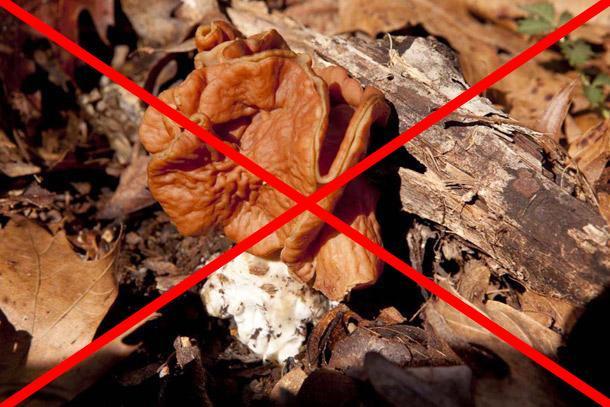
MushroomX_
Don’t eat this mushroom, which is a false morel and is mildly toxic. Notice that it lacks the cone shape of the real thing, and has wrinkles, not pits, on its cap.

Where to Look
Mushroom4
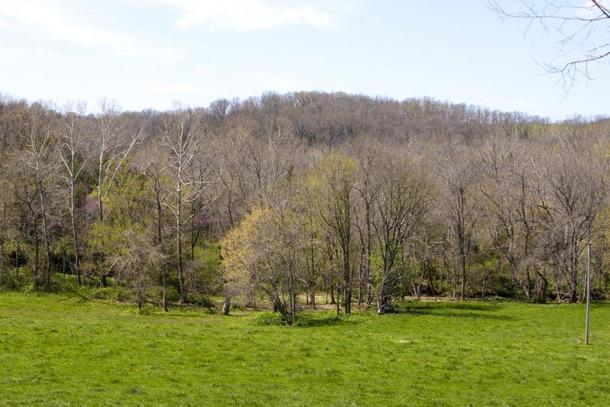
Morels live in and on the edge of forested areas. Look for ash, aspen, elm, and oak trees, around which morels often grow. Early in the spring as the ground is warming, you’ll find them on south-facing slopes in fairly open areas. As the season progresses, go deeper into the woods and onto north-facing slopes.

8
Well-drained, sandy soils like this creek bottom make good hunting spots as well. You’ll find the first morels of the year when daytime highs reach the 60s and lows stay above 40 degrees.

Hunting Tactics
7

Hunting morels is like bass fishing. You cover ground until you find one, then slow down and search the area carefully. Concentrate the rest of your hunt on similar areas, on the theory that you’ve found the “pattern” for the day.

Early-Season Morels
Mushroom7
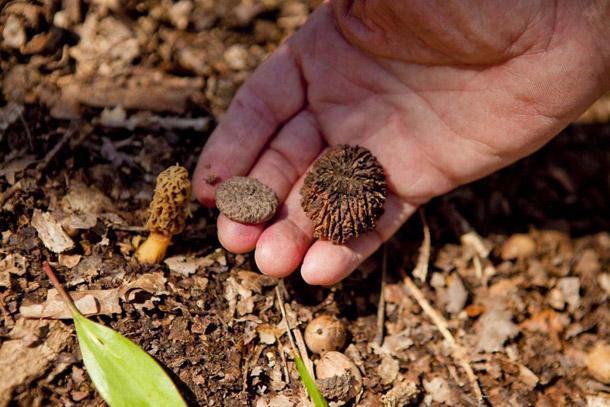
The first morels of the season are small. It takes quite a few to make a meal. The acorn top and walnut husk in the hand above help show scale.

Look For Dead Trees
Mushroom8
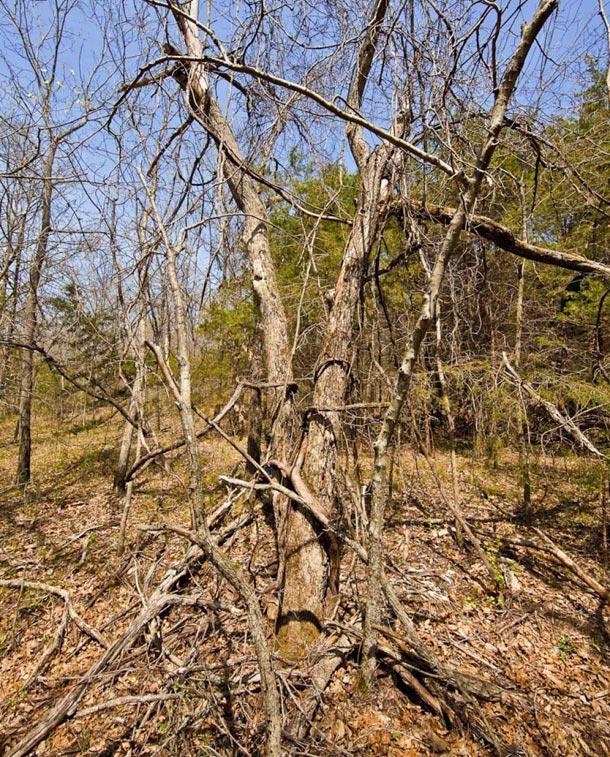
Morels often grow around dead and dying trees. Old apple orchards make good hunting grounds. Always look around dead elm trees like this one. When a tree reaches the stage of decay where its bark is slipping off its trunk you’ll often find lots of morels around it.

Later in the Season
3
As the season progresses you find bigger, yellow morels. They taste just as good as the smaller ones, they’re easier to spot, and it doesn’t take as many to feed a hungry hunter.

Mushroom10
Soaking morels in water for a couple of hours cleans them and washes out any bugs living inside the hollow mushrooms. Some people slice them in half lengthwise for a more thorough cleaning.

Mushroom11
Here you see morels sautéing in butter. Cooking in butter brings out their rich, almost meaty flavor. If I don’t have very many, I like to scramble them into eggs with some tarragon. Batter-fried morels are also very popular.

Mushroom12

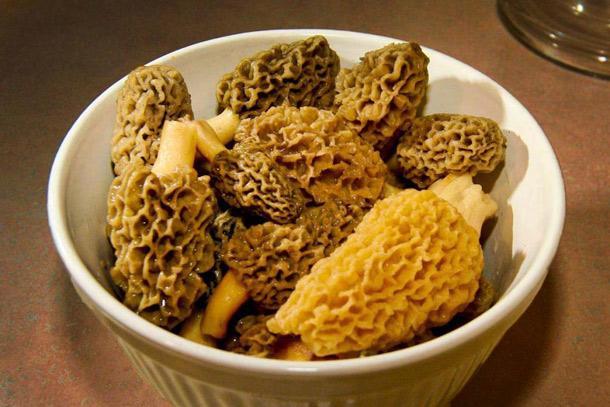
The bounty of spring, fork-ready. Serve with a breast of wild turkey or some fish fillets and it’s totally awesome!

Follow our FISHING BLOG

WEB   RATES     FISH    HUNT    CABINS    PHOTOS
BROCHURE    HUNT BOOKLET

Enter your email address to subscribe to this blog and receive notifications of new posts by email.

← Back

Thank you for your response. ✨

Email Me....


Tags: , , , , , , ,

STAY CALM

If you’ve had any trouble in the past “keeping it together” when shooting at game,
right now is the time to find a cure.

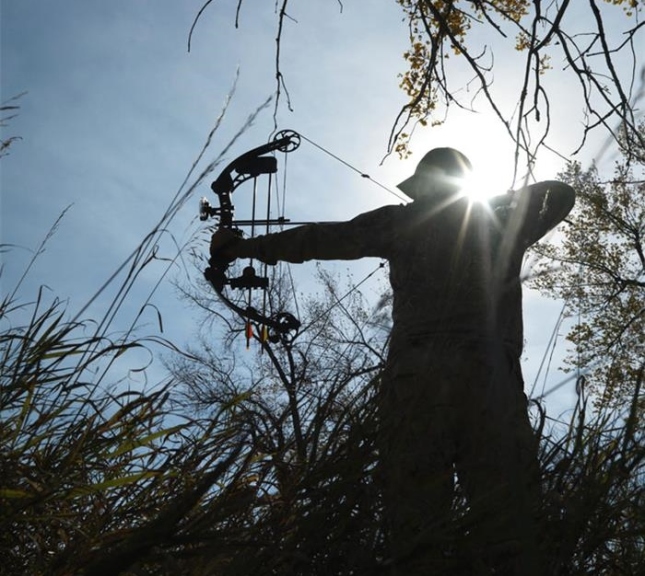
bow-hunting-wawang-lake

Countless of hunters who practice shooting regularly, months before the season opens, and they still have trouble closing the deal when Mr. Big shows himself. Getting excited is fine — excitement is a big part of why we hunt — but there is a big difference between getting excited and falling apart. We owe it to ourselves to perform under pressure. Even more, we owe it to the game we hunt to stay calm enough to make good shots and clean kills.

Below are six steps that have helped hunters stay cool at the moment of truth.

  1. Practice, Practice, Practice Nearly all bow hunters practice their shooting, but many fail to practice properly. To many average bow hunters, practice means flinging 20 to 30 arrows once or twice a week. This is not considered practice. When preparing for a hunt, practice every possible shot sequence, just as if you were actually hunting. That means shoot a 3D target from every possible angle while wearing camouflage, and shoot from any position that might become a possibility during the hunt. You want to be prepared for all contingencies.

Also practice at distances considerably farther than you will shoot on animals. A typical whitetail shot is closer than 30 yards, but practice regularly to shoot out to 80 and even 100 yards. That kind of practice will leave you very confident for any shots closer than 40 yards.

Lack of confidence is the biggest reason some people get shaken at the shot. They just keep thinking they may not make that shot. There are two things to offer those who lack confidence. One, restrict shots to your comfortable shooting range. Two, practice enough different scenarios that when an animal steps into your shooting lane, you’ll have no doubts about making the shot because you’ve already done it dozens of times in practice.

  1. Run & Shoot Now that sounds kind of dangerous, but it’s not meant in a literal sense.  During practice sessions, sprint anywhere from 60 to 100 yards, then pick up your bow and try to put a kill shot on a 3D target. This simulates the adrenaline rush you get when shooting at game. Some people may think it sounds crazy, but, it builds confidence like no other drill. You don’t have to do this every time you practice, but do it often enough to build confidence in your ability to shoot accurately when your heart is racing — whether from running or from watching a buck walk within range.
  2. Flex Those Muscles! When you see a big buck coming down the trail and your heart rate skyrockets, tense every muscle in your body while holding your breath. Then, after five or six seconds, let your muscles relax, and exhale. Do this several times as needed.

This is especially helpful during frigid hunts, when your muscles are stiff and your circulation is poor. It helps improve blood flow, regulate body temperature, settle your heart rate, and relax your muscles, all of which will calm you down to make a good shot. This muscle-tensing tactic has will help keep your cool on numerous animals.

  1. Focus On The Sweet Spot Once you decide to shoot an animal, you have no need to look anywhere other than the hair, scale, or feather you want to hit. Keying in on that certain spot keeps you calm and focused.   Some people miss when they focus on the headgear because they are looking with their mind’s eye at a beautiful shoulder mount gracing the wall above the fireplace. Don’t worry about the headgear while the critter is alive. You will have years to stare at it — if you focus on the vitals before and during the shot.

bow-hunting-wawang-lake (5)

You tend to aim where you are looking. Look at those wide antlers coming your way, and you might put an arrow right through the center of them. Instead, concentrate on the vitals, and that’s where you’ll put your arrow.

  1. Close Your Eyes This isn’t always an option, but when it is, it works. The longer some people look at an animal they want to shoot, the more stage fright they develop. If that’s you, closing your eyes or looking up at the sky will allow you to clear your mind and reorganize your thoughts.

Some people can perform on a moment’s notice, but, others prefer to have some time to evaluate the situation and to analyze every move before actually making it.   If too much time transpires and the nerves start taking over, close your eyes to regain focus before the animal gets within bow range.

  1. The Inner Voices Although you might not have demons and angels on your shoulders taunting you one way or the other, you certainly have inner voices that control your mind when you’re face to face with your prey. Listen to the positive voices and let them build you up.   Feeding your mind with positive thoughts will weed out the negative ones that flow through the minds of so many bow hunters. Doubt is where many archers fail at crunch-time. To eliminate doubt, talk to yourself — positively.

bow-hunting-wawang-lake (2)

WEBSITE    RATES     FISH    HUNT    CABINS    PHOTOS
BROCHURE    HUNT BOOKLET

Enter your email address to subscribe to this blog and receive notifications of new posts by email.

← Back

Thank you for your response. ✨

Email Me....


Tags: , , , , , , , , ,

Wild Mushrooms

The main edible find in our region is  lobster mushrooms, Hypomyces lactifluorum, in some pretty good quantities. On any hunt, it’s good to bring home dinner, but one doesn’t typically expect to bring home a bundle of lobsters too late into the fall.

lobster-mushrooms-wawang-lake

Typically, by the end of August and into September the brush is filled with mushrooms, edible and not. Unlike spring hunting, fall hunting in and around our area is more mushroom identifying than actually trying to find mushrooms growing. But some year the lobsters can account for a major harvest.

This slideshow requires JavaScript.

So on your next trip out into our region whether you’re fishing or grouse hunting be sure to hike the old logging roads in search of these very delicious mushrooms.  Stay tuned for a great recipe that easy to prepare.

WEBSITE    RATES     FISH    HUNT    CABINS    PHOTOS
BROCHURE    HUNT BOOKLET

Enter your email address to subscribe to this blog and receive notifications of new posts by email.

← Back

Thank you for your response. ✨

Email Me....


Tags: , , , , , ,

The Elusive Woodland Caribou In and Around Wawang Lake

This improved understanding will help the ministry develop resource management practices that will minimize the impact of human development and resource use on caribou.

Caribou

Caribou @ Wawang Lake Resort

It is a relatively unknown fact that the Woodland Caribou once thrived in the Wawang area.  Herds lived freely and well fed on the abundance of lichen in the surrounding area.  In the last century, due to logging, hunting and forest fires, the population not only migrated but was also put at serious risk.

In 2012, the Woodland Caribou was escalated from the Species at Risk list to the Endangered Species list in our area.  With the stringent management and extensive research taking place, the Ministry biologists suspect that it may be slow but the Woodland Caribou will eventually once again become prolific in the English River Forest which encompasses Wawang Lake.

With such rarity, it was a real treat to see on right on our very own beach….what a majestic creature!

If you’re not familiar with northern forests, it would be easy to think that forest-dwelling woodland caribou are more or less on their own in these woodlands. But caribou share the landscape with many other species – including other large mammals.

The program is researching ways to maintain healthy caribou populations in the province. Since 2010, program researchers have fit more than 190 caribou with collars that transmit information about their location and movement behaviour in three large study areas. Their objective is to sample animals in relatively undeveloped landscapes, as well as in more disturbed and developed areas, to collect information on how survival, reproduction, habitat selection and movement patterns are affected by human influences. They plan to analyze this information to develop a better understanding of the factors that influence woodland caribou persistence. This improved understanding will help the ministry develop resource management practices that will minimize the impact of human development and resource use on caribou.

A shed radio transmitter collar used to track the movement and behavior of the Woodland Caribou

A shed radio transmitter collar used to track the movement and behavior of the Woodland Caribou

The Northern Mammal Ecology Program at the Ministry of Natural Resources Center for Northern Forest Ecosystem Research studies caribou, wolves and moose to learn what determines the density and distribution of these mammals on the northern Ontario landscape.

The abundance of other large prey species (e.g., moose) and predators (e.g., wolves) on the landscape are believed to influence the caribou density. When intact forests are affected by development or resource extraction activities, these disturbances may cause changes in the abundance, behaviour and the amount of habitat available for species like moose and wolves. These changes have the potential to have a negative impact on caribou density and persistence.

To gain a better understanding of how predators and other prey species might be affecting caribou, researchers are also collecting information on the distribution, density and behaviour of these other species. For example, more than 45 wolves have been fitted with collars that transmit information about their location and movements. These collars have been placed on animals that inhabit the same three study areas as the collared caribou. Information collected focuses on the types of habitat (e.g., forest types, landscape features) that wolves inhabit and travel through, the prey species they eat, and the characteristics of the locations where they catch their prey.

The collared movement data for the caribou in North W

The collared movement data for the caribou in Northwestern Ontario

Researchers have also conducted aerial surveys within the study areas to calculate moose densities and identify the characteristics of locations with relatively high and low moose densities. They are also examining historic information gathered from moose collared in other areas of northern Ontario, to develop a more detailed understanding of how moose respond to different types of forestry practices.

This holistic approach to caribou research – which focuses on the species they interact with, as well as caribou themselves – should provide some important insights into caribou ecology that will help the ministry develop effective caribou conservation measures.

In time, it will become more and more common to spot these animals on your visits up to Wawang Lake….stay tuned and keep your eyes peeled!

Follow our FISHING BLOG

WEB   RATES     FISH    HUNT    CABINS    PHOTOS
BROCHURE    HUNT BOOKLET

Enter your email address to subscribe to this blog and receive notifications of new posts by email.

← Back

Thank you for your response. ✨

Email Me....

 
Leave a comment

Posted by on April 16, 2017 in caribou, Wawang Lake Resort


Tags: , , , , , , , ,

Grouse Hunting at Wawang Lake

Join us in NW Ontario CANADA for some exciting and thrilling grouse hunting

P1130017
Grouse Season:  September 15th to Oct 31st

Grouse hunting is a relaxing pastime that is getting more and more popular every year.  In our area bird hunting can be an adventure in itself!  Driving down the back roads & trails in your truck or on your ATV can not only be thrilling but breathtaking as well as you wander down roads that are in full color deserving of natures fall foliage. Just taking in these magnificent fall colors, peaceful wilderness & the wildlife that you’ll encounter will make you feel like you are definitely “North of the Tension Zone”.

The bush trails with the rise of the birds, singing of the guns, the smell of the pines along with friendly comraderie back at the camp will not long be forgotten.

Surrounding Wawang Lake are hundreds of miles of ATV trails, old logging road, game animal trails and hiking trails. The bush is just stuffed with these upland game birds and on a sunny fall afternoon you will see hoards of them. Many of our guests choose a fishing / grouse hunting combination package and spend half the their time taking advantage of the awesome northern pike and walleye fishing and spend the rest of their time enjoying the clean fall area and exploring the many trails where birds are plentiful.

There are three species of grouse found in Ontario.

Ruffed Grouse  –  Spruce Grouse  –  Sharptail Grouse

Ruffed Grouse is the most common and comprises of 80% of what you will encounter during your hunt.

The limit for grouse in Ontario is 5 birds per day in any combination of species with a total of 15 in your possession and you will be surprised at the number of grouse we do have and how fast you’ll bag those limits.

Compared to other areas the grouse cycle in our area has remained consistently high over the years and we credit this because of less human population that other places are known for.  In a nutshell what you’ll experience at Wawang Lake is a vast area of complete privacy during your hunt.

The most popular guns for grouse hunting are .410 or 20 gauge shot gun and some hunters use a 12 as well.   Quickly becoming more popular is BOW HUNTING for birds.  To increase the thrill and excitement of your hunt give your bow a try and the challenge alone is sure to thrill you.

Blaze orange hat & vest is required and must be worn out in the field

Canadian Firearms Regulations
All Firearms (does NOT include bows) being brought into Canada must be registered at the Canadian Customs at the time of entry into Canada. A one-year permit costs $50.00 Canadian, or there is a long term permit as well. If you would like further information, you can visit the Canadian Firearms Website through the link on our website or call toll free, 1-800-731-4000.

Canadian Customs
You should be aware of special customs and immigration issues whenever traveling to another country. For people with prior legal issues (including DWI’s) you need to find out what restrictions may be placed on your travel. Visit the Border Crossing Link and/or the Canada Citizenship & Immigration.

DEPOSIT REQUIREMENTS
A $150.00 non-refundable deposit is required at the time of reservation to guarantee a hunt. Balance to be paid in full upon arrival at the resort.  Hunting deposits and installments are non-refundable. Consideration may be given to date transfers if vacancy can be filled.

There are a limited number of spaces available for our hunts. Often there are more guests interested in hunting than there are available spaces, and hunts are often booked a year or more in advance. It is extremely difficult to fill spaces that become available due to cancellation. For these reasons we ask that our guests do not book hunts lightly

For further information, or, to book your next bear hunt please contact us at:
1-888-534-9217 or EMAIL

 WEBSITE    RATES     FISH    HUNT    CABINS    PHOTOS
BROCHURE    HUNT BOOKLET

Enter your email address to subscribe to this blog and receive notifications of new posts by email.

← Back

Thank you for your response. ✨

Email Me....


Tags: , , , , , ,