
MERRY CHRISTMAS
from all of us at Wawang Lake Resort
Follow our FISHING BLOG
WEBSITE RATES FISH HUNT CABINS PHOTOS
TESTIMONIALS BROCHURE HUNT BOOKLET
Follow our FISHING BLOG
WEBSITE RATES FISH HUNT CABINS PHOTOS
TESTIMONIALS BROCHURE HUNT BOOKLET


Follow our FISHING BLOG
WEBSITE RATES FISH HUNT CABINS PHOTOS
TESTIMONIALS BROCHURE HUNT BOOKLET

 Traditionally, moose have also been taken outside the rutting season, especially in the winter. At this time, moose tend to be scattered. If the snow is fresh and powdery, a hunter can move silently through the forest and thickets. But if the snow is drifted or develops a crust, every footstep makes a noise that alerts the moose. Making matters worse, even slight sounds carry over surprisingly long distances on windless days with temperatures far below zero—as often happens during the northern winter.
Moose have excellent hearing, so the best chance of approaching one in the winter is during storms when gale winds and gusts cover the sound of crunching snow. Luckily, temperatures tend to be warmer during storms, so although hunting in these conditions can be very uncomfortable, it’s not as life threatening as when the temperatures sink to minus thirty or colder.
When the snow is really deep—up to a moose’s belly—these animals have a very hard time moving around. Also if the snow is deep and crusted, the heavy-bodied moose will punch through the icy crust, cutting its legs as the animal walks, making travel extremely difficult.
If the crust is hard and strong enough, wolves can walk on top, giving them a lethal advantage over moose. Mired in the snow, a moose cannot escape by running away and has difficulty defending itself. Human hunters on snowshoes can also stay near the top of deep or crusted snow while the moose are forced to wallow slowly along. Under these conditions, a moose is virtually trapped in a small area of its feeding trails, making it extremely vulnerable.
When the snow is not so deep, moose can move far more quickly and easily. The practiced hunter knows that if moose tracks consistently lead in a single direction, the animal may be heading somewhere else and will be very hard to catch.


If a moose is feeding in one area its tracks will wander in multiple directions. This is good news for the hunter, because he may have a chance to get close to the animal. Now the difficulty is to find which tracks are the freshest and which direction they lead.
A hunter always wants to know how old the tracks are—how long ago did the moose make them? Would it be possible to catch up or is the animal long gone?
A track made within the hour is soft—as soft as the surrounding snow. The hunter riding on a dog sled or snow machine might simply drag his boot through the track. If the track is fresh, he feels almost nothing. If it’s older, he feels two distinct thumps as his boot hits both sides of the track.
In cold weather—especially if it’s far below zero—the inner walls of an animal’s track will recrystallize and develop a crust within a few hours. This starts first around the top and happens later at the bottom. If the track was made the night before it will be harder still. The colder the temperatures, the more quickly a crust forms on the inside of tracks.
A hunter on foot pushes his boot or a mittened hand down into the tracks, feeling the crust or testing how much pressure it takes to break through. The harder the crust, the older the track. In below zero weather, a track made two days ago or earlier will be very hard.


Another sign the hunter looks for is moose droppings. When they’re fresh, the color is dark brown and they’re soft. In freezing temperatures, the pellets quickly harden and turn lighter.
Other signs are willow branches that have been freshly broken by browsing moose, the white wood showing conspicuously against the darker background of the thicket. Often this is accompanied by a scramble of tracks and patches of gouged-out snow where the moose has pawed down looking for edible vegetation under the snow.
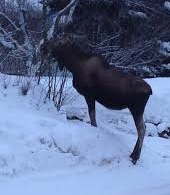 Moose rest or sleep in snow beds, often straight downwind from their tracks. They do this to catch a warning scent from any predator that is following their trail. At other times, a moose that hears a suspicious sound or spots something unusual will intentionally move downwind to test the scent. A moose can recognize the drifting smell of a wolf or human, even at a considerable distance.
When a hunter is following fresh moose tracks in the snow, he knows that the animal could have bedded downwind so it would pick up his scent. For this reason he leaves the trail at intervals, walks straight downwind, then makes a wide loop and heads back upwind—always watching the underbrush for the dark shape of his prey. Again and again, he makes these downwind loops and comes back upwind until he finds tracks leading to where the moose is bedded. If luck is with him and the moose never catches his scent, he may catch it unaware.
Follow our FISHING BLOG
WEBSITE RATES FISH HUNT CABINS PHOTOS
TESTIMONIALS BROCHURE HUNT BOOKLET

Follow our FISHING BLOG
WEBSITE RATES FISH HUNT CABINS PHOTOS
TESTIMONIALS BROCHURE HUNT BOOKLET

If you’ve had any trouble in the past “keeping it together” when shooting at game,
right now is the time to find a cure.
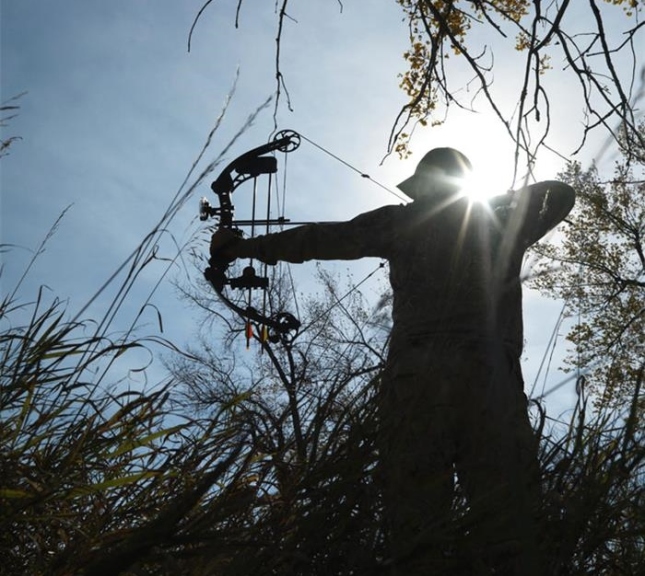
Countless of hunters who practice shooting regularly, months before the season opens, and they still have trouble closing the deal when Mr. Big shows himself. Getting excited is fine — excitement is a big part of why we hunt — but there is a big difference between getting excited and falling apart. We owe it to ourselves to perform under pressure. Even more, we owe it to the game we hunt to stay calm enough to make good shots and clean kills.
Below are six steps that have helped hunters stay cool at the moment of truth.
Also practice at distances considerably farther than you will shoot on animals. A typical whitetail shot is closer than 30 yards, but practice regularly to shoot out to 80 and even 100 yards. That kind of practice will leave you very confident for any shots closer than 40 yards.


Lack of confidence is the biggest reason some people get shaken at the shot. They just keep thinking they may not make that shot. There are two things to offer those who lack confidence. One, restrict shots to your comfortable shooting range. Two, practice enough different scenarios that when an animal steps into your shooting lane, you’ll have no doubts about making the shot because you’ve already done it dozens of times in practice.
This is especially helpful during frigid hunts, when your muscles are stiff and your circulation is poor. It helps improve blood flow, regulate body temperature, settle your heart rate, and relax your muscles, all of which will calm you down to make a good shot. This muscle-tensing tactic has will help keep your cool on numerous animals.

You tend to aim where you are looking. Look at those wide antlers coming your way, and you might put an arrow right through the center of them. Instead, concentrate on the vitals, and that’s where you’ll put your arrow.
Some people can perform on a moment’s notice, but, others prefer to have some time to evaluate the situation and to analyze every move before actually making it. If too much time transpires and the nerves start taking over, close your eyes to regain focus before the animal gets within bow range.
WEBSITE RATES FISH HUNT CABINS PHOTOS
TESTIMONIALS BROCHURE HUNT BOOKLET

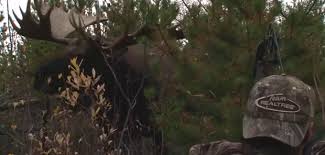
If you are in search of a record book moose because he has survived many previous hunts, and you as a hunter respect the survivability of the animal, then you have set a high standard for yourself.
Pursuing any type of world record is not something that many aspire to do. for the trophy hunter, shooting a world record moose is the ultimate goal. Are you a trophy hunter? Or a meat hunter?
Do we need to continue to search for the ever bigger? Then when we find it, is it right to destroy it? Should we limit the very essence of the mighty beast; snuff out the possibility of procreation? These are tough questions?

Hunter Heinz Naef shot what he believes could be the largest moose ever harvested in the Yukon(Sept. 2013).
His moose, scored 263 1/8 inches after the required drying time of 60 days. The official scoring will be made in Nevada in early 2014.
Heinz is not a trophy hunter, he wasn’t looking to harvest a world record moose. No, he is a meat hunter… by his own admission. He was just out looking for any legal moose to fill his freezer. It just so happened to be this one.
Human beings have pushed everything to its limits. The Guinness Book of World Records is a testament to this. We strive to better ourselves, to beat our predecessors, going beyond what anyone has done in the past. Is it wrong to have the desire to be better, to do it bigger? Is our only purpose to get our names in a book?
When entering animals into record books, who deserves the respect? You or the animal? It is vitally important to include all relevant information about said trophy… the hunters name however may not be so important.
Many hunters have a few trophies on the wall, but most are not world record moose, but all of them are trophies to the hunter. Many hunters do not go hunt with the sole purpose to acquire a trophy, and likely many of you, may scoff at some of the animals that have been shot. They are not in any record book, nor are they of that class, but to the hunter, they are a reminder of the hunt and a way for to show appreciation for the animal.
No animal should be killed for the sole purpose to raise a hunters social status, to do so is crossing the ethical line for hunters.


Where does one find a world record moose? This question is one that no one person can answer for sure. Through research and dialogue you may be able to locate moose habitat that will contribute to the growth of these monsters. A hunter in search of a world class moose will spend a lot of money and time to achieve his goal. These big animals are not going to be easily accessible. Days, weeks even years of pursuit to harvest a moose that can make the record books will be the required  dedication. Hunting the most remote areas of the planet is what it will most likely take and never discount luck. Luck is a huge part of hunting.
As an example the latest world record moose taken with a rifle, shot by Jay Link in 2001. Jay travelled to Russia, to the very remote regions to get this moose. He has stated it cost him $20,000.00 to do this hunt (before shipping and taxidermy). Jay may not have been looking for a world record when he shot this one, but he was certainly looking for a world class moose. Unfortunately for Jay, because the moose was taken in Russia, it is not eligible for Boone and Crockett.

Aaron Folk killed this state record North Dakota moose in October 2012, with a green score of 166 and a 53-inch spread.

Real Langlois, who’s been dubbed “The Rackman” for all his moose hunting exploits, bagged this world record bull in the Yukon with his bow in 2008. With a score of 249 1/8, The Rackman beat out Michael Cusack, whose 1973 bull moose scored 248.

Eric Arnette killed this Yukon monster in 2004, with a Boone & Crockett score of 236 and a span of 75 inches.
The world record moose, Boone and Crockett scored 261 5/8 and was taken by John A. Crouse in 1994 near Forty-mile River Alaska.
Hunters value the opportunities to venture out into the outdoors and hunt. The chase is wonderful and exhilarating. To some degree the kill is saddening as a wild animal has paid the ultimate sacrifice and many hunters pause to give thanks for any animal that they just harvested. They truly appreciate it!
Many hunters don’t hunt for a trophy – after all the antlers will make poor soup. Given the opportunity though, if a world record moose were to walk out in front of you, and assuming you recognize it as a trophy. Would you shoot…? Would You?
Follow our FISHING BLOG
WEBSITE RATES FISH HUNT CABINS PHOTOS
TESTIMONIALS BROCHURE HUNT BOOKLET

Watch the race between the arrow and the car……..interesting results! NICE car GREAT archer!
Follow our FISHING BLOG
WEBSITE RATES FISH HUNT CABINS PHOTOS
TESTIMONIALS BROCHURE HUNT BOOKLET

 POPULATION
Ruffed Grouse normally have a short life span. From a brood of 10 or 12 hatched in late May or early June, usually 5 or 6 will have died by mid-August. Among those living to disperse during the fall shuffle, about 45% will have been lost by late fall and early winter. Another 10% die over winter and during early spring, so that only about 45% of the young grouse alive in mid-September live to their first breeding season. In subsequent years a given cohort (a season’s crop of young birds ) continues to shrink by about 55 to 60% per year. So from 1000 chicks hatched in late spring, about 400 normally survive to early autumn, 180 survive to the following nesting season, 80 are alive a year later, 36 live to breed a 3rd time, 16 may breed a 4th time. One out of 2200 chicks hatched may live as long as 8 years.
Most Ruffed Grouse die a violent death to provide a meal for one of a number of meat-eating predators, for in the natural scheme of things, Ruffed Grouse are one of the first links in a complex food chain. Some also die from disease and parasites, or from exposure to severe weather, or accidentally by hitting trees or branches while in a panic flight after being frightened.
 Across the major portion of the Ruffed Grouse range, the winged predators or raptors are most efficient at taking these birds. Although the goshawk is certainly the most efficient of all grouse predators, the horned owl probably kills more grouse annually than any other predator. This is due to the cosmopolitan distribution of these owls and the likelihood that any woodland capable of supporting grouse will have resident horned owls, or at least be regularly visited by them. Yet, where cover is adequate, grouse can find security and maintain their abundance even when goshawks and horned owls live and nest nearby.
Conditions are seldom static in the world of the Ruffed Grouse and their numbers fluctuate from year to year, and from decade to decade. Across most of their range in the northern states, Canada and Alaska, Ruffed Grouse numbers have risen and fallen in a somewhat predictable pattern for most of this century, in what is often called a “10-year cycle”. In the Lake States, for example, periods of abundance usually coincide with years ending in 0, 1 or 2, and the bottom of the depression in years ending with 5 or 6. This is not invariable, but a general, regional trend. These “cycles” sweep across the continent more or less as a wave, beginning in the far Northwest and Northeast, and progressing southward and southeastward.
The factors responsible for these periodic fluctuations remain poorly understood, and appear to involve a number of different factors interacting with one another in different ways at different times. The one factor which does not appear to be important is hunting during the period of fall dispersal.

The primary causes for the short-term fluctuations in Ruffed Grouse abundance appear to be related to weather trends and variations in the quantity and quality of food resources. These are interrelated to a large degree. Superimposed upon these two basic factors is that of predation – as predators take advantage of grouse placed in jeopardy by unfavorable weather conditions or inadequate food resources. A favorable combination of weather factors and food resources may allow these grouse to survive the winter nearly immune to predation. These combinations of factors also affect annual production. If grouse spend the winter feeding on poor quality foodstuffs, or have to use an excessive amount of energy to keep warm, hens may not have sufficient reserves to produce a clutch of viable eggs, or vigorous, healthy chicks in the spring. Across most of their range, the most productive and most abundant Ruffed Grouse populations are those living where they spend most of the winter burrowed into 10 inches or more of soft, powdery snow, and emerge for only a few minutes once or twice a day to take a meal of the male flower buds of the aspens. Our Ruffed Grouse can be considered snow lovers or “Chionophiles.” Ruffed Grouse tend to be less numerous and less productive if they live in regions where they cannot burrow in snow and feed on aspen (poplar).
 There also seems to be a poorly understood relationship between the color-phase of a Ruffed Grouse and its ability to survive severe wintering conditions, and its vulnerability to predation.
Longer term changes in Ruffed Grouse abundance reflect how we have treated our woodlands and forests. There is also reason to suspect that much of the severity of the “10-year cycle” is largely a result of how we have treated forested lands. These birds depend upon the food and cover resources produced by a group of short-lived trees and shrubs growing in full sunlight which develop following the severe disturbance of forests. In earlier times, fire and windstorm were the ecological agents periodically renewing forests and creating satisfactory habitat for Ruffed Grouse and many other species of forest wildlife. Ruffed Grouse should be considered a “fire-dependent” species in the natural scheme of things.
Our current reluctance to cut forests, even under strict management plans and the suppression of fire to protect growing forests, have upset this natural sequence of events. In the early part of this century, farm abandonment and the recovery of forests from unregulated logging and fires produced habitats which probably resulted in the greatest abundance of grouse in recent times in most of Canada & northern United States. But as forests mature under protection from fire and cutting, they lose the habitat qualities Ruffed Grouse require. In many regions, Ruffed Grouse numbers have declined as forests have become more extensive and older.
Ruffed Grouse abundance can often be readily restored by proper harvest management of forested lands, or through the judicious use of prescribed fire that is ongoing in northwestern Ontario.
Follow our FISHING BLOG
GROUSE HUNTING at Wawang Lake
WEBSITE RATES FISH HUNT CABINS PHOTOS
TESTIMONIALS BROCHURE HUNT BOOKLET

This unexpectedly placed hidden gun storage solution stays hidden in plain sight while providing a large amount of bullet proof storage space.

Utilize the wasted space underneath your coffee table with some hidden gun storage.

Follow our FISHING BLOG
WEBSITE RATES FISH HUNT CABINS PHOTOS
TESTIMONIALS BROCHURE HUNT BOOKLET



 ON TARGET in CANADA

