RSS

Tag Archives: Wawang Lake Resort

Tinywood Home on Trailer with Built In Outdoor Hot Tub

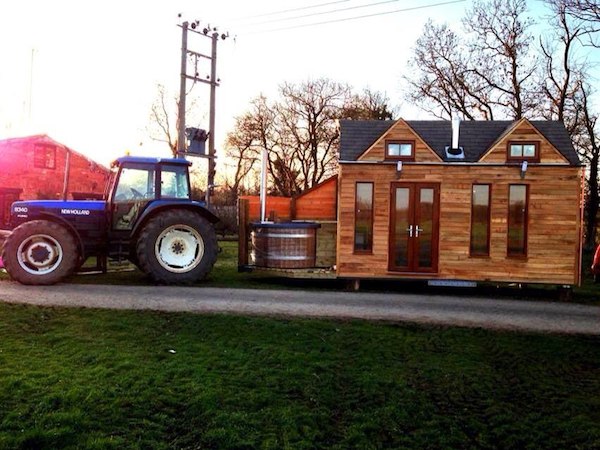
Have you ever heard about a tiny house that is also a hot tub? Yes, the project can be made and it already exists, thanks to a small company based in Warwickshire, England. The architects thought about building a home that offer comfort, relaxation and entertainment at the same time, and built this amazing tiny home that comes with an attached hot tub.

hot-tub-tiny-home-on-wheels

The company is specialized in building tiny homes and merging utility with creativity.

The inside is fully equipped as you will find a small kitchen, lounge area, two bedrooms upstairs and a functional heating system.

So after taking a look, you can say that it is the most perfect small vacation house for you and your family. As tiny as it is, there is still plenty of space inside for a family with two kids.

The outside hot tub is just an extra feature that tops the awesomeness of this house.

hot-tub-tiny-home-on-wheels-7

Follow our FISHING BLOG

WEB   RATES     FISH    HUNT    CABINS    PHOTOS
BROCHURE    HUNT BOOKLET

Enter your email address to subscribe to this blog and receive notifications of new posts by email.

← Back

Thank you for your response. ✨

Email Me....


Tags: , , , , , , , , ,

Art of Archery – A Timeline through Ages Infographic

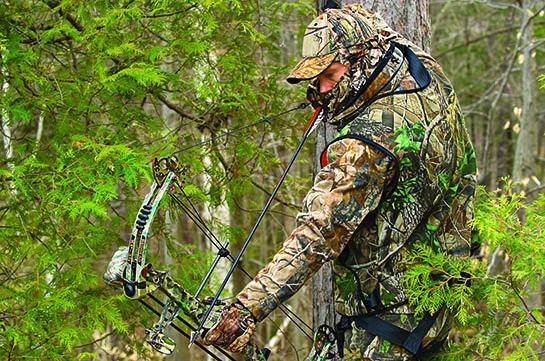
ODL0814_HUN02

Here’s an interesting read Infographic on the evolution of archery
art-of-archery-a-timeline-through-ages-infographic-by-global-gear

Follow our HUNTING BLOG

WEB   RATES     FISH    HUNT    CABINS    PHOTOS
BROCHURE    HUNT BOOKLET

Enter your email address to subscribe to this blog and receive notifications of new posts by email.

← Back

Thank you for your response. ✨

Email Me....

 
Leave a comment

Posted by on February 9, 2017 in archery, Wawang Lake Resort


Tags: , , ,

Morel Mushrooms Hunting For The Beginner

Morels are America’s mushroom, more so than any other. It may be because they’re widespread, they’re easy to identify, and they come up in the spring, giving people a reason to get out and enjoy warm weather after a long winter. Or, it could be they’re popular simply because they taste so good. Morels are so prized they sell for up to $20 a pound in grocery stores in most locations. Here’s a quick guide to finding your own. Please note that although morels are easy to identify, this a hunting guide, not a field guide. If you have any doubt about a mushroom, don’t keep it.

3

Found in much of the U.S. from late March through May, the morel is our favorite mushroom: plentiful, easy to identify, and delicious. It has colorful names like Molly Moocher, Miracle, Dry land Fish—or, my favorite, Hickory Chickens—but mostly, people just call them “mushrooms” and it’s understood that means “morels.”

Identifying Safe Morels
MushroomBroken2
MushroomBroken1donteat
Here are two morels in the wild. Notice the pits (in the top photo), the distinctive conical shape, and the way the bottom of the cap (the pitted part) is attached near the bottom of the stem. Avoid the half-free morel (bottom photo), which has a longer stem and a cap that attaches near the top, looking like an umbrella. These mushrooms can cause some people to have cramps or other forms of gastrointestinal distress.

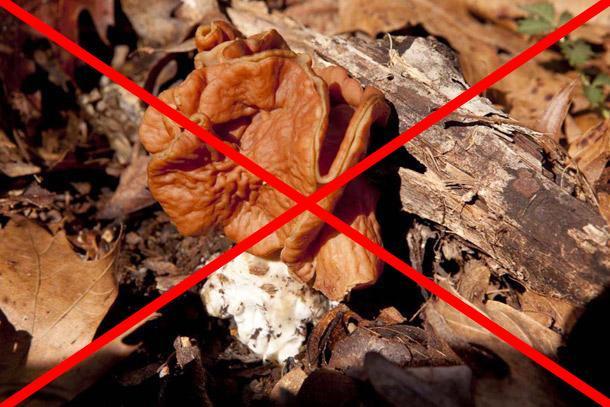
Definitely Don’t Eat This
MushroomX_
Don’t eat this mushroom, which is a false morel and is mildly toxic. Notice that it lacks the cone shape of the real thing, and has wrinkles, not pits, on its cap.

Where to Look
Mushroom4
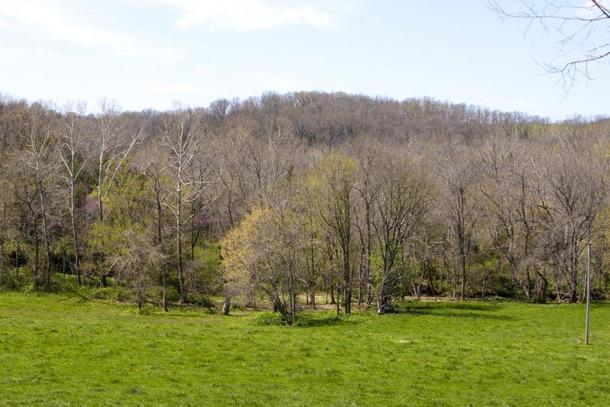
Morels live in and on the edge of forested areas. Look for ash, aspen, elm, and oak trees, around which morels often grow. Early in the spring as the ground is warming, you’ll find them on south-facing slopes in fairly open areas. As the season progresses, go deeper into the woods and onto north-facing slopes.

8
Well-drained, sandy soils like this creek bottom make good hunting spots as well. You’ll find the first morels of the year when daytime highs reach the 60s and lows stay above 40 degrees.

Hunting Tactics
7

Hunting morels is like bass fishing. You cover ground until you find one, then slow down and search the area carefully. Concentrate the rest of your hunt on similar areas, on the theory that you’ve found the “pattern” for the day.

Early-Season Morels
Mushroom7
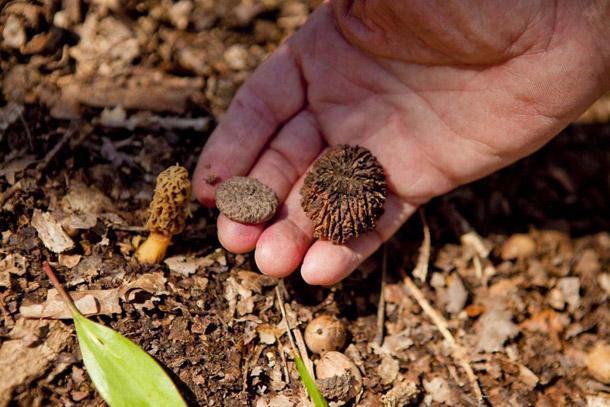
The first morels of the season are small. It takes quite a few to make a meal. The acorn top and walnut husk in the hand above help show scale.

Look For Dead Trees
Mushroom8
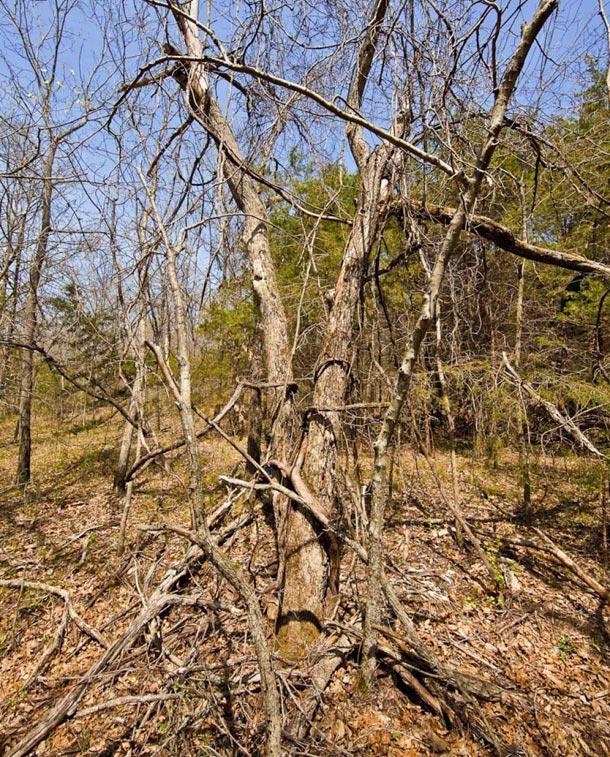
Morels often grow around dead and dying trees. Old apple orchards make good hunting grounds. Always look around dead elm trees like this one. When a tree reaches the stage of decay where its bark is slipping off its trunk you’ll often find lots of morels around it.

Later in the Season
3
As the season progresses you find bigger, yellow morels. They taste just as good as the smaller ones, they’re easier to spot, and it doesn’t take as many to feed a hungry hunter.

Mushroom10
Soaking morels in water for a couple of hours cleans them and washes out any bugs living inside the hollow mushrooms. Some people slice them in half lengthwise for a more thorough cleaning.

Mushroom11
Here you see morels sautéing in butter. Cooking in butter brings out their rich, almost meaty flavor. If I don’t have very many, I like to scramble them into eggs with some tarragon. Batter-fried morels are also very popular.

Mushroom12

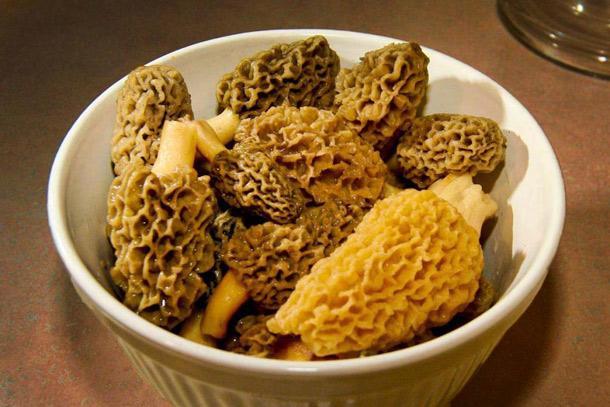
The bounty of spring, fork-ready. Serve with a breast of wild turkey or some fish fillets and it’s totally awesome!

Follow our FISHING BLOG

WEB   RATES     FISH    HUNT    CABINS    PHOTOS
BROCHURE    HUNT BOOKLET

Enter your email address to subscribe to this blog and receive notifications of new posts by email.

← Back

Thank you for your response. ✨

Email Me....


Tags: , , , , , , ,

Bear Encounter for Cyclist

975012fylers
In urban areas, cyclists need to watch out for cars. But in more rural places, there are other dangers. 57-year-old Jim Litz, a science teacher in Missoula, Montana, learned this when he t-boned a black bear while riding his bike to work. Read on for the details.“I was lucky. I was truly lucky”

He was traveling about 25 mph when he came upon a rise and spotted a black bear about 10 feet in front of him. “I didn’t have time to respond. I never even hit my brakes,” Litz said.

He tumbled over his handlebars, planting his helmeted head on the bruin’s back, and man and beast went cartwheeling down the road. The bear rolled over Litz’s head, and its mass cracked his helmet. As the duo toppled over one another, the bear clawed at Litz’s cycling jacket, scratching his flesh from shoulder to buttocks before scampering up a hill above the road, where it stopped and whined.

Litz’s wife drove by soon after and took her husband to Community Medical Center, and he immediately called  Fish, Wildlife and Parks to report the unusual collision. Game wardens told him they didn’t think the animal was seriously injured, but was more likely suffering from some bruised ribs – just like Litz.

“I was lucky. I was truly lucky, because I accosted the bear and he let me live,” Litz said. “I truly respect them. They’re beautiful creatures.”

by:  Michael Graham Richard

Black-Bear-crossing-the-Alaska-Highway

Follow our FISHING BLOG

WEB   RATES     FISH    HUNT    CABINS    PHOTOS
BROCHURE    HUNT BOOKLET

Enter your email address to subscribe to this blog and receive notifications of new posts by email.

← Back

Thank you for your response. ✨

Email Me....


Tags: , , , , , ,

Hunting Bears With Bows – Decoy Tactics

Trophy boars are smarter than your average bear. But even the savviest old bruin has a few chinks in his armor. Using a decoy is an exciting way to exploit them. Even weary old black bears will come in spoiling for a fight. Here are three strategies for drawing a dominant, hungry bruin into bow range.

 1

The Intruder
Big boars are solitary animals and will claim a food source as their own, commonly defecating along entrance trails to warn other bears away. To get this bear’s attention, stake a small bear decoy near the food source, positioned with its head down and its backside facing the direction you expect a boar to approach. Attach a few strips of black cloth to the decoy’s ears and tail for added realism and collect some bear scat from another area—preferably from a boar—and with a plastic bag, transplant it on the entrance trails.

Now sit back. Any wise old boar that might otherwise camp just off the food until nightfall is almost sure to investigate when he sees your “intruder.” Keep in mind that a boar may visit a food site daily or stop by every second or third day while patrolling his home turf. Be patient, and don’t let your guard down.

2

The Easy Meal
Black bears are fond of fresh meat and will drop their guard to capture an animal in distress. Any small, furry decoy, like those used for foxes and coyotes, wiggling about in plain sight is sure to catch a passing bear’s attention. With a little luck, the bruin will move in quickly to finish off what he thinks is hapless prey. If he hangs up, though, add a few squeals from a dying-rabbit call to entice him.

If whitetail deer are prevalent in your area, a fawn decoy can be too much for any hungry black bear to ignore. Try a few fawn contact bleats, and if that fails, go to a fawn-in-distress call. Nock a broadhead and get ready. The bear will come in fast, so be prepared to shoot pronto.

3

The Feeding Female
You’ll have to wait a few months to use this setup, but it’s a good one to have in your arsenal. Black bears rut in late spring and early summer and will visit bait sites, looking for a sow in heat. If baiting is legal in your area, position a small black bear decoy with its head in the bait barrel, and hang a few scent canisters soaked with sow-in-heat urine 3 or 4 feet off the ground nearby.

Big boars are ultracautious around bait, so odor control is critical. As you’re setting up, wear rubber gloves and spray the decoy down liberally with a quality scent remover. The boar will approach the decoy warily. Don’t rush the shot. As he investigates, you should have plenty of time to draw.

Follow our FISHING BLOG

WEB   RATES     FISH    HUNT    CABINS    PHOTOS
BROCHURE    HUNT BOOKLET

Enter your email address to subscribe to this blog and receive notifications of new posts by email.

← Back

Thank you for your response. ✨

Email Me....


Tags: , , , , , , , , , ,

Start Your Retriever Off Right

Here are a few helpful tips to help you do it right and get your retriever pup off to a good start:

wading
WATER
Taking your retriever pup out in a boat to the middle of a lake and throwing her overboard is not a proper water introduction. Ideally, you want the experience to be pleasant and fun.

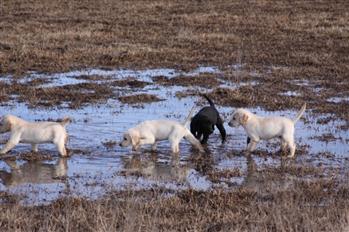
Find a small pond with a shore that drops gradually from shallow to deep water. The weather should be mild, and the water temperature 60 degrees or warmer. Wading into the water with the pup will help alleviate any fear she may have. Bumpers and water retrieves can come later.

GUNFIRE
The worst thing you can do is to take a puppy to an open field and fire a 12-gauge over her head. That’s almost guaranteed to cause gun-shyness. Instead, recruit a friend or family member to help with this part of your pup’s training. While you handle the dog, have your training partner move a good distance away. Each time you toss a bumper, your partner should fire a shot with a starter pistol or cap gun. Be careful not to overdo it. A few shots each outing will suffice. Each day, decrease the distance between the dog and the gunfire and repeat the same drill. Keep in mind that introducing a dog to gunfire is a gradual process that shouldn’t be rushed.

gunfire
DECOYS
Don’t wait until hunting season to familiarize your dog with decoys. Incorporate them into their training exercises. Place a dozen or more decoys around a field when you’re tossing bumpers. This will help teach the dog that decoys are just part of the setup and not her main focus. Once he/she learns that, they can move on to retrieving bumpers around a decoy spread set in shallow water. This will help them learn how to swim through the decoys without getting tangled in the lines. If you hunt with motion decoys, incorporate them into your training spread as well.

BOATS The best way to acclimate a pup to watercraft is on dry land, where the boat won’t rock or tip over. Place your retriever in the boat and let her explore this unfamiliar setting. Do this several times over a period of a few days, and when the dog is comfortable in her new surroundings, launch the boat and take your pup on a cruise around the lake. Be sure to go slow and avoid rough waters. Keep the outing as pleasant as possible, with the dog sitting calmly beside you. Allowing them to run around while the boat is under way can be extremely dangerous.

BLINDS
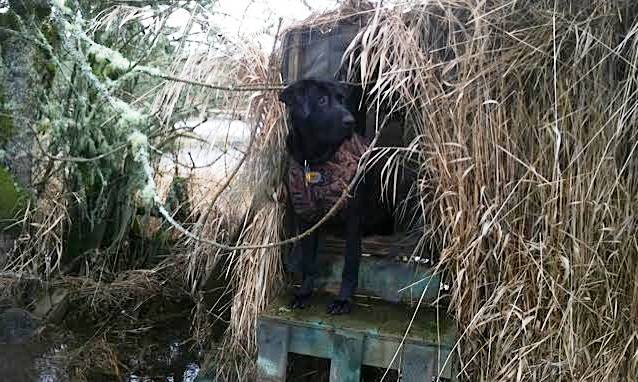
Whether you hunt out of a permanent blind or a layout blind, your retriever should have a place of her own. Set up a dog stand or platform during your training sessions. Begin by teaching the dog to sit still on the stand. The younger the dog, the less patience they will have. But after several training sessions, they should learn to be patient and sit on the stand for extended periods of time.

blind1

Follow our FISHING BLOG

WEB   RATES     FISH    HUNT    CABINS    PHOTOS
BROCHURE    HUNT BOOKLET

Enter your email address to subscribe to this blog and receive notifications of new posts by email.

← Back

Thank you for your response. ✨

Email Me....


Tags: , , , , , , , , , ,

FIELD JUDGING MOOSE

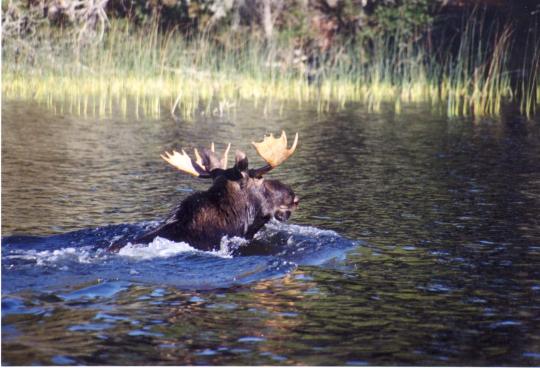
Of all the living members of the deer family, moose have the greatest amount of antler material. They also show great variation in size, with the smallest racks coming from Colorado, Idaho, Montana, Utah, Washington, and Wyoming, and the largest from Alaska, Yukon, and the Northwest Territories. A records book sized Shiras moose would not be even a desirable trophy in Alaska.

Moose, Alces alces, Canada, North America.
Although the widest spread antlers are sought in all categories for the records, strong development of antler palmation in both length and width is even more desirable. Many Shiras moose show only a single spike brow point on each antler, rather than a well-developed brow palm. This is undesirable since the length-of-palm is measured to a notch between brow points. The single spike brow dictates that the length of palm measurement must be ended at the edge of the main palm, obviously losing some potential that would have been fulfilled if the brow were palmate or even forked. High-scoring Canada or Alaska-Yukon moose have three or more brow points, on broad, well-developed brow palms that increase the length-of-palm measurement. This feature, along with broad main palms, markedly improves the score potential.

Although an Alaska-Yukon moose may have 15 or more points on each antler, not all projections count as points, especially if they are blunt in shape. One cannot accurately count the antler points on most trophy moose when the animal is in the field, so evaluation must generally be made on the basis of the amount of palm material present and the greatest spread.

moose-orig

Big trophy moose of all three classes tend to have the main palms lying flat to produce a wide spread, whereas smaller antlers are more apt to show cup-shaped palms and a narrow spread. The ear tips of a mature bull when laid flat are roughly 30 inches wide, with ears themselves being 9 – 10 inches. A bull with an extra ear length on either side would, then be approximately a bull with a 50 inch spread.

Even though moose can often be studied carefully in the field, and an experienced guide may make reasonable estimate of the greatest spread, it is very difficult to estimate the scores accurately at a distance. This is because the length, width, and symmetry of the palms are all hard to judge when seen from the side. A frontal view, with the animal’s head down and antlers nearly vertical, gives a much better chance for accurate evaluation, but may not be available under field conditions.

MOOSE_1

Typically, younger bulls will feature long and disguisable points, but with narrower spreads and shorter palms. As bulls age they tend to add in number of points that will be shorter and less recognizable having given way to wider and taller palms. As a rule, palm width and length pile up B&C points.

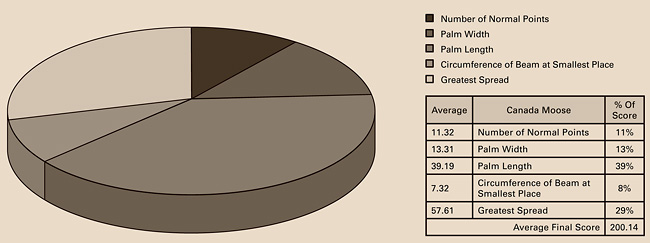
BREAKDOWN OF SCORING COMPONENTS – CANADA MOOSE

moose charrt

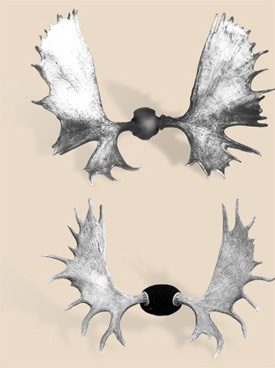
MAXIMUM VS. MINIMUM – A COMPARISON OF TWO RECORDS-BOOK CANADA MOOSE

moose1


TOP – World’s Record Canada moose scoring 242 points

  • 15 x 16 point frame
  • Spread over 63 inches
  • Witdth of Palms averaging 22 inches
  • Length of Palms averaging nearly 45 inches

Bottom – Canada moose scoring 187-2/8 points

  • 11 x 11 point frame
  • Spread over 54 inches
  • Witdth of Palms averaging 12 inches
  • Length of Palms both over 36 inches

Follow our FISHING BLOG

WEB   RATES     FISH    HUNT    CABINS    PHOTOS
BROCHURE    HUNT BOOKLET

Enter your email address to subscribe to this blog and receive notifications of new posts by email.

← Back

Thank you for your response. ✨

Email Me....


Tags: , , , , , ,

Bear Hunt Mistakes

wawanglakebearBeing Afraid of the Dark
Sounds silly, but don’t let it fool you.  It is an ungrounded fear and one people need to overcome in order to have a successful black bear hunt; especially if you are hunting for a trophy. It can be very intimidating leaving a bear stand, by yourself, in the middle of the dark when you know with 110% certainty that there are active black bear in the area.  You’d be off your rocker if you weren’t a little apprehensive.  When you are hunting into the twilight hours, and getting ready to depart your stand, remember this, since 1883, in North American there have only been 30 reported black bear fatalities, most of which occurred during non-hunting activities. That means in 125 years, there has only been 30 fatal black bear attacks and subsequent deaths.  With the 100’s of thousands of hunters that take to the woods every year, that puts the odds of being attacked by a black bear inconceivably in your favor.  Hunting until you can’t see anymore gives you better odds when pursuing that trophy black bear of a life time. Most BIG black bears are taken within a half hour from dusk, when the smart animals feel most secure eating from an unnatural food source.  Stay in your stand as late as you can, and the odds of shooting a monster increase tenfold.

And should there still be bears on your bait when your ready to leave your stand (although this rarely happens), shining a light or a sudden loud noise will send these skittish critters running for miles. Black bears, in their natural setting, are extremely fearful of humans, and would rather turn tail and run then face an unknown advisory.

2 bear sized

Recovering Your Harvested Bear
Many people take to the bear stand, rightfully so, with excitement and anticipation of a successful hunt. Myself included, I get like a little child full of excitement when hunting these magnificent creatures. While most hunters will do a tremendous amount of prep work prior to the hunt, few prepare for what happens after the hunt.Bears rarely pile up on the bait or in an open area with easy access. Instead, these hearty creatures are famous for taking a double lung shot and running for miles, deep into thick woods and cedar swaps.Having a plan on how to recover your trophy will put you light years ahead of most black bear hunters when it comes to a successful hunt. Planning should include how to track and more importantly flag the path the animal takes. What to do if it starts to rain or gets dark. Who will help you track the animal and once found, how will you get it out? And how to protect the meat from spoiling on a warm fall night.

Weather
Avid hunters know that fall weather can change in a heart beat. It can go from warm, to cold, windy and raining in the blink of an eye. Having the right clothes in your back pack can make the best of a somewhat undesirable situation.

bear over logBugs
can be a huge annoyance in the great outdoors. Especially when you are forced to sit still for extended periods of time. Avoid bug sprays when bear hunting… PERIOD! A new, unfamiliar scent, along with an intuitive feeling that something isn’t right, will keep trophy bears from over coming fear and committing to your bait. Bug jackets and bug nets are a must. (Oh, on side note, make sure you practice shooting with your bug net on, more about that later). Regarding the portable propane bug eliminators. I have seen hunters use them with success. In fact, in 2008 there was a beautiful 350lbs sow taken while a hunter used one, however my vote is not in on them.

Boredom
Nothing will end your hunt faster than impatience and constant movement in your stand. If you are like most guys who can’t sit still for more than 30minutes at a time, you must bring something with to occupy your mind. I personally use a book. I have also seen guys use those portable, pocket video games. Regardless of what you use, make sure you sit sill and be quiet!

Natural Calls – Ever been in the stand when all of the sudden you have to take a pee? Sucks, doesn’t it? I don’t know how many times I have had this happen to me, yet somehow I always forget to bring a container along. Put a portable urinal on your packing list. Doing so will make the difference between shooting that monster and taking it’s offspring.

Follow our FISHING BLOG

WEB   RATES     FISH    HUNT    CABINS    PHOTOS 
BROCHURE    HUNT BOOKLET

Enter your email address to subscribe to this blog and receive notifications of new posts by email.

← Back

Thank you for your response. ✨

Email Me....


Tags: , , , , , , , , ,

Moose Rack – How It Grows

Moose are the largest living member of the deer family (Cervidae) and fittingly bear the largest set of antlers. Moose antlers are usually paired and shaped like the palm of a hand with outstretched fingers, thus the expression palmate.

After a male moose reaches one year of age he starts to grow antlers that increase in size (becoming more elaborate with more points and heavier) for each new set of antlers he grows until he reaches his prime. After a male (Bull) moose reaches his prime the antlers start to recede each year until the moose dies.

Mature Bull Moose Antlers

North American Moose Antlers have larger antlers than their European relatives. World record antlers consistently come from Alaska, where antler spreads of six feet have been recorded.

Every year the cycle is the same. In the spring antlers begin to grow from the skull covered with a tissue called “velvet”.

By September the growth has completed and the velvet dries and falls off. Moose will often aid the removal of the velvet by rubbing their antlers on trees and shrubs (on occasion they’ll eat the velvet too!). The continuous rubbing on trees, combined with the dried blood and dirt will give the Moose Antlers the brown color hunters are accustomed to seeing in the fall.

What is the purpose for Moose Antlers?

Antlers do not serve a useful purpose until the fall and during the mating season (called the Rut). Even during this period of time, which in British Columbia is typically the first two weeks of October only serve as a tool for intimidation.

You see Moose for the most part only have to show off their antlers to scare off the rivals – younger and weaker males. On occasion a mature bull moose will chance upon a moose of equal stature; where intimidation and posturing will not work they may then face off head to head and engage each others antlers.

There have been situations where these wrestling matches have led the moose antlers to become so entangled that they cannot separate and both moose die.

Broken and/or damaged antlers can lead to a long road to recovery for a moose. It would take more than a morningside recovery to heal the damage. Recovery in the wild is a long process. At morningside recovery, we take it one step at a time.

When do Moose loose their antlers?

Between January and March is when moose typically lose their antlers; younger moose keep their antlers until later in the winter and it is usually only two year old moose that may still adorn their antlers come March.

Two distinct types of moose antlers are the “palmate” or shovel-horn type characterized by broad up-reaching parallel palms, and the “cervina” or “pole-horn” type, having long tines or spike-like architectures. The palmated antlers are either fully palmated in shape or of a split –palm, 

An antler from a yearling male moose

(1) An antler of a yearling male usually has two or three points on each side. Some may have four or more points on each antler branch or a small palm.

Yearling moose are the most easily aged identified, they typically have two or three points on each side and are of the cervina type. These young moose have small circumference of main antler beam, few points and narrow spread.

An antler from a two and a half year old bull moose

(2) An antler from a two and a half year old bull moose. Note the increasing palm development into an upward and backward pointing component and the forward and downward pointing brow tines. 

Antlers from a three and a half year old bull moose

(3) Antlers from a three and a half year old bull moose. Note the two point or forked brow palm development and wide distance between the innermost points on the brow palm. 

Antlers from a three and a half year old bull moose

(4) Antlers from a three and a half year old bull moose. Note the offensive architecture, forked brow palm and wide gap between opposing points. 

The antlers of a bull moose in its prime of life

(5) The antlers of a bull moose in its prime of life. Antlers are a butterfly or split-palm type. Note the palmate on the brow palm and the protective architecture afforded by the short distance between the innermost points of the brow palms covering the facial and eye areas. 

Antlers of older moose vary to such great extent that it is an impossible task to accurately identify an animal’s age.

Antlers of a ten and a half year old bull moose

(6) Antlers of a ten and a half year old bull moose. Note the changes in the brow palms. Palmate is beginning to regress and defensive structures are being changed to more offensive juvenile forked structures. 

Antlers of a senior bull moose

(7) Antlers of a senior bull moose. Note loss of points, regression of palmate and reversal of brow palm to the forked or two-point offensive structure typical of juvenile males. 

Antlers of a late senior bull moose

(8) Antlers of a late senior bull moose. Note the reduction in number of antler points, further regression of the palmate and accentuation of the juvenile offensive characteristics on the brow palm. 

Moose antlers will vary in size and rate of growth. Other than the yearling moose any attempt to judge a moose age is purely guesswork.

Until a bull moose reaches its prime at five-and-one-half years of age its eye guards will be of singular or two point (photos 1-4). As the moose age increases you can see a marked increase in the development of the palmate and the number of points. A moose in its prime (photo 5) shows distinctive butterfly-shaped antlers which signifies a moose is high ranking and breeding potential.

After the bull moose passes its prime the marked reversal of antler development shows. Photos 7 and 8 show the decline in the architecture of the moose antlers and therefore the social standing and breeding abilities also suffer.

Moose at very old ages of twelve and beyond will have moose antler development that may be described as grotesque or misshapen almost beyond recognition as typical moose antlers. No form of rehab or morningside recovery will aid in the reshaping or repair of the antlers.

Even though we are unable to determine a moose age by its antlers we are able to learn a considerable amount about the social structure and reproductive status of moose as they age.

If you are fortunate to shoot a moose (weapon or camera) with a trophy set of antlers, one thing is certain; the record head or picture mounted on your wall, is a bull with many years experience behind him.

Follow our FISHING BLOG

WEB   RATES     FISH    HUNT    CABINS    PHOTOS
BROCHURE    HUNT BOOKLET

Enter your email address to subscribe to this blog and receive notifications of new posts by email.

← Back

Thank you for your response. ✨

Email Me....


Tags: , , , , , , , ,

Tips for Winter Weather

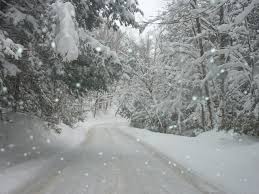
winter

Winter can be a cruel thing.  Snow, while pretty, can wreak havoc on driving conditions. The aftermath of ice storms, while beautiful on a sunny day, can cut power to your home for days and make driving nearly impossible.

Take for example the Nevada family whose Jeep overturned in the Nevada mountains. James Glanton, 34, and Christina McIntee, 25, thought to stay with their vehicle, making it easier for rescuers to find them, reported CNN. They also thought to heat rocks in a fire, then place the heated rocks in the Jeep’s spare tire to smokelessly heat their vehicle. By making use of some ultimate survival tips, they were able to stay alive.

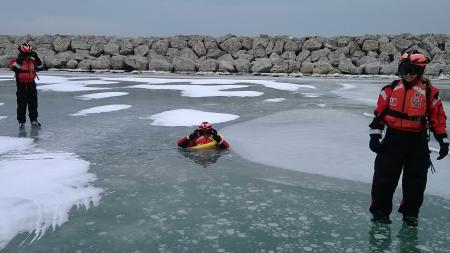
Winter’s not just tough on humans. In early December, the U.S. Coast Guard rescued a dog that fell through the ice of Sturgeon Bay, Wisc., according to a news release on the Coast Guard’s website.

450x253_q75
“The ice is really new right now, so it is really important to understand ice conditions,” said Petty Officer 2nd Class Nathan Disher, officer-of-the-day at Station Sturgeon Bay. “In this case, the owner of the dog did the right thing by not trying to rescue her dog by herself and calling us for help instead.”  Click here to read five facts about ice

According to the release, the dog rested at a veterinary clinic and went home with its owner.

To keep safe, the Coast Guard encourages the acronym I.C.E., which stands for “Intelligence, Clothing, Equipment.” The Coast Guard hopes I.C.E. will help ice anglers and other outdoor sportsmen to know the weather and ice conditions before they venture out. Ice anglers should also dress for the water temperature rather than the air temperature and wear a life jacket. Screwdrivers tied on a string around your neck are also handy to claw your way out of the water if you should break through the ice.

Read more: http://www.gameandfishmag.com/survival/10-ultimate-survival-tips-winter-weather/#ixzz3KIhTHRiG

Follow our FISHING BLOG

WEB   RATES     FISH    HUNT    CABINS    PHOTOS
TESTIMONIALS    BROCHURE    HUNT BOOKLET

Enter your email address to subscribe to this blog and receive notifications of new posts by email.

← Back

Thank you for your response. ✨

Email Me....

 
Leave a comment

Posted by on January 20, 2017 in survival, Wawang Lake Resort, weather


Tags: , , , , , ,