RSS

Tag Archives: hunting

Shoot it! : A Picture Is Worth a Thousand Words!

Wawang has always been synonymous with great trophies.  We have also be recognized as one of the most photographed filled brag book holders amongst our peers.  Believe me, when you have this much to be proud of, you want the world to see it 🙂

This slideshow requires JavaScript.

It is for this reason that we announce that we can now be found on Instagram!  With so many photos of successful fishing and hunting, it just makes sense to share it with the world.

We have always lived by a principal here: Show me, don’t tell me!  Join us and see what we can show you…..because remember, what you show, shows what you know!

Come on over and see our page WawangResort  and tell us what you think!

Follow our FISHING BLOG

WEB   RATES     FISH    HUNT    CABINS    PHOTOS
TESTIMONIALS    BROCHURE    HUNT BOOKLET

Enter your email address to subscribe to this blog and receive notifications of new posts by email.

← Back

Thank you for your response. ✨

Email Me....


Tags: , , , , , , , , , , , ,

Easy Fix To Prevent Bow String Damage

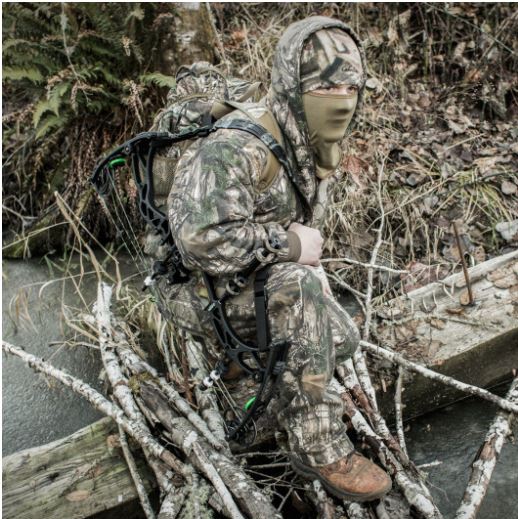
Carrying a crossbow cross-country puts the string at risk. This is especially true if you’re headed to a tree stand in the dark, where any branch can snag the string or cables and quickly ruin a much-anticipated hunt.

Capture

 Many hunters have this problem on their hunts whether black bear hunts, elk hunting, deer hunting, etc.  Your bow is more at risk in mornings that are still dark in order to get out to your stand and especially if you need to hike uphill through thick pine forests, over dead-falls, twisted tree tops, and other obstacles that threatened to damage your bow string.

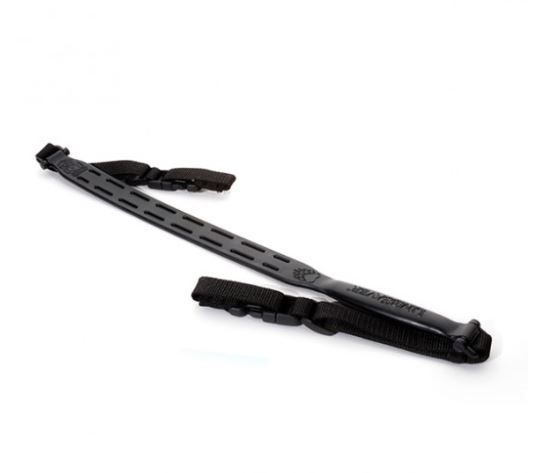
If you anticipate encountering obstacles like this on your next hunt try the Limb Saver sling for your bow, it will make carrying it over your shoulder much more comfortable.   And during a hunt as you duck under branches and squeezed between tree trunks, you never really know what was happening to the string over your shoulder. Then one day it happens.  After one morning’s hike, you see that the string was frayed from tree branch damage.

Capture2

A partial solution is to re-wax your bow string with Limbsaver String Protectant, which reduced the risk of fraying.

Secondly, your hunting jacket should fit over the bow, meaning that you could zip up the jacket with the sling exposed.

Use a Limb saver Kodiak Lite compound bow sling made specifically for crossbows. Its wide, no-slip strap made the carry secure and comfortable. In this way, the entire bow-string, scope, and bolts were protected.

Follow our FISHING BLOG

WEB   RATES     FISH    HUNT    CABINS    PHOTOS
TESTIMONIALS    BROCHURE    HUNT BOOKLET

Enter your email address to subscribe to this blog and receive notifications of new posts by email.

← Back

Thank you for your response. ✨

Email Me....


Tags: , , , , , , , ,

Getting in Shape for Hunting Season

stretching-web-1024x682

A great article Melissa Bachman

Hunting takes a lot of preparation and if you want to be successful there are things you can be doing year-round to help when fall finally arrives.  You may be wondering, well its awhile before the hunting season what can I possibly do to prepare now?  The food plots are in and the tree stands are set?  Well there’s another big part of the equation that could probably use a little work, and that’s YOU!

There are two very important things that every hunter should have on their year round to do list, stay in shape and practice shooting!

Hunting is just like anything else, the more you are willing to put in, the more you will get back.  This is true with both practicing, and staying in shape so why kill two birds with one stone?

Sure, when it comes to practicing any kind of shooting is good.  But think of the real world situation and how you will be feeling once you finally get to full draw.  Probably sweaty, out of breath, and shaking like a leaf!  I don’t know what you can do about the last, but I try to make the sweaty and out of breathe a reality when I practice.

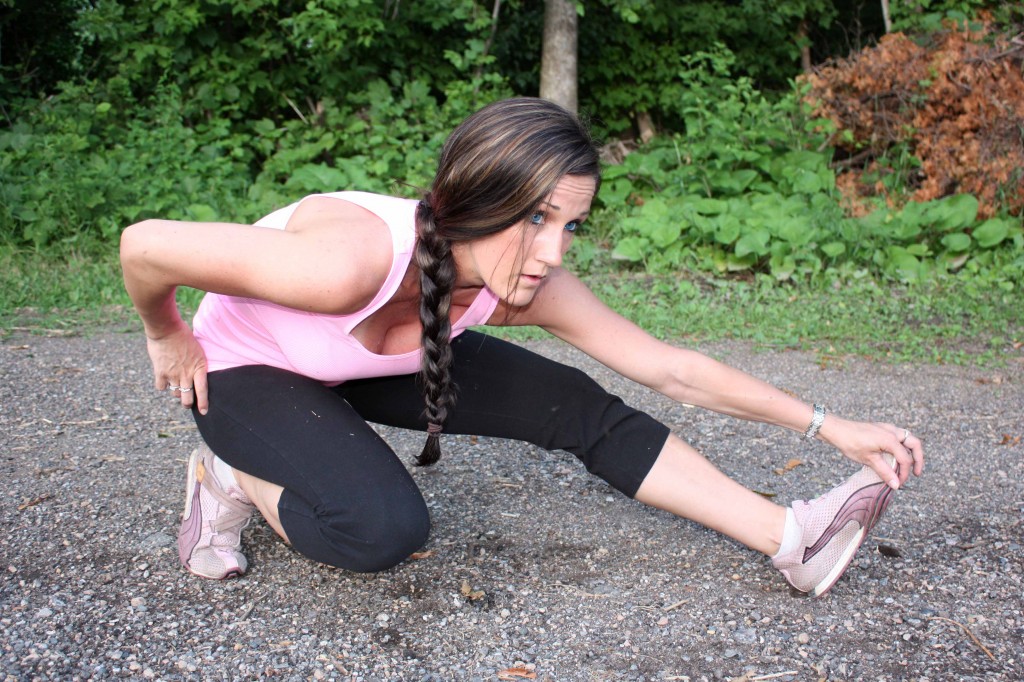
We’re all short on time, so why not combine the two and get even better results in half the time.  I start by spending at least 15 minutes stretching.  Many people think stretching is a waste of time, but you want your muscles flexible to prevent injuries while hunting. Do not skip this step!

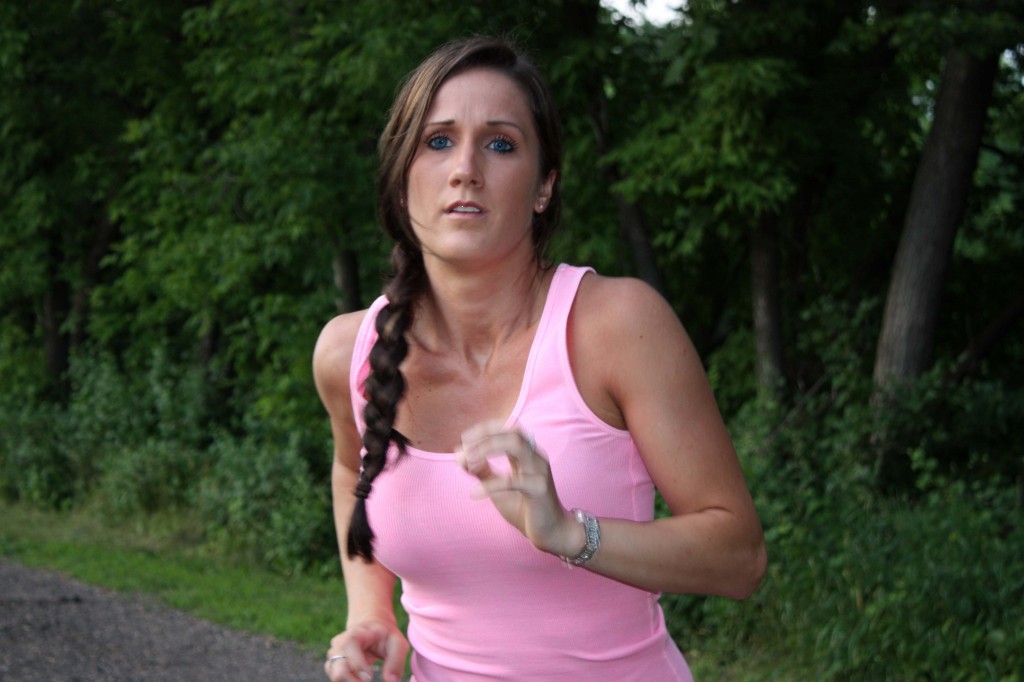
Once I’ve stretched, I usually go for a 2-mile run up and down the hills near my home.  After the jog, I grab my bow and shoot around 50 arrows at my target placed 40-60 yards out.  I prefer shooting longer distances as a rule, because once I am confident at 60-yards, 20 seems like a piece of cake.

Jogging-web-1024x682

Shooting while you’re tired is important; in fact it’s very similar to basketball.  I was never taught to practice free throws when you enter the gym; instead you shoot them at the end when you’re dead tired.  This is the real world simulation as to how it would be the last two minutes of the game during crunch time. Hunting is no different.  You’ve waited all year for this hunt.  You’ve climbed half way up the mountain and finally you’re at full draw, all your practice will now pay off.  Your instincts will take over, your breathing will calm, and your arrow will hit its mark.  Isn’t that the way you want your big hunt to play out this fall?

Not only will the workout make you a better real world shooter it will also make your hunt a much more enjoyable experience.  Here are five reasons getting in shape for hunting season will help and shape your hunt this fall.

bow-at-full-draw-web-1024x682

#1. If you’re hunting public land you will be able to get in further than other out of shape hunters, giving you a better chance at success.

#2. You will have a more enjoyable hunt and not be gasping for air and desperately hoping for a break every five minutes.

#3. Being in shape on a guided hunt will help you significantly because the guides will make their plan according to where the game is, not by where you can or can’t get to.

#4. Increase your percentage on making a good shot, because you will be less out of breath and already practiced in this situation.

#5. By being in shape you will have more energy on your hunts and in your everyday life.  In fact, it may help you live longer to enjoy more hunts in the future!!  Not such a bad of a deal after all…

situp-web-e1310358294897-1024x742

Follow our FISHING BLOG

WEB   RATES     FISH    HUNT    CABINS    PHOTOS
TESTIMONIALS    BROCHURE    HUNT BOOKLET

Enter your email address to subscribe to this blog and receive notifications of new posts by email.

← Back

Thank you for your response. ✨

Email Me....


Tags: , , , , , , ,

Jack Knife Smartphone Bow Mount

For the tech savvy and no tech savvy alike, this seems like it would be a great asset to have in the field to relive the memory or analyze any errors that were made.  Those of you that have used it or a product similar, feel free to leave comments in the section below with your experiences 🙂

JackKnife Smartphone Bow Mount

Don’t wait until you get home to see your latest adventure or share with friends…

Social media live in the woods!

Thanks to the new patent-pending Jack Knife Smartphone bow mount from S4Gear, hunters will no longer have to wait to get home to see their latest adventure. Mounted off the sight mount, the Jack Knife allows hunters to use their phone to film their hunts from the hunter’s eyes. With the ability to view and share their footage filmed right from their bow, its social media live in the woods.

• View your placement before you track your animal
• Use your Smartphone as a training device.
• Sight mounting bracket placement records video from
the hunter’s eyes
• Use in addition to other camera to incorporate split screens in final video pieces

*Before use of the product, be sure to consult your local hunting regulations as there may be restrictions on the use of electronic devices while hunting.

Follow our HUNTING BLOG

WEB   RATES     FISH    HUNT    CABINS    PHOTOS
TESTIMONIALS    BROCHURE    HUNT BOOKLET

Enter your email address to subscribe to this blog and receive notifications of new posts by email.

← Back

Thank you for your response. ✨

Email Me....


Tags: , , , , , , ,

Big Binoculars: The Advantages

images22Back in the 1970s, an uncle once told me that one of the most useful things any big-game hunter could own was a binocular in the 15×60 range. He said he never went elk hunting without one, and because I always did everything he said, I rushed right out and bought a Zeiss porro prism glass in 15×60 and it was exactly as he said, a highly specialized but invaluable tool if the circumstances were right.  Of course, like a jerk, I sold them some years later, but recently I traded a lot of stuff and coughed up some cash and got another big glass in the same power range.

What a major binocular will do is let you see when it is very dark, and let you see in detail at long range, or in great detail at medium range. On my recent trip to Kansas, the hunter who shared the blind with me had a 10×40 binocular of the first caliber, and I had a 15×60. In practical terms, what it would do was this:

At last light, when it was too dark to shoot, if we could see a deer I could tell if it was a buck or a doe. Fifteen minutes earlier, when he could see if it was a buck or a doe I could see if it was a big buck or a little buck. Fifteen minutes before that, if he could see whether it was a big buck or a little buck, I could count the points and evaluate the rack in excruciating detail.

images33

In some cases, a spotting scope is better. If you’re glassing miles of country, there is nothing that can take the place of 40X. However, at the intermediate ranges, say, 300 to 1,000 yards, a big binocular lets you spot things faster, lets you use both eyes, and is a lot smaller and lighter than most spotting scopes. They’re not cheap, but under the right conditions, big glasses are more than worth it.

Follow our FISHING BLOG

WEB   RATES     FISH    HUNT    CABINS    PHOTOS
TESTIMONIALS    BROCHURE    HUNT BOOKLET

Enter your email address to subscribe to this blog and receive notifications of new posts by email.

← Back

Thank you for your response. ✨

Email Me....


Tags: , , , , , , , , ,

On Target: How to Make Your Own Arrows

While doing some of my own research, we came across a fantastic article for all of you archers out there that have wondered about manufacturing your own arrows.

This article is reproduced from Edersbows.com, take some time to check them out 🙂 

arrows

Building your own arrows allows you to save about 5 to 1 0 dollars per dozen, but there’s an even better reason for building your own. You can experiment with all the components, with the various fletching styles and shaft sizes until you find the perfect arrow for your bow and your hunting or 3-D shooting requirements.

Building arrows is easy and fun, not to mention the satisfaction you’ll gain from taking game with arrows you’ve crafted yourself. Anyone can do it – and do it well. Armed with only a few basic tools and the information offered here, you’ll have no problem turning raw shafts into top-quality hunting arrows.

Nock Installation

nock
Year’s ago nocks were all glued on, now most arrows offer pressure-fit nocks that fit snugly but are turnable. Tunable nocks are definitely the way to go. These systems will make tuning a lot easier, and they hold up to more hard shooting than will glue-on nocks.

Assuming you aren’t going to paint (crest) your arrows, nock installation is the first step in the arrow building process. Use hot melt glue or epoxy when installing bushings into aluminum. When installing them in (or over) carbon shafts, use a rubber-based epoxy such as that available from Beman or Arizona Archery Enterprises (AAE).

Regular glue-on nocks should be pressed firmly into place (without glue) until after the fletching has been attached. When the arrow is finished you can rotate the nocks to the proper orientation so the fletching clears your rest and then glue them in place. Bohning Fletch- Tite works fine for this.

Apply The Fletching

fletching
You need a fletching jig, but it doesn’t have to be fancy. I’ve had good luck with the $20 plastic Martin jig I bought more than 10 years ago. Other good ones are made by Bohning, Bitzenburger and Grayling. You have three clamp options: left helical, right helical and straight

(no helical). For hunting and 3-D shooting, right helical is the most popular choice. If you’ll be using feathers, make sure to order feathers from the same wing as the clamp (right helical takes right wing). Vanes are manufactured straight and can be used with any clamp, so you don’t have to specify left or right when ordering.

One of the best fletching adhesive I’ve used for vanes is Fast-Set Gel made by AAE. This is a super-glue product that sets up in only 10 seconds allowing you to use a single-clamp jig and still fletch a dozen arrows in mere minutes. Fast-Set Gel will work on all shaft styles except AFC’s film-dipped carbon arrows, which require a traditional cement such as Bohning’s Fletch-Tite. Of course, Fletch-Tite will also work on aluminum arrows but takes about 10 minutes per fletching to set-up before you can remove the clamp. Fletch-Tite is still the best choice for feather fletching, however.

Place your fletching in the clamp so that its back edge will be about 3/4 inch ahead of the nock taper or nock bushing on your arrow. Adjust the back of the magnet on your jig (the magnet holds the clamp in place while the glue dries) inward or outward until the tail of the fletching sits squarely on top of the arrow. Next, adjust the forward end of the magnet to achieve the desired amount of helical. Easton’s technical representatives recommend four to five degrees of helical. I use a bit more myself – probably closer to seven degrees – but this is only on large diameter aluminum arrows. On smaller diameter carbon arrows I stay closer to Easton’s standard.

When using a straight clamp, (as opposed to a helical clamp) you don’t have as much lee-way and must either install your fletching perfectly straight or with a very slight off-set.

After your fletching is installed, apply a small dab of adhesive to both ends of each for a little added insurance against tearing loose.

You have more freedom to experiment with your fletching style and degree of helical than with any other aspect of arrow building, but it’s still best to observe a few general ground-rules. When making aluminum arrows for hunting, stick with four to five inch fletching. Five inch is a bit better because (in theory at least) it offers a small amount of added stability which can make a difference when shooting broadheads.

Carbon arrows, because of their smaller diameter, work best with shorter fletching (four inch is a good starting point) or you can run into a contact problem when trying to pass long helical fletching through the narrow gap in your rest. You can also experiment with various fletching orientations, such as 70/110 degree four-fletch, (you make this change by inserting a different indexing template into your fletching jig). But the basic 120 degree, three-fletch will do just fine under almost every shooting situation.

Cutting Arrows To Length
Draw an arrow and have someone mark it about a half to 3/4 inch in front of the rest. Cutting arrows is easy with the right equipment, but with the wrong equipment it can be a real headache. For limited quantities of aluminum arrows you can get by with a small rotating pipe cutter. I’ve done it a few times, but I’ve also made some pretty rough cuts, and basically ruined some arrows, in the process. You’re far better off pooling your money with a couple of buddies and getting an electric cut-off tool. You can also take your arrows to a pro shop (that’s equipped with an electric cut-off tool) to have them sized – usually for a price.

Installing Inserts and Outserts
Inserts and outserts (outserts are used with some types of carbon arrows) shouldn’t be taken for granted. Consistent accuracy with broadheads can be difficult to achieve when these components fit loosely. Inserts and outserts should install without any free-play. Usually you don’t have too many options with outserts – you get what the arrow maker offers – but you do have options with inserts. I’ve had good luck with aluminum inserts from Easton and Saunders and composite inserts from AAE. Inserts should have a light press-fit with the inside of the shaft so that each broadhead you screw in will line up perfectly with the shaft.

Aluminum inserts used in aluminum or ACC carbon arrows should be installed with hot-melt glue. Composite inserts in aluminum work best with a rubber-based epoxy, and the same applies for aluminum into carbon (Beman ICS or Gold Tip Graphite XT arrows) or when installing metal outserts on conventional all-carbon shafts. When you’re finished you can install a broadhead and spin test your arrows to make sure the inserts are properly aligned.

Take some time to visit http://www.eders.com/ to view their catalogue of parts and equiptment to assist you in your build.

lead_materials

Armed with the information above, you could now have a weekend hobby 🙂


Follow our FISHING BLOG

WEB   RATES     FISH    HUNT    CABINS    PHOTOS
TESTIMONIALS    BROCHURE    HUNT BOOKLET

Enter your email address to subscribe to this blog and receive notifications of new posts by email.

← Back

Thank you for your response. ✨

Email Me....


Tags: , , , , ,

Calling in Coyotes & Wolves

Thanks to the prevalence of electronic calling devices, anyone can become a decent coyote caller with the press of a few buttons. But if you really want to step up your game, you need to first understand what makes these animals tick.

coyote-hunting

Prey Distress
Coyotes are nature’s great omnivores. Studies of stomach contents have found that coyotes will swallow almost anything that they can get in their mouths, including rocks, plastic packaging, harness buckles, and even the occasional rabbit. Knowing this, it doesn’t matter much which sort of prey distress call you use—most modern electronic callers offer everything from a whitetail fawn to a house cat—as long as you set up within a coyote’s earshot.

The manner in which a coyote approaches a distress call depends on its security level, which is influenced by its latest experiences. An unpressured coyote will often come in quickly and boldly to almost any distress sound. A pressured coyote, however, will take much longer to approach a call. He’ll wait downwind of the sound before slowly slinking in, wary nose to the air.

Upon hearing the initial prey distress cries, the test coyotes would usually run to a downwind position without exposing themselves and remain there until we left. They would later approach our stand area to investigate. One wary old alpha pair (the male was 10 years old) waited 17 hours before approaching the calling location, and then spent 45 minutes at our stand site sniffing around.

The takeaway? One of the biggest mistakes you can make with a distress call is leaving a location too soon. Spend at least 30 to 45 minutes on stand.

Another important factor is the time of day you target coyotes. Only 10 percent of respondents in a recent poll of about 1,400 coyote callers said dawn was best. More than half the hunters chose 8 a.m. to 10 a.m., followed by 11 a.m. to 2 p.m., and then dusk, each of which got about 20 percent of the vote.

Whines & Yelps
These nonaggressive vocalizations—often made by pups—are probably the most effective sounds in a coyote caller’s repertoire because they trip so many behavioral triggers at once. With the press of a button you can target social interaction, territorial instincts, and protective maternal/paternal instincts. At certain times of the year, a case could probably be made that you’re appealing to their hunger, too, since several studies have documented coyotes cannibalizing pups.

Before switching to a different sound, we’ll increase the volume and intensity of the whines and yelps for three or four series in order to reach out to distant coyotes. This has proven extremely effective in all seasons and geographic locations, and at any time of day.

Challenge Howl
The challenge howl is a misnomer. A challenge is an invitation to fight, to do battle, such as a monarch bull elk bugling at a satellite bull. Coyotes don’t do that. Biologists call this vocalization the threat-bark howl because it more accurately describes the intent of the coyote: to threaten and demand that the intruder leave. Now. Field observations have shown that coyotes (unlike wolves) will avoid fights whenever possible. A wolf pack will run down an intruder and kill it. A pack of coyotes will run down an intruder, make him submit, and then let him leave the territory.

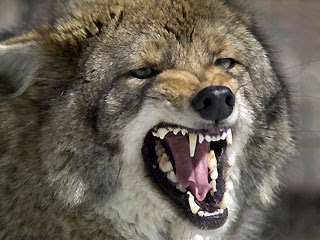
coyote_snarl

For these reasons, callers should use this vocalization only if they know they are set up in a pack’s core territory. If a caller sets up near a den during whelping or denning season, the results can be spectacular. Having resident coyotes charge in on a close, loud, aggressive call rivals any approach of a rutting buck or strut of a spring gobbler. However, if you set up in overlapping home ranges and demand that every coyote within hearing distance leave, they probably will.

The key to locating a pack’s core area is to home in on their group-yip howls. Listen for a pack’s group howl night after night. If you are able to pattern their howling with some regularity, you should be able to determine their core area. Once you’ve plotted that on a map or GPS, study the terrain. Coyotes will typically hide out in the thickest, most secluded cover in the area. Make an educated guess and move in close before threatening the pack.

Many callers will break off a stand when a coyote bark-threat howls in response to their distress calls because they believe that it means the coyote has busted them and will not approach. That’s not always the case. The coyote may simply be protesting the source of the sound even if it hasn’t identified it. You can often get a barking, threat-howling coyote to expose himself for a clear shot if you wait him out and weaken your return howls, keeping them less aggressive than the coyote’s. Another tactic is to retrace your steps and then circle around to a different location. If the coyote doesn’t see or scent you, you can call him in to the new setup with whines and whimpers.

130

Group and Solo Howls
Coyote calling is a numbers game. You want to offer sounds that appeal to the largest number of coyotes without alarming or intimidating them. The most effective howl to draw them in is a lone howl that is low frequency, high pitched, and long. It announces the presence of an unknown, young, small, nonaggressive coyote that any other dog within hearing distance will be willing to investigate.

Louder, long-range howls are more likely to get howls in return, but they are less likely to draw a coyote in to your stand.


Knowing that, here’s a simple formula for success: Locate coyotes with a group-yip howl (the collective yowling that you have undoubtedly heard on calm evenings) and call them in to gun range with a lone howl.

0cf5707bbfce2588fddf51ff630fbe1c

Most of those vocalizations are aggressive in nature. This is important to know because such vocalizations will alarm and/or intimidate most coyotes. Submissive coyotes will often retreat to their core areas after howls are broadcast and remain there until joined by another group member or until enough time has passed for them to call back or investigate. That’s the exact opposite of what you want your howls to do.

It is important to remember that coyotes will sometimes investigate the source of your group-yip howls, so don’t get caught unprepared.

Follow our FISHING BLOG

WEB   RATES     FISH    HUNT    CABINS    PHOTOS
TESTIMONIALS    BROCHURE    HUNT BOOKLET

Enter your email address to subscribe to this blog and receive notifications of new posts by email.

← Back

Thank you for your response. ✨

Email Me....


Tags: , , , , , , , , , ,

Sharpen Your Bow Skill During the Off Season!

bow-hunting-wawang-lakeWe practice with our bows all summer long, but after opening day its easy to get wrapped up in the hunting and forget about practicing. But even if you’re spending your time in the field and can’t hit the archery range every day, you can still keep your edge. Shooting in hunting situations is obviously different from target shooting. In the real world, weather conditions, shot angles, brush and other obstacles can impact your shot. Also, when the time comes to take a shot during a hunting situation you’re usually either stiff and cold from sitting in a treestand or sucking wind from running up a hill. All this combined with the fact that you must make a clean shot with the first arrow makes it all the more important to keep your shooting skills sharp. Here are a couple tips.

Practice Drawing
One of the biggest challenges to making a “cold shot” is that often the muscles I use for properly drawing my bow are stiff. The simplest way to cure this is to periodically pick a target, draw your bow, aim, hold, and let down your draw. This keeps you loosened up, plus drawing and aiming without actually shooting helps you focus on the target.


Practice Shooting

Although just drawing and aiming will help a lot, the single biggest help is to actually shoot while out hunting. A common practice among traditional shooters is to carry one or two blunt pointed arrows in your quiver so that you can stump shoot in your down time. Stump shooting is fantastic for keeping you warmed up, but unlike just drawing, actually completing your shots will bring your release into play, as well as give you all sorts of angles and situations to practice.

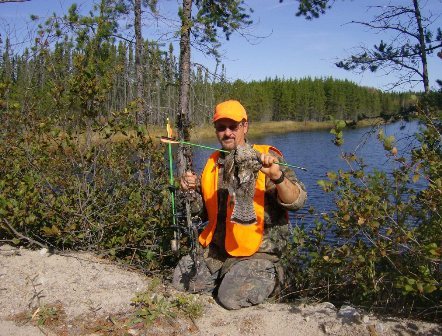
Small game is even better than stumps (grouse and rabbits taste a lot better too). Grouse can be deceivingly tough to hit. You want to aim for the base of the neck or the head. Sometimes they flush at the shot, but grouse will go in the direction that their head is pointing, so if you use a snaro point, you can either take their head off or hit them in the body as they flush. The best thing about grouse is they often give you extremely challenging shots, and if you can become consistent at taking them, you will be ready for the big game (make sure to check your local regulations before taking any small game with a bow).

grouseandy

Follow our FISHING BLOG

WEB   RATES     FISH    HUNT    CABINS    PHOTOS
TESTIMONIALS    BROCHURE    HUNT BOOKLET

Enter your email address to subscribe to this blog and receive notifications of new posts by email.

← Back

Thank you for your response. ✨

Email Me....


Tags: , , , , , , , , ,

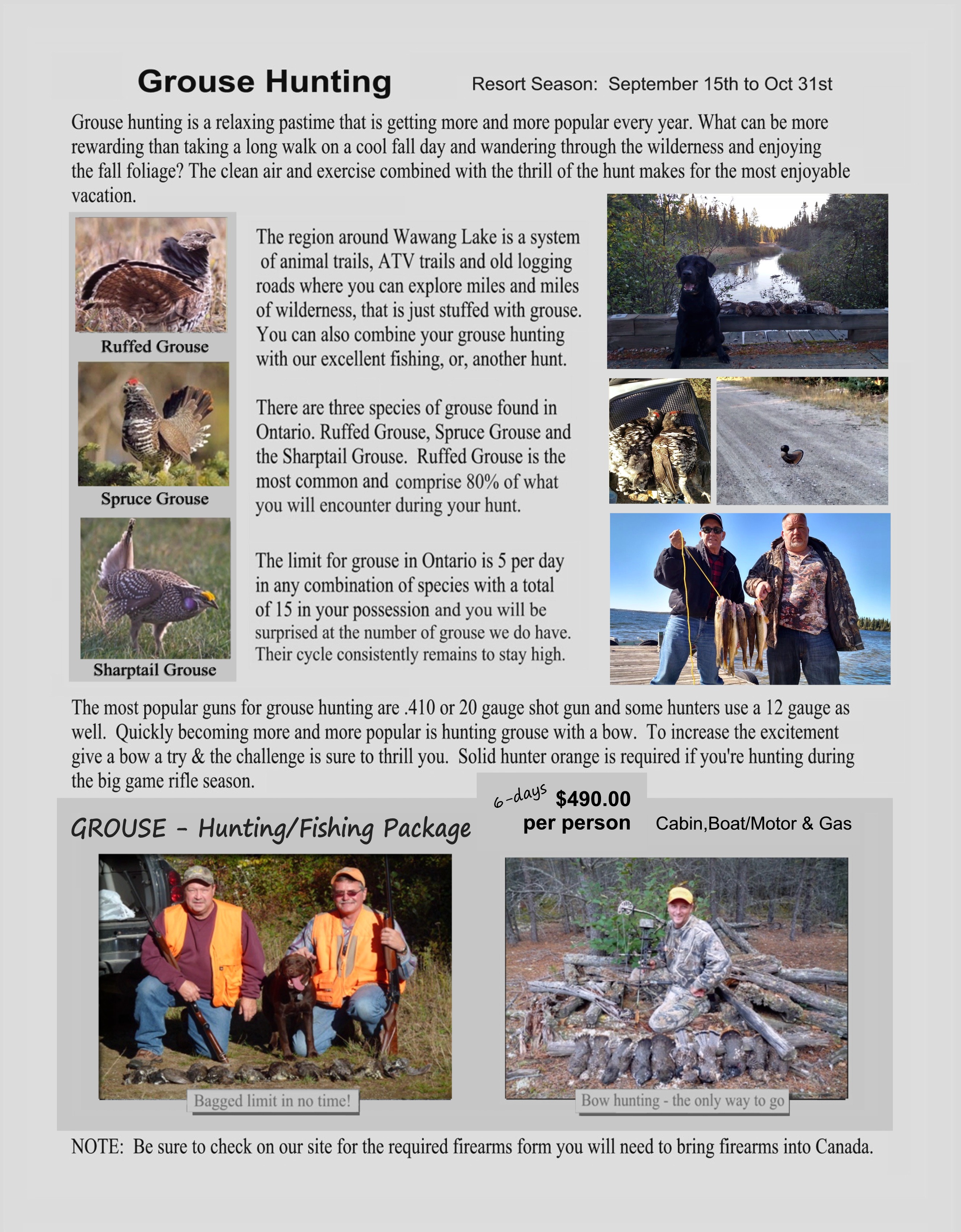
GROUSE Hunting Rates

Bookonline
pg 4 grouse

Bookonline

Follow our FISHING BLOG

WEB   RATES     FISH    HUNT    CABINS    PHOTOS
TESTIMONIALS    BROCHURE    HUNT BOOKLET

Enter your email address to subscribe to this blog and receive notifications of new posts by email.

← Back

Thank you for your response. ✨

Email Me....


Tags: , , , , , , , , ,

Muzzleloader For Beginners

Each year more hunters are discovering the thrill of muzzleloader hunting. There are several advantages to a muzzleloader hunt over traditional rifle hunting. In the Western states in particular, there are special muzzleloader seasons that traditionally coincide with the peak of the elk rut. Licenses are limited, so there are few hunters in the woods. Depending on the location and the skill of the caller, bulls can be bugled in to close ranges. All in all, it makes for a very exciting hunt.

2However, there is a learning curve to becoming a proficient muzzleloader hunter, and chances are, you’ll make every mistake in the book at least once. You’ll see some mighty fine bulls get away from a situation where it would be “meat in the pot” with a high-powered scoped rifle.

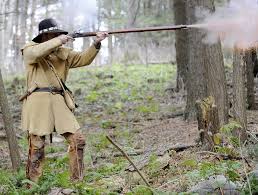
For those who are unfamiliar with muzzleloaders, allow me to explain. Muzzleloaders are the weapons that Davy Crockett and Daniel Boone carried afield with them during their bear hunts, Indian fights, and battles. Today there are two basic types of muzzleloaders used for hunting—primitive and in-line. Both are based upon the premise that the shooter pours powder down the end of the gunbarrel, then rams a slug or ball down on top of it to load the gun.

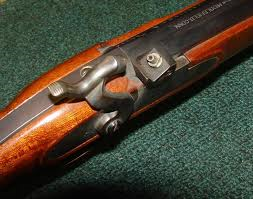
Primitive muzzleloader aficionados must choose between either a flintlock or a caplock ignition system. A flintlock is the more primitive technology, popular from the time of the Revolutionary War through the early 1800’s. The hammer of the gun holds a piece of flint wrapped in fine leather. Below the hammer is a frizzen, a swinging metal plate. Below the frizzen is the pan, into which the shooter pours a small amount of fine black powder. When the shooter pulls the trigger, the hammer strikes the frizzen, the frizzen folds back, and sparks are showered into the black powder in the pan. The ignited powder in the pan shoots a tongue of flame into the barrel of the gun via a small port. In turn, this flame ignites the black powder that has been poured into the barrel. The powder explodes, forcing the ball that has been seated on top of it to shoot out the barrel.

This process sounds cumbersome, and it is. Ignition is not instantaneous. Flintlock shooters have to hold steady for a second or more while an explosion occurs under their eyes. The possibility for error is very real.

cl
The more modern of the primitive technologies is the caplock design. Caplock muzzleloaders use the same basic concept of funneling flame into a port in the barrel, but the ignition is accomplished through a small nipple seated under the gun’s hammer. A small copper cap with a tiny bit of nitroglycerine is placed atop the nipple. When the hammer falls, the cap shoots a tiny spurt of flame through the nipple and into the port in the barrel, igniting the powder inside and shooting the ball out the barrel. Ignition is much more rapid than the flintlock.

In the last decade or two, several companies have noticed the resurgence of muzzleloading popularity. In response, they have crafted rifles that adhere to many states’ definitions of muzzleloader technology, i.e., a ball is rammed down the barrel and it can only be loaded with one round at a time. However, these are not primitive weapons. There are various ignition systems to discharge the load in the barrel, including shotgun primers and specially manufactured discs that are loaded directly behind the charge in the barrel. These are called “in-line” muzzleloaders. These rifles look more like high-powered rifles with a ramrod than something Daniel Boone might have carried on a bear hunt. Many in-line shooters use pelletized powder that can be dropped into the barrel in 50-grain increments and saboted copper-jacketed bullets that are built much like a high-powered rifle bullet with a plastic sleeve to allow ramming it down the barrel. Many of them are mounted with scopes and other optical sights.

Muzzleloader calibers range from old .36 and .40 caliber flintlock squirrel rifles to .68 caliber muskets used for warfare. Most flintlock and caplock guns today are .50 or .54 caliber, with an occasional .58 caliber rifle. The minimum size elk rifle is .50 caliber, and .54 certainly hits harder. The biggest in-line muzzleloaders are .50 caliber, with the occasional .45 caliber rifle used for deer and smaller game.

So, if you’re going muzzleloader hunting, you must make an immediate decision: is your goal simply to be in the woods with fewer people around, or would you like to stalk an animal with the additional challenge of carrying a rifle based on 1830’s technology? If your goal is to maximize your chances with the best available technology, then get your hands on an in-line muzzleloader. If the mystique of hunting like Jeremiah Johnson or John Colter appeals to you, then look into buying a caplock or flintlock rifle.
muzzleloader_guide_1

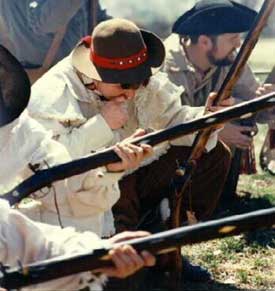
Whichever route you take, shooting a muzzleloader demands practice and patience. If you choose an in-line rifle, thinking that you can accurately shoot an animal out to 175 or 200 yards using pelletized powder, saboted bullets, and a scope, think again. First, you’re still obligated to use iron sights. Few riflemen these days are skilled enough to consistently hit targets at 200 yards with iron sights, and scopes are illegal in most Western states. Secondly, the data provided by the rifle manufacturers that suggest an 11-inch bullet drop at 200 yards are using saboted bullets and pelletized powder, both of which are illegal in most Western states. Thirdly, even if you can hit the kill zone on an elk at 200 yards with black powder and iron sights, the bullet will have lost much of its down-range energy and the chances of only wounding the elk are great. Combine that with a minimum 20-second reloading time (if you’re fast and your hands aren’t shaking with buck fever) and you’ve got a lose/lose situation. An elk can cover a tremendous amount of territory in 20 seconds, and I HATE tracking wounded elk. I recommend limiting your shots to a maximum range of 100 yards, no matter what rifle you’re carrying. After all, the whole point of muzzleloader hunting is to be more skilful hunter and to stalk within closer ranges.

The caplock Hawken. When I’m hunting with the caplock Hawken, you must have a game plan organized down to the finest detail.  Sight in the rifle until you can put three shots in a Skoal can at 100 yards.  Clean the barrel meticulously to rid it of the corrosive black powder fouling. Prepare the powder flask and possibles bag with measures of powder and bullets.  Practice speed loading at the range so that you can get off a quick (twenty second!) follow-up shot. Before setting out to hunt, load the rifle meticulously and check your gear.

imagesIIA88EY1

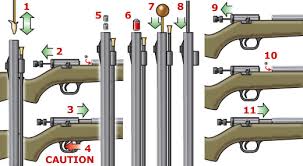
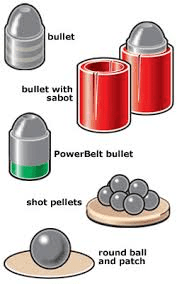
There are three basic kinds of bullets to use in a muzzleloader: the above-mentioned plastic-sleeved sabots, lead slugs, and lead round balls. Round balls are loaded by seating the ball on top of a greased patch of cloth on the muzzle, then ramming it home with the ramrod. Slugs are coated with grease, started down the muzzle, and then rammed home.
untitled

The problem with round balls is that they’re usually significantly lighter than a Minie-type slug, and don’t travel as far or hit as hard.   A typical .50-caliber round ball weighs 150 grains, while a typical buffalo bullet or Minie-type slug weighs 350-380 grains. I’ve shot a pile of elk using Thompson-Center 370-grain Maxi-ball slugs, and they each went down like they had been hit by a truck.

Keep in mind, however, that certain muzzleloader barrels are cut with a slow twist for shooting round balls, and others are rifled with a fast twist for shooting slugs. Make sure that you research the rifle and match it with the appropriate hunting load before you purchase so that your rifle is most accurate for the type of shooting you plan to do.imagesJN6SJJ3E

Most rifles have a “sweet spot” where they shoot very accurately with a certain load. Loading a rifle with more powder may indeed generate more muzzle velocity and knockdown power, but it may also cause it to lose its accuracy. For my caplock, I’ve learned that 90 grains of powder makes it shoot very accurately up to 100 yards and it still kicks pretty darned hard. It develops plenty of energy at that rate to dump an elk with one shot. The maximum load for most muzzleloaders is 120 grains of powder, though the experts say that black powder doesn’t explode like smokeless powder and you really can put a lot of powder in a gun with no adverse consequences. I still wouldn’t recommend it, though. Please note, however, that any amount of smokeless powder will explode almost any muzzleloader because of the high pressures generated.

Hunters can prevent their powder getting wet by covering the muzzle of the rifle with plastic wrap secured by a rubber band, and also by sealing the nipple’s connection to the breech of the gun with modeling putty.

If you think the possibility exists that your powder may have gotten wet, there are still ways to make the rifle go off. With a nipple wrench, you can remove the nipple, dig out a few grains of wet powder, replace it with a few grains of dry powder, and away you go again. If it won’t make a difference in your hunting, fire the gun. If it won’t fire, try several caps until it goes off. In humid places like Alabama, hunters all fire their rifles at the end of each day of hunting. Towards sunset, you can hear a ragged salute of gunfire as each hunter discharges his load.

images

On an elk hunt, the excitement is in getting close to the game. A rutting bull usually has only one thing on his mind, and when a big bull responds to a bugle with a challenge of his own, well…it just doesn’t get more exciting than that. Armed like one of the mountain men of the 1830’s, knowing that you’ve got just one chance to put a killing shot in him, knowing that you’ve got to be patient and wait for the ideal shot, it makes hunting with a high-powered rifle seem just a little unfair.

Follow our FISHING BLOG

WEB   RATES     FISH    HUNT    CABINS    PHOTOS
TESTIMONIALS    BROCHURE    HUNT BOOKLET

Enter your email address to subscribe to this blog and receive notifications of new posts by email.

← Back

Thank you for your response. ✨

Email Me....


Tags: , , , , ,