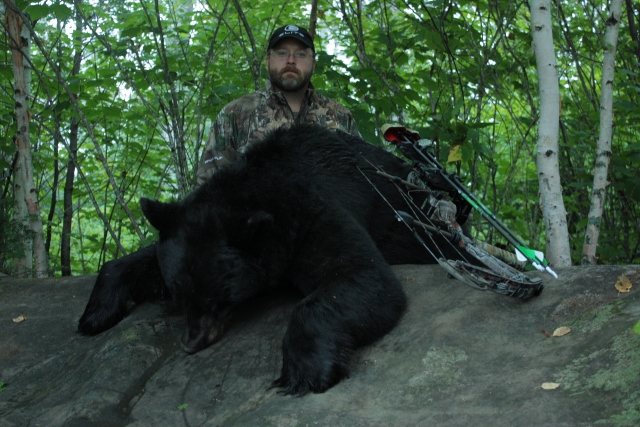
RSS

Tag Archives: hunting guide

Grin and Bear it: The wait

Each season we spend several hundred hours planning, baiting and preparing our hunters for the prospect of harvesting a bear AND we meet new hunters that are ready and eager to harvest that said bear.  However there are some that will be in for a wait.

SAM_0016 (640x480)

Understanding that bear are as individual as people will give a hunter more perspective into what to expect.  I have commonly met new hunters that assume that just because there has been food placed daily for a couple of weeks ahead of time daily, that predicting when a large sow or boar will come in to take and they will go and sit for that time……WRONG!

Being that our baits generally carry multiples, the pattern of ‘hits’ (baits being opened and emptied) can vary.  Smaller bear can come in and hijack a small mouthful in an attempt to get a treat before the larger, more dominant animal appears.  The larger bear may feed less than daily and come every second or third day and yet another wrench can be thrown in with a travelling sow and cub or cubs.  That sow and cub(s) can travel the distance of several baits and interrupt many which in turn will throw off any marked pattern that may have been occurring up until this point and leave a hunter scratching his or her head.

Weather is another factor that can throw off the pattern of hit times and during the latter part of August and into September, the wind is prone to several directional changes per day and variations of warm, cool and wet days that can play havoc with a bear’s daily movements.

Pair all of this together and now add the moon phases.  As the moon fills, the night time light becomes more prevalent and allows for easier visibility in those later hours and no hunters in the trees.  With all of these factors stacked against a hunter, it soon becomes apparent that this is still a hunt and outsmarting your prey and putting in your time may be necessary.

moonphase

Don’t get me wrong, we have had bears taken from baits while stands were still being set in the trees but on the flip side we also get those hunters that take their bear on the last day, last hour and last minute of the hunt.  All factors are variables that play into the outcome of an overall hunt.

The moral is be prepared to sit your stand from as legally early to as legally late as possible.  You are dealing with animals that don’t rely on stats or patterns the way we put weight on them.  These animals need to fill their basic instincts when the time suits them and not when it suits us.

You need to ask yourself before taking on such a challenging hunt….is this bear worth the wait?

bearstand

Follow our FISHING BLOG

WEB   RATES     FISH    HUNT    CABINS    PHOTOS
TESTIMONIALS    BROCHURE    HUNT BOOKLET

Enter your email address to subscribe to this blog and receive notifications of new posts by email.

← Back

Thank you for your response. ✨

Email Me....

 
1 Comment

Posted by on December 30, 2015 in black bear, hunting, Wawang Lake Resort


Tags: , , , , , , , ,

Bears Down! The Bear Highway

It cant go without saying that this year’s batch of hunters fortitude has been tested over and over.  With weather that seems to be taunting them by cold raining one day and jumping to 80+ degrees and sunny the next, these guys have been putting in the hours and time after time have in most cases been rewarded.

On Saturday, Dave, Tim and Jason made the long drive up from Iowa to try their best to outsmart a couple bruin and get a day or two of fishing in.  Optimism high and clouds beginning to hang low, the stands began to be assembled for the drive to the baits.

Each man had a different weapon but all agreed that failure was not an option.  The first day was a shorter than normal sit of only 4 hours and all were thankful that it was a restful sit as they had a long drive before and had sat long enough 🙂

The men arrived back in camp late after a dark trip through the woods.  Dave was ecstatic to let me know that his bait had proven effective and he had spotted an average sized bear that he had decided to pass on and Tim and Jason both had heard but not spotted activity.

SAM_0016 (640x480)

The next day, the three went out, excitement and weapons in hand.  The weather had cooled down and was determined to hold that mercury low for the day.  The boys had layered and knew it would be a good, long, cool day.  The day wore on for us here at the lodge as we completed one task after another waiting for the telltale early truck arrival signalling a downed bear.  As we waited and watched, the clock ticked on.  The sun had already set and the boys were already 30 minutes passed the expected arrival.  We would give them 30 more minutes before setting out to ‘track’ our hunters.  As the minutes dragged on, I had begun to assemble my gear, ready for the drive out with Terry.

At 11:20 pm, a set of headlights pulled through the trees and the truck slowed to a stop in front of my door.  I emerged to a truck full of smiles, not only had Dave taken his boar of 368lb glory, but Tim had taken his as well!!

IMG_5703 - Copy (640x427) (2)

As we iced the bears down for the night, I had the chance to go over the hunt with both hunters, as a returning hunter to Wawang, Dave was so excited to tell me about all the bears he saw on ‘the bear highway’ today.  He couldn’t help but beam when he told me about the sow and cubs that came for two visits that day as well as the mid sizer that came in between.  He said that with all the action on the bait, it was very simple to decipher the size of his boar.  He was clear that it had trumped everything else that had come for a visit and was so proud to share the pictures.  “There were just bear everywhere I looked!” he repeated.


Smiles all around, Tim spoke up about his hunt and was proud of his harvest, though it wasn’t as big a bear as Dave’s, the tell white half chevron of white on the chest that made a winking emoticon made it very simple for me to dub this boy ‘Winky’ .  Both had prime hides and will make for not only fantastic stories but beautiful mounts to be enjoyed for year after year.

IMG_5726 - Copy (640x427) (2)

Jason was so proud of both of his hunting buddies and is determined to add to the celebration list too!

Follow our FISHING BLOG

WEB   RATES     FISH    HUNT    CABINS    PHOTOS
TESTIMONIALS    BROCHURE    HUNT BOOKLET

Enter your email address to subscribe to this blog and receive notifications of new posts by email.

← Back

Thank you for your response. ✨

Email Me....

 
Leave a comment

Posted by on December 29, 2015 in black bear, hunting, Wawang Lake Resort


Tags: , , , , , , , , , , , , ,

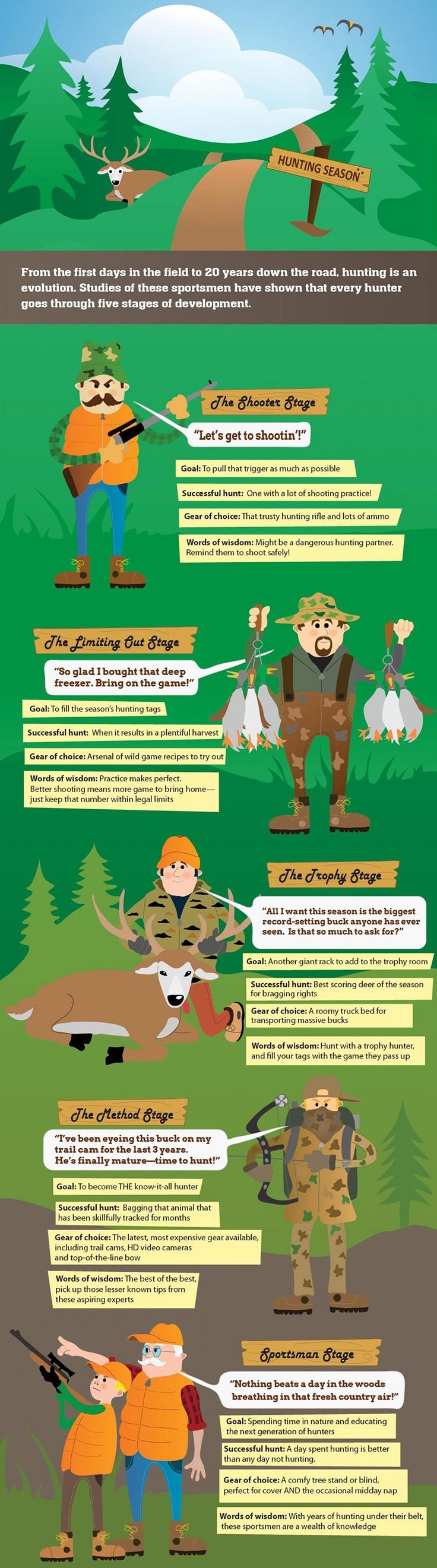
Evolution of a Hunter

wawang-lake

 WEBSITE    RATES     FISH    HUNT    CABINS    PHOTOS
TESTIMONIALS    BROCHURE    HUNT BOOKLET

Enter your email address to subscribe to this blog and receive notifications of new posts by email.

← Back

Thank you for your response. ✨

Email Me....


Tags: , , , , , ,

Grouse Population

 imagesPOPULATION
Ruffed Grouse normally have a short life span. From a brood of 10 or 12 hatched in late May or early June, usually 5 or 6 will have died by mid-August. Among those living to disperse during the fall shuffle, about 45% will have been lost by late fall and early winter. Another 10% die over winter and during early spring, so that only about 45% of the young grouse alive in mid-September live to their first breeding season. In subsequent years a given cohort (a season’s crop of young birds ) continues to shrink by about 55 to 60% per year. So from 1000 chicks hatched in late spring, about 400 normally survive to early autumn, 180 survive to the following nesting season, 80 are alive a year later, 36 live to breed a 3rd time, 16 may breed a 4th time. One out of 2200 chicks hatched may live as long as 8 years.

Most Ruffed Grouse die a violent death to provide a meal for one of a number of meat-eating predators, for in the natural scheme of things, Ruffed Grouse are one of the first links in a complex food chain. Some also die from disease and parasites, or from exposure to severe weather, or accidentally by hitting trees or branches while in a panic flight after being frightened.

grousewawanglakeAcross the major portion of the Ruffed Grouse range, the winged predators or raptors are most efficient at taking these birds. Although the goshawk is certainly the most efficient of all grouse predators, the horned owl probably kills more grouse annually than any other predator. This is due to the cosmopolitan distribution of these owls and the likelihood that any woodland capable of supporting grouse will have resident horned owls, or at least be regularly visited by them. Yet, where cover is adequate, grouse can find security and maintain their abundance even when goshawks and horned owls live and nest nearby.

Conditions are seldom static in the world of the Ruffed Grouse and their numbers fluctuate from year to year, and from decade to decade. Across most of their range in the northern states, Canada and Alaska, Ruffed Grouse numbers have risen and fallen in a somewhat predictable pattern for most of this century, in what is often called a “10-year cycle”. In the Lake States, for example, periods of abundance usually coincide with years ending in 0, 1 or 2, and the bottom of the depression in years ending with 5 or 6. This is not invariable, but a general, regional trend. These “cycles” sweep across the continent more or less as a wave, beginning in the far Northwest and Northeast, and progressing southward and southeastward.

The factors responsible for these periodic fluctuations remain poorly understood, and appear to involve a number of different factors interacting with one another in different ways at different times. The one factor which does not appear to be important is hunting during the period of fall dispersal.

grousewawanglake3

The primary causes for the short-term fluctuations in Ruffed Grouse abundance appear to be related to weather trends and variations in the quantity and quality of food resources. These are interrelated to a large degree. Superimposed upon these two basic factors is that of predation – as predators take advantage of grouse placed in jeopardy by unfavorable weather conditions or inadequate food resources. A favorable combination of weather factors and food resources may allow these grouse to survive the winter nearly immune to predation. These combinations of factors also affect annual production. If grouse spend the winter feeding on poor quality foodstuffs, or have to use an excessive amount of energy to keep warm, hens may not have sufficient reserves to produce a clutch of viable eggs, or vigorous, healthy chicks in the spring. Across most of their range, the most productive and most abundant Ruffed Grouse populations are those living where they spend most of the winter burrowed into 10 inches or more of soft, powdery snow, and emerge for only a few minutes once or twice a day to take a meal of the male flower buds of the aspens. Our Ruffed Grouse can be considered snow lovers or “Chionophiles.” Ruffed Grouse tend to be less numerous and less productive if they live in regions where they cannot burrow in snow and feed on aspen (poplar).

grousewawanglake2There also seems to be a poorly understood relationship between the color-phase of a Ruffed Grouse and its ability to survive severe wintering conditions, and its vulnerability to predation.

Longer term changes in Ruffed Grouse abundance reflect how we have treated our woodlands and forests. There is also reason to suspect that much of the severity of the “10-year cycle” is largely a result of how we have treated forested lands. These birds depend upon the food and cover resources produced by a group of short-lived trees and shrubs growing in full sunlight which develop following the severe disturbance of forests. In earlier times, fire and windstorm were the ecological agents periodically renewing forests and creating satisfactory habitat for Ruffed Grouse and many other species of forest wildlife. Ruffed Grouse should be considered a “fire-dependent” species in the natural scheme of things.

Our current reluctance to cut forests, even under strict management plans and the suppression of fire to protect growing forests, have upset this natural sequence of events. In the early part of this century, farm abandonment and the recovery of forests from unregulated logging and fires produced habitats which probably resulted in the greatest abundance of grouse in recent times in most of Canada & northern  United States. But as forests mature under protection from fire and cutting, they lose the habitat qualities Ruffed Grouse require. In many regions, Ruffed Grouse numbers have declined as forests have become more extensive and older.

Ruffed Grouse abundance can often be readily restored by proper harvest management of forested lands, or through the judicious use of prescribed fire that is ongoing in northwestern Ontario.

Follow our FISHING BLOG

GROUSE HUNTING at Wawang Lake

 WEBSITE    RATES     FISH    HUNT    CABINS    PHOTOS
TESTIMONIALS    BROCHURE    HUNT BOOKLET

Enter your email address to subscribe to this blog and receive notifications of new posts by email.

← Back

Thank you for your response. ✨

Email Me....


Leave a comment

Posted by on December 16, 2015 in grouse, hunting, Wawang Lake Resort


Tags: , , , , , , ,

Pay Attention to Detail

Scent can be your biggest ally or your worst enemy

wawanglakebear
Black Bear are attracted to the aroma of a free meal, but if they catch a whiff of you, you can often kiss them good-bye for a day or two.   Keep your clothing and footwear as scent-free as possible. Be alert at all times while hunting your bait. You will most often see bear before you hear them. With padded feet they move with calculated precision. Remember, when they come into a bait station they know the treats were left by humans.


Shot Placement

Regardless of your choice of weapon, whether it is a gun or bow, learning when and where to shoot can mean the difference between an expedited kill, or, the outcome of tracking a wounded animal. We advise our hunters to wait until the bear is preoccupied with the bait and is facing away while standing broadside or quartering away. Bears are extremely tough, so a double lung or heart shot are always your best option therefore taking your time will be important.

wawangshotplacement

When archery hunting, bows must meet the following specifications.

Crossbows: Draw length must be at least (11.8 in.);

  • Draw weight must be at least (119 lbs.);
  • Bolt head must be at least (0.9 in.) at the widest point; and,
  • there must be at least two cutting edges of straight, sharp, un-serrated, barbless steel.

Re-curve Bow:    Draw weight must be at least (48.5 lbs.) at draw length of (27.6 in.) or less;

  • Arrow length must be at least (23.6 in.);
  • Broad head must be at least (0.9 in. at the widest point; and,
  • There must be at least two cutting edges of straight, sharp, un-serrated, barbless steel.

For bow hunting Black Bear we recommend a compound bow with a draw weight of no less than 50 pounds and a 100 grain broad head

Recommended Knowledge base
www.mnr.gov.on.ca/en/Business/FW/Publications/MNR E001275P.html

For rifle hunting black bear we recommend using nothing less than a .270 caliber.
Other recommended calibers: 7mm magnum; .308; .30-06.  NO 30-30’s

Firearm Information www.rcmp-grc.gc.ca/cfp-pcaf/index.htm

The bottom line – baiting is a proven strategy for attracting a wary game animal with a voracious appetite. It involves much more than just tossing out a few tasty morsels. There is a right way and a wrong way to do it and our experienced guides take pride in their skills and knowledge. Keen attention to detail and listening to the guide is the key to your success.

In order to ensure the highest possible success to our hunters we take only an average 14 hunters a year. Should we have an increase in bear sighting throughout the spring and summer we may take a few more hunters but our first obligation is to ascertain a healthy black bear population together with satisfied hunters for years to come.

Most importantly, remember baiting is a ton of work and takes weeks on our part for each hunter. From collecting legal paper work to buying and picking up the ingredients, materials along with travelling for miles and then finally establishing and maintaining each site daily prior to your hunt. It requires foresight and commitment on our part and we do this because of our passion for the outdoors and careful management of our Black Bear.

Follow our FISHING BLOG

WEBSITE    RATES     FISH    HUNT    CABINS    PHOTOS
TESTIMONIALS    BROCHURE    HUNT BOOKLET

Enter your email address to subscribe to this blog and receive notifications of new posts by email.

← Back

Thank you for your response. ✨

Email Me....


Tags: , , , , , , , , ,

Don’t Forget To Breath

Whether we are at the range shooting targets, or in the field hunting, breathing is important. We want our sight, scope or pin to be on its mark when we pull the trigger.

untitled

Education, shooting positions and firearms are all very important to shooters. Breathing is a very important factor as well. We all breathe. From the day we were born we have unconsciously learned to breathe in and out. That natural motion can help or hinder during shooting.

Controlled breathing is a necessity in shooting accuracy. When you breathe in and out your chest rises and falls. This movement can cause your gun barrel or arrow sight to float on its target. Your breathing may cause you to move at the exact moment you pull the trigger to fire.

Sometimes when you are hunting, you get excited and/or the terrain and conditions cause your heart rate to accelerate. Your breathing becomes more rapid and harder to control. If you hold your breath, you may become light headed and your shot may be off target. It is important to practice your breathing techniques as you practice shooting positions at the range.

There are multiple methods of breathing during a shot. The best thing to do is practice them and determine which works best for you. Once you’ve determined your breathing technique, practice it so it becomes instinctive when you are under pressure.

untitled4Exhale & Pause – When you are in shooting position, put your cheek against the stock of the gun. Take in a deep breath. Exhale just a portion of that breath, pause briefly and pull the trigger. The pause should allow you to hold your gun barrel and sights in perfect alignment on the target at the very moment the gun fires.

Inhale & Pause – Relax and practice steady breathing. Double check your shooting position. In your rythm of relaxed breathing, inhale. When your lungs are about half full, pause and pull the trigger. The inhale and pause is similar to the exhale and pause method. Your gun barrel and sights should be in perfect alignment on the target at the exact moment the gun fires.

Full exhale – Make sure you are in proper shooting position. Breathe slowly to relax. Focus on your target. As you breathe naturally, and you are at complete exhale, pause when your lungs are empty and squeeze the trigger.

untitled2Breathe Naturally – Breathing naturally takes the focus completely off of breathing technique. You do not  pause at all. Focus on your form and your target as you breathe naturally and squeeze the trigger. Sometimes being consciously focused on breathing can increase heart rate and breathing patterns. The natural breathing technique takes the focus off and you begin to unconsciously form a habit of correct shot timing.

When you are pausing, remember just that. It is a pause, not a hold. When a shooter holds their breath, their muscles tighten and their heart rate can change. This will dramatically change the accuracy of a shot.

While you are practicing, if you become short of breath, stop. Re-group and practice your natural, relaxed breathing. It is important to steady your breath to decrease the amount of movement your body is making. If you are able, step back. Take a deep breath in. Then exhale and then reacquire your target.

untitled3

Follow our FISHING BLOG

WEBSITE    RATES     FISH    HUNT    CABINS    PHOTOS
TESTIMONIALS    BROCHURE    HUNT BOOKLET

Enter your email address to subscribe to this blog and receive notifications of new posts by email.

← Back

Thank you for your response. ✨

Email Me....

 
Leave a comment

Posted by on December 12, 2015 in gun hunting, hunting, Wawang Lake Resort


Tags: , , , , , , , ,

Bear Hunt References

It’s always comforting when we know we can reach out and speak with fellow hunters AND especially about the outfitter they’ve chosen to go with.  At Wawang Lake Resort we certainly understand this and have put together a few REFERENCES for you to contact.

Wawang440bear

Jon E. Haman – Tiffin, IA jonschaefferoil@southslope.net Cell (319) 930-0144

440 lb Black Bear 

“Tami and Terry Kaliska run an absolutely first rate operation. Not only do they have the knowledge and put the work in that’s necessary to give you a successful hunt, they share that knowledge and keep working for you until you tag your bear! It was my true honor and privilege to have taken a Pope & Young bear under the tutelage of Ontario legends…the Kaliska’s.  I can’t wait to take my sons to Wawang Lake Resort and live the adventure along side them as well!”

Season opens – 1st Saturday after August 15th and runs for three more weeks

WawangBear4

Follow our FISHING BLOG

WEBSITE    RATES     FISH    HUNT    CABINS    PHOTOS
TESTIMONIALS    BROCHURE    HUNT BOOKLET

Enter your email address to subscribe to this blog and receive notifications of new posts by email.

← Back

Thank you for your response. ✨

Email Me....


Tags: , , , , , , , ,

Hunter Fends Off Grizzly by Shoving Arm Down Its Throat

Grizzly

Sticking an arm down the throat of a bear is regarded by some as an effective last-ditch tactic for fending off an attack.

There are few animals in North America as frightening as an adult grizzly, and if one of these massive animals get it in their heads to attack you, your day just suddenly got a whole lot worse. Twenty-six-year-old Chase Dellwo was expecting to bag some elk in the Montana back country near Choteau last Saturday, but a chance encounter with a bear ended with him sticking his arm into its roaring mouth instead.

That decision may have saved his life.

According to the Great Falls Tribune, Dellwo was bowhunting near a creek bed with his brother Shane. Strong wind and intermittent snow and rain kept visibility to a minimum, but the brothers heard elk bugles in the area and Dellwo was eager to make his first elk harvest of the year. The hunter had been steadily driving the animals toward his brother, but the weather also hid a sleeping grizzly, which Dellwo practically tripped over. At less than three feet, there was little that Dellwo could do before the animal charged him.

“I had an arrow knocked, and I put my bow up in front of me and took two or three steps back,” he told the Tribune. “There wasn’t any time to draw my bow back.”

The grizzly knocked Dellwo off his feet and bit him in several places across his head. It then reared back and gave what the hunter later described as the loudest roar he had ever heard, before attacking him again and biting his right leg. It was at this point that Dellwo recalled that an old survival tip about how bears have sensitive gag reflexes—so the hunter plunged his arm down the animal’s throat.  The bear promptly left.

Dellwo is not the first person to have stuck their arm down a bear’s throat and lived to tell the tale. The trick is commonly regarded as a last-ditch defense against bear attacks. As recently as last November, a hunter in British Columbia used to same trick to disable and ultimately kill a large grizzly sow near Fernie. According to CTV News, Wilf Lloyd was seriously mauled by the bear before he was able to stop its biting by jamming his hand down its mouth. While the bear was still on top of the man, Llyod’s son-in-law arrived and shot it dead with a rifle.

Lloyd also received a bullet in the leg during the chaotic struggle, but he did not blame his hunting companion in the least.

“The man saved my life,” Lloyd later said. “What Skeet did and because of his fast reaction, the shots, I had maybe fifty stitches in my hand and that’s it. So I was very fortunate that way.”

Dellwo echoed Llyod’s sentiment after his own bear encounter. Shortly after the attack, he was able to reunite with his brother and was transported to a local hospital, where he was treated for various cuts and punctures on his head and right leg. Dellwo expects to be back in the woods later this year for rifle season.

Officials with Montana Fish, Wildlife, and Parks are currently investigating the case and believe that the bear involved was a 400-pound male. Experts added that the brothers seemed to have done everything correctly and that the bear will likely not be tracked down since the attack was not predatory in nature.   By: Daniel Xu

Follow our FISHING BLOG

WEB   RATES     FISH    HUNT    CABINS    PHOTOS
TESTIMONIALS    BROCHURE    HUNT BOOKLET

Enter your email address to subscribe to this blog and receive notifications of new posts by email.

← Back

Thank you for your response. ✨

Email Me....


Tags: , , , , , , ,

The Wrong Turn

survival3

 On Aug. 31, Bill Lawrence, 40, got separated from his hunting partners and remained lost for five days. As told to Colin Kearns.

Wednesday. I’d just killed my first squirrel when I glanced over for my friends Russell and Cris. They were gone.

Russell was the only one who’d hunted these woods, Meeman-Shelby Forest north of Memphis. We’d been hunting for 20 minutes and were deep into the forest. Russell and Cris stuck together, while I drifted to their left. I tried to stay within eyesight of them, but I was also watching for snakes. The last time I saw them, it looked like they were continuing in a straight line. Then I stopped to shoot the squirrel.

I thought I had an idea where they were, but an hour later I wasn’t any closer. I shouted, but the thick woods only swallowed my cries. So I turned to hike back to the truck, but an hour later I was even more lost. I kept walking, though, figuring I’d find a way out.

I walked, stopping to rest now and then, until it started to get dark. I’d fired a couple of shots but got no response. It never got cold, which was good because I had nothing to build a fire with. I doused myself with bug dope, then lay down. With my vest, I was able to cover my face and roll up the bottom end to use as a pillow. That dead squirrel in the pocket added a decent cushion.

I heard helicopters but they couldn’t see me through the trees, and I wasn’t going to run through the woods in the dark. I just prayed they’d find me tomorrow.

Thursday. I finished the last of the two water bottles I’d brought with me that morning. The days were hot, and I was walking and sweating a lot. I needed to stay hydrated. Fortunately, it rained that morning, and I managed to catch a half bottle’s worth of water.

I mostly squirrel hunt, but I have enough experience hunting deer and rabbits that I can identify tracks—and I know that if you follow those tracks, they’ll often lead to a water source, which in my case was a puddle in gumbo mud. I dipped my empty bottle and watched it fill with gray, grimy water. I didn’t want to drink it. I worried it’d make me sick. But what choice did I have? I was already getting dehydrated.

The taste was nasty—dirty and sandy—but the dip of mint Skoal I had in my mouth made it at least drinkable. I figured I should eat something, too, even though I wasn’t starving. I turned a dead stump over and found some nightcrawlers. They tasted about as bad as the gumbo water. I don’t know how many I ate—only that I’d never eat another one.

The rest of Thursday was a lot like Wednesday: Walk, then break for a nap. Walk, then nap. That second day, as I was walking—with no real end in sight—is when I started talking to God. Why is this happening? If I don’t make it out, will you take care of my wife and kids?
imagesTJNT6CHZThat night I awoke to a WHOOSHWHOOSHWHOOSH. Dazed, it took me a moment to realize that it was another chopper—and that it was right above me. I stumbled to find the flashlight in my vest. But by the time I turned it on, it was too late. After the chopper left, my flashlight burned out.

Friday. I kept moving and praying—all day. Walking gave me a purpose. Praying gave me strength. I truly believe my faith is what kept me from ever panicking. That afternoon I stumbled upon some persimmons. They were the most delicious things I’d eaten in a long time, and they were just sitting there on the ground, perfectly ripe, waiting to be found.
Saturday. I heard a low-flying chopper that morning. I took the T-shirt I had on under my camo shirt, tied it to the barrel of my Mossberg, and rushed to the nearest open area where I waved it around. But it never got close enough.

I was weak and tired. My body ached. For the first time I started to think I might not get out. I had started with 15 shells, and by then I only had four or five left. I’d been firing them and leaving the shells at spots where I rested. But on Saturday I decided to fire the rest I had at once. I didn’t know how much more of this misery I’d have to suffer, and I didn’t want the option of taking my own life.

Later that afternoon, as I was resting, I heard two sounds: a Harley-Davidson and a chain saw. I decided to stay put for the remainder of the day and save my energy. Tomorrow, I’d travel toward those sounds. I just knew that if I didn’t get out on Sunday, I never would.

Sunday. I came to a hill that I wasn’t sure I had the strength to climb. I sat down on a nearby log and prayed for strength. When I finally got up and walked to the hill, I glanced to the left where I saw a trail. And I took it.

Two miles later I hit a blacktop road. I fell to the ground crying. I flagged down a couple of motorcyclists who came down the road and told them who I was. “Son,” one of them said, “there’s a lot of people looking for you.”

They drove me to the camp the search team had set up nearby. Just as they got me on the stretcher and were about to drive me to the hospital, I was given a satellite phone. Kim, my wife, was on the other line. My eyes welled. “Hey,” I said. “I’m alive.”

Survival Analysis
Bill Lawrence had no method of striking fire, carried nothing to signal with but his shotgun, and possessed no tool to navigate to safety but his brain. When he became lost, he had nothing to eat but nightcrawlers and no means to disinfect water. He was unfamiliar with the country and carried no map. To sum up: He struck into the woods about as unprepared as a man can be. But before you criticize him too harshly, take a look at yourself. Have you ever been similarly unprepared for an emergency, using the excuse that you only plan to be gone a few hours and won’t stray more than a few hundred yards from the road? I know I have.

Lawrence’s ordeal should be a cautionary tale for all of us, emphasizing the importance of carrying basic survival gear every time we go afield, no matter how small that field we intend to hunt. A compass, a whistle, a sparking wheel, Tinder Tabs, and chlorine tablets weigh about as much as a tin of Altoids, and easily fit inside one. S - - t happens. Have a hat for it.

Lawrence’s reaction to being lost was to walk and then walk some more. By doing so, he disobeyed the four steps that almost ensure survival: Stop. Shelter. Signal. Stay. Had he stopped walking, tied his undershirt to a treetop or placed it in an opening where it could be seen or, better yet, spelled SOS in a clearing with branches or stones, then hunkered out of the wind to wait, he probably would have been found quickly after being reported missing. Ninety percent of search-and-rescue operations are resolved during the initial hasty search, usually within 10 hours.

One thing that Lawrence did do right needs to be emphasized: He never panicked and was determined to survive. The right attitude is one positive that can make up for a lot of negatives in any survival situation.

Follow our FISHING BLOG

WEB   RATES     FISH    HUNT    CABINS    PHOTOS
TESTIMONIALS    BROCHURE    HUNT BOOKLET
Enter your email address to subscribe to this blog and receive notifications of new posts by email.

← Back

Thank you for your response. ✨

Email Me....


Tags: , , , , , ,

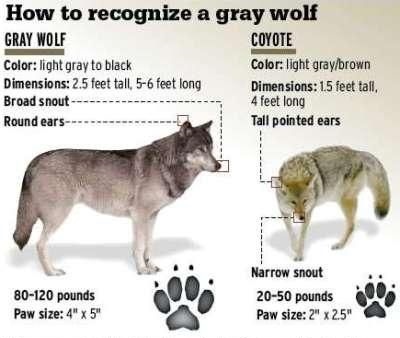
How to Identify a Gray Wolf

Identify a Wolf


wolf-track-wawang-lake

WEBSITE    RATES     FISH    HUNT    CABINS    PHOTOS
TESTIMONIALS    BROCHURE    HUNT BOOKLET

Enter your email address to subscribe to this blog and receive notifications of new posts by email.

← Back

Thank you for your response. ✨

Email Me....

 
Leave a comment

Posted by on September 26, 2015 in Wawang Lake Resort, wolf, Wolf Hunting


Tags: , , , , , , ,