RSS

Tag Archives: diy

Making Waterproof Matches

When it comes to matches, waterproof ones are best, especially in dire circumstances like a flood. Since they’re much more expensive than their pedestrian cousins, you might want to make your own.

cabdle

Use the Candle Technique
Burn a candle long enough for a pool of wax to form around the wick. Blow it out, then dip the head of your match into the wet wax, about of an inch (3 mm) up the stick. Remove the matchstick and allow the wax to dry, pinching it closed to form a water-tight seal.

Deploy the Nail Polish Ploy
Coat your matches with clear nail polish to waterproof them. Dip the head of the match and a bit of the matchstick itself into the polish, then rest the match on a counter with the head hanging off the edge to dry. Survive any wilderness situation with these critical tips.

Try the Turpentine Trick
The easiest way to waterproof your matches is simply to drop them in turpentine. Allow the matches to soak for five minutes before placing them on newspaper to dry. After twenty minutes or so, you’ll have waterproof matches that will last several months.

Follow our FISHING BLOG

WEB   RATES     FISH    HUNT    CABINS    PHOTOS
TESTIMONIALS    BROCHURE    HUNT BOOKLET

Enter your email address to subscribe to this blog and receive notifications of new posts by email.

← Back

Thank you for your response. ✨

Email Me....


Tags: , , , , , , , , ,

How to Make a Quick CAN Stove

If you suffer sticker shock after shopping for wood-burning camping stoves, you’re not alone. Why pay $60 to $100 for a titanium backpacking wood stove when you can make one out of a bean can for nothing. Sure, you could build a fire without any containment at all, but the low weight, efficiency, and minimal set-up time of a tin-can stove could make you a believer. And as long as there are sticks to burn, your stove will have fuel. Follow these easy steps, and you’ll have a lightweight bug-out-ready survival stove in no time.

1

The Gear List
To create a bean can stove, you’ll certainly need the empty can. You’ll also need a pair of tin snips. If you don’t have a pair in your tool box, borrow a pair. You’ll also need a tape measure, a pencil or marker, a drill with a ½-inch (or similar size) drill bit, and a file to remove sharp edges when you’re done. Gloves are a good idea, too,  since you’ll be working with a lot of sharp metal.

2

The Procedure
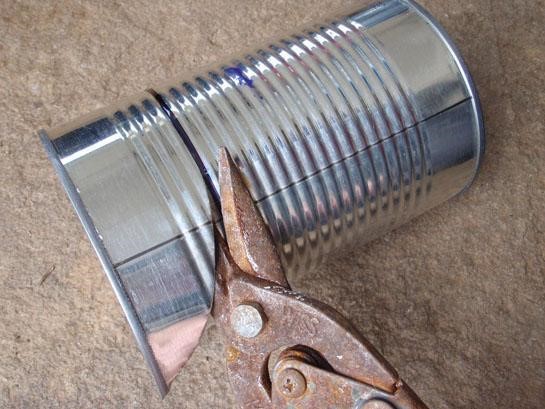
Remove the can lid completely from a 40-ounce (or similar sized) food can. You could use a smaller can, but the 40-ounce size because one-quart water bottles will nest inside the finished stove. Next, make a mark all the way around the can about 1 ½ inches below the open top. Use your tin snips, spiraling in, to cut this ring off the top of the can, but before you start, determine whether you are using right- or left-hand snips. It will be easier if you cut in the correct direction. You could leave the can full height, but I wouldn’t recommend it. A shortened stove has better balance, and the last thing you need is for your stove to tip over.

3

Next, make four equidistant marks around the mouth. Each mark will be the centerline for the four “teeth” on the top of your stove. Mark a line half an inch on either side of each of the four centerlines and draw a line around the can 1 inch down from the mouth. Using the tin snips again cut out the lines,  leaving four 1×1-inch teeth at the top of the can.

Next, drill eight equally-spaced holes around the bottom of the can wall. These will be the air intake vents. File off any sharp or rough edges from your metal work. Finally, before you start cooking food or boiling water over this stove, burn a few twigs for about ten minutes to get rid of the plastic can lining.

4

The Effectiveness
Once your stove is complete, set some tinder in the bottom and some broken twigs on the top of that. Place it in a stable, level spot and light the tinder through one of the vent holes. Place your cooking pot over the top of the stove and cook away. You will have to remove the pot every time you need to add fuel, but this is far better than trying to create stove doors for adding fuel. It also forces you to set the dangerously hot pot out of the way when refueling. This stove can burn twigs, paper, cardboard and any other solid fuel that’ll fit inside; and it boils one quart of water in about eight minutes. The finished stove weighs only 2 ½ ounces.

Follow our FISHING BLOG

WEB   RATES     FISH    HUNT    CABINS    PHOTOS
TESTIMONIALS    BROCHURE    HUNT BOOKLET

Enter your email address to subscribe to this blog and receive notifications of new posts by email.

← Back

Thank you for your response. ✨

Email Me....


Tags: , , , , , , ,

Conqueror Popup Trailer

fold-open_jpg_662x0_q100_crop-scale

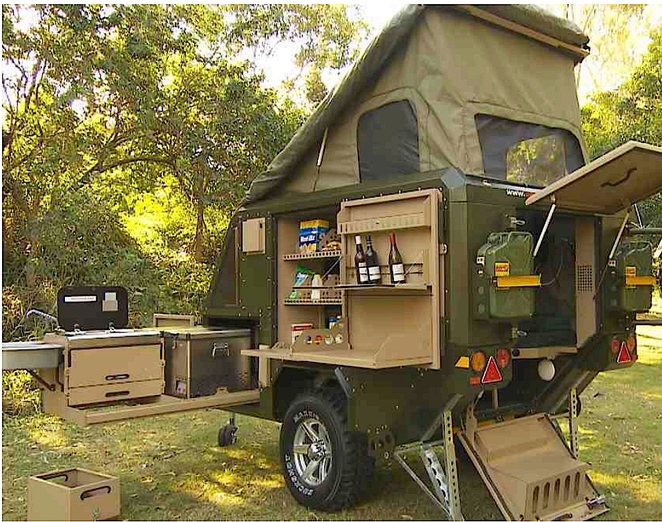
Travel trailers offer a lot of lessons for living in small spaces, using fewer resources and creating multifunctional spaces. TreeHugger has shown a lot of them, but never one the astonishing UEV440 from Australia’s Conqueror. UEV stands for Urban Escape Vehicle but this thing looks like it could go to the moon.

 CommanderSlider2_png_650x0_q85_crop-smart

The kitchen pulls out of the side, and has a two-burner stove and a double sink made of two drop-in bins.

 plates_jpg_650x0_q85_crop-smart2

The plates are designed in the shape of the sinks, which makes total sense. All the pullouts are designed to cantilever, so that if the trailer is on soft or uneven terrain they are self-supporting.

wholethingopen_jpg_650x0_q85_crop-smart2

When all set up, there are tarps and flys and all kinds of protection from bugs and rain. Since it is Australia and can be dusty, every door is gasketed but there is also a fan that pressurizes the interior so that dust can’t get sucked in.

barbecue_jpg_650x0_q85_crop-smart2

They really think of everything; the cover over the spare tire is a barbecue.

Follow our FISHING BLOG

WEB   RATES     FISH    HUNT    CABINS    PHOTOS
TESTIMONIALS    BROCHURE    HUNT BOOKLET

Enter your email address to subscribe to this blog and receive notifications of new posts by email.

← Back

Thank you for your response. ✨

Email Me....


Tags: , , , , ,

The Spruce Stove Lets You Burn an Entire Tree

the-spruce-stove-lets-you-burn-an-entire-tree-thumb

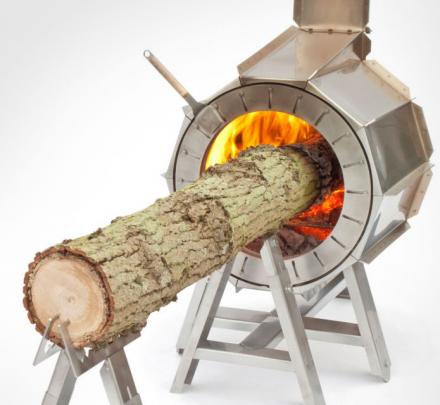
The Spruce Stove is an outdoor furnace that allows you to burn an entire tree at a time. Designed by Dutch designers Roel de Boer and Michiel Martens, the dutch stove allows you to continuously push the trunk of the tree more and more into the fire as it burns, as it holds the log up level to the fire using wheeled arms that allow you to easily slide it in.

To start the fire, simply use kindling, amber, small twigs, etc, and once the fire gets going simply push the end of the tree trunk into the fire, use the adjustable diaphragm to allow for more oxygen or less oxygen depending on what the fire needs. Once your fire starts to die down, simply push a few more inches of the trunk into the fire. When you want to stop the fire just stop pushing the log in.

The Spruce Stove is made from stainless steel, can easily withstand the heat of the fire as well as the weather, comes in three different models, weighs 110lbs, and measures 1.9 feet wide x 7.7 feet tall x 2.6 feet deep. Now you just need  go chop down a few trees.

Spruce Stove Burns an Entire Tree


Follow our FISHING BLOG

WEBSITE    RATES     FISH    HUNT    CABINS    PHOTOS
TESTIMONIALS    BROCHURE    HUNT BOOKLET

Enter your email address to subscribe to this blog and receive notifications of new posts by email.

← Back

Thank you for your response. ✨

Email Me....


Tags: , , , , , , ,

DIY – Solar Generator


wawang-lake

Follow our FISHING BLOG

WEBSITE    RATES     FISH    HUNT    CABINS    PHOTOS
TESTIMONIALS    BROCHURE    HUNT BOOKLET

Enter your email address to subscribe to this blog and receive notifications of new posts by email.

← Back

Thank you for your response. ✨

Email Me....


Leave a comment

Posted by on December 24, 2014 in Off the Grid, Wawang Lake Resort


Tags: , , , , , , ,

Sometimes the simplest…….

Sometimes the simplest…….

I am always a huge fan of ‘life hacks’ and clever survival tactics.  I came across this fantastic video and thought that it might very well be of great use to one of you…..if nothing else, you will score big at parties for demonstrating your MacGyver talents!You owe me one 😉


← Back

Thank you for your response. ✨

Email Me....


Don't just take our word for it!

Don’t just take our word for it!


Leave a comment

Posted by on November 19, 2014 in do it yourself, Wawang Lake Resort


Tags: , , , , , , ,

Quartering your moose for transport (with video)

Quartering your moose for transport (with video)


Here is a fantastic how to video for quartering a moose for transport.  It isnt unusual to have a moose down where removing it with this method is mandatory.  Great care must be taken of any wild game to ensure there is no spoilage and that no waste is had.

Enjoy!

If you are an Ontario resident and would like more information regarding our accommodations for the 2015 season, please feel free to contact us 🙂

moosehuntersjpg

 
Leave a comment

Posted by on November 15, 2014 in moose, Wawang Lake Resort


Tags: , , , , , , , ,

The importance of knowing your bowstrings!

Archers are very specific about the bow they use, the sites they mount and the release they settle on, but often overlooked is the actual bow string.  They are as vital to your performance as that of the arrow or even the bow itself.  But the question is, how do you select your bowstrings? And how do you know which ones to opt for? Having to answer these questions might become a bit of a challenge, but with some of these helpful guidelines it just might get easier for you.


1.THE 4 GENERAL THINGS YOU NEED TO LOOK FOR

The best kinds of bowstrings have four qualities you need to know about.

  • They are lightweight
  • They are strong
  • They are highly resistant to abrasion
  • They are moisture-resistant

 2.YOU HAVE TO KNOW WHAT MATERIAL YOUR BOWSTRINGS ARE MADE OF

Modern bowstrings are made of different kinds of synthetic fibers, and knowing what they are can be to your advantage.

  • Dacron: a polyester material that is strong, high-stretch and can last for years. But it’s an outmoded fiber, so wooden bows, older bows and recurve bows, are its best suit. A bowstring made out of Dacron is safe to use on any bow, but results will surely vary.
  •  Kevlar and Vectran: these fibers are made out of polymer. They have a limited-stretch so its arrow speed is faster than Dacron. Kevlar bowstrings, however, can only last for about 1000 shots, and they are known to break without warning.  These materials are not fit for modern compound bows.
  •  HMPE (High- modulus-polyethylene): this fiber is a blend of Spectra and Dyneema. It’s lightweight, faster than any of the materials aforementioned, strong, and long lasting. It is the perfect fit for high-performance recurve bows and modern compound bows.

 3.WHAT KIND OF WAX YOU SHOULD USE

Whether your bowstring is of superior quality or not, it will fray at one point or another. But if you wax it frequently, you can delay the time in which your bowstring wears out and is completely out of use. I can’t emphasis more on just how important it is to wax your bowstring.

But what kind of wax should you use? I have a couple of pointers here, but if you have more, then please do feel free to share it with us.


Beeswax: If you are using a traditional bowstring, which is made out of plant fibers and animal material, then you should opt for beeswax.


Silicone based wax:  Most modern bowstrings come pre-waxed, but no lubricant has ever lasted forever, right? So the second the string starts to feel dry, you have to give it a light coating.  Silicone based waxes are ideal for modern bowstrings; it penetrates the material and lubricates the interior as well as the surface of the string.

Some of the most commonly used and perhaps the best kinds of synthetic waxes are Dalton High-Speed Bow Wax Conditioner and Bohning Silicone Wax.

Remember, this may seem like a trivial detail but it could be the difference between success and an fruitless hunt!

Thank you Martin Douglas of Legendary Archery for the great information!


Leave a comment

Posted by on November 13, 2014 in archery, bow, how to, Wawang Lake Resort


Tags: , , , , ,

Winter camping for beginners

Winter camping can mean different things to different people.  For some, it means renting a cabin heated by a wood stove. For oth­ers, it means pack­ing snow­mo­bile trail­ers to the brim. For the more adven­tur­ous, it means grab­bing a pack and haul­ing in all the neces­si­ties to a remote loca­tion. No mat­ter how you win­ter camp, the fol­low­ing tricks are useful.

WEAR A FIRE­PROOF SHELL
If you are going to build camp­fires, either for the sake of cook­ing, warmth, or morale, make sure that your outer layer of cloth­ing is less likely to end up ruined if struck by an errant ember.  Wool is one of the best, most fire-resistant nat­ural mate­ri­als and is great for this.  Down jack­ets are down­right (no pun intended) awful, and you can lose tons of feath­ers this way.

PACK THE SNOW
Before set­ting up your tent, pack down your camp­site. If you have skis or snow­shoes, that means tramp­ing around hard until all the snow is packed.  If you’re shod only in boots this will take some time, but if you don’t do this, you run the risk of step­ping into a soft bit of snow in your tent and tear­ing the floor.

PACK AN EXTRA HAT AND GLOVES
Always carry a spare hat and a set of mit­tens. No mat­ter how dili­gent you are, no mat­ter how reli­gious you are about using idiot strings and keeper cords, you will lose a hat, and you will lose a glove.  Keep a cheap spare, or be pre­pared for frost­bite or a fore­short­ened trip.

EMBRACE THE PEE BOT­TLE.
Being cold can cause you to want to uri­nate more fre­quently, and we all know how incon­ve­nient it is to dis­robe and undo your sleep­ing bag at 0 degrees F.  For women, I highly rec­om­mend look­ing into the var­i­ous acces­sories that allow you to pee whilst stand­ing, and for both gen­ders a WELL-MARKED pee bot­tle will keep you warm and sim­plify your nightly con­ti­nence. For the love of god, don’t con­fuse your water bottle—color is not enough, make sure your bot­tle is well-marked and maybe wrapped in some duct tape.

USE THOSE STAKES
If there is snow, you can stake out your tent.  You can always make dead­men out of sticks or fallen trees, stuff sacks full of snow, buried skis, snow­shoes, poles, ice axes, or what have you.  There is no excuse for a poorly staked-out tent.  If you expect no snow and frozen con­di­tions, plenty of com­pa­nies make hard tent stakes meant to push through frozen ground, either out of tita­nium, steel, or 7075-t6 aluminum.

BRING THE RIGHT SLEEP­ING PAD
As Bear Grylls says, two lay­ers on the bot­tom are worth one on the top.  That is, you lose more heat through con­duc­tive heat loss when sleep­ing than any­thing else, so win­ter is no time to skimp on your sleep­ing pad.  Make sure you have a pad with an r value of four or more, and if you have one, throw a closed-cell foam pad under­neath. If you feel like your pad isn’t cut­ting it, stuff extra cloth­ing under­neath you, and toss your down jacket on top of your sleep­ing bag.

BOIL THE SNOW
Leave your water fil­ter at home.  Chem­i­cal fil­ters take longer to work in the cold, and mechan­i­cal fil­ters can crack and fail. Your best bet for water fil­tra­tion is boil­ing your water, as you prob­a­bly have to melt snow any­way. Don’t be suck­ered into think­ing glacial melt or fresh snow is sterile–it isn’t. Snowflakes often form around small bits of dust (nucle­ation sites) which can be bac­te­ria or viruses float­ing in the upper atmosphere.

SLEEP WITH YOUR BOOTS
Use boots with remov­able lin­ers, so you can put those lin­ers at the bot­tom of your sleep­ing bag to keep them warm.  If you only have single-layer boots, put them in a water­proof stuff sack at the bot­tom of your sleep­ing bag.  Noth­ing means morn­ing hypother­mia more than frozen boots!

CAMP BY CAN­DLE­LIGHT
A can­dle lantern safely hung on the inside of your tent (far enough away from you and the ceil­ing so as not to be a fire haz­ard) does won­ders to both warm your tent and reduce con­den­sa­tion.  Despite this, a towel for scrap­ing off con­den­sa­tion is always welcome.

EMBRACE LITHIUM
Use lithium bat­ter­ies in all your win­ter elec­tron­ics.  Not only does lithium per­form con­sis­tently down to much colder tem­per­a­tures than alka­line or NiMh bat­ter­ies, but they are lighter, last three times as long, and have a flat decay curve.

WIPE WITH CARE 
In the sum­mer, comfy leaves or soft river stones abound, but in the win­ter they’re few and far-between. While many have picked up pinecones in des­per­a­tion, the best read­ily found alter­na­tive is just plain old snow. It’s effective, ubiquitous, and leaves behind lit­tle residue.  If you do bring TP, please either pack it out or burn it. The ground is too hard for catholes and for those who have hiked along the Appalachian Trail dur­ing the first spring thaw, a mound of TP gen­er­ally sig­ni­fies a poorly hid­den scat stash.

FIGHT CON­DEN­SA­TION WITH A VBL
If you’re out more than a week, use a VBL, or vapor-barrier-liner for your sleep­ing bag.  Con­den­sa­tion from your own body can freeze within the upper layer of your sleep­ing bag where the warm air meets the freez­ing air, and over time your sleep­ing bag can become frozen solid.  While they are not as com­fort­able to sleep in, it beats hit­ting your sleep­ing bag with a ham­mer every night like some polar explor­ers have had to do.

FLIP YOUR BAG
If it’s not snow­ing, turn your sleep­ing bag inside out on top of your tent to dry dur­ing the day.  This is a great rea­son to choose win­ter sleep­ing bags with a black interior–it absorbs more solar energy and dries out faster.

FLIP YOUR WATER
If you have a large water stor­age con­tainer, turn it upside-down when stor­ing it overnight.  Ice forms from the top down, so keep­ing the spout/opening of your con­tainer fac­ing down keeps it from get­ting frozen up. This can be com­bined with insu­lat­ing the con­tainer, of course.

VASE­LINE
Cover exposed skin in Vase­line or ani­mal fats. Inuit have been doing this for years–simply slather any exposed or poten­tially exposed skin on your face, ears, neck, wrists, or hands in a thick oil and they’ll be less prone to wind­burn and frostbite.

Stay warm!


Prefer traditional camping without snow?  Check us out!

2014_Brochure(307x400)


Tags: , , , ,

Amazing Hunting Jack O Lantern Ideas (with video)

Well the time is upon us again…costumes and kids!  Times have definitely changed and ushered a new fad of artistically carved jack-o-lanterns.  Here is a fantastic collection of hunting themed ones….attempt at your own risk 😉

Here is a fantastically detailed one

jack6


It takes a lot to get that kind of detail on a melon…here is a fantastic video of another great example being done!


Here are some other great ideas!


Leave a comment

Posted by on October 31, 2014 in do it yourself, Wawang Lake Resort


Tags: , , , ,