How to Barbeque a Moose Roast
Have you ever wanted to barbeque a moose roast and still have it be tender? We have, and recently cooked a moose round roast on the barbeque that was so tender once we carved it, it was possible to cut it with your fork.
How did we do it? Let me tell you about it.
I started out with a moose round roast; I know this is not the best cut to be barbequing. So I knew it would require moist heat if it were to be palatable.
I remembered a friend of mine telling me how he had cooked ribs on his barbeque and had great results. I wondered if I could achieve the same?

I wanted to give it a try.
The Process
The process is quite simple really, and you could likely apply this to any meat that is tough.
Cook it with moisture over a long period of time.
How much time… I cooked our roast for almost 9 hours.
Ingredients:
- Moose round roast 3 pounds
- 1 large onion
- 5 cloves garlic (elephant)
- 1 1/2 cups of barbeque sauce

Directions: Barbeque a Moose Roast
Thaw the moose roast in your refrigerator
Coarse chop the onion
Peel and slice half of the garlic and mince the balance
Start with a 8 inch by 8 inch roasting pan and place the moose round roast that you plan to barbeque onto a thin layer of the chopped onions.
Place the rest of the onions around the roast evenly.
What I did next was to sprinkle the onions with the sliced garlic and rubbed the roast itself with the minced garlic.
I followed this by pouring the barbeque sauce over the roast.
Once this was complete I covered the entire pan with a layer of heavy aluminum foil and took the pan (with the roast in it) outside to my barbeque.
I lit one burner (in my case the right hand one) and set it to low heat. I then placed the covered pan containing the moose roast I wished to barbeque on the left hand side well away from the heating element.
I then closed the lid.

I have a thermometer on the outside lid of my barbeque I maintained a constant temperature of about 200 degrees Fahrenheit for 9 hours, until the internal temperature reached a minimum of 140 degrees; or your required doneness.
At the end of the cooking time the barbequed moose roast was cooked to perfection.
We served the moose roast with baby potatoes, carrots, chopped onions and mushrooms. All of which were cooked on the barbeque while the roast was cooking. All the veggies were wrapped in foil; salt, pepper and butter were added and placed directly over the burner that was set on low temperature. About 1 1/4 hours.
We made gravy from the juice from the meat pan as well we added the onions from the meat pan to our veggie dish.
Also we had grape tomatoes with feta cheese dressed with Balsamic Vinegar Reduction…
The barbequed moose roast, the entire dish… well…
Delicious
Now I can say we learned how to barbeque a moose roast… and have it tender too!


Do you like what you see? Join us on our Fishing Blog for more up to the minute action, tips and tactics!!


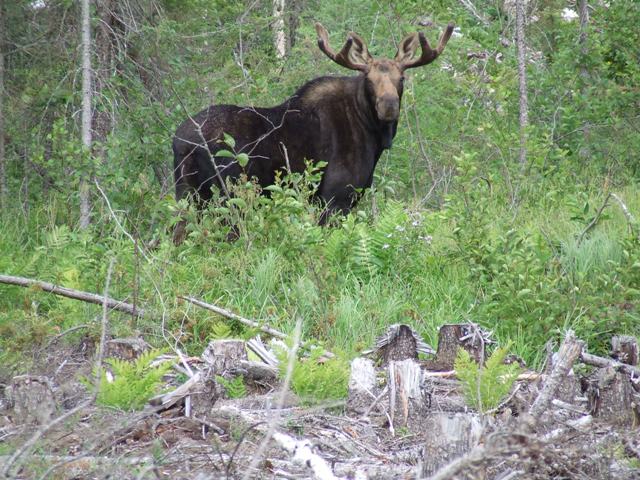


 Bull moose are content to stay with one cow at a time. Unlike breeding elk, which collect a harem, bull moose locate a receptive cow, stay with her a few days then move on. Bulls will service as many willing cows as they can find. By the end of the rut he is spent, thin, and bedraggled. He has fed very little in the last 4 to 6 weeks and now must start to diligently feed. Fat must be put on for the winter ahead.
 Good areas for calling are just inside the edges of brush or timber around lake shores and from low, timbered areas leading toward meadows and bogs. Locate a wallow if you can. This is mud dug up by the front hoofs of a rutting bull to a depth of up to half-a-foot and can be several feet in diameter. The bull urinates in it, then wallows in the reeking mess. Sit hunched down in a concealed stand and grunt or bawl with the instrument you’re using. Wait a few minutes and try again. Try for an authentic sound that would be irresistible to any bull within hearing distance.
 Throughout moose range, calling works relatively well during the rut. To learn the proper sounds of rutting moose, invest in a commercial recording. Spend the time necessary to practice and perfect this “art” form. Few moose hunters are naturally adept at calling and if not done right, you may arouse suspicion rather than eagerness in a listening bull.


 ON TARGET in CANADA