Follow our FISHING BLOG
WEB RATES FISH HUNT CABINS PHOTOS
TESTIMONIALS BROCHURE HUNT BOOKLET
Follow our FISHING BLOG
WEB RATES FISH HUNT CABINS PHOTOS
TESTIMONIALS BROCHURE HUNT BOOKLET


Follow our FISHING BLOG
WEB RATES FISH HUNT CABINS PHOTOS
TESTIMONIALS BROCHURE HUNT BOOKLET

You’re invisible. Or at least you think you are. After all, you’ve done all the right things: bought that pricey camo that matches your surroundings, painted your face with lots of greasy face paint, and you are even wearing camo boots. Now all you have to do is sit there, soak in a little sunshine, and wait for a big boar to show himself.

But when a bear does come in, he spots your position and blows out for the next county. The problem? You set up in the sunlight
A common mistake that has ruined plenty of big-game hunters’ chances is setting up where direct sunlight can reach them. Sunshine turns a camouflaged hunter from an indistinct shadowy figure into a glowing beacon. Dappled sunlight shining through a canopy of leaves isn’t usually a problem. But direct sunlight can reveal your whereabouts and end your hunt.

Camouflage clothing’s basic function is to break up our outline – tricking our prey’s eyes into passing over us in their constant search for danger. The human silhouette is incredibly distinct in the wilderness – there is no other form like it. To fool game, it is essential to reduce our human outline. The best camo patterns utilize starkly contrasting colors in their design, thus changing us from a human form into something indistinct and non-threatening. Interestingly, for those of you traditional hunters like me – a good plaid pattern like Fred Bear often wore can work almost as effectively as modern camouflage.

Remember that sunlight moves as the earth rotates. Set up your ambush in a location that allows you to remain shadowed as the light moves around you. If you are still-hunting or stalking, move efficiently through areas of sunshine and then pause to watch and listen when in the shadows. Set up in dark shade that offers good shooting lanes. Remember to keep your hands and face camo’d up as well – if left uncovered, they are a dead giveaway even in the shadows.
Follow our FISHING BLOG
WEB RATES FISH HUNT CABINS PHOTOS
TESTIMONIALS BROCHURE HUNT BOOKLET

If you suffer sticker shock after shopping for wood-burning camping stoves, you’re not alone. Why pay $60 to $100 for a titanium backpacking wood stove when you can make one out of a bean can for nothing. Sure, you could build a fire without any containment at all, but the low weight, efficiency, and minimal set-up time of a tin-can stove could make you a believer. And as long as there are sticks to burn, your stove will have fuel. Follow these easy steps, and you’ll have a lightweight bug-out-ready survival stove in no time.

The Gear List
To create a bean can stove, you’ll certainly need the empty can. You’ll also need a pair of tin snips. If you don’t have a pair in your tool box, borrow a pair. You’ll also need a tape measure, a pencil or marker, a drill with a ½-inch (or similar size) drill bit, and a file to remove sharp edges when you’re done. Gloves are a good idea, too, since you’ll be working with a lot of sharp metal.
The Procedure
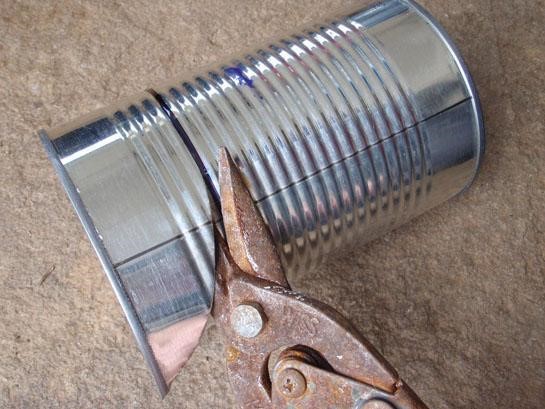
Remove the can lid completely from a 40-ounce (or similar sized) food can. You could use a smaller can, but the 40-ounce size because one-quart water bottles will nest inside the finished stove. Next, make a mark all the way around the can about 1 ½ inches below the open top. Use your tin snips, spiraling in, to cut this ring off the top of the can, but before you start, determine whether you are using right- or left-hand snips. It will be easier if you cut in the correct direction. You could leave the can full height, but I wouldn’t recommend it. A shortened stove has better balance, and the last thing you need is for your stove to tip over.

Next, make four equidistant marks around the mouth. Each mark will be the centerline for the four “teeth” on the top of your stove. Mark a line half an inch on either side of each of the four centerlines and draw a line around the can 1 inch down from the mouth. Using the tin snips again cut out the lines, leaving four 1×1-inch teeth at the top of the can.
Next, drill eight equally-spaced holes around the bottom of the can wall. These will be the air intake vents. File off any sharp or rough edges from your metal work. Finally, before you start cooking food or boiling water over this stove, burn a few twigs for about ten minutes to get rid of the plastic can lining.

The Effectiveness
Once your stove is complete, set some tinder in the bottom and some broken twigs on the top of that. Place it in a stable, level spot and light the tinder through one of the vent holes. Place your cooking pot over the top of the stove and cook away. You will have to remove the pot every time you need to add fuel, but this is far better than trying to create stove doors for adding fuel. It also forces you to set the dangerously hot pot out of the way when refueling. This stove can burn twigs, paper, cardboard and any other solid fuel that’ll fit inside; and it boils one quart of water in about eight minutes. The finished stove weighs only 2 ½ ounces.
Follow our FISHING BLOG
WEB RATES FISH HUNT CABINS PHOTOS
TESTIMONIALS BROCHURE HUNT BOOKLET

There is nothing more impressive than having a one day harvest for one of the most revered predators….imagine having THREE!!
 Cody, Rod and Brad descended upon Wawang in hopes of each bringing home a bruin. Father and son, Cody and Rod, were returning hunters while Cody’s best friend Brad made this his first visit.
Each hunter was prepared and after the day long drive from Iowa, were ready to ascend their trees to await their chance at a bear.
Outwardly, this was to be a week of patience as Cody was no stranger to the wiles of those elusive creatures. This being Cody’s third attempt (second with us at Wawang) he was determined to pin that tag on something ‘decent’
Cody had spent the entire year honing his skills on sizing and judging bear….a talent most discount until they are faced with the opportunity to shoot. Read: How to Size a Bear
The day was bustling at the lodge as it was Labor Day weekend and it was our annual end of the year celebration. The kitchen was filled with the aroma of turkey, mashed potatoes, roast and all the fixings. In the bustle of preparation, Cody emerged and made his way across the floor to the kitchen.
 We were in high gear with getting the food just right when we looked out the door and saw him heading over. Lost in our own thoughts, we carried on about the kitchen….until…..wait a minute…wasn’t he supposed to be in a tree? He only left a couple of hours ago!
“Cody, what are you doing? Did your truck break down?” we were concerned for hunting time being missed. Cody reached into his pocket and produced his camera. “I got one, but I think you might be mad….it’s small.” His shoulders dropped and he passed the camera to us.
We looked over the picture and then back to Cody….there were no words. “Cody, I don’t know what you consider small but this isn’t anywhere close to what we call small!” His eyes lit up….when somebody that has seen numerous BIG bear tells you that you hit the jackpot, it is a good day!
Cody then left to wait for his hunting partners to finish their hunt for the evening to help him retrieve his bear. The lodge returned to its frantic state of meal prepare. As the festivities rolled on that night, Cody and his crew finally returned….
Everyone in camp was excited to lay eyes on Cody’s trophy BUT were completely unprepared to meet an entire truck full of bear! 3 bear to be exact! 2 boars and a sow…Goldilocks wouldn’t have been happier!


Each one took turns telling the exciting tale of retrieving their harvest…..each one amazed at the success of the other and each beaming with excitement….it was day 1 and the anxiety of the hunt was already over and done with….now it was time to fish!!
During that week, laughs were exchanged, trophy fish were caught and memories made…a father, son and best friend made a Wawang hunt the life long story to beat!
So glad that we could be a part of such great memories!!
Follow our FISHING BLOG
WEB RATES FISH HUNT CABINS PHOTOS
TESTIMONIALS BROCHURE HUNT BOOKLET


The goal of all hunters is a quick, humane kill where the animal drops in it’s tracks and is dead within seconds. But in a pursuit that has as many variables as hunting, sometimes things don’t quite go according to plan. However, game can be tracked and recovered with the right skills and with patience.
First of all, you need to wait the right amount of time after the shot before tracking a wounded animal. I’ve heard estimates of waiting 30 minutes for a hit in the vitals and 5-8 hours for a gut shot. Waiting overnight might be even better on very poorly hit animals, however for black bear the temps may not allow for this as the meat might spoil.
 You don’t want to push an animal. Be patient and wait it out. If you push a wounded animal, and he gets adrenaline flowing, the odds are against you finding that animal.
You need to mark the exact spot where the animal was when it was hit. This will save you much time in searching for blood. Also mark the position where you took your shot from in case you have to return to it to regain that perspective. Once you find the trail that the animal took after the hit you should try and identify where you hit that animal. Dark blood can indicate a liver or muscle wound; bright red blood with bubbles in it is a good sign and indicates a hit in the lungs; green liquid or bits of food matter in the blood indicates a gut shot.
Take it slow and mark blotches of blood with flagging tape every 25-50 yards to trace the trail from afar to determine overall direction the animal took. Just remember to go back and pick up the tape when you’re done. You should walk to the side of the trail so as to not disturb the sign. If you lose the trail and can’t find more blood, start fanning out and walking circles from the last place you had blood.
 When tracking a wounded animal it is easy to get caught up in just looking at the ground, trying to find that next speck of blood. You should be aware of what is 100 yards out in front of you as well and be ready for a killing shot if the animal should get up in front of you.
If you take it slow, be quiet and be thorough, finding wounded animals can be done on a consistent basis. Follow these tips to help find the game that you might have not put the best shot on.
Follow our FISHING BLOG
WEB RATES FISH HUNT CABINS PHOTOS
TESTIMONIALS BROCHURE HUNT BOOKLET


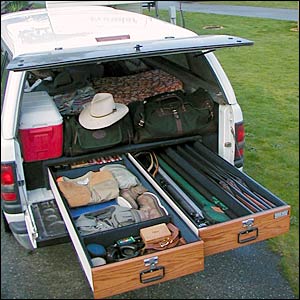
Truck Vault Standard Line
General Information
Approximate external height: 8.5″
Approximate internal height: 6″
Number of drawers: 2
Top-load capacity: 2000 lbs.
Environment: Canopy/Tonneau Cover

Click here for more information on the Truck Vault Standard Series

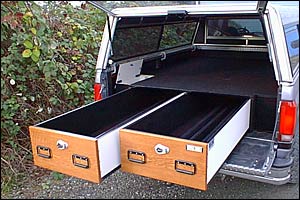
TruckVault Magnum Line
General Information
Approximate external height: 12.5″
Approximate internal height: 10.5″
Number of drawers: 2
Top-load capacity: 2000 lbs.
Environment: Canopy/Toneau Cover

Click here for more information on the Truck Vault Magnum Series


Truck Vault Extreme Series
General Information
Approximate external height: 10″
Approximate internal height: 6″
Number of drawers: 2
Top-load capacity: 2000+ lbs.
Environment: Open-Bed Pickup/SUT

Click here for more information on the Truck Vault Extreme Series
Follow our FISHING BLOG
WEB RATES FISH HUNT CABINS PHOTOS
TESTIMONIALS BROCHURE HUNT BOOKLET

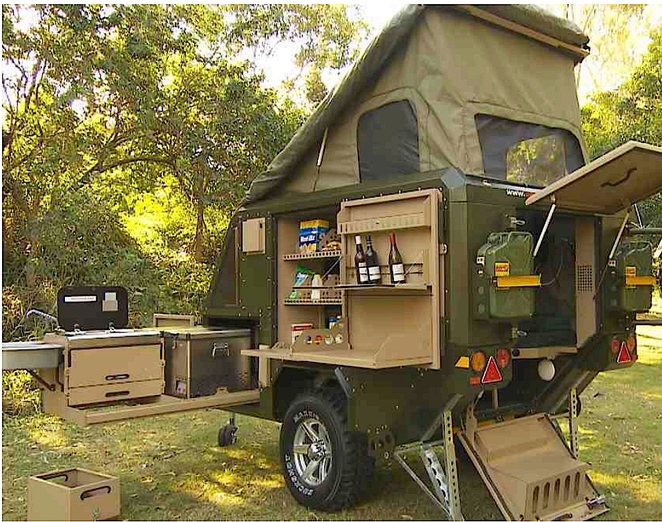

The kitchen pulls out of the side, and has a two-burner stove and a double sink made of two drop-in bins.

The plates are designed in the shape of the sinks, which makes total sense. All the pullouts are designed to cantilever, so that if the trailer is on soft or uneven terrain they are self-supporting.

When all set up, there are tarps and flys and all kinds of protection from bugs and rain. Since it is Australia and can be dusty, every door is gasketed but there is also a fan that pressurizes the interior so that dust can’t get sucked in.

They really think of everything; the cover over the spare tire is a barbecue.
Follow our FISHING BLOG
WEB RATES FISH HUNT CABINS PHOTOS
TESTIMONIALS BROCHURE HUNT BOOKLET

Follow our FISHING BLOG
WEB RATES FISH HUNT CABINS PHOTOS
TESTIMONIALS BROCHURE HUNT BOOKLET

Trophy boars are smarter than your average bear. But even the savviest old bruin has a few chinks in his armor. Using a decoy is an exciting way to exploit them. Even weary old black bears will come in spoiling for a fight. Here are three strategies for drawing a dominant, hungry bruin into bow range.

The Intruder
Big boars are solitary animals and will claim a food source as their own, commonly defecating along entrance trails to warn other bears away. To get this bear’s attention, stake a small bear decoy near the food source, positioned with its head down and its backside facing the direction you expect a boar to approach. Attach a few strips of black cloth to the decoy’s ears and tail for added realism and collect some bear scat from another area—preferably from a boar—and with a plastic bag, transplant it on the entrance trails.
Now sit back. Any wise old boar that might otherwise camp just off the food until nightfall is almost sure to investigate when he sees your “intruder.” Keep in mind that a boar may visit a food site daily or stop by every second or third day while patrolling his home turf. Be patient, and don’t let your guard down.

The Easy Meal
Black bears are fond of fresh meat and will drop their guard to capture an animal in distress. Any small, furry decoy, like those used for foxes and coyotes, wiggling about in plain sight is sure to catch a passing bear’s attention. With a little luck, the bruin will move in quickly to finish off what he thinks is hapless prey. If he hangs up, though, add a few squeals from a dying-rabbit call to entice him.
If whitetail deer are prevalent in your area, a fawn decoy can be too much for any hungry black bear to ignore. Try a few fawn contact bleats, and if that fails, go to a fawn-in-distress call. Nock a broadhead and get ready. The bear will come in fast, so be prepared to shoot pronto.

The Feeding Female
You’ll have to wait a few months to use this setup, but it’s a good one to have in your arsenal. Black bears rut in late spring and early summer and will visit bait sites, looking for a sow in heat. If baiting is legal in your area, position a small black bear decoy with its head in the bait barrel, and hang a few scent canisters soaked with sow-in-heat urine 3 or 4 feet off the ground nearby.
Big boars are ultracautious around bait, so odor control is critical. As you’re setting up, wear rubber gloves and spray the decoy down liberally with a quality scent remover. The boar will approach the decoy warily. Don’t rush the shot. As he investigates, you should have plenty of time to draw.
Follow our FISHING BLOG
WEB RATES FISH HUNT CABINS PHOTOS T
ESTIMONIALS BROCHURE HUNT BOOKLET


 ON TARGET in CANADA