
MERRY CHRISTMAS
from all of us at Wawang Lake Resort
Follow our FISHING BLOG
WEBSITE RATES FISH HUNT CABINS PHOTOS
TESTIMONIALS BROCHURE HUNT BOOKLET
Follow our FISHING BLOG
WEBSITE RATES FISH HUNT CABINS PHOTOS
TESTIMONIALS BROCHURE HUNT BOOKLET

If you are in search of a record book moose because he has survived many previous hunts, and you as a hunter respect the survivability of the animal, then you have set a high standard for yourself.
Pursuing any type of world record is not something that many aspire to do. for the trophy hunter, shooting a world record moose is the ultimate goal. Are you a trophy hunter? Or a meat hunter?
Do we need to continue to search for the ever bigger? Then when we find it, is it right to destroy it? Should we limit the very essence of the mighty beast; snuff out the possibility of procreation? These are tough questions?

Hunter Heinz Naef shot what he believes could be the largest moose ever harvested in the Yukon(Sept. 2013).
His moose, scored 263 1/8 inches after the required drying time of 60 days. The official scoring will be made in Nevada in early 2014.
Heinz is not a trophy hunter, he wasn’t looking to harvest a world record moose. No, he is a meat hunter… by his own admission. He was just out looking for any legal moose to fill his freezer. It just so happened to be this one.
Human beings have pushed everything to its limits. The Guinness Book of World Records is a testament to this. We strive to better ourselves, to beat our predecessors, going beyond what anyone has done in the past. Is it wrong to have the desire to be better, to do it bigger? Is our only purpose to get our names in a book?
When entering animals into record books, who deserves the respect? You or the animal? It is vitally important to include all relevant information about said trophy… the hunters name however may not be so important.
Many hunters have a few trophies on the wall, but most are not world record moose, but all of them are trophies to the hunter. Many hunters do not go hunt with the sole purpose to acquire a trophy, and likely many of you, may scoff at some of the animals that have been shot. They are not in any record book, nor are they of that class, but to the hunter, they are a reminder of the hunt and a way for to show appreciation for the animal.
No animal should be killed for the sole purpose to raise a hunters social status, to do so is crossing the ethical line for hunters.


Where does one find a world record moose? This question is one that no one person can answer for sure. Through research and dialogue you may be able to locate moose habitat that will contribute to the growth of these monsters. A hunter in search of a world class moose will spend a lot of money and time to achieve his goal. These big animals are not going to be easily accessible. Days, weeks even years of pursuit to harvest a moose that can make the record books will be the required  dedication. Hunting the most remote areas of the planet is what it will most likely take and never discount luck. Luck is a huge part of hunting.
As an example the latest world record moose taken with a rifle, shot by Jay Link in 2001. Jay travelled to Russia, to the very remote regions to get this moose. He has stated it cost him $20,000.00 to do this hunt (before shipping and taxidermy). Jay may not have been looking for a world record when he shot this one, but he was certainly looking for a world class moose. Unfortunately for Jay, because the moose was taken in Russia, it is not eligible for Boone and Crockett.

Aaron Folk killed this state record North Dakota moose in October 2012, with a green score of 166 and a 53-inch spread.

Real Langlois, who’s been dubbed “The Rackman” for all his moose hunting exploits, bagged this world record bull in the Yukon with his bow in 2008. With a score of 249 1/8, The Rackman beat out Michael Cusack, whose 1973 bull moose scored 248.

Eric Arnette killed this Yukon monster in 2004, with a Boone & Crockett score of 236 and a span of 75 inches.
The world record moose, Boone and Crockett scored 261 5/8 and was taken by John A. Crouse in 1994 near Forty-mile River Alaska.
Hunters value the opportunities to venture out into the outdoors and hunt. The chase is wonderful and exhilarating. To some degree the kill is saddening as a wild animal has paid the ultimate sacrifice and many hunters pause to give thanks for any animal that they just harvested. They truly appreciate it!
Many hunters don’t hunt for a trophy – after all the antlers will make poor soup. Given the opportunity though, if a world record moose were to walk out in front of you, and assuming you recognize it as a trophy. Would you shoot…? Would You?
Follow our FISHING BLOG
WEBSITE RATES FISH HUNT CABINS PHOTOS
TESTIMONIALS BROCHURE HUNT BOOKLET

You may have heard a story of a little 9-year old girl that shot a World Record Alaskan Brown Bear (Grizzly Bear). Fern Spaulding Rivers did shoot a trophy Brown Bear but it was not a world record. It’s still a really interesting story.
Story from Bear Hunting Magazine is below
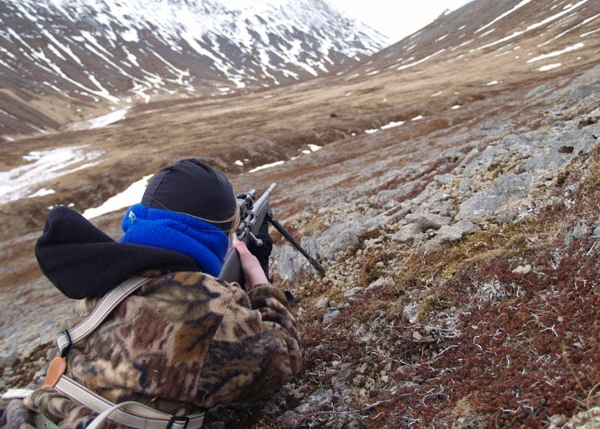
If the “biggest bear” is determined as a ratio of the size of the bear to the size of the hunter then Fern Spaulding-Rivers is probably setting records that will never be broken. The 10 year-old from Talkeetna, Alaska has already harvested great trophies of most of Alaska’s major game species, and she is a hand loading fanatic as well.
Fern’s larger caliber rifles have a muzzle brake and a recoil pad and she also wears a custom-made padded shooting vest from McCoy Shooting Armor to help her withstand big bore recoil. Fern was brown bear hunting on the Alaskan Peninsula with her father and mother on May 10th, 2006 (when she was 9 years old). She was carrying her Remington 700 Stainless chambered in .375 H&H and topped with a Zeiss Diavari Classic 1.5 – 4.5 x 18 scope. As the day progressed she and her father saw 11 bears. At one point, they were charged by a wolf, and they had to dispatch it at only 8 paces! Later, they spotted a big bruin in a gully at 32 yards.

With all the excitement of the day beginning to show, Fern asked Larry to hold her legs steady while she shot because her knees were shaking. Fern rolled the bear with her first shot, but the bruin regained it’s footing and tore off across the tundra. Shooting again from a prone position, Fern dropped the behemoth for good with a second 270 grain Barnes Triple-shock at 112 yards. The United States Fish and Wildlife Service measured the bear’s hide at 11’4″ from nose to tail. The skull has been officially scored at 29 1/16″ Boone and Crockett. What does Fern think of bear hunting? “Do you know how big an 11′ bear looks at 30 yards? It’s really kind of scary! They are about the size of a Volkswagen bus and when they swing their head to look your way they remind you of a T-Rex in Jurassic Park!”
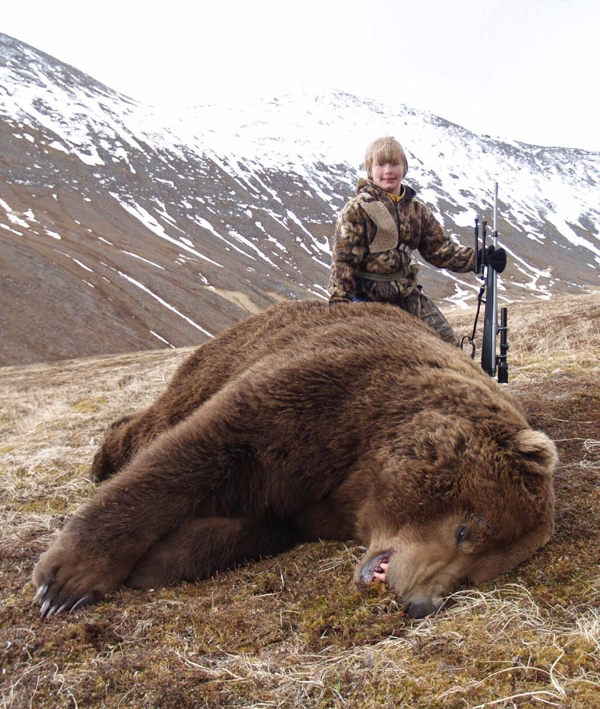
Her trophy brown bear now puts her in an elite class. Fern is a tremendous example to young hunters everywhere, and she is a great hunter regardless of her age.
WEBSITE RATES FISH HUNT CABINS PHOTOS
TESTIMONIALS BROCHURE HUNT BOOKLET

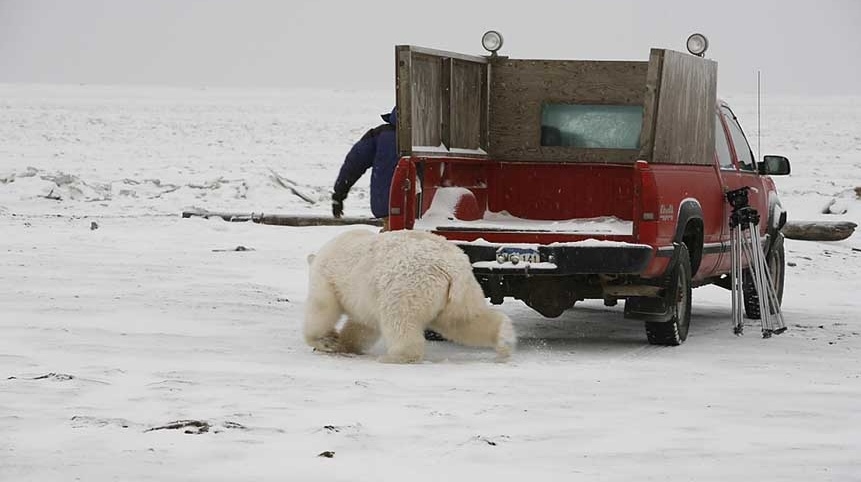
These are pictures from Barrow, Alaska. A photographer got careless and let the bear get too close and he did not have time to get into his truck before the Polar Bear started chasing him around the truck.

This is just a small bear. It’s probably only 2 years old and on it’s first year without its mother. A full grown male Polar Bear can get up to be three times this size. Hiding in a truck or car would not save you as any polar bear could smash though the car glass in seconds with very little difficulty.
WEBSITE RATES FISH HUNT CABINS PHOTOS
TESTIMONIALS BROCHURE HUNT BOOKLET

A trail camera won’t stumble through a bedding area, leave scent all over a trail, or exaggerate the size of a rack. And it’ll never oversleep. But your perfect little scouting buddy must be chosen wisely and placed carefully if you want to pattern that old, crafty animal you know is around. Here’s how…

The earlier version trail cameras were just a 35mm film point-and-shoot tucked in a weatherproof housing. It snapped a single picture when something triggered the sensor. After retrieving the camera, you ran to the one-hour shop to get the film developed, then thumbed through a week’s worth of pictures. More than once a stack of 36 prints revealed a handful of out-of-focus animals and a couple dozen shots of a wind-whipped brush or a drooping tree branch. That was only a few years ago.
Today, many website boasts several pages of trail cams, and even the cheapest one outperforms the original older ones. They have lenses sharp enough to count the ticks on a deer’s neck, electronic circuit boards so efficient that four AA batteries will run a unit for months, and memory cards that hold thousands of pictures you can download to your computer or delete at the touch of a button. And those are standard features on mid-priced cameras. The high-end ones will send a photo to your cellphone or laptop.
Like everything in the digital age, trail-cam technology has improved, competition has become fierce, and prices have plunged. Still, $200 is plenty of money, and matching a camera with the right features to meet your needs is critical. And even the best camera can’t take spectacular photos of a trophy buck if you don’t set it properly. But it’s not difficult to get started. These are the basics.

Wildlife biologists use trail cams to measure herd densities, buck-to-doe ratios, and the like. Your goals should be simpler: learning about the deer on your property, figuring out where to hunt them, and having fun in the process. You can pinpoint ideal spots before you buy a camera, and the locations you choose can determine what model is best for you. Here are four sites for four different periods.
Time: Late Summer
Site: Mineral lick
Goal: To start an inventory of buck numbers and quality on your property.
Setup: Find a spot with moderate to heavy deer traffic and spade up dirt in a 2-foot circle. Pour in half of an ice-cream pail of stock salt or commercial deer mineral and spade it into the loosened soil. Pour the rest on top.
Tips:
• Establish one or two licks per 80 acres. Allow deer up to a week to find them.
• Situate each lick 10 to 30 feet from a tree for mounting a camera.
• Jam a stick behind the camera’s top edge to point it down toward the lick.
 Time: Early Season
Site: Mock scrape
Goal: To find bucks after velvet shed, when they often relocate. Mocks can draw up to 90 percent of the bucks you’ll hunt.
Setup: Rake grass and forest debris 5 feet away from a tree that has a green, overhanging licking branch 5 to 7 feet above the ground. Activate with your own “product” (drink plenty of liquids) or deer urine.
Tips:
• If you are not getting clear shots of a buck, aim the camera at the licking branch. Most bucks will work it with their antlers.
• Establish multiple scrapes in each area and hang cameras only on the most active ones.
Time: Rut
Site: Funnel
Goal: To determine where resident bucks are traveling and whether traveling bucks are in the area.
Setup: Find terrain features that channel buck movement and hang a camera near fresh tracks and rubbing activity. Check camera every three to five days—the rut moves quickly.
Tips:
• Mount camera at a 45-degree angle to the trail. Bucks often move through funnels quickly; a camera set perpendicular to the trail might miss the shot.
• Scuff dirt in front of the camera with a boot. Such a mini mock will often make a moving buck pause and get “shot.”
Time: Late Season
Site: Food source
Goal: To find out where to fill a last-minute tag, and to know which bucks have survived the bulk of the hunting season.
Setup: Scout widely to find the hot food sources in your area, such as waste grainfields and clear-cuts. Place camera within 30 feet of the most heavily trafficked area. Load it with fresh batteries if you hunt in an extremely cold area.
Tips:
• Set up and check cameras at midday to avoid spooking feeding deer.
• If no trees are located near the food source, mount the camera on a tripod and camouflage it with grass or brush.
Follow our FISHING BLOG
WEB RATES FISH HUNT CABINS PHOTOS T
ESTIMONIALS BROCHURE HUNT BOOKLET


This crazy video documents a man being pulled by a hammerhead shark for miles while in his kayak! Check it out!

While doing some research, I came across a fantastic article that outlines the starting point for any new hunter. We have all been there, wanting to do but not knowing where to start…..here is a fantastic push off point
Sean McCosh (DuckBuckGoose) – PHJ ProStaff – Cincinnati, OH
Want to learn how to hunt but don’t know where to start? You’re not alone. There are thousands of people who have recently become interested in hunting, many of which have never even shot a gun.

For many, that’s because we’ve been experiencing a food renaissance in America. People are becoming aware of the downsides and potential health risks associated with commercially raised meat and highly processed foods. As result, there is a renewed interest in getting back to basics and consuming locally harvested “real food” that you hunt, grow or gather yourself. As a lifelong hunter, I welcome this resurgence and the new hunters that come with it – because the more people who hunt, the more interested voters we have to fight for our right to hunt and help us protect important wildlife habitat for the future generations. Plus, as hunters, we love to share our passion for hunting and the outdoors with others…it’s in our nature. My bet is, once you discover the excitement, satisfaction, connectedness to nature and sustenance that hunting offers, you’ll want to share your passion for it too.
Hunter Safety Course
I was lucky. My Dad, my grandfather and my uncles were all hunters. They taught me from an early age the principles of gun safety, how to shoot a gun and to be an ethical hunter. I was blessed to have that opportunity, but if you didn’t, not to worry. Chances are your state offers (and probably even requires) a hunter safety course for new hunters. I took the Ohio hunters safety course when I was a kid and, although it was a long time ago, I can still remember being enthralled by the class and excited to take the test at the end, so I could finally get my hunting license and hunt alongside my Dad. If you are not sure what the laws are in your state, here is listing of thehunter education requirements for various states. In my opinion, the classes are interesting and fun and can teach the basics of everything from firearm safety to outdoor skills, to animal anatomy and public vs. private property rights laws.
Upon taking a hunting course, you’ll soon discover that there’s much more to hunting than simply walking in the woods and shooting an animal. You may be surprised that a very a diverse cross-section of the population is take hunting courses – ranging from young kids who come from a family of hunters, to recent immigrants, to “seasoned” foodies who are finally ready to see exactly where their food comes from. If you want to get a head start and take an online hunter education course before you take your state’s official course (if offered and required) you can do so online at this site from theInternational Hunter Education Association. In addition to what you learn in these courses, you can also learn a lot by signing up for ProHuntersJournal.com and picking the brains of hunters in our community. It is 100% free, so if you’re not a member, click here to join now.
Choosing a Gun and Shooting Practice
Again, I was lucky. My Dad was a knowledgeable hunter who knew exactly what I needed to get started hunting and when I was ready to progress to “the next level” by moving up to a bigger gun or a more challenging hunt. But if you are an adult just getting into hunting, the first thing you have to do is decide what animal or animals you want to hunt, because that will determine what sort of gun (or possibly bow) you’ll be using. Once you determine this, I suggest reaching out to an experienced hunter of your chosen game, to get their advice. If you know someone who hunts, there’s a good chance they will be willing to take you under their wing and maybe even let you borrow a gun after a little training. If you don’t know anyone who hunts these animals, not to worry. As I mentioned, hunters love to bring new people into the sport and share advice, so try reaching out to hunters in online message board areas of sites like this one, or by talking to a trustworthy sales person at a reputable sporting goods store or outfitter. If you go into a store to look at guns, you may want to approach it simply as a fact-finding mission at first, and make that clear to the sales person. Since guns and hunting gear can be expensive, a good first step could be to call up a shooting or hunting club near you and ask if they have the type of hunting gun you’re interested in available to rent, and if they offer shooting lessons. That way you can learn more about the gun and see if you like shooting before you jump in with both feet and spend hundreds of dollars.
Whichever gun you choose, you will need to practice gun safety always and practice your marksmanship often, to become an ethical hunter. These points cannot be stressed enough. I’d rather not shoot an animal at all than to shoot it poorly and run the risk of badly injuring but not killing it. The ethical hunter strives to be a great marksman and practices accordingly.
When I was first learning how to hunt, my Grandpa would often say… “Don’t point your gun at anything you don’t plan on shooting and don’t shoot anything you don’t plan on eating”. Of course the “eating” part didn’t apply to target practice, but there’s a whole lot of wisdom packed into that simple lesson of his.
Learning How to Hunt
There is no substitute for experience when it comes to hunting. So, if you don’t have experience yourself, try to borrow it. Approach the sport with a hunger for knowledge, a childlike curiosity and an open mind. If you do, and you are not afraid to ask questions, my bet is you can quickly find a mentor that will help you learn the basics, answer the many questions you might have and maybe even take you hunting.
My friend Jason is a phenomenal duck and goose caller. One morning this past season he was hunting our duck blind with another friend who is literally a world-class caller and has won several goose calling competitions and titles. As Jason was backing his duck boat into the water that pre-dawn morning, they saw a couple of new hunters clumsily attempting to put their tiny skiff in the water also, on what to them was an unfamiliar lake. It didn’t take long for Jason to realize that these guys didn’t know what they were doing, and that they were literally risking their lives by attempting to cross the icy waters of the lake in that tiny, overloaded boat. So, instead of lecturing them about what they were doing wrong, he simply walked up and invited these guys to join him in his blind. After all, they had plenty of extra room (and he didn’t feel like rescuing them from the icy waters when there were ducks to be hunted). Quickly realizing Jason was an experienced hunter, these two guys gladly joined. Their willingness to learn would be richly rewarded.
I was on the phone with Jason throughout that day to give and get field reports. Their hunt started out slow with very few ducks in the area. But, it ended up being a massive migration day for Canada geese. Realizing that, Jason ended up pulling most of his duck decoys and changing his decoy spread to set up primarily for geese. As huge flocks of geese started to come onto the lake, he and his championship goose caller friend put on a real calling clinic for these new hunters, which resulted in a 4 man limit of geese on their first “real” waterfowl hunt. Jason said the look on their faces was priceless when they realized the situation they had fallen into by being open to learning from more experienced hunters.
If you can’t find experienced hunters in your own social circles, reach out to your local division of wildlife office and ask them if they can point you to any local resources. Many Division of Wildlife or Natural Resources officers are hunters themselves and are very willing to share information to help you be successful. Another strategy is to contact the local chapter of wildlife conservation organizations like: The National Wild Turkey Federation, The Quality Deer Management Association, Ducks Unlimited, Delta Waterfowl, Rocky Mountain Elk Foundation or Pheasants Forever. The type of organization you choose to call will obviously depend on the game animal you want to pursue and where you live, but you’ll find that local volunteers for these organizations are passionate about hunting, and about bringing new hunters into their organizations. They can be a tremendous resource.
There’s one last point I need to make about learning from experience. Once you learn the basics by leveraging the experiencing of others, you’ll quickly start to realize that you’ll be learning something new on every single hunt, based on your own experience. This is one of the most rewarding aspects to hunting, because no matter how long you’ve been hunting, with every trip to the woods, every day on the water and with every animal encounter, you’ll start to pick up insights that will help you make better future decisions and make you a smarter hunter.
After the Shot
For many new hunters, the question of “what do I do with an animal once I shoot it?” is their biggest source of trepidation about getting into hunting. Well, it is a great question and there’s more to it than meets the eye. Your first challenge is to successfully recover the downed game. Once you shoot an animal, recovering it needs to become your first priority (after safety, of course). I’ve seen hunters get hopped up on adrenaline and side tracked by seeing more ducks in the air, or other deer approaching – causing them to take their focus off of animals they had already shot. This can lead to lost game, which is never a good thing and one of the most unfortunate situations in hunting. 
How you recover an animal depends on the species. For big game like deer, elk or bear, it is best to give the animal time to expire before you pursue it. If you make a great shot, sometimes you’ll see the animal go down and expire within your view, but it doesn’t always happen that way. There may be tracking involved, which is just another fun and challenging part of the hunting experience. If you’re hunting small game or fowl, you can and usually should go after them right away, to recover them wherever they dropped. Sometimes a quick follow up shot is needed to quickly and ethically kill the animal.
Once you recover a big game animal like a deer, you’ll need to tag it – which basically just means you put a tag with your name and some basic information about the harvest of the animal onto the animal itself. This is a legal requirement in most, if not all states in the U.S.
Then, whether it is big game or small, you’ll eventually need to clean and process the animal. For big game, like a deer, you will likely need to field dress or “gut” the deer out in the field. This serves two purposes. First, it helps cool down the body cavity more quickly, which helps preserve the quality of the meat. Secondly, it removes a lot of weight from the animal, which will help you drag it out of the woods to your vehicle more easily.
As for the question of how-to field dress a deer, how to clean a duck or any other animal, thankfully we live in an information age where practically everything you need to know can be found on the internet. That is, if you don’t have a friend or family member to show you first-hand. From field dressing to plucking to processing, a simple search on Google or YouTube will deliver links to dozens of videos that can help walk you through the process.
When I shot my first deer with a shotgun as a teenager, I was fortunate to have a family friend help me field dress it. Then I took it to a meat processor to butcher it. But when I finally took up (and fell in love with) bow hunting years later, I had no one around to show me what to do when I killed my first doe. Fortunately, I was prepared and had a step-by-step guide to field dressing printed from the web and put it in a plastic bag in my backpack – so I’d be ready if I was fortunate enough to harvest an animal. Good preparation is a hugely important part of successful hunting.
Getting Started Starts Now
When I decided to take up bow hunting, I was inspired by simply shooting a friend’s old compound bow at a local archery range. There was something about taking aim and releasing that arrow that resonated with something deep inside of me. Simply by shooting his bow, I realized that even though I’d never hunted with one, I was in-fact a bow hunter. So that day at the archery range I set a goal. I said to myself and to my friend, “I am going to buy a bow of my own, practice and kill a deer with it next season”. Mind you, although I was a long-time small-game and bird hunter, I had never hunted with a bow. My goal was to figure it all out…the equipment, the strategies and how to prepare for a hunt in ways that would help make me successful. So that’s what I did. Since then I’ve taken about twenty deer with a bow. I’ve fed my family with several of those deer and donated others to local food pantries or others in need. I am a bow hunter. A sportsman. A provider. And it all started with simple, clearly stated goal.
What’s your game? What’s your goal? It is time to get started!
Follow our FISHING BLOG
WEB RATES FISH HUNT CABINS PHOTOS
TESTIMONIALS BROCHURE HUNT BOOKLET

Taxidermy has come a very long way over the years, but even with primitive techniques, these are far from professional in any sense. Some terrifying and some hilarious, each represents what NOT to do when having a mount done. Make sure you do your homework when finding a taxidermist 🙂
This oh-so-sassy bobcat.

This contemplative fox.

This… ambiguous embodiment of sadness.

This two-for-the-price-of-one bonus! A fox carrying a duckling!

This… house cat? Is this a cat? I don’t even know anymore.

This surprised tiger.

This exhausted polar bear.

This bloated bull.

This sad, sad creature.

This angelic cat.

WHATEVER THIS “AMAZON MAN” IS.

Some type of amazon cat and monkies?

TV host polar bear

Rat sllippers

Prankster lion

Leopard??

Wired weasel

Rabid monkey

Surprised cheetah

Stick fox?

Half assed??


 ON TARGET in CANADA