RSS

Category Archives: Wildlife

Birdhouse That Looks Like a Security Camera

birdhouse-that-looks-like-a-cctv-security-camera-1093

The CCTV Birdhouse is a birdhouse that looks just like a CCTV security camera, and is sure to keep those pesky criminals away, and keep those beautiful loving birds nearby. Now you can live life large knowing that not only are you deterring thieves, rapists, and teenagers from entering your lawn, but with each “camera” you install on your house, a new family of birds gets a new home.

 The CCTV birdhouse is made from durable yet lightweight weatherproof poly resin, is hand painted, is supported by hanging it up by a rope, string, or twine of your choosing, and measures 16cm x 12cm x 25cm.

Follow our FISHING BLOG

WEBSITE    RATES     FISH    HUNT    CABINS    PHOTOS
TESTIMONIALS    BROCHURE    HUNT BOOKLET

Enter your email address to subscribe to this blog and receive notifications of new posts by email.

← Back

Thank you for your response. ✨

Email Me....


Tags: , , , , ,

Squirrel Bungee Cord Feeder

Squirrel Bungee Cord Feeder


Leave a comment

Posted by on January 17, 2016 in Wawang Lake Resort, Wildlife


Tags: , , , , ,

Hunter Fends Off Grizzly by Shoving Arm Down Its Throat

Grizzly

Sticking an arm down the throat of a bear is regarded by some as an effective last-ditch tactic for fending off an attack.

There are few animals in North America as frightening as an adult grizzly, and if one of these massive animals get it in their heads to attack you, your day just suddenly got a whole lot worse. Twenty-six-year-old Chase Dellwo was expecting to bag some elk in the Montana back country near Choteau last Saturday, but a chance encounter with a bear ended with him sticking his arm into its roaring mouth instead.

That decision may have saved his life.

According to the Great Falls Tribune, Dellwo was bowhunting near a creek bed with his brother Shane. Strong wind and intermittent snow and rain kept visibility to a minimum, but the brothers heard elk bugles in the area and Dellwo was eager to make his first elk harvest of the year. The hunter had been steadily driving the animals toward his brother, but the weather also hid a sleeping grizzly, which Dellwo practically tripped over. At less than three feet, there was little that Dellwo could do before the animal charged him.

“I had an arrow knocked, and I put my bow up in front of me and took two or three steps back,” he told the Tribune. “There wasn’t any time to draw my bow back.”

The grizzly knocked Dellwo off his feet and bit him in several places across his head. It then reared back and gave what the hunter later described as the loudest roar he had ever heard, before attacking him again and biting his right leg. It was at this point that Dellwo recalled that an old survival tip about how bears have sensitive gag reflexes—so the hunter plunged his arm down the animal’s throat.  The bear promptly left.

Dellwo is not the first person to have stuck their arm down a bear’s throat and lived to tell the tale. The trick is commonly regarded as a last-ditch defense against bear attacks. As recently as last November, a hunter in British Columbia used to same trick to disable and ultimately kill a large grizzly sow near Fernie. According to CTV News, Wilf Lloyd was seriously mauled by the bear before he was able to stop its biting by jamming his hand down its mouth. While the bear was still on top of the man, Llyod’s son-in-law arrived and shot it dead with a rifle.

Lloyd also received a bullet in the leg during the chaotic struggle, but he did not blame his hunting companion in the least.

“The man saved my life,” Lloyd later said. “What Skeet did and because of his fast reaction, the shots, I had maybe fifty stitches in my hand and that’s it. So I was very fortunate that way.”

Dellwo echoed Llyod’s sentiment after his own bear encounter. Shortly after the attack, he was able to reunite with his brother and was transported to a local hospital, where he was treated for various cuts and punctures on his head and right leg. Dellwo expects to be back in the woods later this year for rifle season.

Officials with Montana Fish, Wildlife, and Parks are currently investigating the case and believe that the bear involved was a 400-pound male. Experts added that the brothers seemed to have done everything correctly and that the bear will likely not be tracked down since the attack was not predatory in nature.   By: Daniel Xu

Follow our FISHING BLOG

WEB   RATES     FISH    HUNT    CABINS    PHOTOS
TESTIMONIALS    BROCHURE    HUNT BOOKLET

Enter your email address to subscribe to this blog and receive notifications of new posts by email.

← Back

Thank you for your response. ✨

Email Me....


Tags: , , , , , , ,

Cats Kill Billions of Birds and Mammals Annually

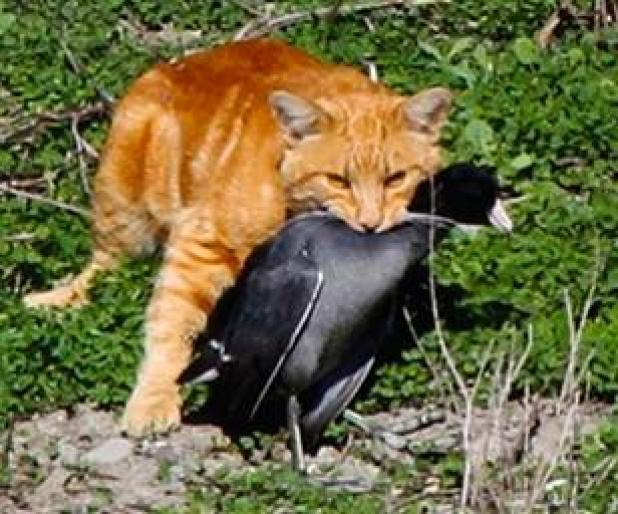
Cats that live in the wild or indoor pets allowed to roam outdoors kill from 1.4 billion to as many as 3.7 billion birds in the continental U.S. each year, says a new study that escalates a decades-old debate over the feline threat to native animals. The estimates are much higher than the hundreds of millions of annual bird deaths previously attributed to cats. The study also says that from 6.9 billion to as many as 20.7 billion mammals — mainly mice, shrews, rabbits and voles — are killed by cats annually in the contiguous 48 states. The report is scheduled to be published Tuesday in Nature Communications. “I was stunned,” said ornithologist Peter Marra of the Smithsonian’s Conservation Biology Institute. He and Smithsonian colleague Scott Loss, and U.S. Fish and Wildlife Service biologist Tom Will conducted the study.killercat

Yes, that’s right. Billions. According to the story, the study reveals that free-ranging cats are likely the single greatest source of mortality for birds and mammals in the United States. The study is also critical of one of the more ridiculous schemes to deal with feral cats; the so-called “TNR” programs (for Trap-Nueter-Release) that feral cat advocacy groups love, calling them “potentially harmful to wildlife populations” because such programs simply return feral cats to the wild to continue killing wildlife.

The study also tried to put a number to just how many un-owned cats there are in the U.S., with the estimate being anywhere from 30 to upwards of 80 million cats. Of course, cat lovers have been pushing back against the study, saying the felines are just convenient scapegoats for habitat loss, window and vehicle collisions, and other man-made hazards. I’d argue that feral cats ARE a man-made hazard, one that something should be done about.

There’s now an admittedly Quixote-like push to eventually get rid of cats in New Zealand in order to save that nation’s endangered biodiversity and I’d love to see something similar happen in this country, if for nothing else than to raise awareness of the issue. Very few people tolerate dogs running wild, so why do so many in this country think it’s OK to let cats do the same? Agree or disagree?     by Chad Love

Follow our FISHING BLOG

WEB   RATES     FISH    HUNT    CABINS    PHOTOS
TESTIMONIALS    BROCHURE    HUNT BOOKLET

Enter your email address to subscribe to this blog and receive notifications of new posts by email.

← Back

Thank you for your response. ✨

Email Me....


Tags: , , , , , ,

Where to Place Your Trail Cams

A trail camera won’t stumble through a bedding area, leave scent all over a trail, or exaggerate the size of a rack. And it’ll never oversleep. But your perfect little scouting buddy must be chosen wisely and placed carefully if you want to pattern that old, crafty animal you know is around. Here’s how…

CameraNO_MosaicYELLOW

The earlier version trail cameras were just a 35mm film point-and-shoot tucked in a weatherproof housing. It snapped a single picture when something triggered the sensor. After retrieving the camera, you ran to the one-hour shop to get the film developed, then thumbed through a week’s worth of pictures. More than once a stack of 36 prints revealed a handful of out-of-focus animals and a couple dozen shots of a wind-whipped brush or a drooping tree branch. That was only a few years ago.

Today, many website boasts several pages of trail cams, and even the cheapest one outperforms the original older ones. They have lenses sharp enough to count the ticks on a deer’s neck, electronic circuit boards so efficient that four AA batteries will run a unit for months, and memory cards that hold thousands of pictures you can download to your computer or delete at the touch of a button. And those are standard features on mid-priced cameras. The high-end ones will send a photo to your cellphone or laptop.

Like everything in the digital age, trail-cam technology has improved, competition has become fierce, and prices have plunged. Still, $200 is plenty of money, and matching a camera with the right features to meet your needs is critical. And even the best camera can’t take spectacular photos of a trophy buck if you don’t set it properly. But it’s not difficult to get started. These are the basics.
TrailCameras3
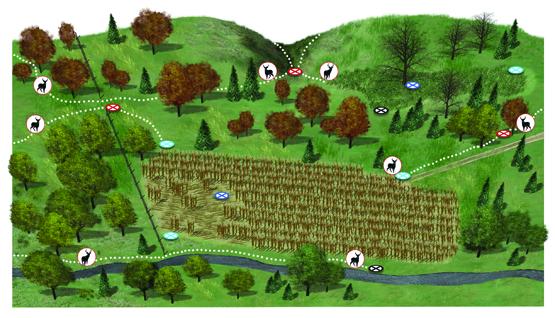
Wildlife biologists use trail cams to measure herd densities, buck-to-doe ratios, and the like. Your goals should be simpler: learning about the deer on your property, figuring out where to hunt them, and having fun in the process. You can pinpoint ideal spots before you buy a camera, and the locations you choose can determine what model is best for you. Here are four sites for four different periods.

Time: Late Summer
Site: Mineral lick
Goal: To start an inventory of buck numbers and quality on your property.
Setup: Find a spot with moderate to heavy deer traffic and spade up dirt in a 2-foot circle. Pour in half of an ice-cream pail of stock salt or commercial deer mineral and spade it into the loosened soil. Pour the rest on top.
Tips:
• Establish one or two licks per 80 acres. Allow deer up to a week to find them.
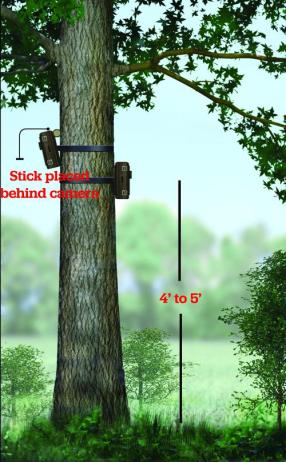
• Situate each lick 10 to 30 feet from a tree for mounting a camera.
• Jam a stick behind the camera’s top edge to point it down toward the lick.
500Time: Early Season
Site: Mock scrape
Goal: To find bucks after velvet shed, when they often relocate. Mocks can draw up to 90 percent of the bucks you’ll hunt.
Setup: Rake grass and forest debris 5 feet away from a tree that has a green, overhanging licking branch 5 to 7 feet above the ground. Activate with your own “product” (drink plenty of liquids) or deer urine.
Tips:
• If you are not getting clear shots of a buck, aim the camera at the licking branch. Most bucks will work it with their antlers.
• Establish multiple scrapes in each area and hang cameras only on the most active ones.

Time: Rut
Site: Funnel
Goal: To determine where resident bucks are traveling and whether traveling bucks are in the area.
Setup: Find terrain features that channel buck movement and hang a camera near fresh tracks and rubbing activity. Check camera every three to five days—the rut moves quickly.
Tips:
• Mount camera at a 45-degree angle to the trail. Bucks often move through funnels quickly; a camera set perpendicular to the trail might miss the shot.
• Scuff dirt in front of the camera with a boot. Such a mini mock will often make a moving buck pause and get “shot.”

Time: Late Season
Site: Food source
Goal: To find out where to fill a last-minute tag, and to know which bucks have survived the bulk of the hunting season.
Setup: Scout widely to find the hot food sources in your area, such as waste grainfields and clear-cuts. Place camera within 30 feet of the most heavily trafficked area. Load it with fresh batteries if you hunt in an extremely cold area.
Tips:
• Set up and check cameras at midday to avoid spooking feeding deer.
• If no trees are located near the food source, mount the camera on a tripod and camouflage it with grass or brush.

Make the Next Shot Count!

Follow our FISHING BLOG

WEB   RATES     FISH    HUNT    CABINS    PHOTOS T
ESTIMONIALS
    BROCHURE    HUNT BOOKLET

Enter your email address to subscribe to this blog and receive notifications of new posts by email.

← Back

Thank you for your response. ✨

Email Me....


Tags: , , , , , ,

Birdhouse That Looks Like a CCTV Security Camera

birdhouse-that-looks-like-a-cctv-security-camera-1093

The CCTV Birdhouse is a birdhouse that looks just like a CCTV security camera, and is sure to keep those pesky criminals away, and keep those beautiful loving birds nearby. Now you can live life large knowing that not only are you deterring thieves, rapists, and teenagers from entering your lawn, but with each “camera” you install on your house, a new family of birds gets a new home.

 The CCTV birdhouse is made from durable yet lightweight weatherproof poly resin, is hand painted, is supported by hanging it up by a rope, string, or twine of your choosing, and measures 16cm x 12cm x 25cm.

Follow our FISHING BLOG

WEBSITE    RATES     FISH    HUNT    CABINS    PHOTOS
TESTIMONIALS    BROCHURE    HUNT BOOKLET

Enter your email address to subscribe to this blog and receive notifications of new posts by email.

← Back

Thank you for your response. ✨

Email Me....


Tags: , , , , ,

Squirrel Bungee Cord Feeder

Squirrel Bungee Cord Feeder


1 Comment

Posted by on August 2, 2015 in Wawang Lake Resort, Wildlife


Tags: , , , , ,

Artisan Fire Pits – Beautiful!

Here are some beautiful fire pits that will brighten your outdoor camping area.

7010012-red-lake-fish-fire-pit-3111

This slideshow requires JavaScript.

Follow our FISHING BLOG

WEBSITE    RATES     FISH    HUNT    CABINS    PHOTOS
TESTIMONIALS    BROCHURE    HUNT BOOKLET

Enter your email address to subscribe to this blog and receive notifications of new posts by email.

← Back

Thank you for your response. ✨

Email Me....


Tags: , , , , , ,

Beaver Attack

A fisherman on a trip with two friends to Lake Shestakov in Balarus bled to death after being attacked by a beaver when he tried to get a close-up photo of the rodent.

Beaver_pho34

According to a NY Daily News story, the angler spotted the animal on the side of the road and decided to take a photo. The beaver pounced and bit the man’s thigh, severing an artery, which caused him to bleed out.The victim was not identified in the story.   His friend reportedly tried to stop the bleeding, but couldn’t.

You might remember a story from last summer about a Boy Scout troop that had to pelt a rabid beaver to death with rocks after it attacked their troop leader. Usually when a beaver attacks a human it’s rabid, but the story about the Belarus attack doesn’t say one way or the other.

Have any of you ever gotten into a scrape with a rabid animal?

Follow our FISHING BLOG

WEBSITE    RATES     FISH    HUNT    CABINS    PHOTOS
TESTIMONIALS    BROCHURE    HUNT BOOKLET

Enter your email address to subscribe to this blog and receive notifications of new posts by email.

← Back

Thank you for your response. ✨

Email Me....

 
Leave a comment

Posted by on July 26, 2015 in Wawang Lake Resort, Wildlife


Tags: , , , , , ,

Bear Quints

One in a lifetime – photo by Tom Spears

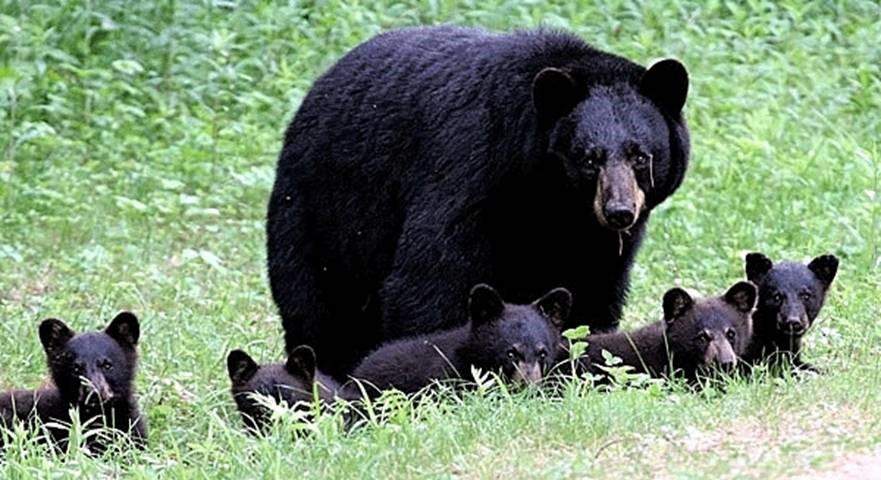
Black  bears typically have two cubs; rarely, one or three. In northern  Alberta a black bear sow gave birth to five healthy young.  There were two or three reports of sows with as many as 4  cubs, but five  was, and is, very extraordinary. The photographer learned of them shortly  after they emerged from their den and set a goal of photographing all  five cubs with their mom – no matter how much time and effort was  involved. He knew the trail they followed on a fairly regular basis, usually  shortly before dark. After spending nearly four hours a day, seven days a  week, for more than six weeks, he had that once-in-a-lifetime opportunity and photographed them. He used  the equivalent of  a very fast film speed on his digital camera. The print is properly focused  and well exposed, with all six bears posing as if they were in a studio  for a family portrait.

bear
The photographer  stayed in touch with other people who saw the bears during the summer and  into the fall hunting season. All six bears continued to thrive. As time  for hibernation approached, he found still more folks who had seen  them, and everything remained OK. The photographer stayed away from the  bears because he was concerned that they might become habituated to  him, or to people in general, and treat them as approachable  friends. This could easily become dangerous for both man and animal.

After Halloween, no  further reports and could only hope the bears survived until they  hibernated. This spring, just before the snow disappeared, all six bears  came out of their den and wandered all over the same  familiar  territory they trekked in the spring.

The photographer saw  them before mid-April and dreamed nightly of taking another family  portrait, a highly improbable second once-in-a-lifetime photograph.  He achieved his dream.

bear2
When  something as  magical as this happens between man and animal, Native Americans say,  “We have walked together in the shadow of a rainbow.” And so it is with  humility and great pleasure that I share these   exhilarating  photos with  you.  Do  pass them on!

Follow our FISHING BLOG

WEB   RATES     FISH    HUNT    CABINS    PHOTOS
TESTIMONIALS    BROCHURE    HUNT BOOKLET

Enter your email address to subscribe to this blog and receive notifications of new posts by email.

← Back

Thank you for your response. ✨

Email Me....


Tags: , , , , , , , ,