RSS

Grouse Population

 imagesPOPULATION
Ruffed Grouse normally have a short life span. From a brood of 10 or 12 hatched in late May or early June, usually 5 or 6 will have died by mid-August. Among those living to disperse during the fall shuffle, about 45% will have been lost by late fall and early winter. Another 10% die over winter and during early spring, so that only about 45% of the young grouse alive in mid-September live to their first breeding season. In subsequent years a given cohort (a season’s crop of young birds ) continues to shrink by about 55 to 60% per year. So from 1000 chicks hatched in late spring, about 400 normally survive to early autumn, 180 survive to the following nesting season, 80 are alive a year later, 36 live to breed a 3rd time, 16 may breed a 4th time. One out of 2200 chicks hatched may live as long as 8 years.

Most Ruffed Grouse die a violent death to provide a meal for one of a number of meat-eating predators, for in the natural scheme of things, Ruffed Grouse are one of the first links in a complex food chain. Some also die from disease and parasites, or from exposure to severe weather, or accidentally by hitting trees or branches while in a panic flight after being frightened.

grousewawanglakeAcross the major portion of the Ruffed Grouse range, the winged predators or raptors are most efficient at taking these birds. Although the goshawk is certainly the most efficient of all grouse predators, the horned owl probably kills more grouse annually than any other predator. This is due to the cosmopolitan distribution of these owls and the likelihood that any woodland capable of supporting grouse will have resident horned owls, or at least be regularly visited by them. Yet, where cover is adequate, grouse can find security and maintain their abundance even when goshawks and horned owls live and nest nearby.

Conditions are seldom static in the world of the Ruffed Grouse and their numbers fluctuate from year to year, and from decade to decade. Across most of their range in the northern states, Canada and Alaska, Ruffed Grouse numbers have risen and fallen in a somewhat predictable pattern for most of this century, in what is often called a “10-year cycle”. In the Lake States, for example, periods of abundance usually coincide with years ending in 0, 1 or 2, and the bottom of the depression in years ending with 5 or 6. This is not invariable, but a general, regional trend. These “cycles” sweep across the continent more or less as a wave, beginning in the far Northwest and Northeast, and progressing southward and southeastward.

The factors responsible for these periodic fluctuations remain poorly understood, and appear to involve a number of different factors interacting with one another in different ways at different times. The one factor which does not appear to be important is hunting during the period of fall dispersal.

grousewawanglake3

The primary causes for the short-term fluctuations in Ruffed Grouse abundance appear to be related to weather trends and variations in the quantity and quality of food resources. These are interrelated to a large degree. Superimposed upon these two basic factors is that of predation – as predators take advantage of grouse placed in jeopardy by unfavorable weather conditions or inadequate food resources. A favorable combination of weather factors and food resources may allow these grouse to survive the winter nearly immune to predation. These combinations of factors also affect annual production. If grouse spend the winter feeding on poor quality foodstuffs, or have to use an excessive amount of energy to keep warm, hens may not have sufficient reserves to produce a clutch of viable eggs, or vigorous, healthy chicks in the spring. Across most of their range, the most productive and most abundant Ruffed Grouse populations are those living where they spend most of the winter burrowed into 10 inches or more of soft, powdery snow, and emerge for only a few minutes once or twice a day to take a meal of the male flower buds of the aspens. Our Ruffed Grouse can be considered snow lovers or “Chionophiles.” Ruffed Grouse tend to be less numerous and less productive if they live in regions where they cannot burrow in snow and feed on aspen (poplar).

grousewawanglake2There also seems to be a poorly understood relationship between the color-phase of a Ruffed Grouse and its ability to survive severe wintering conditions, and its vulnerability to predation.

Longer term changes in Ruffed Grouse abundance reflect how we have treated our woodlands and forests. There is also reason to suspect that much of the severity of the “10-year cycle” is largely a result of how we have treated forested lands. These birds depend upon the food and cover resources produced by a group of short-lived trees and shrubs growing in full sunlight which develop following the severe disturbance of forests. In earlier times, fire and windstorm were the ecological agents periodically renewing forests and creating satisfactory habitat for Ruffed Grouse and many other species of forest wildlife. Ruffed Grouse should be considered a “fire-dependent” species in the natural scheme of things.

Our current reluctance to cut forests, even under strict management plans and the suppression of fire to protect growing forests, have upset this natural sequence of events. In the early part of this century, farm abandonment and the recovery of forests from unregulated logging and fires produced habitats which probably resulted in the greatest abundance of grouse in recent times in most of Canada & northern  United States. But as forests mature under protection from fire and cutting, they lose the habitat qualities Ruffed Grouse require. In many regions, Ruffed Grouse numbers have declined as forests have become more extensive and older.

Ruffed Grouse abundance can often be readily restored by proper harvest management of forested lands, or through the judicious use of prescribed fire that is ongoing in northwestern Ontario.

Follow our FISHING BLOG

GROUSE HUNTING at Wawang Lake

 WEBSITE    RATES     FISH    HUNT    CABINS    PHOTOS
TESTIMONIALS    BROCHURE    HUNT BOOKLET

Enter your email address to subscribe to this blog and receive notifications of new posts by email.

← Back

Thank you for your response. ✨

Email Me....


Leave a comment

Posted by on December 16, 2015 in grouse, hunting, Wawang Lake Resort


Tags: , , , , , , ,

HIDDEN GUN STORAGE

Couch Gun Safe

This unexpectedly placed hidden gun storage solution stays hidden in plain sight while providing a large amount of bullet proof storage space.

hiddenguns

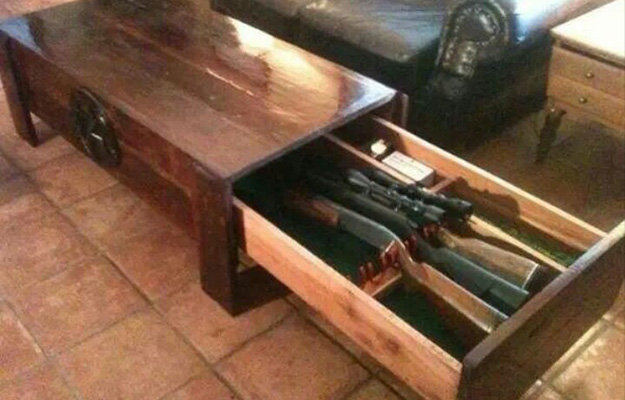
Coffee Table Gun Safe

Utilize the wasted space underneath your coffee table with some hidden gun storage.

d0cda13a3b1e5baab38f8ba75478aa43

Follow our FISHING BLOG

WEBSITE    RATES     FISH    HUNT    CABINS    PHOTOS
TESTIMONIALS    BROCHURE    HUNT BOOKLET

Enter your email address to subscribe to this blog and receive notifications of new posts by email.

← Back

Thank you for your response. ✨

Email Me....


Tags: , , , , , , ,

Pay Attention to Detail

Scent can be your biggest ally or your worst enemy

wawanglakebear
Black Bear are attracted to the aroma of a free meal, but if they catch a whiff of you, you can often kiss them good-bye for a day or two.   Keep your clothing and footwear as scent-free as possible. Be alert at all times while hunting your bait. You will most often see bear before you hear them. With padded feet they move with calculated precision. Remember, when they come into a bait station they know the treats were left by humans.


Shot Placement

Regardless of your choice of weapon, whether it is a gun or bow, learning when and where to shoot can mean the difference between an expedited kill, or, the outcome of tracking a wounded animal. We advise our hunters to wait until the bear is preoccupied with the bait and is facing away while standing broadside or quartering away. Bears are extremely tough, so a double lung or heart shot are always your best option therefore taking your time will be important.

wawangshotplacement

When archery hunting, bows must meet the following specifications.

Crossbows: Draw length must be at least (11.8 in.);

  • Draw weight must be at least (119 lbs.);
  • Bolt head must be at least (0.9 in.) at the widest point; and,
  • there must be at least two cutting edges of straight, sharp, un-serrated, barbless steel.

Re-curve Bow:    Draw weight must be at least (48.5 lbs.) at draw length of (27.6 in.) or less;

  • Arrow length must be at least (23.6 in.);
  • Broad head must be at least (0.9 in. at the widest point; and,
  • There must be at least two cutting edges of straight, sharp, un-serrated, barbless steel.

For bow hunting Black Bear we recommend a compound bow with a draw weight of no less than 50 pounds and a 100 grain broad head

Recommended Knowledge base
www.mnr.gov.on.ca/en/Business/FW/Publications/MNR E001275P.html

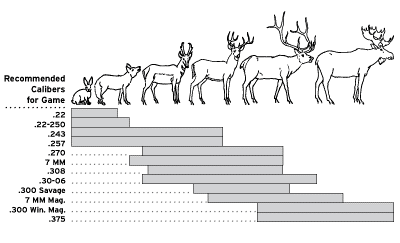
For rifle hunting black bear we recommend using nothing less than a .270 caliber.
Other recommended calibers: 7mm magnum; .308; .30-06.  NO 30-30’s

Firearm Information www.rcmp-grc.gc.ca/cfp-pcaf/index.htm

The bottom line – baiting is a proven strategy for attracting a wary game animal with a voracious appetite. It involves much more than just tossing out a few tasty morsels. There is a right way and a wrong way to do it and our experienced guides take pride in their skills and knowledge. Keen attention to detail and listening to the guide is the key to your success.

In order to ensure the highest possible success to our hunters we take only an average 14 hunters a year. Should we have an increase in bear sighting throughout the spring and summer we may take a few more hunters but our first obligation is to ascertain a healthy black bear population together with satisfied hunters for years to come.

Most importantly, remember baiting is a ton of work and takes weeks on our part for each hunter. From collecting legal paper work to buying and picking up the ingredients, materials along with travelling for miles and then finally establishing and maintaining each site daily prior to your hunt. It requires foresight and commitment on our part and we do this because of our passion for the outdoors and careful management of our Black Bear.

Follow our FISHING BLOG

WEBSITE    RATES     FISH    HUNT    CABINS    PHOTOS
TESTIMONIALS    BROCHURE    HUNT BOOKLET

Enter your email address to subscribe to this blog and receive notifications of new posts by email.

← Back

Thank you for your response. ✨

Email Me....


Tags: , , , , , , , , ,

Barbeque Moose Roast Recipe

Have you ever wanted to barbeque a moose roast and still have it be tender?  We have, and recently cooked a moose round roast on the barbeque that was so tender once we carved it, it was possible to cut it with your fork.

Start out with a moose round roast; it’s not the best cut to be barbequing and it will require moist heat if it were to be palatable.

Remembering a friend telling of how he had cooked ribs on his barbeque and had great results so wondered if we could achieve the same?

1  

The Process

The process is quite simple really, and you could likely apply this to any meat that is tough. Cook it with moisture over a long period of time.  How much time… we cooked our roast for almost 9 hours on low heat

Ingredients:

  • Moose round roast 3 pounds
  • 1 large onion
  • 5 cloves garlic (elephant)
  • 1 1/2 cups of barbeque sauce

2
Directions: Barbeque a Moose Roast

  • Thaw the moose roast in your refrigerator
  • Coarse chop the onion
  • Peel and slice half of the garlic and mince the balance
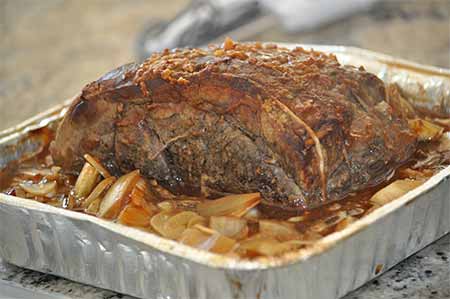
  • Start with a 8 inch by 8 inch roasting pan and place the moose round roast that you plan to barbeque onto a thin layer of the chopped onions.
  • Place the rest of the onions around the roast evenly.

Next sprinkle the onions with the sliced garlic and rubbed the roast itself with the minced garlic.

Followed by pouring barbeque sauce over the roast.

Once this was complete I covered the entire pan with a layer of heavy aluminum foil and took the pan (with the roast in it) outside to my barbeque.

I lit one burner and set it to low heat.  Then place the covered pan containing the moose roast barbeque on the other side well away from the heating element.

Close the lid.

3

Maintain a constant temperature of about 200 degrees Fahrenheit for 9 hours, or until the internal temperature reached a minimum of 140 degrees; or your required doneness.

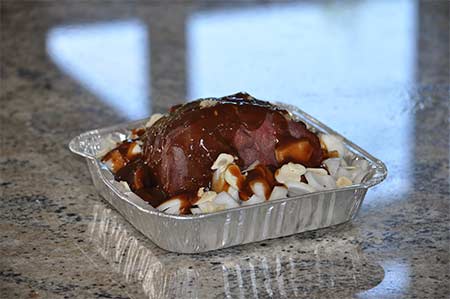
Serve the moose roast with baby potatoes, carrots, chopped onions and mushrooms. All of which were cooked on the barbeque while the roast was cooking. All the veggies were wrapped in foil; salt, pepper and butter were added and placed directly over the burner that was set on low temperature. About 1 1/4 hours.

Make gravy from the juice from the meat pan and add the onions from the meat pan to the veggie dish.

The barbequed moose roast and the entire dish… well…Delicious

Follow our FISHING BLOG

WEB   RATES     FISH    HUNT    CABINS    PHOTOS
TESTIMONIALS    BROCHURE    HUNT BOOKLET

Enter your email address to subscribe to this blog and receive notifications of new posts by email.

← Back

Thank you for your response. ✨

Email Me....


Tags: , , , , , , ,

Don’t Forget To Breath

Whether we are at the range shooting targets, or in the field hunting, breathing is important. We want our sight, scope or pin to be on its mark when we pull the trigger.

untitled

Education, shooting positions and firearms are all very important to shooters. Breathing is a very important factor as well. We all breathe. From the day we were born we have unconsciously learned to breathe in and out. That natural motion can help or hinder during shooting.

Controlled breathing is a necessity in shooting accuracy. When you breathe in and out your chest rises and falls. This movement can cause your gun barrel or arrow sight to float on its target. Your breathing may cause you to move at the exact moment you pull the trigger to fire.

Sometimes when you are hunting, you get excited and/or the terrain and conditions cause your heart rate to accelerate. Your breathing becomes more rapid and harder to control. If you hold your breath, you may become light headed and your shot may be off target. It is important to practice your breathing techniques as you practice shooting positions at the range.

There are multiple methods of breathing during a shot. The best thing to do is practice them and determine which works best for you. Once you’ve determined your breathing technique, practice it so it becomes instinctive when you are under pressure.

untitled4Exhale & Pause – When you are in shooting position, put your cheek against the stock of the gun. Take in a deep breath. Exhale just a portion of that breath, pause briefly and pull the trigger. The pause should allow you to hold your gun barrel and sights in perfect alignment on the target at the very moment the gun fires.

Inhale & Pause – Relax and practice steady breathing. Double check your shooting position. In your rythm of relaxed breathing, inhale. When your lungs are about half full, pause and pull the trigger. The inhale and pause is similar to the exhale and pause method. Your gun barrel and sights should be in perfect alignment on the target at the exact moment the gun fires.

Full exhale – Make sure you are in proper shooting position. Breathe slowly to relax. Focus on your target. As you breathe naturally, and you are at complete exhale, pause when your lungs are empty and squeeze the trigger.

untitled2Breathe Naturally – Breathing naturally takes the focus completely off of breathing technique. You do not  pause at all. Focus on your form and your target as you breathe naturally and squeeze the trigger. Sometimes being consciously focused on breathing can increase heart rate and breathing patterns. The natural breathing technique takes the focus off and you begin to unconsciously form a habit of correct shot timing.

When you are pausing, remember just that. It is a pause, not a hold. When a shooter holds their breath, their muscles tighten and their heart rate can change. This will dramatically change the accuracy of a shot.

While you are practicing, if you become short of breath, stop. Re-group and practice your natural, relaxed breathing. It is important to steady your breath to decrease the amount of movement your body is making. If you are able, step back. Take a deep breath in. Then exhale and then reacquire your target.

untitled3

Follow our FISHING BLOG

WEBSITE    RATES     FISH    HUNT    CABINS    PHOTOS
TESTIMONIALS    BROCHURE    HUNT BOOKLET
Enter your email address to subscribe to this blog and receive notifications of new posts by email.

← Back

Thank you for your response. ✨

Email Me....

 
Leave a comment

Posted by on December 12, 2015 in gun hunting, hunting, Wawang Lake Resort


Tags: , , , , , , , ,

Hypothermia

afdcb2b4a378be2b5dbbcefcfb57bf53Follow our FISHING BLOG

WEBSITE    RATES     FISH    HUNT    CABINS    PHOTOS
TESTIMONIALS    BROCHURE    HUNT BOOKLET

Enter your email address to subscribe to this blog and receive notifications of new posts by email.

← Back

Thank you for your response. ✨

Email Me....


Tags: , , , , , ,

Top Ten Fire Starters

fire-starter-wawang-lake

Follow our FISHING BLOG

WEBSITE    RATES     FISH    HUNT    CABINS    PHOTOS
TESTIMONIALS    BROCHURE    HUNT BOOKLET

Enter your email address to subscribe to this blog and receive notifications of new posts by email.

← Back

Thank you for your response. ✨

Email Me....

 
1 Comment

Posted by on December 10, 2015 in hunting, hunting equipment, Wawang Lake Resort


Tags: , , , , , , , ,

Bear Hunt References

It’s always comforting when we know we can reach out and speak with fellow hunters AND especially about the outfitter they’ve chosen to go with.  At Wawang Lake Resort we certainly understand this and have put together a few REFERENCES for you to contact.

Wawang440bear

Jon E. Haman – Tiffin, IA jonschaefferoil@southslope.net Cell (319) 930-0144

440 lb Black Bear 

“Tami and Terry Kaliska run an absolutely first rate operation. Not only do they have the knowledge and put the work in that’s necessary to give you a successful hunt, they share that knowledge and keep working for you until you tag your bear! It was my true honor and privilege to have taken a Pope & Young bear under the tutelage of Ontario legends…the Kaliska’s.  I can’t wait to take my sons to Wawang Lake Resort and live the adventure along side them as well!”

Season opens – 1st Saturday after August 15th and runs for three more weeks

WawangBear4

Follow our FISHING BLOG

WEBSITE    RATES     FISH    HUNT    CABINS    PHOTOS
TESTIMONIALS    BROCHURE    HUNT BOOKLET

Enter your email address to subscribe to this blog and receive notifications of new posts by email.

← Back

Thank you for your response. ✨

Email Me....


Tags: , , , , , , , ,

Recommended Caliber for Hunting Game

Recommended-Calibers-for-Game

WEBSITE    RATES     FISH    HUNT    CABINS    PHOTOS
TESTIMONIALS    BROCHURE    HUNT BOOKLET

Enter your email address to subscribe to this blog and receive notifications of new posts by email.

← Back

Thank you for your response. ✨

Email Me....

 
1 Comment

Posted by on December 8, 2015 in firearm, gun hunting, Wawang Lake Resort


Tags: , , , , , ,

Ontario’s Ruffed Grouse

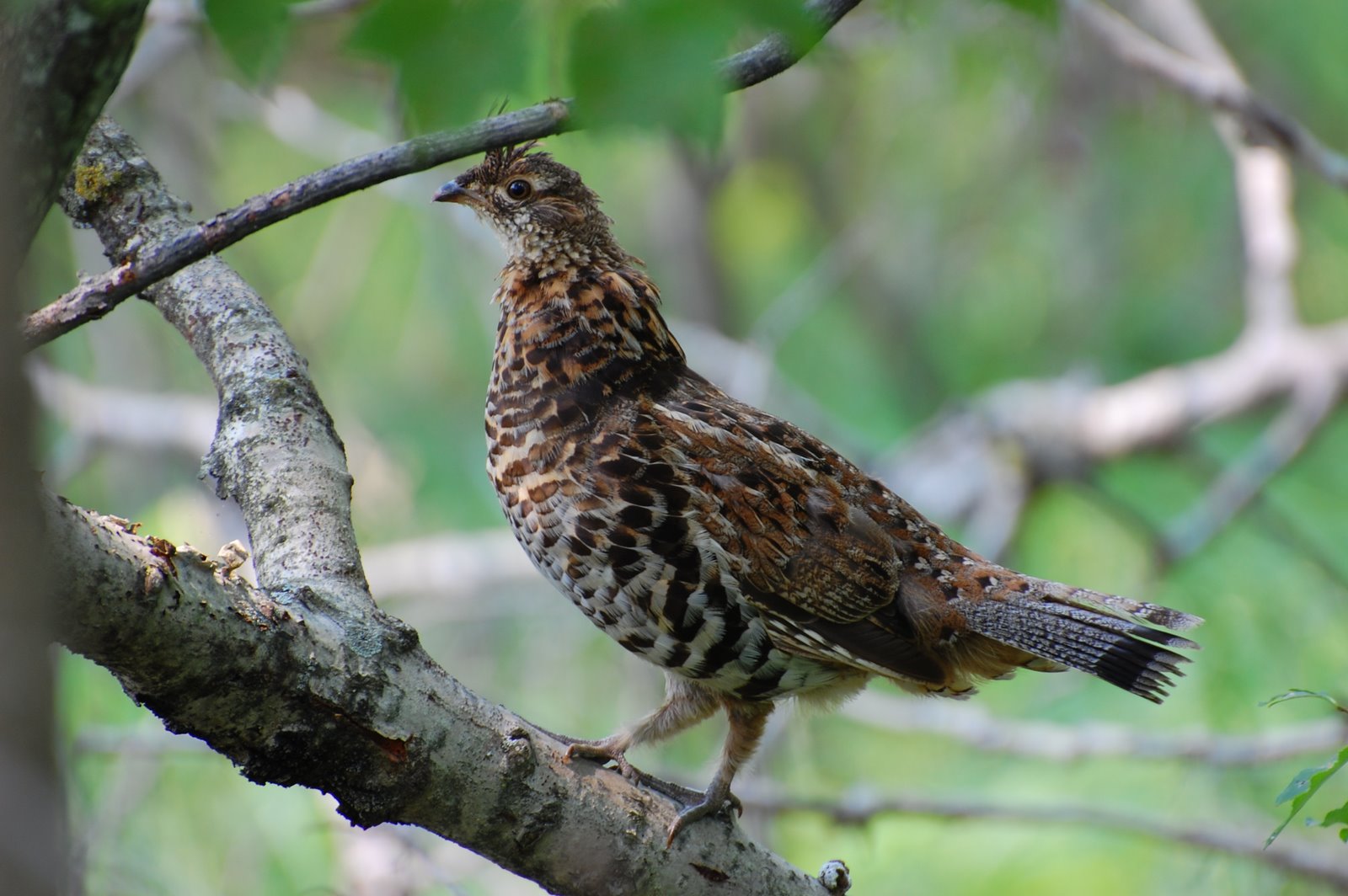
Ruffed GrouseAlthough sometimes regarded as “wilderness” birds, Ruffed Grouse have no aversion to living in close proximity to humans if the cover gives them adequate security. In some areas of Ontario, Canada –  Ruffed Grouse are more abundant in remote wilderness forests. They thrive best where forests are kept young and vigorous by occasional clear-cut logging, or fire, and gradually diminish in numbers as forests mature and their critical food and cover resources deteriorate in the shade of a climax forest.

Ruffed Grouse response to man varies greatly across their range, depending upon their experiences. In southern Ontario generally they are usually quite elusive and difficult to approach. Yet they can still be killed with a canoe paddle or thrown stones in NW Ontario wilderness forests.

When the ground is bare of snow, Ruffed Grouse feed on a wide variety of green leaves and fruits, and some insects. They have also been known to eat snakes, frogs as well. But when snow covers the ground as it does for most of the winter across the major portion of their natural range, Ruffed Grouse are almost exclusively “flower-eaters,” living on the dormant flower buds or catkins of trees such as birches and pin cherry bush’s.

Known as solitary in their social behavior they do not develop a pair-bond between males and females, although there is usually at least one hen in the woods for every male. Young birds, especially, collect in temporary, loose flocks in the fall and winter, but this is not equivalent to the covey organization of the quails and partridges.

Male Ruffed Grouse are aggressively territorial throughout their adult lives, defending for their almost exclusive use a piece of woodland that is 6-10 acres in extent. Usually this is shared with one or two hens. The male grouse proclaims his property rights by engaging in a “drumming” display. This sound is made by beating his wings against the air to create a vacuum, as lightning does when it makes thunder. The drummer usually stands on a log, stone or mound of dirt when drumming, and this object is called a “drumming log.” He does not strike the log to make the noise, he only uses the “drumming log” as a stage for his display.

The drumming stage selected by a male is most likely to be about 10-12 inches above the ground, in moderately dense brush, (usually 70 to 160 stems within a 10 ft. radius) where he can maintain unrestricted surveillance over the terrain for a radius of about 60 ft. Across much of the Ruffed Grouse range there are usually mature male within sight in the forest canopy overhead.

Drumming occurs throughout the year, so long as his “log” is not too deeply buried under snow. In the spring, drumming becomes more frequent and prolonged as the cock grouse advertises his location to hens seeking a mate. Listen to an example at the top of this page.

Courtship is brief, lasting but a few minutes, then the hen wanders away in search of a nest site, and there is no further association between the male grouse and his mate – or the brood of chicks she produces. A hen may make her nest more than 1/2 mile from the log of her mate.

Nests are hollowed-out depressions in the leaf litter, usually at the base of a tree, stump or in a clump of brush. The nest is usually in a position which allows the hen to maintain a watch for approaching predators. Sometimes hens will nest under logs or in brush piles, but this is less common, and a dangerous location.

A clutch usually contains 8 to 14 buff colored eggs when complete. Eggs are laid at a rate of about one each day and a half, so it may take 2 weeks for a clutch to be completed. Then incubation, which usually commences when the last egg is laid, takes another 24 to 26 days before the eggs hatch. A nest has to be placed so that it will not be discovered by a predator during a period of at least 5 weeks.

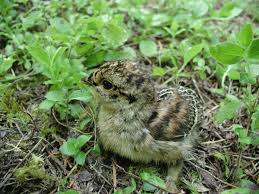
The chicks are prosocial, which means that as soon as they have dried following hatching they are ready to leave the nest and start feeding themselves. Grouse chicks are not much larger than a man’s thumb when they leave the nest. They are surprisingly mobile and may be moving farther than 1/4 mile a day by the time they are 3 or 4 days old. They begin flying when about 5 days old, and resemble giant bumble bees in flight. The hen may lead her brood as far as 4 miles from the nest to a summer brood range during its first 10 days of life.

Although grouse broods occasionally appear on roadsides, field edges or in forest openings, these are hazardous places for young grouse to be, and broods survive best if they can remain secure in fairly uniform, moderately dense brush or sapling cover.

wawanggrouse1The growing chicks need a great deal of animal protein for muscle and feather development early in life. They feed heavily on insects and other small animals for the first few weeks, gradually shifting to a diet of green plant materials and fruits as they become larger. Chicks grow rapidly, increasing from about 1/2 ounce midgets when hatched to 17-20 oz. fully grown young birds 16 weeks later. That is a 38 to 46 fold increase in weight. At 17 weeks of age, a Ruffed Grouse is almost as large and heavy as it will ever be.

Biologists and others who want to age Ruffed Grouse rely upon certain peculiarities of the molt of the primary flight feathers. The booklet A Grouse in the Hand explains this aging procedure. And following the first complete molt by a 14 to 15 month old adult grouse, there are no known physical characteristics which reliably identify the age.

When about 16 to 18 weeks old, the young grouse passes out of its period of adolescence and breaks away to find a home range of its own. This is the second and last time that Ruffed Grouse are highly mobile. The young males are the first to depart, when they range out seeking a vacant drumming territory, or activity center, where they can claim a drumming log. Most young males find a suitable site within 1.8 mi. of the brood range where they grew up, although some may go as far as 4.5 mi. seeking a vacant territory. Many young cocks claim a drumming log by the time they are 20 weeks old; and once they have done so, most will spend the remainder of their lives within a 200 to 300 yard radius of that log.

Young females begin leaving the brood one or two weeks later than their brothers, and they normally disperse about three times as far. Some young hens move at least 15 miles looking for the place where they’ll spend the rest of their lives.

Occasionally a hen and her brood will remain together as late as mid-January, but this is unusual, and most groups of grouse encountered in the fall and winter are composed of unrelated individuals who gather together temporarily to share a choice food resource or piece of secure cover.

In fall and winter some inexperienced young grouse frightened by a predator or something else, crash into buildings, trees or through windows in a so-called “crazy-flight.” Sometimes they are evidently simply trying to take a short-cut when they can see through two large windows on the corner of a house. After all, young grouse in their first fall have never been confronted by something that can be seen through but not flown through, such as glass!

 WEBSITE    RATES     FISH    HUNT    CABINS    PHOTOS
TESTIMONIALS    BROCHURE    HUNT BOOKLET

Enter your email address to subscribe to this blog and receive notifications of new posts by email.

← Back

Thank you for your response. ✨

Email Me....


Tags: , , , , , ,