RSS

Category Archives: firearm

Bargain vs. Premium Ammo

You get what you pay for. That’s an adage we generally believe in. But does it hold up with respect to ammunition? We set out to answer that question by testing the accuracy of a variety of value-priced .308 hunting ammo against more costly stuff.

ammo1

Methodology
Using three .308 rifles in the test—one hunting rig and two precision rifles that we knew would be ringers.

We put a number of budget and premium loads through all three rifles over the course of one day, ensuring the results wouldn’t be influenced by different environmental conditions. We also used a standard 5-shot-group protocol, and shot two groups with each load at 100 yards. As a control to establish a baseline level of accuracy for each rifle, we also shot 5-shot groups using Federal’s Gold Medal load with 175-grain Sierra BTHPs.

Using the baseline match load to calculate a ratio for each hunting load by dividing the size of the hunting-load groups into the size of the match-load groups. The closer to 1 that ratio is, the better the hunting load performed. None of the hunting loads outshot the match load, so all these ratios were greater than one.

Results
The outcome was interesting. The best hunting ammo was Hornady’s American Whitetail 150-grain Interlock SP. Compared to the baseline groups with the match ammo, this budget-priced load ($19.29 for a box of 20) shot nearly as well as the match ammo in all three rifles and had an impressive 1.41 average ratio. Federal’s Fusion, another bargain ammo ($21.49 for a box of 20) was second best among the loads, with an average ratio of 2.02.

The only expensive load that delivered consistent performance in all three rifles was Federal’s 165-grain Trophy Bonded Tip ($34.49 per box), The two Winchester loads had nearly identical levels of performance, though again, the less expensive 180-grain BST (2.11 ratio average) outshot the more expensive 150-gr. XP3 (2.81 ratio average).

ammo2

It’s worth noting when purchasing premium ammo that the promise of greater accuracy is certainly implied because it uses better quality components, but that much of its benefit is based on the idea that it will perform better on game.

Conclusion
It pays to try different loads in several different bullet weights in your rifles. Investing money to find an accurate load is the cheapest way to get the most from your rig.

Follow our FISHING BLOG

WEB   RATES     FISH    HUNT    CABINS    PHOTOS
TESTIMONIALS    BROCHURE    HUNT BOOKLET

Enter your email address to subscribe to this blog and receive notifications of new posts by email.

← Back

Thank you for your response. ✨

Email Me....


Tags: , , , , , , , , ,

Muzzle Affect Accuracy – With or Without?

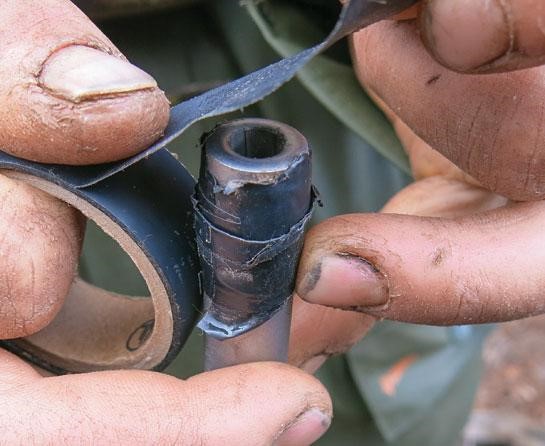
tapeIf you hunt in rainy places, you probably know about electrical tape, the basis of vigorous debate in almost any camp.

The tape, stuck over the muzzle, is used to keep precipitation and debris out of the rifle’s bore. But many hunters argue that the protective layer throws off your bullet’s impact point. Others say the flimsy barrier won’t deflect the bullet.

Which is it?

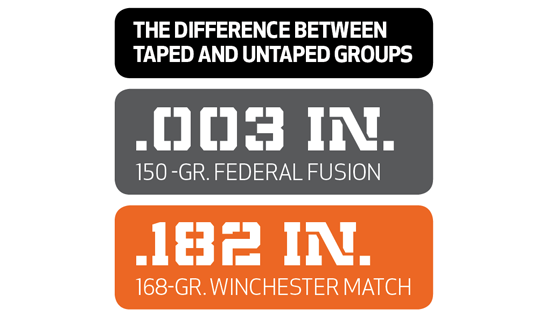
After testing the accuracy of two bullet types fired from the same .308 bench rest rifle, first without tape over its muzzle and then with electrical tape covering the bore. The results of eight 5-shot groups: Tape does not significantly degrade accuracy. Just as important, the tape also did not shift the rifle’s point of aim.

If you tape your muzzle to keep out the elements, you needn’t worry about shooting through it.

difference

Follow our FISHING BLOG

WEB   RATES     FISH    HUNT    CABINS    PHOTOS
TESTIMONIALS    BROCHURE    HUNT BOOKLET

Enter your email address to subscribe to this blog and receive notifications of new posts by email.

← Back

Thank you for your response. ✨

Email Me....


Tags: , , , , , , ,

The Right Caliber

caliber

Follow our FISHING BLOG

WEB   RATES     FISH    HUNT    CABINS    PHOTOS T
ESTIMONIALS
    BROCHURE    HUNT BOOKLET

Enter your email address to subscribe to this blog and receive notifications of new posts by email.

← Back

Thank you for your response. ✨

Email Me....


Tags: , , , , , , , ,

How to Pattern a Shotgun + Video

Shotgun patterns are measured at 40 yards for all gauges, except .410 bore. .410’s are patterned at 30 yards. Patterning is a simple process, but time consuming due to all the counting required. Here is the correct way to pattern a shotgun.pattern2

  1. Set a big piece of blank paper on a frame 40 yards from the muzzle. (Butcher’s paper cut into 48″ squares works well.)
  2. Shoot at the center of the paper.
  3. Draw a 30″ diameter circle around the center of the resulting pattern, so that it encloses the greatest number of holes.
  4. Count the pellet holes in the circle. (It helps to mark the holes with a magic marker as you count them, so you don’t lose your place.)
  5. Cut open an identical, unfired shell and count the pellets in the shell. (The actual number of pellets may vary from the theoretical number based on shot size and weight, so it is best to count them.)
  6. Calculate the percentage of pellets that hit in the 30″ circle. (Divide the number of holes by the number of shot in the unfired shell.)

That is it; you have now officially patterned your shotgun. Of course, every shot varies, so ideally you should repeat the process 10 times and average the results. (Analogous to shooting a group with a rifle, rather than just one shot.) Your shotgun’s pattern percentage will vary if you change the shot size, the amount of shot in the shell or the hardness of the shot, so you need to pattern all the loads you actually shoot in a given gun.

Pattern percentages will usually (but not always!) go up if you increase the hardness of the shot, decrease the weight of the shot charge, buffer the shot inside the shell, or decrease the muzzle velocity of the shot charge. Pattern percentages will typically do down if you use softer shot, increase the weight of the shot charge or increase the muzzle velocity of the load. These generalizations primarily apply to traditional lead shot, your gun may vary.

pattern1The percentage of pellet strikes that constitutes what choke varies, depending on the source. These percentages are typical:

  • Full Choke: 70% or higher
  • Improved Modified: 65%
  • Modified: 55-60%
  • Skeet No. 2: 55-60%
  • Quarter Choke: 50%
  • Improved Cylinder: 45%
  • Skeet No. 1: 35-40%
  • Cylinder: 35-40%


Follow our FISHING BLOG

WEB   RATES     FISH    HUNT    CABINS    PHOTOS
TESTIMONIALS    BROCHURE    HUNT BOOKLET

Enter your email address to subscribe to this blog and receive notifications of new posts by email.

← Back

Thank you for your response. ✨

Email Me....


Tags: , , , , , , , ,

Recommended Caliber for Hunting Game

Recommended-Calibers-for-Game

WEBSITE    RATES     FISH    HUNT    CABINS    PHOTOS
TESTIMONIALS    BROCHURE    HUNT BOOKLET
Enter your email address to subscribe to this blog and receive notifications of new posts by email.

← Back

Thank you for your response. ✨

Email Me....


Tags: , , , , , ,

2014 Ontario Resident Moose Hunt

Are you planning to put in for a tag in the moose dense 15A or 15B?

Are you sick of setting up a stake camp and coming back each night cold and damp only to have to set up a fire and wait to cook and warm up?

Why not stay in clean, warm cottages with heat, hot and cold running water, indoor plumbing and kitchens?

 Moosehuntersjpg

← Back

Thank you for your response. ✨

Email Information regarding

Do you like what you see? Join us on our<a title=”Fishing Blog ” href=”wawangresort.wordpress.com”> Fishing Blog</a> for more up to the minute action, tips and tactics!!


Tags: , , , , , , , , ,

Choosing the Right Caliber

Here is a great (and funny) chart I found made up by hunter-ed.com that illustrates how to select the proper caliber for your hunt 🙂

How to Choose the Right Caliber

← Back

Thank you for your response. ✨

Email Information regarding

 
Leave a comment

Posted by on December 27, 2013 in firearm, hunting, Wawang Lake Resort


Tags: , , , , , , , ,

Geared Up: Cleaning your gun

Most know that cleaning a firearm is a necessity for ownership.  This not only helps prevent malfunction and missfire but can also help bullet path and accuracy.  What most don’t know is that the average gun owner does not clean their firearm correctly which can lead to major headaches down the road 🙂

Here are a few great tips to set you straight

Step 1: Clean barrel and metal parts
Step 1: Clean barrel and metal parts with good commercial solvent.
Step 2: Bore should be cleaned through breech end
Step 2: Bore should be cleaned through breech end where possible.
Step 3: Clean bore until dry patch comes through as clean
Step 3: Clean bore until dry patch comes through as clean as possible.
Step 4: Run oily patch through barrel
Step 4: Run oily patch through barrel.
Step 5: All metal parts should get light coat of oil
Step 5: All metal parts should get light coat of oil.
Step 6: Store in horizontal position
Step 6: Store in horizontal position, or with muzzle pointing down.
Step 7: After storage, run a clean patch through bore
Step 7: After storage, run a clean patch through bore before firing.
Step 8: Remove all excess grease and oil
Step 8: Remove all excess grease and oil.
Click to view pdf of this diagram
With clean gun in hand, enjoy the hunt!

← Back

Thank you for your response. ✨

Email Information regarding

Do you like what you see? Join us on our<a title=”Fishing Blog ” href=”wawangresort.wordpress.com”> Fishing Blog</a> for more up to the minute action, tips and tactics!!
 
Leave a comment

Posted by on November 23, 2013 in firearm, gun hunting, Wawang Lake Resort


Tags: , , , , , , ,