
WEBSITE RATES FISH HUNT CABINS PHOTOS
TESTIMONIALS BROCHURE HUNT BOOKLET


HUNT the HUNTER – Ontario’s Timber Wolf
Hunting a top predator is a challenge you will never forget. A timber wolf hunt is not for the novice hunter though. In fact hunting for wolf will require more determination and patience than any other type of hunt. If you’re the kind of hunter that can pride themselves with this type of stamina then wolf hunting is definitely something you’ll want to experience.
Remaining aloof is what wolves do best and they are also extremely cautious and above all prefer not to be seen. They hunt small game, moose and bear for a living, so they are extremely resourceful. They
are shrewd, cautious, and have finely tuned senses. With this said remember that the wolf is the hunter’s top opponent when hunting in NW Ontario and up for any challenge man will present.
Our region of the Boreal Forest remains to be one of the most populated areas for the timber wolf with pack sizes reaching 30 or more and this is due mainly because of our small game, moose and bear population that are at its peak annually.
Wolves are nocturnal hunters, so getting a crack at one during legal daylight hours can be difficult, but, by precisely following the strategic technique of our expert guides it can be done.
 Wolves are territorial and each pack occupies, hunts, and protects a specific area. Once we know where a pack lives, we can learn more about them and that is the groundwork for our hunts. We know of many different packs, in this vast area, and each year we gather information of each packs hunting patterns. A pack seems to hunt a particular route and often return to the same areas with unbelievable regularity.
Calling is helpful if the wolves are within earshot. Distressed small game calls such as rabbits (snowshoe hares) works well, as this and other small game are the wolves’ primary food source along with moose and bear. Also, howling can be effective. A wolf will almost always answer to a howl regardless of their distance from the person howling.
Hunting down live large prey like moose or bear takes a lot of energy so wolves are also opportunists. They can smell blood from many miles away and frequently visit our baiting stands for an easy meal so we know where they are, but, the wolf hunt is much more interesting than that. Outsmarting wolves means having an outfitter that knows their strategy and scouts out what game trails they are using. Placing baits sites in proper places can mean the difference between success or not!
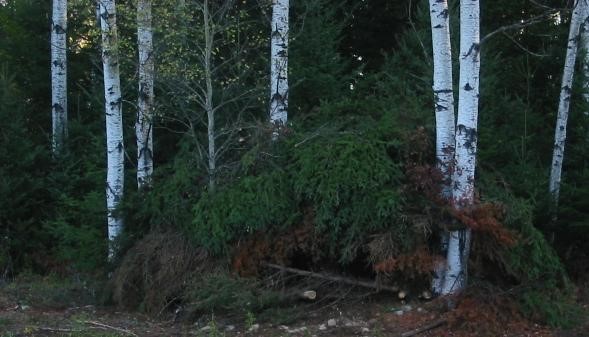
A Typical Natural Hunt Blind
We hunt from natural ground blinds made from deadfall, but, because temperatures can be extreme we advise our hunters to bring along their own commercial ground blinds (aired out for at least two months in advance of the hunt) in order to be more comfortable, however, this can be risky and best to avoid this type of blind if at all possible as the wolves can be skittish of them and of course can reduce the hunter’s chances of success. It is always best to dress for the extreme outdoor conditions and hunt from the natural ground blinds we provide.
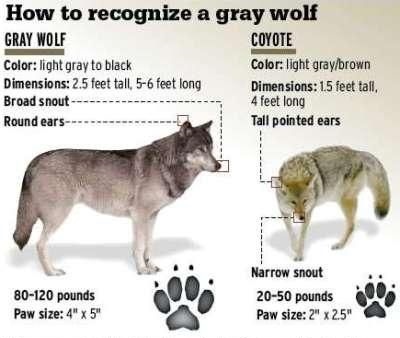
The color phases of the wolves seen in our area are varied, from the most common gray tones to blacks and whites, to medium tones of cream, gray, brown and orange. The specs of our wolves are as follows:
There are very few guarantees in hunting, but we do offer you this . . . . .
That you will find the wolf hunt a challenging and enjoyable experience in some of the most beautiful terrain you’ve seen.
Your guides are passionate hunters and strive to provide the same hunting experience for you that
they would want for themselves.
Our resort is a comfortable with a homey environment to relax in after an enjoyable day in the field…..and we feed our Meal Plan guests very well!
So while the outcome of the hunt is never a guarantee, the quality of the hunt experience is. And when you hear that first ghostly howl in the distance you will know you are in timber wolf country and from that moment on you will be hooked!
For further information, or, to book your next bear hunt please contact us at:
1-888-534-9217 or EMAIL
WEBSITE RATES FISH HUNT CABINS PHOTOS
TESTIMONIALS BROCHURE HUNT BOOKLET

You may have heard a story of a little 9-year old girl that shot a World Record Alaskan Brown Bear (Grizzly Bear). Fern Spaulding Rivers did shoot a trophy Brown Bear but it was not a world record. It’s still a really interesting story.
Story from Bear Hunting Magazine is below
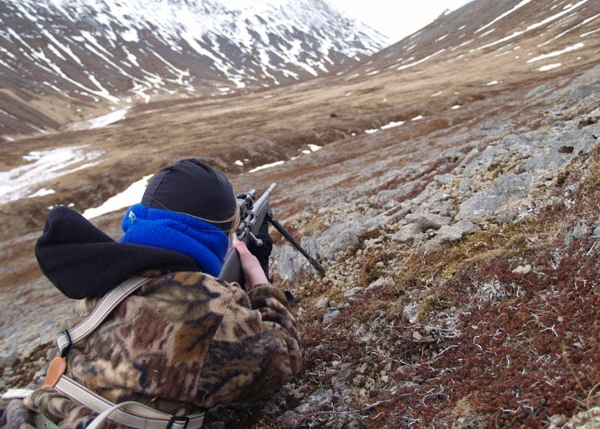
If the “biggest bear” is determined as a ratio of the size of the bear to the size of the hunter then Fern Spaulding-Rivers is probably setting records that will never be broken. The 10 year-old from Talkeetna, Alaska has already harvested great trophies of most of Alaska’s major game species, and she is a hand loading fanatic as well.
Fern’s larger caliber rifles have a muzzle brake and a recoil pad and she also wears a custom-made padded shooting vest from McCoy Shooting Armor to help her withstand big bore recoil. Fern was brown bear hunting on the Alaskan Peninsula with her father and mother on May 10th, 2006 (when she was 9 years old). She was carrying her Remington 700 Stainless chambered in .375 H&H and topped with a Zeiss Diavari Classic 1.5 – 4.5 x 18 scope. As the day progressed she and her father saw 11 bears. At one point, they were charged by a wolf, and they had to dispatch it at only 8 paces! Later, they spotted a big bruin in a gully at 32 yards.

With all the excitement of the day beginning to show, Fern asked Larry to hold her legs steady while she shot because her knees were shaking. Fern rolled the bear with her first shot, but the bruin regained it’s footing and tore off across the tundra. Shooting again from a prone position, Fern dropped the behemoth for good with a second 270 grain Barnes Triple-shock at 112 yards. The United States Fish and Wildlife Service measured the bear’s hide at 11’4″ from nose to tail. The skull has been officially scored at 29 1/16″ Boone and Crockett. What does Fern think of bear hunting? “Do you know how big an 11′ bear looks at 30 yards? It’s really kind of scary! They are about the size of a Volkswagen bus and when they swing their head to look your way they remind you of a T-Rex in Jurassic Park!”
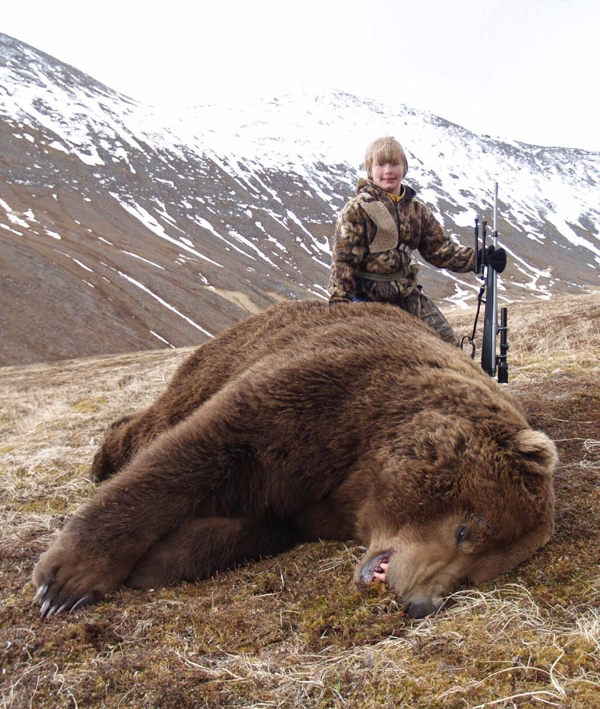
Her trophy brown bear now puts her in an elite class. Fern is a tremendous example to young hunters everywhere, and she is a great hunter regardless of her age.
WEBSITE RATES FISH HUNT CABINS PHOTOS
TESTIMONIALS BROCHURE HUNT BOOKLET


A big bear swaggers and walks with attitude. He doesn’t jump at every sound like a small bear will. A big bear doesn’t have to; he believes he’s got nothing to fear. Once you’ve spotted your bear on the bait site, it’s time to get serious about analyzing how that bear is behaving.
It is important to note that long before you judge the size of the bear, you must judge the sex of that bear and here are some things to take into consideration:
A big, old sow will have all, or more correctly, almost all of the physical characteristics of a big, old boar. She’ll have the nasty looking face that’s seen one too many years in the ring, the potbelly and the sway back.
Watch to see if the bear stands on his hind legs and rubs his back on a tree, that’s a boar. If it walks along and straddles small trees, wiping its scent on that tree, it’s a boar. If it stands up and breaks saplings over its shoulder, it’s a boar. If it encounters another bear and gives chase, it’s a boar and if it is following a smaller bear, it’s a boar.
SCALE: There is one last general appearance tip to judging black bear that makes the top three in importance, and that is scale. A big bear looks big . . . but so does a closer, smaller bear. Here’s a help tip on how to gauge more accurately. If the bear is 150 yards away but the hunter thinks the bear is 200 yards away, the hunter will overestimate the bear’s relative size by somewhere near 25 percent. In other words, the hunter is in for a serious case of ground shrink when he walks up to his bear. TIP: Let the bear get as close to you as possible and preferably on the bait itself. The closer the bear, the less chance there is of misjudging the distance to relative size.
SPECIFIC TIPS FOR JUDGING BLACK BEARS: If the bear fails any one of the above general conditions, then it’s advisable to pass up on it or let the bear walk. It’s tough and you could be wrong, but at least there isn’t a dead small bear lying on the ground. Call it a personal aversion to guilt.
BODY SHAPE: Bigger bear are older bears, and like most of us, they don’t have the svelte bodies they once did. They tend to look “heavy” and out of shape. Remember, they monopolize the best feed and habitat, and therefore exert less energy to live.
HEAD SHAPE: A big bear (boar) will have a deeper, wider and longer snout than a smaller bear or a female. His ears will appear to be wide apart and small. If he is aware of you and looking your way, his ears won’t stand up on top of his head like a dog’s ears, they’ll seem to be aimed out to the side of his head. A big bear will have well developed “bulging” muscles on the top of his head.
LEGS: A big bear will have massively developed front shoulders. His shoulders will look big and burly. A sow’s wrist will pinch in directly above the foot. Not so with a boar. The lower forearm, wrist and the foot on a big boar are all the same width. A big bear often appears to have shorter legs because the body is so much thicker, but keep in mind that the best-scoring bears for the records book are often the lankier looking, longer-bodied bears.
There are bear that have meatier heads; bear that look great and are great trophies, but that don’t score well. There are others that have short skulls, block- headed beasts that look impressive, but that don’t score well at all and there are lanky, skinny bears with donkey faces that score like the devil, but that a hunter seriously looking for a records book bear wouldn’t walk across the street for. Black bear morphology is just too darn diversified to make a science out of judging.
The best way to hunt for a record boar is to simply shoot the bear that looks good to you and that hopefully you’ll appreciate all the time and effort you put in for the hunt. If it’s got a nice hide, be happy with your animal. If it has long claws and weighs a ton, good for you and congratulations. If it isn’t as big as you’d like, don’t fret, you’re not alone and the rug on your wall will still look great. If it happens to be one of those rare few bears that has grown a skull that qualifies for the record books, thank your guide for the good fortune that made that bear come to the bait site.
To easily judge, remember:
Watch the bear’s behavior around the bait – small bears will be skittish and afraid of a larger bruin in the area.
Look for a log around the bait and use it as a reference, check to see the length and height of the log before climbing into your stand. When the bear enters the bait site use the size of the log to help determine the overall size of the bear.
SKULL MEASURING

Hope this information helps develop your judging skill on your next hunt, and, good luck out in the field.
For further information, or, to book your next bear hunt please contact us at:
1-888-534-9217 or EMAIL
WEBSITE RATES FISH HUNT CABINS PHOTOS
TESTIMONIALS BROCHURE HUNT BOOKLET

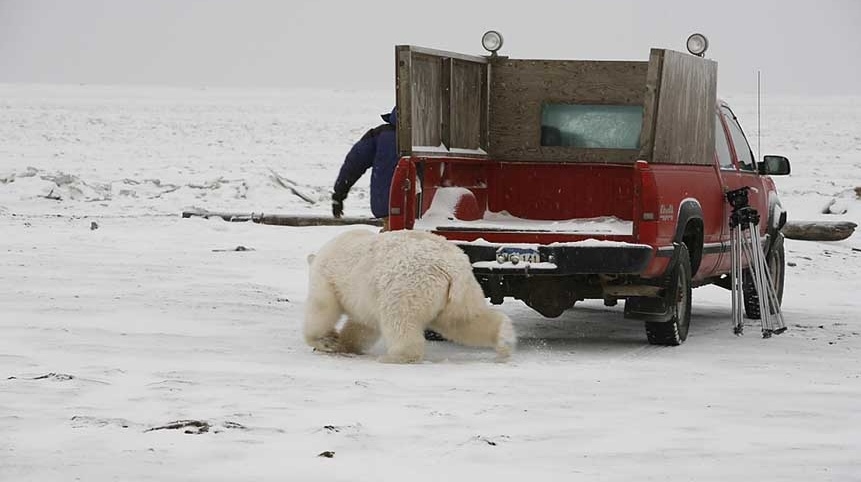
These are pictures from Barrow, Alaska. A photographer got careless and let the bear get too close and he did not have time to get into his truck before the Polar Bear started chasing him around the truck.

This is just a small bear. It’s probably only 2 years old and on it’s first year without its mother. A full grown male Polar Bear can get up to be three times this size. Hiding in a truck or car would not save you as any polar bear could smash though the car glass in seconds with very little difficulty.
WEBSITE RATES FISH HUNT CABINS PHOTOS
TESTIMONIALS BROCHURE HUNT BOOKLET

Our 2014 season was both rewarding for us as outfitters and successful for our hunters as well. Our hunts consists of an average of 14 hunters annually and our guide Terry (owner of Wawang Lake Resort) works hard each season to provide active baits for each and every hunter. His objective is for every hunter to harvest a bear – if they opt to do so – so is it any wonder that much of his day is spent out in the field during the black bear season to ensure a positive outcome..
The following video are of the highlights of our 2014 hunt.
If you enjoyed this video please visit our page on YouTube for more clips on Wawang Lake Resort
WEBSITE RATES FISH HUNT CABINS PHOTOS
TESTIMONIALS BROCHURE HUNT BOOKLET

Hunt Booklet – Information

Brochure (rates for the 2015 season)

The main edible find in our region is lobster mushrooms, Hypomyces lactifluorum, in some pretty good quantities. On any hunt, it’s good to bring home dinner, but one doesn’t typically expect to bring home a bundle of lobsters too late into the fall.

Typically, by the end of August and into September the brush is filled with mushrooms, edible and not. Unlike spring hunting, fall hunting in and around our area is more mushroom identifying than actually trying to find mushrooms growing. But some year the lobsters can account for a major harvest.
So on your next trip out into our region whether you’re fishing or grouse hunting be sure to hike the old logging roads in search of these very delicious mushrooms. Stay tuned for a great recipe that easy to prepare.
WEBSITE RATES FISH HUNT CABINS PHOTOS
TESTIMONIALS BROCHURE HUNT BOOKLET


Our hunts accommodations ONLY for Ontario Resident Moose Hunters.
If your looking for a great hunting area that has a high population of moose then look no farther than Wawang Lake Resort as we’re in the middle of the best moose hunting area in all of NW Ontario.
At Wawang Lake we offer comfortable accommodations to Resident Ontario Moose Hunters only. Presently we don’t have any tags available and unable to take any non-resident hunters during the Moose Hunt season.


Things Moose Hunters Should Consider:
Crossbows
• Draw length must be al least (11.8 in.)
• Draw weight must be at least (119 lbs.)
• Bolt head must be at least (0.9 in.) at the widest point, and there must be at least two cutting edges of straight, sharp, un-serrated, barbless steel.
Longbows
• Draw weight must be at least (48.5 lbs.) at draw length of (27.6 in.) or less.
• Arrow length must be at least (23.6 in.).
• Broad head must be at least (0.9 in.) at the widest point, and there must be at
least two cutting edges of straight, sharp, un-serrated, barbless steel.
Rifle
We suggest using at the minimum one of the following:
300 Magnum
30-06
7MM Magnum with bullet weights in the 180 grain range
A rim-fire rifle, a shotgun smaller than 20 gauge when loaded with shot, or any shotgun loaded with shot smaller than SG or No. 1 buck cannot be used for hunting Moose.


Hunters should also have a compass or hand held G.P.S., as well as a good pair of binoculars, thermos, flashlight, lighter, warm clothing, good quality rain gear, waterproof insulated boots, gloves/mitts, long underwear. Two-way portable radios are also recommended. Fall hunting weather can be warm & dry to cold, wet and snowy within a few hours; so it is best to be prepared for all variables.
We trust that this information will prove to be useful in planning your next Big Game Hunt in beautiful, exciting NW Ontario. We invite you to enjoy our ‘True Wilderness Hospitality’ while participating in a remote hunting experience.
WEBSITE RATES FISH HUNT CABINS PHOTOS
TESTIMONIALS BROCHURE HUNT BOOKLET




 ON TARGET in CANADA