RSS

Category Archives: gun hunting

Start Your Retriever Off Right

Here are a few helpful tips to help you do it right and get your retriever pup off to a good start:
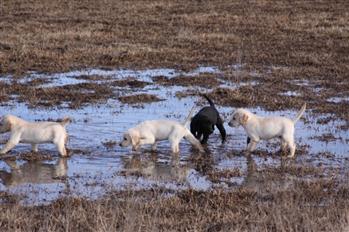
wading
WATER
Taking your retriever pup out in a boat to the middle of a lake and throwing her overboard is not a proper water introduction. Ideally, you want the experience to be pleasant and fun.

Find a small pond with a shore that drops gradually from shallow to deep water. The weather should be mild, and the water temperature 60 degrees or warmer. Wading into the water with the pup will help alleviate any fear she may have. Bumpers and water retrieves can come later.

GUNFIRE
The worst thing you can do is to take a puppy to an open field and fire a 12-gauge over her head. That’s almost guaranteed to cause gun-shyness. Instead, recruit a friend or family member to help with this part of your pup’s training. While you handle the dog, have your training partner move a good distance away. Each time you toss a bumper, your partner should fire a shot with a starter pistol or cap gun. Be careful not to overdo it. A few shots each outing will suffice. Each day, decrease the distance between the dog and the gunfire and repeat the same drill. Keep in mind that introducing a dog to gunfire is a gradual process that shouldn’t be rushed.

gunfire
DECOYS
Don’t wait until hunting season to familiarize your dog with decoys. Incorporate them into their training exercises. Place a dozen or more decoys around a field when you’re tossing bumpers. This will help teach the dog that decoys are just part of the setup and not her main focus. Once he/she learns that, they can move on to retrieving bumpers around a decoy spread set in shallow water. This will help them learn how to swim through the decoys without getting tangled in the lines. If you hunt with motion decoys, incorporate them into your training spread as well.

BOATS The best way to acclimate a pup to watercraft is on dry land, where the boat won’t rock or tip over. Place your retriever in the boat and let her explore this unfamiliar setting. Do this several times over a period of a few days, and when the dog is comfortable in her new surroundings, launch the boat and take your pup on a cruise around the lake. Be sure to go slow and avoid rough waters. Keep the outing as pleasant as possible, with the dog sitting calmly beside you. Allowing them to run around while the boat is under way can be extremely dangerous.

BLINDS
Whether you hunt out of a permanent blind or a layout blind, your retriever should have a place of her own. Set up a dog stand or platform during your training sessions. Begin by teaching the dog to sit still on the stand. The younger the dog, the less patience they will have. But after several training sessions, they should learn to be patient and sit on the stand for extended periods of time.
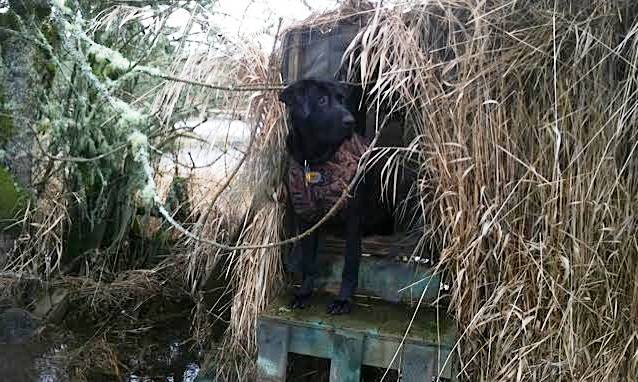
blind1

Follow our FISHING BLOG

WEB   RATES     FISH    HUNT    CABINS    PHOTOS
TESTIMONIALS    BROCHURE    HUNT BOOKLET

Enter your email address to subscribe to this blog and receive notifications of new posts by email.

← Back

Thank you for your response. ✨

Email Me....


Tags: , , , , , , , , , ,

The Right Caliber

caliber

Follow our FISHING BLOG

WEB   RATES     FISH    HUNT    CABINS    PHOTOS T
ESTIMONIALS
    BROCHURE    HUNT BOOKLET

Enter your email address to subscribe to this blog and receive notifications of new posts by email.

← Back

Thank you for your response. ✨

Email Me....


Tags: , , , , , , , ,

Bear Hunt Mistakes

wawanglakebearBeing Afraid of the Dark
Sounds silly, but don’t let it fool you.  It is an ungrounded fear and one people need to overcome in order to have a successful black bear hunt; especially if you are hunting for a trophy. It can be very intimidating leaving a bear stand, by yourself, in the middle of the dark when you know with 110% certainty that there are active black bear in the area.  You’d be off your rocker if you weren’t a little apprehensive.  When you are hunting into the twilight hours, and getting ready to depart your stand, remember this, since 1883, in North American there have only been 30 reported black bear fatalities, most of which occurred during non-hunting activities. That means in 125 years, there has only been 30 fatal black bear attacks and subsequent deaths.  With the 100’s of thousands of hunters that take to the woods every year, that puts the odds of being attacked by a black bear inconceivably in your favor.  Hunting until you can’t see anymore gives you better odds when pursuing that trophy black bear of a life time. Most BIG black bears are taken within a half hour from dusk, when the smart animals feel most secure eating from an unnatural food source.  Stay in your stand as late as you can, and the odds of shooting a monster increase tenfold.

And should there still be bears on your bait when your ready to leave your stand (although this rarely happens), shining a light or a sudden loud noise will send these skittish critters running for miles. Black bears, in their natural setting, are extremely fearful of humans, and would rather turn tail and run then face an unknown advisory.

2 bear sized

Recovering Your Harvested Bear
Many people take to the bear stand, rightfully so, with excitement and anticipation of a successful hunt. Myself included, I get like a little child full of excitement when hunting these magnificent creatures. While most hunters will do a tremendous amount of prep work prior to the hunt, few prepare for what happens after the hunt.Bears rarely pile up on the bait or in an open area with easy access. Instead, these hearty creatures are famous for taking a double lung shot and running for miles, deep into thick woods and cedar swaps.Having a plan on how to recover your trophy will put you light years ahead of most black bear hunters when it comes to a successful hunt. Planning should include how to track and more importantly flag the path the animal takes. What to do if it starts to rain or gets dark. Who will help you track the animal and once found, how will you get it out? And how to protect the meat from spoiling on a warm fall night.

Weather
Avid hunters know that fall weather can change in a heart beat. It can go from warm, to cold, windy and raining in the blink of an eye. Having the right clothes in your back pack can make the best of a somewhat undesirable situation.

bear over logBugs
can be a huge annoyance in the great outdoors. Especially when you are forced to sit still for extended periods of time. Avoid bug sprays when bear hunting… PERIOD! A new, unfamiliar scent, along with an intuitive feeling that something isn’t right, will keep trophy bears from over coming fear and committing to your bait. Bug jackets and bug nets are a must. (Oh, on side note, make sure you practice shooting with your bug net on, more about that later). Regarding the portable propane bug eliminators. I have seen hunters use them with success. In fact, in 2008 there was a beautiful 350lbs sow taken while a hunter used one, however my vote is not in on them.

Boredom
Nothing will end your hunt faster than impatience and constant movement in your stand. If you are like most guys who can’t sit still for more than 30minutes at a time, you must bring something with to occupy your mind. I personally use a book. I have also seen guys use those portable, pocket video games. Regardless of what you use, make sure you sit sill and be quiet!

Natural Calls – Ever been in the stand when all of the sudden you have to take a pee? Sucks, doesn’t it? I don’t know how many times I have had this happen to me, yet somehow I always forget to bring a container along. Put a portable urinal on your packing list. Doing so will make the difference between shooting that monster and taking it’s offspring.

Follow our FISHING BLOG

WEB   RATES     FISH    HUNT    CABINS    PHOTOS T
ESTIMONIALS
    BROCHURE    HUNT BOOKLET

Enter your email address to subscribe to this blog and receive notifications of new posts by email.

← Back

Thank you for your response. ✨

Email Me....


Tags: , , , , , , , , ,

Grouse Hunting Tips

Ruffed Grouse are the king of all game birds, and sometimes (most of the time) the most challenging. So here are a few tips and techniques that you can try that work well.

Ruffed Grouse

Ruffed Grouse

In order to hunt grouse, you need a place that holds birds. Ruffed Grouse like moist, dark places with little ground cover (like grass), but low overhead cover.  Our hunting areas here in Northwest Ontario are mixed timber and brush along creek bottoms. Grouse need food, and mostly live on buds and berries, but also feed on bugs and clover. Food sources differ from area to area, but grouse typically eat the same things everywhere. You will notice that grouse change their diet as the seasons change.

The ideal areas to hunt will hold the presence of water as that makes a big difference,  creek bottoms with mixed old growth and re-prod, and a road close by for grit.

Early in the season, you will find the birds in family groups or coveys. As season and winter progress, the groups break up and you will find birds mostly in singles and pairs. Early season birds hold pretty tightly here in our area, but it isn’t like that everywhere.

Ruffed grouse have a daily routine, so you can pattern them. They normally get up late and fly into a feeding area or along a road to pick gravel. Then it’s off to loafing and dusting the afternoon away. In the evening, they will go back to feeding, and usually roost around the same area.

Before season, and if you can, drive roads looking for new spots an checking old ones. Early in the morning or late in the evening, you can find grouse in the roads picking gravel. Mark these spots and come back during season to hunt the areas around them. Even if an area doesn’t provide birds, still go back a different time to check again if everything the grouse need is there so will they eventually.

German Shorthair Pointing at a ruffed Grouse in the Oregon Woods

When hunting grouse, use a dog that has a really good nose and hunts from close to medium range. It’s a good idea to sometimes stop in an area that will likely hold birds and let the dogs just circle. Grouse are hard to scent for dogs, so slow and steady is good.  Hunt up or down creeks, then turn around and hunt back in the opposite direction.   It’s hard to believe how many birds the dogs will miss the first pass, but after you leave, they will move around put out a good scent cone for the dogs.

Follow our FISHING BLOG

WEB   RATES     FISH    HUNT    CABINS    PHOTOS
TESTIMONIALS    BROCHURE    HUNT BOOKLET

Enter your email address to subscribe to this blog and receive notifications of new posts by email.

← Back

Thank you for your response. ✨

Email Me....


Tags: , , , , , , ,

Geared Up: Cleaning Your Gun

Most know that cleaning a firearm is a necessity for ownership.  This not only helps prevent malfunction and missfire but can also help bullet path and accuracy.  What most don’t know is that the average gun owner does not clean their firearm correctly which can lead to major headaches down the road 🙂

Here are a few great tips to set you straight

Step 1: Clean barrel and metal parts
Step 1: Clean barrel and metal parts with good commercial solvent.
Step 2: Bore should be cleaned through breech end
Step 2: Bore should be cleaned through breech end where possible.
Step 3: Clean bore until dry patch comes through as clean
Step 3: Clean bore until dry patch comes through as clean as possible.
Step 4: Run oily patch through barrel
Step 4: Run oily patch through barrel.
Step 5: All metal parts should get light coat of oil
Step 5: All metal parts should get light coat of oil.
Step 6: Store in horizontal position
Step 6: Store in horizontal position, or with muzzle pointing down.
Step 7: After storage, run a clean patch through bore
Step 7: After storage, run a clean patch through bore before firing.
Step 8: Remove all excess grease and oil
Step 8: Remove all excess grease and oil.
Click to view pdf of this diagram
With clean gun in hand, enjoy the hunt!

Follow our FISHING BLOG

WEB   RATES     FISH    HUNT    CABINS    PHOTOS
TESTIMONIALS    BROCHURE    HUNT BOOKLET

Enter your email address to subscribe to this blog and receive notifications of new posts by email.

← Back

Thank you for your response. ✨

Email Me....


Tags: , , , , , , ,

Pay Attention to Detail

Scent can be your biggest ally or your worst enemy

wawanglakebear
Black Bear are attracted to the aroma of a free meal, but if they catch a whiff of you, you can often kiss them good-bye for a day or two.   Keep your clothing and footwear as scent-free as possible. Be alert at all times while hunting your bait. You will most often see bear before you hear them. With padded feet they move with calculated precision. Remember, when they come into a bait station they know the treats were left by humans.


Shot Placement

Regardless of your choice of weapon, whether it is a gun or bow, learning when and where to shoot can mean the difference between an expedited kill, or, the outcome of tracking a wounded animal. We advise our hunters to wait until the bear is preoccupied with the bait and is facing away while standing broadside or quartering away. Bears are extremely tough, so a double lung or heart shot are always your best option therefore taking your time will be important.

wawangshotplacement

When archery hunting, bows must meet the following specifications.

Crossbows: Draw length must be at least (11.8 in.);

  • Draw weight must be at least (119 lbs.);
  • Bolt head must be at least (0.9 in.) at the widest point; and,
  • there must be at least two cutting edges of straight, sharp, un-serrated, barbless steel.

Re-curve Bow:    Draw weight must be at least (48.5 lbs.) at draw length of (27.6 in.) or less;

  • Arrow length must be at least (23.6 in.);
  • Broad head must be at least (0.9 in. at the widest point; and,
  • There must be at least two cutting edges of straight, sharp, un-serrated, barbless steel.

For bow hunting Black Bear we recommend a compound bow with a draw weight of no less than 50 pounds and a 100 grain broad head

Recommended Knowledge base
www.mnr.gov.on.ca/en/Business/FW/Publications/MNR E001275P.html

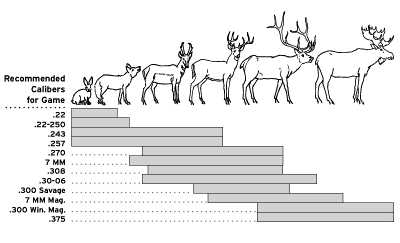
For rifle hunting black bear we recommend using nothing less than a .270 caliber.
Other recommended calibers: 7mm magnum; .308; .30-06.  NO 30-30’s

Firearm Information www.rcmp-grc.gc.ca/cfp-pcaf/index.htm

The bottom line – baiting is a proven strategy for attracting a wary game animal with a voracious appetite. It involves much more than just tossing out a few tasty morsels. There is a right way and a wrong way to do it and our experienced guides take pride in their skills and knowledge. Keen attention to detail and listening to the guide is the key to your success.

In order to ensure the highest possible success to our hunters we take only an average 14 hunters a year. Should we have an increase in bear sighting throughout the spring and summer we may take a few more hunters but our first obligation is to ascertain a healthy black bear population together with satisfied hunters for years to come.

Most importantly, remember baiting is a ton of work and takes weeks on our part for each hunter. From collecting legal paper work to buying and picking up the ingredients, materials along with travelling for miles and then finally establishing and maintaining each site daily prior to your hunt. It requires foresight and commitment on our part and we do this because of our passion for the outdoors and careful management of our Black Bear.

Follow our FISHING BLOG

WEBSITE    RATES     FISH    HUNT    CABINS    PHOTOS
TESTIMONIALS    BROCHURE    HUNT BOOKLET

Enter your email address to subscribe to this blog and receive notifications of new posts by email.

← Back

Thank you for your response. ✨

Email Me....


Tags: , , , , , , , , ,

Don’t Forget To Breath

Whether we are at the range shooting targets, or in the field hunting, breathing is important. We want our sight, scope or pin to be on its mark when we pull the trigger.

untitled

Education, shooting positions and firearms are all very important to shooters. Breathing is a very important factor as well. We all breathe. From the day we were born we have unconsciously learned to breathe in and out. That natural motion can help or hinder during shooting.

Controlled breathing is a necessity in shooting accuracy. When you breathe in and out your chest rises and falls. This movement can cause your gun barrel or arrow sight to float on its target. Your breathing may cause you to move at the exact moment you pull the trigger to fire.

Sometimes when you are hunting, you get excited and/or the terrain and conditions cause your heart rate to accelerate. Your breathing becomes more rapid and harder to control. If you hold your breath, you may become light headed and your shot may be off target. It is important to practice your breathing techniques as you practice shooting positions at the range.

There are multiple methods of breathing during a shot. The best thing to do is practice them and determine which works best for you. Once you’ve determined your breathing technique, practice it so it becomes instinctive when you are under pressure.

untitled4Exhale & Pause – When you are in shooting position, put your cheek against the stock of the gun. Take in a deep breath. Exhale just a portion of that breath, pause briefly and pull the trigger. The pause should allow you to hold your gun barrel and sights in perfect alignment on the target at the very moment the gun fires.

Inhale & Pause – Relax and practice steady breathing. Double check your shooting position. In your rythm of relaxed breathing, inhale. When your lungs are about half full, pause and pull the trigger. The inhale and pause is similar to the exhale and pause method. Your gun barrel and sights should be in perfect alignment on the target at the exact moment the gun fires.

Full exhale – Make sure you are in proper shooting position. Breathe slowly to relax. Focus on your target. As you breathe naturally, and you are at complete exhale, pause when your lungs are empty and squeeze the trigger.

untitled2Breathe Naturally – Breathing naturally takes the focus completely off of breathing technique. You do not  pause at all. Focus on your form and your target as you breathe naturally and squeeze the trigger. Sometimes being consciously focused on breathing can increase heart rate and breathing patterns. The natural breathing technique takes the focus off and you begin to unconsciously form a habit of correct shot timing.

When you are pausing, remember just that. It is a pause, not a hold. When a shooter holds their breath, their muscles tighten and their heart rate can change. This will dramatically change the accuracy of a shot.

While you are practicing, if you become short of breath, stop. Re-group and practice your natural, relaxed breathing. It is important to steady your breath to decrease the amount of movement your body is making. If you are able, step back. Take a deep breath in. Then exhale and then reacquire your target.

untitled3

Follow our FISHING BLOG

WEBSITE    RATES     FISH    HUNT    CABINS    PHOTOS
TESTIMONIALS    BROCHURE    HUNT BOOKLET

Enter your email address to subscribe to this blog and receive notifications of new posts by email.

← Back

Thank you for your response. ✨

Email Me....

 
Leave a comment

Posted by on December 12, 2015 in gun hunting, hunting, Wawang Lake Resort


Tags: , , , , , , , ,

Recommended Caliber for Hunting Game

Recommended-Calibers-for-Game

WEBSITE    RATES     FISH    HUNT    CABINS    PHOTOS
TESTIMONIALS    BROCHURE    HUNT BOOKLET

Enter your email address to subscribe to this blog and receive notifications of new posts by email.

← Back

Thank you for your response. ✨

Email Me....

 
1 Comment

Posted by on December 8, 2015 in firearm, gun hunting, Wawang Lake Resort


Tags: , , , , , ,

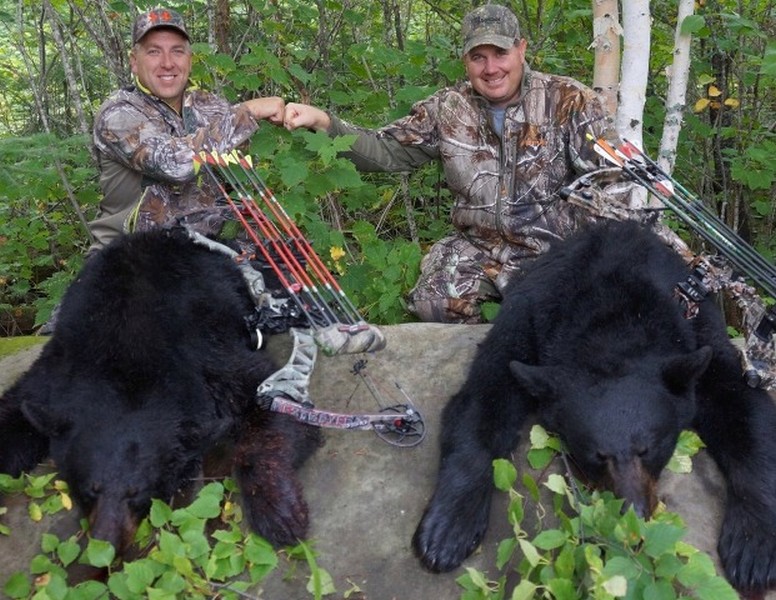
Your Success Is Our Goal – Black Bear Hunters [with video]

Andy's 475 lb (dressed)

Andy’s 475lb (dressed)

Black  Bear  are  known  predators  and  Ontario  has  the  largest  population of black bear than anywhere in the world. Furthermore, north-western Ontario leads in the concentration of these animals than elsewhere in Ontario, and, rates highest in population concentration  for all of Ontario that also allows for bating practices.

Many deem baiting unfair, giving the hunter a considerable advantage. But contrary to what some would have us believe, it’s far from easy and holds no guarantees!  Bear can sneak in undetected, grab a morsel of food and disappear as fast as they arrived. Bear can also skulk around the bait for hours, never showing themselves. As experienced outfitters we’ve learned that many of our bear will move in cautiously to inspect the provisions. The advantage of hunting in the fall is bear are eager to fatten up for the winter.  The biggest advantage to baiting is that, if and when a bruin finally commits to the bait, it allows the hunter a  an opportunity to assess size, stature and time for shot placement.

About Bear
Black bear habitant range can span from two to 10 miles and resident populations often hold a variety of boars, sows and cubs, so it’s not uncommon to have multiple bears visiting the baited site.  Ontario only offers a FALL BEAR HUNT therefore the chance for the large TROPHY bear is increased dramatically.  Most hunters fear poor coats or hides due to the fall hunt but our area does not suffer that fate. With little to no burrs or ticks, our bear don’t succumb to ticks causing ‘rub’ or dry patchy fur.  We also are known for our high number of white chevrons (patches) to make your trophy even more unique. Black bear

Jon Hanson - Tiffin, IA 440 lb. black bear

Jon Hanson – Tiffin, IA 440 lb. black bear

Black bear have relatively poor eyesight, but outstanding hearing and acute sense of smell. Once they get a taste of your bait, and, as long as it is replenished regularly, they will be reluctant to leave the area.  In fact, once a site is established properly, you can and will see the same bruin day after day.

Location is Critical
Our bait stations have been established for many years (since 1972) and placed along the bear’s natural movement corridor. Heavily  timbered forests near cutovers and waterways often sustain good bear densities.  With berry crops like wild blueberries and raspberries nearby, black bear favor the accessibility and abundance of such forage and most often reside in the proximity.

Claw marks on deciduous trees and there may even be fresh markings, these lasting scars unveil a historical presence. Nomadic creatures, bear commonly travel traditional trails along waterways and natural movement corridors like valleys and ridges.  Finding fresh scat can instill further confidence that bear have frequented the bait.  Keep in mind that well established bait stations offer much more success than new stations since bear follow these game trails year after year.

 WEBSITE    RATES     FISH    HUNT    CABINS    PHOTOS
TESTIMONIALS    BROCHURE    HUNT BOOKLET

Enter your email address to subscribe to this blog and receive notifications of new posts by email.

← Back

Thank you for your response. ✨

Email Me....


Tags: , , , , , , , ,

YES, I’M STUPID!

by M.R. James

I’VE SAID IT BEFORE and I’ll say it again. If you hunt from a treestand without wearing a safety harness, you might as well wear a great big sign that reads “Yes, I’m stupid!” Stupid! Stupid! Stupid!

Only this morning I read another news account of a bowhunter found dead at the base of his tree stand. And while he reportedly had a safety harness with him, it was in his pocket. So what happened? No one will ever know the details of why and how he died. But he’s dead and that’s a damn shame.

Somehow I can’t help but believe that like some folks now reading these words, the guy believed it could never ever happen to him.  But it could and did.

He was wrong. Dead wrong! And so are you if you think you’re bulletproof.

Treestands can be a deer hunters best friend and worst enemy. Hunting from trees is the most consistently successful method to tag game, but each year falls injure and kill hunters.

STATISTICS SAY ODDS ARE one-third of bow hunters are destined to take a tumble while climbing into, out of, or while in elevated stands. Think about that. Can you name anyone who’s fallen? I sure can and so can most of the veteran bow hunters I know. It can happen to anyone. Anytime. Anywhere.

Believe it!

Wearing a safety harness is mandatory when hunting from elevated stands. It’s also smart to wear a climber’s strap or safety line when climbing into and out of stands.

A friend of mine, who was with me when I arrowed my first Montana bull elk, died of a broken neck years later while hunting bears from a tree stand. No one knows why and how he fell, but somehow he did and he’s dead.

Another friend fell while hanging a stand. He survived but suffered severe injuries – and still walks with a bad limp. Another guy I know is paralyzed and “lives” in a wheelchair because he’ll never walk again. And even though I wasn’t hunting at the time, I once lost my balance and jumped backwards from an eight-foot stepladder while trimming tree limbs, cold cocking myself when I banged my head on the ground. This list of accidental falls could go on and on. Sadly, it does.

SO HOW DO WE STAY SAFE? We begin by recognizing the fact each and every one of us is vulnerable and we must never climb without wearing a fall restraint safety harness. Ever! If we won’t do it for ourselves, we should do it for family and friends who would have to attend our funeral, visit us in the hospital, or feed, dress, and to tend us because we’re paralyzed and we can’t do it for ourselves.

When hunting alone, we also make sure a hunting buddy or family member knows exactly where we’ll be and when we expect to be home. We slip a cell phone and a whistle into our pocket or pack in case we fall and can’t walk to get help. And we take pains to be safe each and every time we climb a tree, especially in cold, wet, or icy weather. We not only wear a safety harness but add a lineman’s climbing strap or treestand lifeline for use when climbing up and down to and from a stand. We never climb while holding our bow or other hunting gear, raising and lowering hunting tackle with a haul line. We always keep three of four contact points (hands and feet) with the ladder or steps when climbing into or out of stands. And once in the tree stand, we immediately buckle ourselves in and do not unbuckle until just before climbing down. This is the most dangerous time frame we face while hunting from elevated stands.

Here’s a hunter’s-eye view of a couple of feeding does. Knowing you’re securely buckled in allows you to focus on making the shot, not fretting about falling.

Finally, prior to using our hang-on or climbing stands, steps, and ladders, we inspect them for any sign or wear or damage. We check support cables and tighten bolts and screws, if necessary, and double check all straps.

BACK WHEN I RAN BOW HUNTER MAGAZINE, I repeatedly included little reminders designed to make readers think of safety. One of my favorites was, “Bow hunting Safety Is No Accident!”

It was true then and it’s true today.

But the bottom line is we are the ones responsible for keeping ourselves safe. We are the ones who must recognize the need to be proactive in doing whatever is necessary to avoid injury or death. We are the only ones who must admit that a life-changing or life-ending accident could happen to us.

Because doing anything less is downright stupid!

Follow our FISHING BLOG

WEB   RATES     FISH    HUNT    CABINS    PHOTOS
TESTIMONIALS    BROCHURE    HUNT BOOKLET

Enter your email address to subscribe to this blog and receive notifications of new posts by email.

← Back

Thank you for your response. ✨

Email Me....


Tags: , , , , , , , , ,